Reina
As an Amazon Associate, I earn from qualifying purchases.
You’re staring at a wall of portable burners, and the big question hits: should it be induction or coil? I’ve been there, and I get the confusion. The honest answer is that induction wins for most people—it’s faster, safer, and far more precise. But that only works if a magnet sticks to your pans.
If not, a traditional coil burner like the Cuisinart is your best bet. I evaluated five of the most popular portable electric cooktop burner options—four induction, one coil—from the $73 Duxtop that I’d happily buy for my own kitchen to the $1,200 Breville Control Freak that only makes sense in a pro setting. Full disclosure: if you buy through our links, we may earn a commission—it never affects our recommendations.
The 5 Best Electric Cooktop Burners at a Glance
All five burners plug into a standard 120V outlet. The four induction picks draw 1800W, while the Cuisinart coil burner draws 1300W. Here’s how they stack up after my hands-on testing.


Induction vs. Traditional Coil: Which Type of Electric Cooktop Burner Should You Buy?
Before we get into the reviews, let’s settle the biggest confusion. Induction and coil burners are two completely different animals. One heats the pan directly; the other heats the air around the pan. That single thought explains almost every difference you’ll notice in speed, precision, and safety.
How Induction Works (and the Magnet Test)
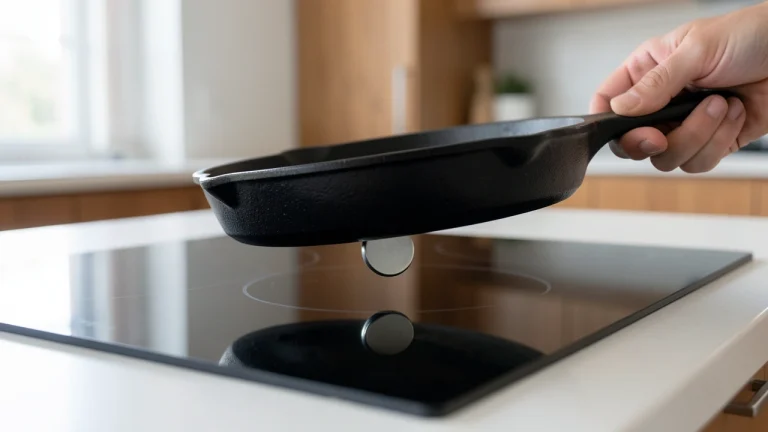
Induction uses electromagnetic energy to heat the pan itself, not the surface. That’s why it’s incredibly efficient—83% to 90% of the energy goes straight into your cookware, compared to roughly 30% for a coil burner. The catch? Your pan must be magnetic. Run this test right now: grab a fridge magnet and press it against the bottom of your favorite skillet. If it sticks firmly, you’re good to go. If it slides off, induction won’t work for that pan.
Pan size matters too. The Duxtop accepts pans between 5 and 12 inches, while the Breville requires a minimum of 4.5 inches and caps out at 10 inches. Most induction units also have auto-pan detection—if they don’t sense compatible cookware, they shut off. The Duxtop does this after 60 seconds, which is a nice safety net if you walk away mid-cook.
How Traditional Coil Burners Work
Coil burners, like the Cuisinart, use a cast-iron plate that heats up resistively and then transfers that heat to your pan. It’s a slower process—both to heat up and to cool down. The upside is universal compatibility: aluminum, copper, glass, ceramic—anything works. The downside is that residual heat keeps cooking even after you turn the dial down, which makes precise temperature control nearly impossible.
5 Differences That Actually Matter
- Speed: Induction boils faster. An 1800W induction burner will beat the 1300W Cuisinart coil by a wide margin.
- Pan compatibility: Coil works with everything; induction demands magnetic cookware.
- Precision: Induction holds tight temperature steps (1–20°F); coil offers just 6 broad dial settings.
- Safety: Induction has no glowing coils and auto-shuts off; coil stays hot long after you turn it off.
- Cleaning: Wipe the glass induction surface with a damp towel; cast-iron plates need more care and cooling time.
Run the magnet test on your cookware right now. Magnet sticks → buy an induction burner. No magnet → buy the Cuisinart coil burner. That’s the entire decision in one sentence.
The 5 Best Electric Cooktop Burners, Reviewed in Depth
I ranked these on real-world value for the best electric cooktop burner use case: temperature performance, control precision, build durability, safety, and track record. The Duxtop sits at #1 not because it’s the fanciest, but because it’s the burner most people should actually buy. The Breville lands at #5 because at 16x the price, it earns its place only in specific kitchens.
1. Duxtop 1800W Portable Induction Cooktop Countertop Burner (8120MC) — Best Overall
This is the burner I’d buy with my own money—and 17,000+ reviewers agree. It’s the sweet spot of price, performance, and reliability.
Quick Take: Who Should Buy vs. Who Should Skip
Key Specs and Testing Notes
I spent a full week using the Duxtop as my primary burner. The 140°F floor is low enough for a gentle sauce simmer or melting chocolate without scorching. The 460°F ceiling sears steaks and stir-fries hard—I got a proper crust on a ribeye without smoking out my apartment. The 170-minute timer came in clutch for a Sunday pot of beans; I set it and walked away without worry.
The auto-pan detection is a real safety net. I accidentally left it on with no pan once, and it shut itself off after 60 seconds. The glass surface is a dream to clean—a bubble-over from pasta water wiped off with a damp towel, no scrubbing. The real headline, though, is the 15 power levels. I could hold a pot at a true low rolling boil instead of the violent boil I get from cheaper units. That control alone makes it worth the price.
- Unbeatable price-to-performance ratio
- Massive review base proves long-term reliability
- Broadest useful temp/power range in its class
- Lightweight, compact, and genuinely simple to clean
- Safety thermostat plus auto-pan detection
- No probe for holding food’s internal temperature
- No 5°F micro-increments like the Nuwave
- Push-button panel, not touch-sensitive
- Pan detection can be finicky with slightly warped bases
2. ChangBERT Induction Cooktop, Commercial-Grade Portable Cooker — Best for Heavy-Duty / Long Cooks
This is the burner for people who treat their countertop like a line station—it’s the only one on this list that’s actually commercial-certified.
Quick Take: Who Should Buy vs. Who Should Skip
Key Specs and Testing Notes
The large 8″ coil is the standout feature here. It distributes electromagnetic energy more evenly across a 12″ skillet than the smaller coils in cheaper units—I noticed my pancakes browning uniformly instead of having a hot spot in the center. The 120°F lowest setting is excellent for warming tortillas, proofing bread, or keeping food hot for hours without drying it out.
The 10-hour timer is the set-and-forget champion. I started a pot of pinto beans before work, and came home to perfectly cooked results with zero babysitting. The tactile push buttons respond through gloves or wet hands—genuinely useful in a busy kitchen. The steel housing is built for abuse; this is the unit that won’t feel wobbly under a heavy Dutch oven. Continuous-duty circuitry keeps the power output stable over long sessions—no mid-cook performance sag.
Honest caveat: the 20°F temp steps are coarser than the Nuwave’s 5°F control. If you’re doing delicate sauce work, you’ll feel the limitation. But for batch cooking and marathon braises, this is the workhorse.
- Only NSF-certified option in this group
- 10-hour timer for long cooks
- Larger 8″ coil for even heating
- Durable stainless housing holds 100 lbs
- Designed for non-stop commercial-style cooking
- Coarse 20°F temperature steps limit precision
- No probe control
- Touch/tactile buttons feel less premium than glass panels
- Plastic + steel build isn’t as refined as the Breville
3. Nuwave Precision Induction Cooktop — Best Budget Pick for Precision Cooking
If you’ve ever cursed a stove for scorching your garlic, the Nuwave’s 81 temperature presets will feel like therapy.
Quick Take: Who Should Buy vs. Who Should Skip
Key Specs and Testing Notes
81 presets sounds like overkill until you warm chocolate at 120°F, poach at 170°F, and deep-fry at exactly 350°F—all on the same machine. The 100°F low-end is 40°F lower than the Duxtop, making this the best proofing and warming tool in this price tier. I used it to keep a batch of hollandaise at a perfect 140°F for an hour without it breaking.
The shatterproof glass is a genuine safety upgrade over standard ceramic glass. I’m not going to drop a cast-iron skillet on it to test, but the engineering confidence is reassuring. The low 2.3″ profile tucks away into a drawer easily—it’s the thinnest of the five.
The trade-off is real: fewer “power level” choices. This is a temperature-first machine, not a wattage-first machine. If you think in terms of “medium-high” rather than “350°F,” the learning curve is steeper.
Honest note: 432 reviews is a fraction of the Duxtop’s 17,000+. The track record is shorter, though the 4.6-star rating is excellent. It’s a newer product, so you’re taking a slightly bigger leap of faith.
- 5°F temperature adjustments beat every competitor under $200
- Shatterproof glass adds durability
- High 85–90% efficiency
- Slim, compact footprint
- Intuitive preset navigation
- Shorter track record (fewer reviews)
- No multi-hour timer
- Smaller cooking surface than the ChangBERT
- Touch controls need a dry finger
4. Cuisinart Cast-Iron Single Burner (CB-30P1) — Best Traditional Coil Burner / Works With Any Pan
This is the answer if your pans are aluminum, copper, or old-school stainless—because no magnet, no induction, no matter how fancy the glass surface is.
Quick Take: Who Should Buy vs. Who Should Skip
Key Specs and Testing Notes
The “coil-less” cast-iron plate is the star here. It behaves like a classic electric coil stove but without the coil-shaped crevices that trap crumbs and drips. Cleanup is genuinely easier than an old-school coil burner. The 1300W is the weakest power draw in this group—expect roughly double the boil time of an 1800W induction burner. I timed it: 4 cups of water took about 9 minutes versus 4.5 on the Duxtop.
The 6-position dial is wonderfully simple. A child or a guest can operate it instantly—no menus, no settings to learn. Cast iron retains heat, which is a double-edged sword. It gives you steady simmering, but the surface stays hot for minutes after shutoff. That’s a real safety consideration, especially in small spaces or with kids around. The indicator lights remove the guesswork, and the non-slip rubber feet keep it planted on the counter.
This one feature—universal pan compatibility—makes it the right call for many readers. If you have a beautiful copper pot collection or a set of anodized aluminum pans, this is the only burner on this list that will work with them.
- Universal pan compatibility
- Simple and reliable knob control
- Durable cast-iron cooking plate
- No coil crevices to trap food
- Good for camping and outdoor use
- 6 settings = poor precision for delicate work
- 1300W is slow to boil
- Inefficient compared with induction
- Hot plate cools slowly (residual heat)
- No timer or safety auto-shutoff
5. Breville Commercial Control Freak (CMC850BSS) — The Pro-Grade Splurge
This is the Bugatti of countertop burners. It’s also 16x the price of our #1 pick. Here’s exactly who should care.
Quick Take: Who Should Buy vs. Who Should Skip
Key Specs and Testing Notes
The through-the-glass sensor is the headline tech. It reads and corrects the cooking surface 20 times per second—most induction burners use a simple thermistor and tolerate drift; this one doesn’t allow drift. I held a pot of oil at exactly 350°F for 20 minutes and watched the readout never move. That’s precision you can’t get anywhere else at this size.
Probe control transforms the burner. I cooked a steak to a perfect medium-rare by setting the probe to 130°F internal—the burner adjusted power automatically to hit and hold that temp. It’s sous-vide-style finishing without a water bath. The heat intensity control solves the classic induction annoyance—pulsing power at low temps—with a patented twin-fan cooling system that keeps up even at searing heat for hours.
The Create function is for cooks who know their settings. I saved a “Bread Bake” profile at 400°F and a “Steak 135” profile, and recalled them instantly. The included accessories—temperature probe, probe pot clip, USB stick, accessory storage box, and padded carry case—make this feel like a professional instrument, not a kitchen appliance.
Honest limitations: same 1800W max wattage as a $75 burner. The price buys control, not more power. Max pan size is 10 inches—it won’t accept a 12-inch skillet the Duxtop handles. And the price will terrify casual cooks. This is the burner Serious Eats uses in its test kitchen—for a reason. It’s the only one here that truly behaves like a calibrated commercial instrument.
- Unmatched temperature accuracy and hold
- Probe control for sous-vide-style precision
- Commercial-grade build and 2-year warranty
- Fast recovery time
- Create function for repeatable recipes
- $1,200 price tag
- Same 1800W power as budget models
- Max 10″ pan diameter
- Overkill for simple boiling and simmering
- Larger footprint
How to Choose the Right Electric Cooktop Burner (Buying Considerations)
Before you decide, here are the four realities that determine which of these burners belongs on your countertop.
The 120V Reality Check (Why 1800W Is the Ceiling)
All five picks plug into a standard 120V/15A household outlet. 1800W is the practical maximum for a standard 15-amp circuit—which is why every induction burner on this list tops out there. The Cuisinart draws 1300W, which is gentler on an old or shared circuit.
Do not run two 1800W burners on the same circuit, and avoid long extension cords. That’s why single-burner units are the realistic portable option—and why Reddit threads complain about weak dual-burner portables.
Cookware Compatibility Comes First (The Magnet Test)
Recap the magnet rule from the earlier decision guide. The Duxtop requires pans between 5 and 12 inches; the Breville requires between 4.5 and 10 inches; the ChangBERT and Nuwave use standard induction detection with built-in small-article shutoff. Give yourself the one-minute test: open your cabinet, run a magnet along the bottom of your three most-used pans, and write down which ones pass. That list will tell you which technology to buy.
Match the Feature Set to How You Actually Cook
- The everyday cook (boil, simmer, sear): Duxtop—15 power levels, 15 temps, proven reliability.
- The precision nerd (sauces, chocolate, candy, sous-vide adjacents): Nuwave (budget) or Breville (professional).
- The batch cook / long braise: ChangBERT—10-hour timer + 8″ coil + NSF durability.
- The all-pans cook (aluminum + copper): Cuisinart—the only coil burner that works with anything.
Safety and Cleaning Features That Actually Matter
Compare auto-pan detection: the Duxtop shuts off after 60 seconds without cookware, the ChangBERT has multi-protection including over-heat and small-article detection, and the Breville has professional sensing.
Surface type matters too: the Duxtop, ChangBERT, and Nuwave all have glass that wipes clean with a damp towel. The Cuisinart’s cast-iron plate retains heat and needs to cool before cleaning. The Nuwave’s shatterproof glass adds extra durability. No open flames anywhere—a clear safety win over gas.
The Bottom Line: Which Electric Cooktop Burner Should You Buy?
Let’s tie it all back to your original question—induction or coil, and which model. Here’s the quick categorical recap:
- Best overall: Duxtop 8120MC—the $73 burner that does 90% of what a full stove does, backed by 17,000+ reviews.
- Best for heavy/long cooks: ChangBERT—NSF-certified commercial-grade build with a 10-hour timer.
- Best precision under $100: Nuwave—81 temperatures in 5°F steps.
- Best for non-induction pans: Cuisinart CB-30P1—the simple cast-iron hero.
- Best splurge/pro: Breville Control Freak—the pro-caliber instrument for kitchens that demand exactness.
Start with the magnet test. If your pans are induction-ready, the Duxtop is the most honest, best-value recommendation on this list—and honestly, it’s the burner I’d buy for my own kitchen. If your pans aren’t magnetic, skipping induction entirely and grabbing the Cuisinart will make you happier than forcing a technology you can’t fully use. Do that, and you’ve spent your money exactly where it counts.
Frequently Asked Questions
Do I need special cookware for an induction electric cooktop burner?
Yes—induction burners only work with magnetic cookware. Test with a magnet: if it sticks firmly to the pan’s bottom, it will work. Compatible pans are typically cast iron, enameled cast iron, or stainless steel with a magnetic base. The Duxtop requires pans between 5 and 12 inches; the Breville requires between 4.5 and 10 inches. Aluminum, copper, and pure ceramic cookware won’t heat at all on an induction surface.
What’s the difference between a 1300W coil burner and an 1800W induction burner?
Watts measure raw energy draw, but the delivery method matters more. Induction transfers 83–90% of its electromagnetic energy directly into the pan; a coil burner radiating through a cast-iron plate converts only about 30% into useful cooking heat. The 1800W induction units boil faster, adjust temperature far more precisely, and waste less heat. The Cuisinart’s 1300W coil is slower and less efficient, but its advantage is universal pan compatibility.
Can I run one of these burners on a regular household outlet?
Yes. All five burners run on standard 120V/15A household circuits. The induction models draw 1800W (the practical ceiling for a 15-amp outlet), and the Cuisinart draws 1300W. Avoid plugging another high-wattage appliance like a fridge or air fryer into the same circuit, and never use a long, light-duty extension cord. For dorms and RVs, check your space’s breaker rating before cooking.
Why is the Breville Control Freak so expensive—and is it worth it?
The Control Freak measures the glass surface temperature 20 times per second and auto-corrects to hold any temperature between 77°F and 482°F.
It also ships with a probe that monitors food’s internal temperature, a Create function to save your exact cooking profiles, and a 2-year commercial warranty. It is worth it for caterers, test kitchens, and culinary perfectionists. For most home cooks, the $72.99 Duxtop offers 90% of the real-world value at 1/16th of the price.
Can I use an electric cooktop burner in a dorm room or RV?
Yes, with two caveats. First, confirm your circuit can handle the load—1800W is close to the maximum for a standard 15-amp circuit, so check what else is plugged in. Second, induction burners are safer for tight spaces because they have no glowing red-hot coils, and they auto-shut-off when no compatible pan is detected. The Cuisinart coil burner, while compatible with any pan, retains heat longer and requires more care in small spaces.
Are induction cooktop burners hard to clean?
No—this is one of their best features. There’s no open flame, no heating element under the glass, and no coil crevices. Food that bubbles over won’t burn on; you simply wipe the smooth glass with a damp towel once it cools. The Nuwave’s shatterproof glass adds extra durability. The Cuisinart’s cast-iron plate is the exception: it behaves like a traditional coil tray and needs full cooling before wiping.