Reina
As an Amazon Associate, I earn from qualifying purchases.
No, an electric cooktop and an induction cooktop are not the same thing.
They share a power source and often look identical from the outside, but one uses resistance coils that glow red-hot, while the other uses electromagnetic fields that heat the pan directly. Every induction cooktop is technically an electric cooktop, but most electric cooktops sold today are not induction.
I understand why the question comes up. Walk into any appliance store, and you’ll see both technologies nestled under the same “electric” category. Both plug into the same 240-volt outlet.
Both have that smooth glass surface on top. And both are marketed as an alternative to gas.
Beyond that, they part ways in ways that genuinely affect how you cook, how much you spend, and whether your current pot set will even work.
Over the next few minutes, I’ll walk you through how each method actually heats your food, what it costs to own and install, and which one matches your kitchen habits better.
By the end, you’ll know exactly which question to ask yourself before you buy — and what to verify with an electrician before you commit.
- It’s not just “electric vs. electric”: Radiant electric cooks by heating a glass surface; induction cooks by generating a magnetic field that heats the pan itself.
- Speed and efficiency favor induction: You’ll boil water roughly twice as fast and waste less heat, but the cooktop costs more upfront.
- Cookware is the dealbreaker: Unless your pans are magnetic, induction won’t heat them at all. Electric radiant tops accept nearly anything.
That last point is often where people get stuck — so I want to tackle it head-on before we get into the details.
The “magnet test” isn’t a vague rumor; it’s the single most reliable way to know whether your kitchen is ready for induction.
What Makes an Electric Cooktop Different from an Induction Cooktop?
An electric cooktop — whether it’s the old coil design with exposed spirals or a modern smooth glass radiant top — works by passing electricity through metal resistance elements.
Those coils heat up until they glow, and that heat then radiates upward through the glass surface and into the bottom of your pot. The surface gets hot. The air around it gets hot.
And the pan gets hot because it’s sitting on a hot surface.
An induction cooktop takes a completely different approach. Instead of a heating element, it houses a coil of copper wire beneath the glass.
When you switch on the burner, an alternating current creates a high-frequency electromagnetic field.
That field passes right through the glass without heating it, and when it meets a pot made from a ferromagnetic material — meaning something a magnet sticks to — it induces electric currents in the metal itself.
Those currents generate heat directly inside the pan’s base.
Heating coils sit under a glass-ceramic surface. The coils glow red, warm the glass, and the glass warms the pan. Heat escapes upward and sideways, which is why the surface stays dangerously hot after you turn it off.
A copper coil under the glass generates an electromagnetic field. The field passes through the surface and agitates magnetic molecules inside the pan, so the pan becomes the heat source. The glass only gets warm from residual contact with the pan.
That single difference cascades into everything else: how fast the stovetop responds, how much energy it wastes, what pans you can use, and how hot the surface gets.
It also explains why induction tops feel almost magical the first time you use them — you can place a paper towel under a frying pan, cook an egg in the pan, and the paper towel won’t even singe.
One common confusion worth clearing up: smooth glass-topped radiant cooktops are still very much “electric cooktops.” They’re the direct descendant of the coil stove, just with nicer looks.
When someone asks whether an electric cooktop is the same as an induction cooktop, they’re almost always picturing one of these radiant models — and the answer is a firm no.
Induction vs. Electric: A Side-by-Side Comparison
Putting the two side by side makes the practical differences easy to see. I’ve kept each row short so you can scan it quickly, then I’ll dig into the details that don’t fit into a table.
Beyond the table, there are a few behavioral quirks that reviewers rarely mention until you’ve lived with an induction top for a week. The first is the hum.
Induction cooktops emit a faint electrical buzzing, particularly when running at high power or when the pan has a slightly warped base.
It’s not loud enough to annoy most people, but it’s there, and it might take you a few days to stop noticing it.
Then there’s simmer control. Induction’s precision is remarkable at the low end — you can hold a sauce at a gentle bubble that a radiant top simply can’t replicate without constant fiddling.
But that precision can feel twitchy if you’re used to the slow, forgiving response of electric heat.
You learn to trust the settings quickly, but the first few sessions involve more babysitting than you’d expect from a “set it and forget it” appliance.
Also worth mentioning for households with medical devices: induction generates an electromagnetic field, and while it’s not considered dangerous for the general public, the FDA and most manufacturers recommend keeping a distance of at least 12 inches for anyone with a pacemaker or implantable defibrillator.
Keep the field in mind when you’re cleaning the cooktop after cooking — the magnetic field shuts off when the burner is off, so there’s no lingering risk.
How to Tell If Your Cookware Works With an Induction Cooktop
This is the shortest section of this article, but it’s the one that trips up the most people after they buy.
If you’re considering induction, you need to know whether your existing cookware will even register on the burner — before you commit to the purchase.
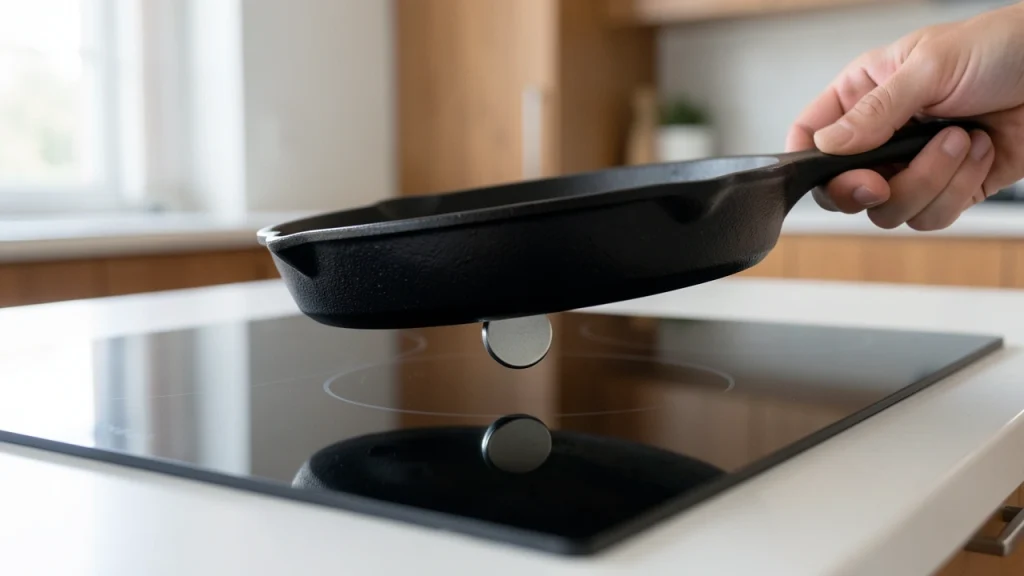
The test takes about ten seconds. Grab a refrigerator magnet and press it against the bottom of a pot or pan. If the magnet sticks firmly, that pan will work on an induction top.
If it slides off or barely clings, the pan will not heat, because the induction field needs magnetic metal to generate heat inside the pan.
A weak magnet that barely sticks means the pan may still work, but poorly. An induction burner needs solid magnetic contact to transfer enough energy, so if the magnet wavers, expect slow and uneven heating. The best results come from pans with a magnetic stainless steel layer or cast iron construction.
When you’re checking your kitchen, the materials behind each pan make the biggest difference in how an induction burner responds.
Here’s the breakdown at a glance so you can sort your cupboards quickly before bringing the magnet over.
- Cast iron — including enameled Dutch ovens
- Magnetic stainless steel (often marked with “induction compatible” on the label)
- Enameled steel — the interior matters less than the base layer
- Carbon steel — a favorite of pro cooks
- Pure aluminum — unless it has a magnetic base plate
- Copper — beautiful, but won’t register at all
- Glass or ceramic cookware — the induction field passes straight through
- Most nonstick pans under $50 — aluminum core, no magnetic layer
If you discover your favorite pans won’t cut it, you don’t necessarily need to toss the whole set.
Induction-compatible replacements like tri-ply stainless steel or cast iron are widely available, and many cookware brands now label their lids and bases with an induction symbol.
Budget for a few key pieces — a large skillet, a saucepan, and a Dutch oven — and you’ll be set for most cooking.
Installation and Electrical Requirements: What to Know Before You Buy
Installation is the invisible run-blocker that no one warns you about. Both electric and induction cooktops require a dedicated 240-volt circuit — the same kind used by a standard electric range.
If you’re switching from a gas cooktop to either one, you’ll likely need a licensed electrician to run new wiring.
If you already have an electric cooktop installed, the good news is you can usually swap it for induction on the same circuit, provided the breaker rating matches.