Reina
Reina 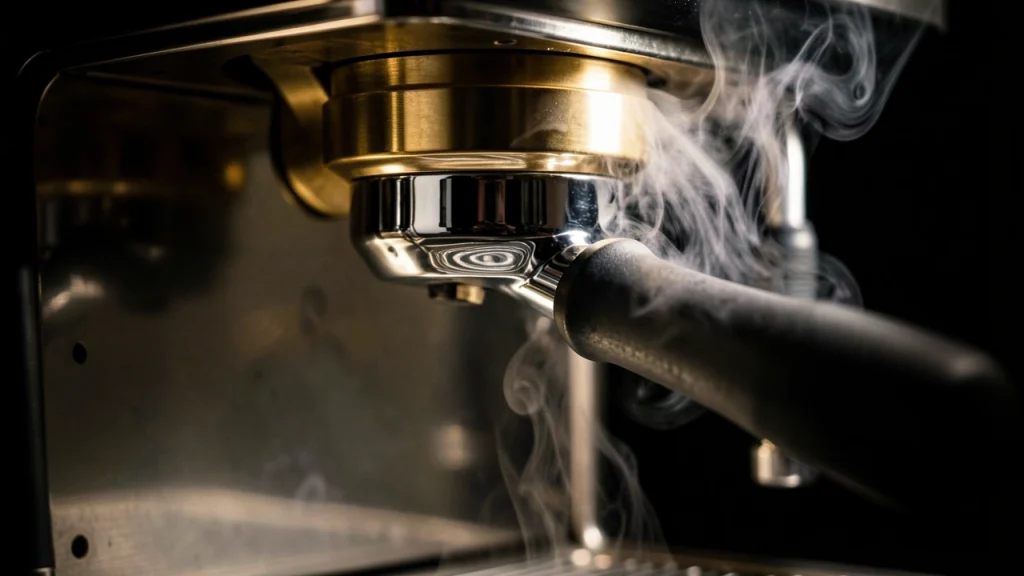
As an Amazon Associate, I may earn a small commission from qualifying purchases at no extra cost to you. This helps me create more valuable, tested content for you.
The E61 group head is the brass or chrome block on the front of an espresso machine that holds the portafilter. It was introduced on the Faema E61 in 1961.
Premium machines use it because its thermosiphon loop keeps the brewing temperature stable without any electronics, and its mechanical pre-infusion chamber gently wets the coffee puck before full pressure hits it.
This produces sweeter, more even shots than simpler group head designs.
This article will explain how the E61 group head works, why it became the standard for prosumer machines, and where it falls short compared to newer technology.
By the end, you will know whether a machine with an E61 group head is the right choice for you.
Anatomy of the E61: What It Is and Where It Lives
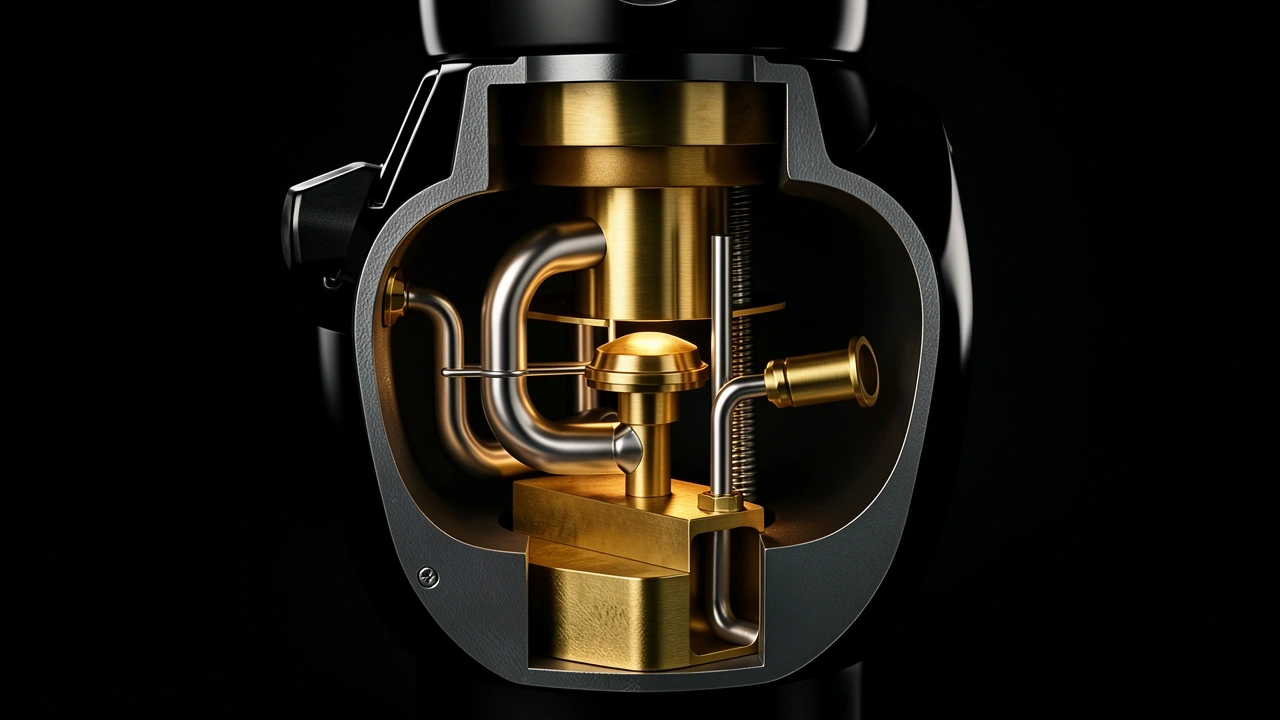
The E61 group head is the metal assembly that connects your portafilter to the rest of the espresso machine.
On the outside, you see a polished chrome or brass block with two or three lugs that lock the portafilter into place. Inside, behind the shower screen, is where the important parts live.
This component is not the boiler and not the pump. It is the final delivery system. Water leaves the boiler, travels through the machine, and enters the group head before it hits your coffee grounds.
The E61 group head is responsible for controlling the temperature and pressure of that water right before extraction.
The name comes from the machine it debuted on: the Faema E61, where E stands for “Espresso” and 61 stands for 1961.
That machine changed commercial espresso forever, and the group head design has been copied and refined by every major prosumer brand since.
The 1961 Faema E61: The Machine That Killed the Lever
Before 1961, most espresso machines used spring-loaded lever groups.
The barista pulled a lever down to fill a chamber with water, and a spring pushed that water through the coffee at around 9 bar of pressure.
It worked, but it required physical strength and a consistent pull to get good results. Temperature control was manual and inconsistent because the group head was directly connected to the boiler.
The Faema E61 introduced two big innovations. First, an electric rotary pump that delivered 9 bar of pressure consistently, every time.
Second, a new group head that stayed at the right temperature without intervention.
The group head used a thermosiphon loop to passively circulate hot water from the boiler through the brass block, keeping it at brewing temperature.
The pump and the thermosiphon together gave baristas control over two variables that were previously guesswork.
The patent on this group head design expired decades ago. That is why you see an E61-style group head on machines from ECM, Profitec, Rocket, Lelit, Quick Mill, and many others.
They all build their own versions, but the core engineering is the same.
Inside the E61: The Thermosiphon, the Pre-Infusion Chamber, and the Mushroom
To understand why the E61 group head is so respected, you need to know what is happening inside it during a shot.
Three components work together: the thermosiphon loop, the pre-infusion chamber, and the mushroom valve.
The Thermosiphon Loop
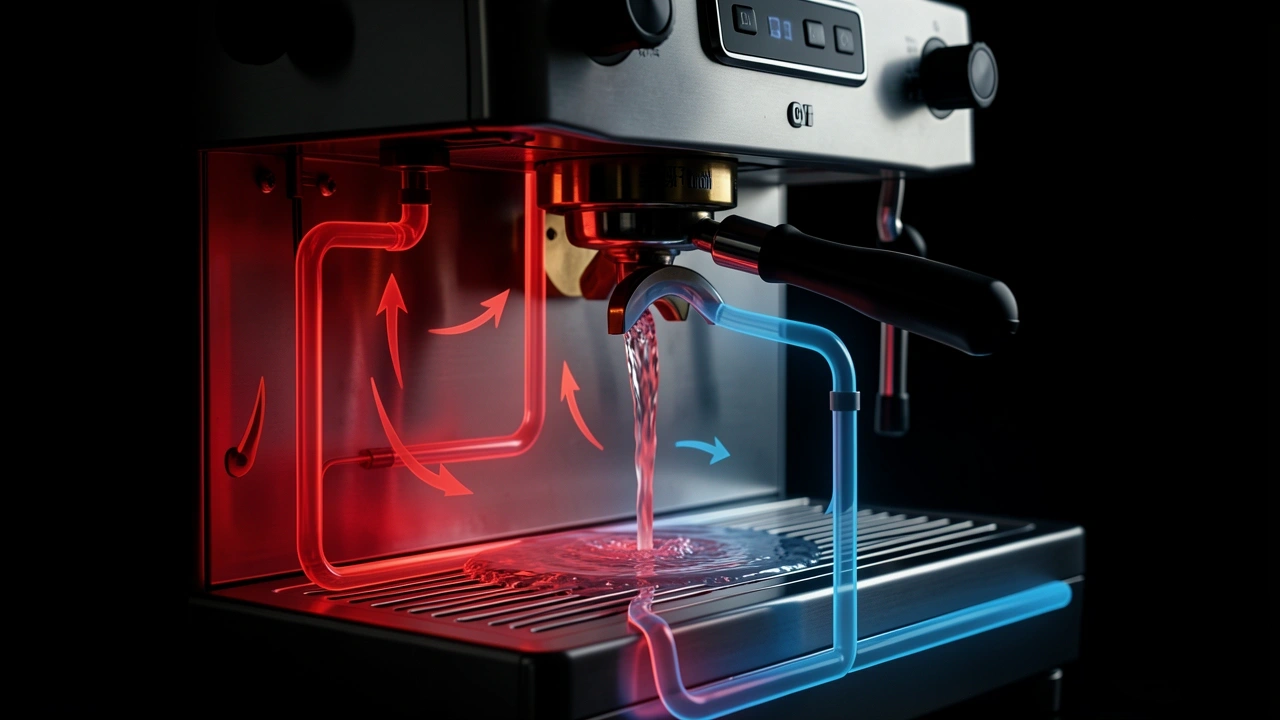
This is the feature that makes the E61 special. The thermosiphon is a passive circulation system with no moving parts.
Hot water from the boiler rises into the group head through one pipe, transfers heat into the brass mass, then cools down and sinks back to the boiler through a second pipe.
This loop runs constantly, keeping the entire group head at brewing temperature.
Think of it like a radiator in a home heating system. The hot water from the furnace rises into the radiator, heats the metal, and then falls back to be reheated.
The brass group head acts like a massive heat battery. When you pull a shot, the group head does not cool down dramatically because the thermosiphon is constantly refreshing it with hot water.
This design allows the machine to maintain a stable brewing temperature without any electronic PID controller on the group head itself. It is simple, reliable, and it works.
The Pre-Infusion Chamber
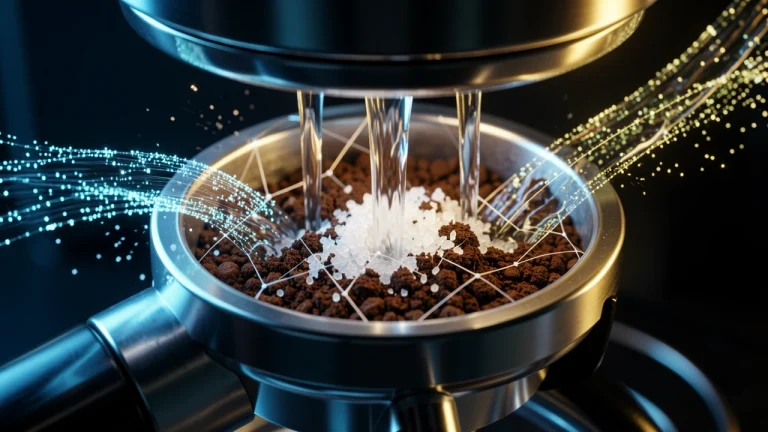
Above the shower screen inside the group head is a small cavity. When you start the pump, water fills this chamber at low pressure before the pressure builds enough to push it through the coffee puck.
This is mechanical pre-infusion.
The gentle saturation wets the coffee evenly and lets it expand, which reduces channeling.
Channeling happens when water finds a path through the puck and extracts only part of the coffee, leaving the rest under-extracted.
The E61 pre-infusion chamber helps avoid this, resulting in a more balanced extraction on every shot.
The Mushroom Valve and Expansion Valve
The “mushroom” is a metal valve inside the E61 group head that controls the flow of water during the brewing cycle.
When you start the pump, the mushroom lifts to let water through the pre-infusion chamber and into the coffee.
When you stop the pump, the mushroom closes and the expansion valve releases excess pressure.
This expansion valve is important. During heating, water in the boiler expands and puts pressure on the group head.
The expansion valve opens slightly to relieve that pressure, which prevents the machine from building up dangerous pressure when it is just sitting there heating up.
Why Premium Espresso Machine Makers Keep Choosing E61
If the E61 group head is over sixty years old, why is it still the standard for premium home machines? There are five concrete reasons.
1. Thermal Stability Without Electronics
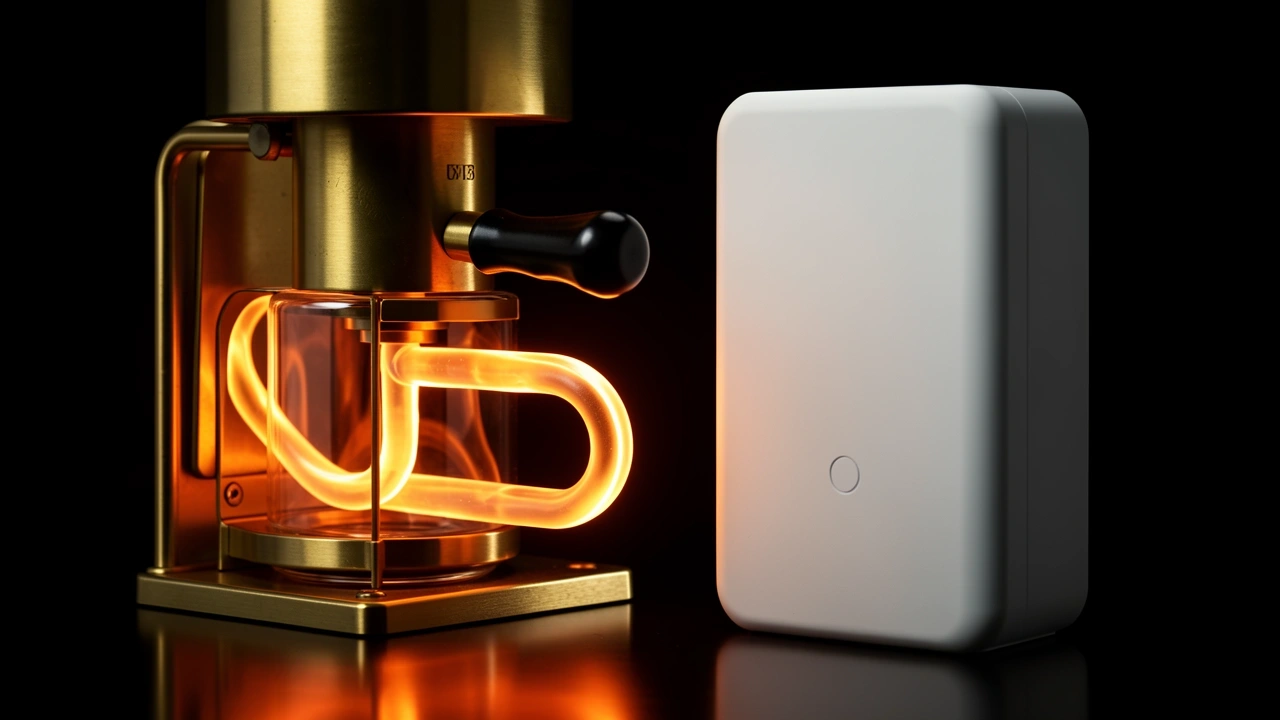
The thermosiphon loop and the mass of brass keep the group head temperature stable throughout a shot sequence. You do not need a PID controller on the group head to get consistent results.
This reduces manufacturing cost and potential failure points.
2. Mechanical Pre-Infusion
The pre-infusion chamber provides a gentle pressure ramp that mimics the feel of a lever machine. This is difficult to achieve with a simple solenoid valve system.
The mechanical design adds nothing to the part count and does not require programming.
3. Serviceability
E61 group heads use standardized parts. The gasket, shower screen, and internal seals are all off-the-shelf items that any espresso repair shop stocks.
If something breaks, you can fix it yourself with basic tools and a YouTube video. This is not true for proprietary group heads on many newer machines.
4. Pump Flexibility
An E61 group head works with both vibration pumps and rotary pumps. Vibration pumps let you use the machine with a water tank, while rotary pumps allow you to plumb it directly into a water line.
This flexibility lets manufacturers build one group head that fits across multiple price tiers.
5. Aesthetic and Community
The iconic chrome group head is part of the look of a classic espresso machine. It signals quality. There is also a massive ecosystem of accessories, videos, and forums dedicated to E61 machines.
If you buy one, you are not alone. The community knowledge base is deep.
There is also an economic reason. E61 machines are cheaper to engineer than machines with saturated group heads. Saturated group heads take more machining and more precise temperature control.
The E61 is the reason you can buy a premium home espresso machine for $1,500 to $4,000 instead of paying $6,000 for a commercial-grade machine.
The Reality Check: E61 Versus the Saturated Group Head
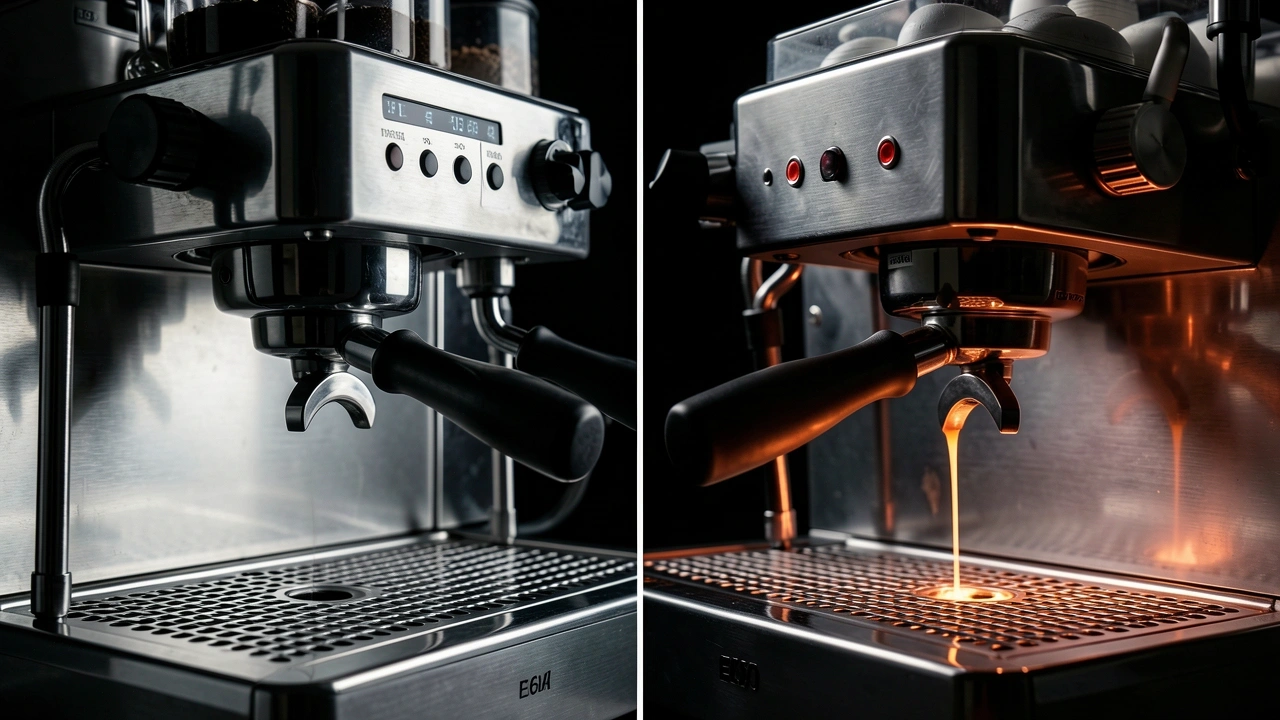
Here is the honest truth. The E61 group head is not the best group head technology in absolute terms. If it were, La Marzocco would use it on their Linea Mini. They do not.
They use a saturated group head that is directly integrated with the boiler. The difference matters.
| Feature | E61 Group Head (Thermosiphon) | Saturated Group Head |
|---|---|---|
| Temperature stability | Good after 30-45 minute warm-up | Excellent after 15-20 minute warm-up |
| Temperature recovery between shots | Slower; may require a short flush | Faster; the group head is actively heated by boiler water |
| Warm-up time | 20 to 45 minutes | 15 to 20 minutes |
| Maintenance | Standard parts, user-serviceable | Proprietary parts, often requires a technician |
| Cost to manufacturer | Lower | Higher |
| Repairability | Easy; parts widely available | Moderate to difficult; parts can be hard to find |
The verdict is simple. The E61 is the best value group head for a home machine. It gives you thermal stability, pre-infusion, and serviceability at a price that makes sense for a prosumer budget.
The saturated group head is more thermally precise but costs significantly more and requires more specialized maintenance. For the vast majority of home users, the E61 is more than good enough.
One more important distinction. On a heat exchanger machine, the mass of the E61 group head masks temperature swings from the boiler. The brass acts as a buffer.
On a dual boiler machine, the E61 group head acts as a stabilization buffer for the dedicated brew boiler. Both configurations work, but the flushing behavior is different.
What You Are Signing Up For: Warm-Up Times, Flushing, and Annual Maintenance
Before you buy an E61 machine, you need to understand the daily and yearly habits it demands.
The E61 Dance
On a heat exchanger machine, you cannot just walk up and pull a shot. The boiler is set to steam temperature, and the thermosiphon brings the group head to a similar temperature.
You need to flush water through the group head until the temperature drops to brewing range. This is called the E61 dance.
On a dual boiler machine, the brew boiler is set to a lower temperature, so the flushing requirement is less aggressive.
You still need a small flush to stabilize the group after it has been idle, but it is more forgiving.
Here is a quick reference for flushing:
- Heat exchanger machines: Flush until the water runs steadily for about 5-10 seconds, then wait a moment for the brew boiler to refill before locking in the portafilter.
- Dual boiler machines: A short 2-3 second flush is usually enough to stabilize the group on your first shot of the day.
- Between shots: Wait until the brew thermometer or your group head thermocouple shows the temperature has recovered before flushing again.
The Warm-Up Reality
An E61 machine needs 20 to 45 minutes to fully stabilize. The thermosiphon loop must heat the entire brass mass.
Some machines, especially those with improved insulation, warm up faster, but you still need to plan ahead. Many owners use a smart plug to turn the machine on before they wake up.
Annual Maintenance
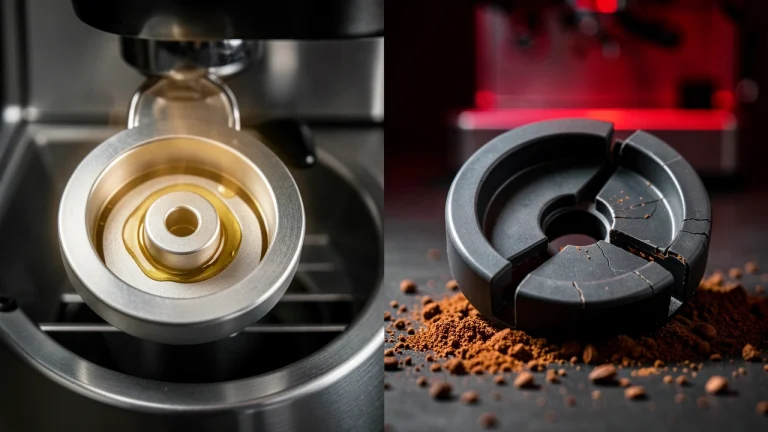
The group head gasket and shower screen should be replaced once a year, or sooner if you see leaks around the portafilter. A silicone gasket lasts longer than a rubber gasket.
After a year, rubber gaskets get hard and brittle. Silicone stays flexible and gives a better seal.
Backflushing is critical for E61 machines. Coffee oils accumulate in the mushroom valve and the internal passages.
You should backflush with water after every day of use and with espresso cleaner once a week or once a month, depending on how much coffee you pull. A blind basket is the tool you need for this.
Frequently Asked Questions
Are all E61 group heads identical?
No. The patent expired long ago, so many manufacturers build their own versions.
They share the same standard dimensions, which means they all use a 58mm portafilter basket and the same three-lug locking system.
But the internal machining quality, the materials, and the finishing differ between brands. A higher-end E61 group head might use a more durable brass alloy or have better thermal insulation.
How long does an E61 espresso machine take to warm up?
Most E61 machines take 20 to 45 minutes to reach stable brewing temperature. The exact time depends on the machine’s insulation and the ambient room temperature.
This is longer than single-boiler or saturated-group machines.
Can I use any 58mm portafilter on an E61 machine?
Yes, the 58mm basket and three-lug design are industry standard across E61 group heads.
One common exception is the Gaggia Classic, which uses a different lug spacing and will not lock onto an E61 group head.
For any proper E61 machine, any standard 58mm portafilter with three lugs will work.
Is the E61 group head good for light-roast coffee?
It depends on the machine. A dual boiler E61 machine with a PID controller handles light roasts well because you can set the brew temperature accurately.
A heat exchanger E61 machine requires careful flush management because the brew temperature is more variable. For light roasts, a dual boiler E61 machine is the better choice.
Why is the group head so hot on an E61 machine?
This is by design. The thermosiphon keeps the entire brass block at brewing temperature. You cannot touch the group head when the machine is on.
It is not a fault; it is a necessary part of how the machine works.
Do I still need to backflush an E61 if I use it daily?
Yes. You must backflush with water after every day of use. You need to backflush with espresso cleaner on a regular schedule. How often depends on your usage, but once a week is a good starting point.
Coffee oils will build up inside the mushroom valve and the internal passages, and backflushing is the only way to remove them.
The E61 group head is not perfect. It takes a long time to warm up, it requires a cooling flush on heat exchanger machines, and it is not as thermally precise as a saturated group head.
But it is reliable, serviceable, and affordable. For home espresso, that combination has kept it at the top for over sixty years.