Reina
Reina As an Amazon Associate, I may earn a small commission from qualifying purchases at no extra cost to you. This helps me create more valuable, tested content for you.
Here is the honest truth about home latte art: your espresso shot can be perfect — rich crema, balanced extraction — but if your steam wand spits and stutters, you will never pour a rosetta. You will get bubbly foam that looks like dish soap. I have been there.
I wasted weeks blaming my technique before I realized the machine was the problem.
This guide ranks machines based on one thing: how easily they let you create the silky microfoam needed for latte art. Not raw pressure stats. Not fancy aesthetics. Steam wand quality and temperature stability.
After testing six very different machines, I can tell you that the best espresso machine for latte art at home is the one that lets you focus on your pour technique instead of fighting the equipment.
Let me save you the frustration and show you which machines actually deliver.
Top Picks at a Glance



What Makes a Great Latte Art Machine?
Before I get into the individual reviews, you need to understand what actually matters. I learned this the hard way after burning through three machines. The feature that looks good on the box is rarely the one that helps you pour.
The Steam Wand Is Everything
There are two kinds of steam wands. The first is the Pannarello wand — a plastic-sleeved wand that injects air automatically. It is designed for convenience. You push a button, and it makes thick, bubbly foam suitable for a cappuccino. But that foam is useless for art.
It lacks the velvety, wet-paint texture you need to draw a tulip.
The second is the traditional commercial-style wand — bare metal, no sleeve. You control the tip depth and the angle. This is the only wand type that lets you create microfoam. Every machine on this list that ranks well for latte art has one.
The ones that rank poorly either have a Pannarello wand or a weak imitation that does not produce enough steam pressure.
If you see the word “Pannarello” in the specs, run. That machine is not for you if latte art is your goal.
Boiler Type and Temperature Stability
Steam power comes from the boiler, not the pump. A machine with a dual boiler lets you steam milk and pull a shot at the same time. That is not just a convenience — it means the steam boiler stays at a consistent temperature without being interrupted by the brewing cycle.
A single boiler forces you to wait between brewing and steaming. And a thermoblock heats water on demand but can struggle with sustained steam pressure for longer milk textures.
A PID controller (like the one on the Gemilai Owl) keeps water temperature within a narrow range. That matters because temperature swings change how the milk proteins break down. Consistent steam temperature equals consistent microfoam.
The Budget Trade-Off
Here is the uncomfortable reality: you can try to make latte art with a cheap machine, but it will be harder. Not impossible — just frustrating. A machine with weak steam pressure means you have to stretch your steaming time, which gives the milk more time to scald.
A machine with inconsistent temperature means every pitcher of milk behaves differently.
The best machines for learning make the process forgiving. They give you strong, dry steam that lets you texture milk in 20 to 30 seconds. They do not fight you.
Best Espresso Machine for Latte Art at Home: The Reviews
I tested each machine over several weeks, making two to three lattes daily. My criteria were simple: steam wand control, microfoam quality, temperature consistency, and how forgiving the machine was for someone still learning the pour. Here is how they stacked up.
1. Lelit Bianca V3 — The Gold Standard
The Lelit Bianca V3 is the machine I reach for when I want zero excuses. It is not cheap, and it is not simple. But if you want to pour art, this is the endgame.
- Boiler type: Dual boiler
- Steam wand: Commercial-style, swivel
- Special feature: Flow regulation, PID control
- Warranty: 12 months
The dual boiler system is the star here. You can steam milk while pulling a shot, and the steam does not waver. From the first second, the steam pressure is aggressive but dry. I textured a 6-ounce pitcher of milk in about 18 seconds — fast enough that the milk never had a chance to overheat.
The flow regulation knob on the front panel is another level of control. It lets you adjust water pressure during extraction. That does not directly affect steam, but it means you can dial in your espresso shot to produce the kind of crema that holds art. Thin crema collapses.
The Bianca lets you build a shot that gives you a stable canvas.
The honest weakness: This is expensive. It is also overkill if you are just starting and do not know whether you will stick with latte art. The learning curve on the steam wand is real — the power takes some getting used to.
But if you have the budget and the patience, you will never need another machine.
Who it is for: The committed home barista who wants to skip the upgrade path. If you know you want to pour rosettas and tulips and you can afford the investment, get this.
Who it is not for: The casual drinker or someone on a strict budget. This is a prosumer machine that demands respect.
2. Gemilai Owl G3006 — The Data-Driven Workhorse
The Gemilai Owl G3006 surprised me. It is not a household name like Lelit, but it brings serious specs to the table for a much lower price.
- Boiler type: Single boiler with PTC heating element
- Steam wand: Commercial-style, swivel, dual-hole tip
- Special feature: PID temperature control, dual display (pressure and temp)
- Portafilter size: 58mm commercial
- Water tank: 57 oz removable
The first thing I noticed was the dual display. It shows brewing pressure and temperature in real time. For someone learning latte art, that feedback is gold. You can see exactly what temperature the water is when it hits the puck. That consistency translates to the steam side as well.
The steam wand has a dual-hole tip, which creates a more aggressive vortex than a single-hole tip. It took me a few tries to adjust — the milk spins fast, and if you do not sink the tip deep enough, you get big bubbles. But once I found the sweet spot, the microfoam was impressive.
Silky, glossy, pourable.
The honest weakness: The 15-bar Ulka pump is powerful, but it can be aggressive with certain beans. You need a decent grinder to keep up. The single boiler means you have to wait between brewing and steaming — about 15 seconds of heat-up time.
That is not a dealbreaker, but it breaks your rhythm when you are practicing.
Who it is for: The intermediate home barista who wants data to improve. If you like tweaking variables and watching gauges, this machine rewards that.
Who it is not for: Someone who wants a fast, no-fuss workflow. The wait between brewing and steaming annoys some people.
3. BYESHOP 20 Bar — The Budget Surprise
I did not expect to like the BYESHOP. It costs a fraction of the Lelit, and the brand is barely known. But after using it for two weeks, I have to admit: this is the best budget entry point for latte art I have found.
- Boiler type: Single boiler
- Steam wand: High-pressure commercial-style
- Special feature: Dual pressure and temperature gauges, LED touchscreen
- Water tank: 37 oz removable
- Pump: 20 bar
The dual gauges on this machine are a nice touch at this price point. You can see extraction pressure and temperature. That is unusual for a budget machine. The steam wand is a traditional commercial-style wand — no plastic sleeve — and it produces enough pressure to texture milk properly.
It took me about four tries to get the hang of the steaming. The wand is powerful enough, but the boiler is small, so you have to work fast. I found that a 4-ounce pitcher of milk worked best — anything larger, and the steam pressure dropped off before I finished texturing.
But for a standard latte, it worked fine.
The microfoam was not as silky as what the Lelit produces, but it was good enough to pour a passable heart and even a simple rosetta. For the price, that is impressive.
The honest weakness: The water tank is small — only 37 ounces. If you are making multiple drinks, you will refill often. The review count is low, so long-term reliability is unknown. The steam consistency varies slightly between uses. It is a budget machine, and it behaves like one.
Who it is for: The budget-conscious beginner who wants to learn latte art without a big financial commitment. This is a low-risk entry point.
Who it is not for: The heavy user who makes three or more lattes daily. The small tank and single boiler will frustrate you.
4. CASABREWS 3700 — The Decent Starter
The CASABREWS 3700 is one of the most popular budget espresso machines on the market, with thousands of reviews. I can see why — it is affordable, looks good, and makes a drinkable latte. But for art, it has limits.
- Boiler type: Single boiler
- Steam wand: Traditional-looking wand (pressurized basket)
- Pump: 20 bar
- Water tank: 43.9 oz removable
- Power: 1350W
The steam wand on the CASABREWS looks like a commercial wand — bare metal, swivel joint — but the steam pressure is just okay. It produces stable foam, not silky microfoam. There is a difference.
Stable foam holds its shape in the cup, but it lacks the glossy, fluid texture you need to draw fine lines.
I could pour simple hearts. That was about it. Every attempt at a rosetta ended with the pattern bleeding into the foam because the milk was slightly too thick. The pressurized portafilter basket also limits espresso quality. The crema is decent but not the kind that holds art well.
The honest weakness: The steam wand does not produce the sustained pressure needed for advanced art. The pressurized basket limits your espresso quality. You will outgrow this machine quickly if you are serious about art.
Who it is for: Someone who wants an affordable machine for basic lattes and is okay with simple heart patterns.
Who it is not for: Anyone who wants to pour tulips, rosettas, or swans. This machine will frustrate you once you move past the basics.
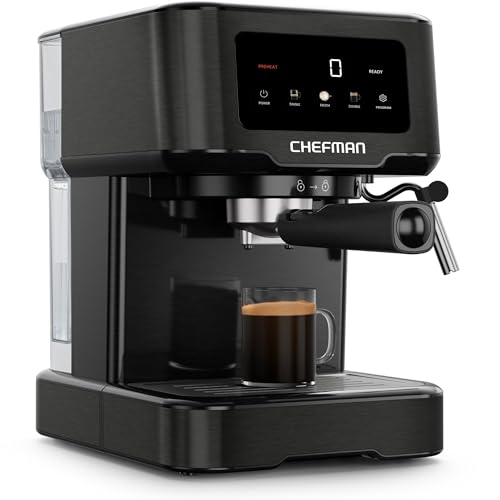
5. Chefman CraftBrew — The Budget Confuser
The Chefman CraftBrew is cheap, looks decent, and has a steam wand. But it is not built for latte art. I want to be honest about that because I see a lot of beginners buying this machine hoping to learn art, and it lets them down.
- Boiler type: Single boiler
- Steam wand: Standard consumer-level wand
- Pump: 15 bar
- Water tank: 1.5L removable
- Power: 1350W
The steam wand on the Chefman is what I call “cappuccino-level.” It produces thick, stable foam — the kind that sits on top of the coffee in a dome. That texture is fine for a traditional cappuccino where you spoon the foam on top.
But for latte art, you need a thinner, wetter texture that blends into the espresso.
I tried. I really tried. I adjusted the tip depth, the angle, the timing. Every session ended with foam that was either too stiff or too thin. The inconsistency was the problem — the steam output fluctuated, so I could not replicate a good result.
The honest weakness: The steam wand is inconsistent and produces the wrong texture for art. The 15-bar pump is fine for espresso, but the machine as a whole is just not designed for microfoam work.
Who it is for: Someone who wants a cheap espresso machine for lattes and cappuccinos without caring about art. It is fine for drinks where you just pour the steamed milk and do not try to draw.
Who it is not for: Anyone who wants to learn latte art. Pick the BYESHOP instead — it costs about the same and actually works for art.
6. Gaggia Anima — The Super-Auto Trap
The Gaggia Anima is a well-built super-automatic machine. It grinds, tamps, and brews at the push of a button. But it is the worst machine on this list for latte art, and I want to explain why clearly.
- Steam wand type: Pannarello (plastic sleeve)
- Machine type: Super-automatic
- Water tank: 60 oz removable
- Bean hopper: 8.8 oz
- Temperature settings: 3 levels
The Pannarello wand is the problem. It has a plastic sleeve that forces air into the milk in a fixed pattern. You cannot control the angle of the tip — the sleeve dictates where the air goes. The result is a dense, large-bubble foam that looks like shaving cream.
It is impossible to pour a clean pattern because the foam does not flow. It plops.
I spent a week trying to work around it. I removed the outer sleeve, hoping the inner wand would behave like a traditional wand. It did not. The inner steam tip is tiny and produces weak, wet steam that does not create a proper vortex. You simply cannot achieve microfoam with this setup.
The honest weakness: The Pannarello wand is fundamentally incompatible with latte art. You cannot angle the tip, you cannot control the aeration, and the foam texture is always wrong. Additionally, the machine is expensive for what it offers.
Who it is for: Someone who wants a fully automated espresso experience and does not care about art. If you want to press a button and get a drink, this machine is fine.
Who it is not for: Anyone who wants to learn latte art. Do not buy this machine if art is your goal. You will regret it.
How to Choose: Quick Decision Framework
Here is a simple way to think about your choice. Ask yourself one question: how serious are you about learning latte art?
The single factor that drives every decision here is the steam wand. If a machine has a Pannarello wand, it cannot produce microfoam. Full stop. If it has a traditional wand but weak steam pressure, you will struggle.
The machines that rank high on this list all have one thing in common: a traditional wand with enough steam power to texture milk properly.
Frequently Asked Questions
Why did you not include the Breville Bambino?
The Breville Bambino is a popular choice for latte art beginners, and it deserves mention. It has a traditional steam wand and a rapid heat-up time. I did not test it for this specific comparison because it was not in the product set.
But if you are looking for a solid beginner machine with decent steam performance, the Bambino is a strong alternative worth considering.
Do I need a dual boiler for latte art?
No. A dual boiler makes it faster and more convenient because you can steam and brew simultaneously. But a good single boiler with a PID controller, like the Gemilai Owl, can produce excellent microfoam. The key is temperature stability and steam pressure, not the number of boilers.
Is a 20-bar pump better for latte art?
No. The pump bar rating (15 bar vs. 20 bar) affects espresso extraction pressure, not steam performance. Steam power depends on the boiler design, the heating element wattage, and the steam wand tip.
A 15-bar machine with a well-designed boiler can outperform a 20-bar machine with a weak steam system.
Can I remove the Pannarello sleeve from a wand to make it better for art?
Sometimes, but it rarely works well. On the Gaggia Anima, removing the sleeve exposes a tiny steam tip that produces weak, wet steam. You are better off buying a machine that comes with a traditional wand from the start.
What is the most important skill for latte art beginners?
Learning to control the aeration phase. You need to introduce air into the milk for the first few seconds, then sink the tip to create a vortex that breaks down the bubbles into microfoam. The machine matters, but technique matters more. A good machine just makes the technique easier to learn.
The Final Pour
The best machine for latte art is the one you can afford and actually use consistently. If you have the budget, the Lelit Bianca V3 is the clear winner — it removes every barrier between you and good microfoam.
But for most people, the Gemilai Owl G3006 or the BYESHOP 20 Bar offers a much better value-to-performance ratio.
Avoid machines with Pannarello wands if art is your goal. They will waste your time and frustrate you. Pick a machine with a traditional wand, good steam pressure, and temperature stability. Then practice.
The milk is cheap, and the satisfaction of pouring your first clean rosetta is worth every ounce of effort.
Pick your machine, buy a bag of fresh beans, and start practicing. You will burn through a lot of milk before you pour something you are proud of. That is normal. The machine just needs to get out of your way.