Reina
Reina 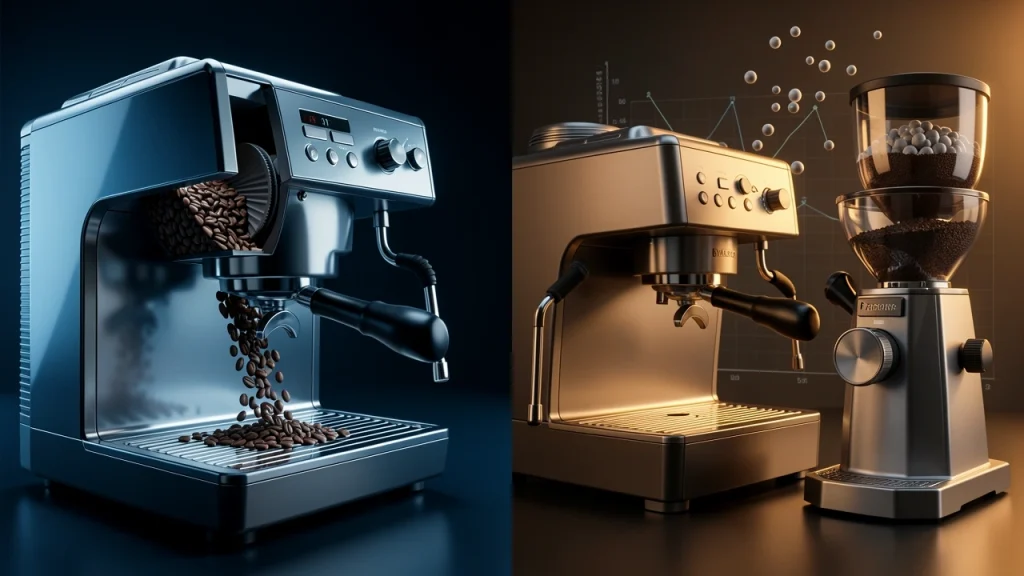
As an Amazon Associate, I may earn a small commission from qualifying purchases at no extra cost to you. This helps me create more valuable, tested content for you.
I have spent years making espresso at home. I started with a cheap machine and a blade grinder, moved to a semi-automatic with a built-in grinder, and eventually switched to separate components.
Each step taught me something about what “worth it” actually means. The truth is that the answer depends entirely on who you are and what you want from your coffee.
For some people, a machine with an integrated grinder is the best purchase they will ever make. For others, it is a trap that limits their espresso for years.
This article will help you figure out which group you belong to.
What You Actually Get with a Built-In Grinder
Let me start with what the marketing does not tell you. Most built-in grinders use conical burrs. That is fine for basic espresso, but the adjustment range is limited.
I owned a Breville Barista Express for two years. The grinder has 30 settings, but only about 6 of them produce usable espresso. The rest are either too coarse or too fine.
The grind consistency is where the compromise shows. Entry-level standalone grinders like the Baratza Encore ESP produce a more uniform particle size.
That matters because uneven grounds cause channeling — water finding the path of least resistance through the puck. The result is sour or bitter shots that are hard to fix.
Another hidden issue is retention. When I ground coffee in my Barista Express, roughly 2 grams stayed inside the burrs after each dose. That stale coffee mixed into the next shot the next morning.
You can clean it out, but not easily. Most standalone grinders have the same problem, but they are simpler to access and purge.
The one clear advantage is workflow. You press a button, the beans grind directly into the portafilter, and you tamp. No transferring grounds, no mess. It is faster than any separate setup I have used.
If you make espresso while half asleep, that speed matters.
The Hidden Cost Problem
This is the part that most articles skip. When you buy a machine with a built-in grinder, you are locking the grinder into the machine forever.
If the grinder motor burns out after three years — and I have seen this happen to friends — you have a few options.
- Repair the grinder module. This costs between $150 and $300 depending on the brand. The labor alone can exceed the cost of a decent standalone grinder.
- Replace the whole machine. That is $600 to $1,500 down the drain.
- Keep using the machine with pre-ground coffee. This defeats the purpose of having an integrated grinder.
With separate components, a failed grinder means you buy a new grinder. Your espresso machine keeps working. I replaced my Baratza grinder after five years because the burrs wore out.
The repair cost $40 for new burrs and 20 minutes of my time.
Upgrade paths work the same way. After a year with my built-in machine, I wanted better grind quality. I could not improve the grinder without replacing the entire machine.
That is a hard lesson when you realize your equipment has a ceiling you already hit.
Who Gets the Most Value from a Built-In Grinder
Based on my experience and conversations with other home baristas, the persona alignment is clearer than most reviews suggest.
| User Type | Recommendation | Reason |
|---|---|---|
| Casual drinker making 1-2 milk drinks daily | Built-in grinder works well | Convenience outweighs quality ceiling. Milk masks minor shot flaws. |
| Budget-conscious beginner | Separates preferred | A $300 Bambino plus $150 hand grinder outperforms $600 integrated machines. |
| Aspiring enthusiast | Separates required | You will outgrow the grinder in 6-12 months. Better to start with flexible gear. |
| High-volume user (4+ drinks daily) | Separates preferred | Built-in grinders overheat and retain more stale coffee under heavy use. |
The casual drinker is the sweet spot. If you mainly make lattes or cappuccinos, the milk covers most of the espresso imperfections. You do not need a perfect extraction.
What you need is a fast, clean morning routine. A built-in grinder delivers that.
When Separate Components Win
Even if you are a beginner, there are situations where separates make more sense.
You plan to drink espresso for more than two years. The learning curve with espresso is real. After a few months, most people start noticing flavor differences.
If you care about those differences, you will want a grinder with stepless adjustment. Most built-in grinders have stepped adjustments that cannot fine-tune for different beans.
You value shot quality over speed. A separate grinder like the DF64 or Eureka Mignon produces flakeless, consistent grounds that let you dial in exactly.
I spent three weeks with a built-in machine pulling sour shots because the grinder could not go fine enough without choking the machine. That frustration is common.
You have counter space. Two machines take up more room, but they also give you flexibility. You can place the grinder on a shelf or in a cabinet and only bring it out when needed.
My current setup has the espresso machine on the counter and the grinder on a rolling cart. It fits in a small apartment without looking cluttered.
How to Evaluate a Built-In Grinder Before You Buy
If you decide that a built-in grinder fits your life, use this checklist to avoid the worst models.
- Burr type and size. Conical burrs are standard. Flat burrs are better for consistency, but rare in integrated machines. Look for at least 40mm burrs.
- Number of grind settings. More is not always better, but 30 settings minimum with clear click points helps repeatability. Avoid machines with fewer than 15 settings.
- Dose retention. Read reviews for retention numbers. Under 1 gram is acceptable. Over 2 grams means stale coffee in every shot.
- Cleaning access. Can you remove the upper burr without tools? Can you brush out the grinding chamber? Some machines require disassembling the whole unit.
Frequently Asked Questions
Can I use pre-ground coffee in a machine with a built-in grinder?
Yes, most machines have a bypass doser. You fill the portafilter manually. But this wastes the main benefit of having a grinder.
The grinder also takes up space inside the machine that could otherwise be smaller.
Do built-in grinders work for pour-over or drip coffee?
Rarely. They are optimized for espresso fineness, which is around 200-300 microns. Most cannot produce the coarse grind needed for pour-over without significant retention and inconsistency.
Some super-automatics have a separate grind chamber for different methods, but not all.
Are super-automatic built-in grinders different from semi-automatic integrated grinders?
Super-automatics grind, dose, tamp, and brew automatically. Semi-automatics require you to tamp the coffee manually.
The grinder mechanics are similar, but super-automatics add complexity and more potential failure points. For example, the tamp mechanism can jam if the grind is too fine.
How often should I clean the grinder burrs?
Every 1-2 months, depending on bean oiliness. Oily beans like dark roasts cause buildup that leads to stale coffee and can clog the chute. Use a brush and a grinder cleaning tablet.
Neglecting this is the most common cause of poor shots from built-in grinders.
What is the most reliable espresso machine with a built-in grinder under $1,000?
The Breville Barista Pro is a popular choice. The grinder has 30 settings and decent retention. But in my experience, the grinder is often the first part to fail.
The Breville Barista Express is similar but slightly slower. The Ninja Luxe is a newer option that also handles drip coffee, but reviews on long-term durability are still limited.
The real takeaway is this: a built-in grinder is a convenience tool, not a quality tool. If you accept that trade-off, you will enjoy your machine.
If you expect it to match a standalone grinder, you will be disappointed. Know yourself first, then choose the equipment that matches your priorities.