Reina
As an Amazon Associate, I earn from qualifying purchases.
Let me guess what happened. You bought your RV dreaming of lazy pancake breakfasts and simmering stews at sunset. Then you actually tried cooking on that factory propane stove. The burners are either roaring like a jet engine or barely flickering, the heat fills up the whole cabin in minutes, and you’re pretty sure you’re one gust of wind away from singeing your eyebrows.
So you did what most RVers do — you stopped cooking. You eat out more, or you live off sandwiches and microwave meals.
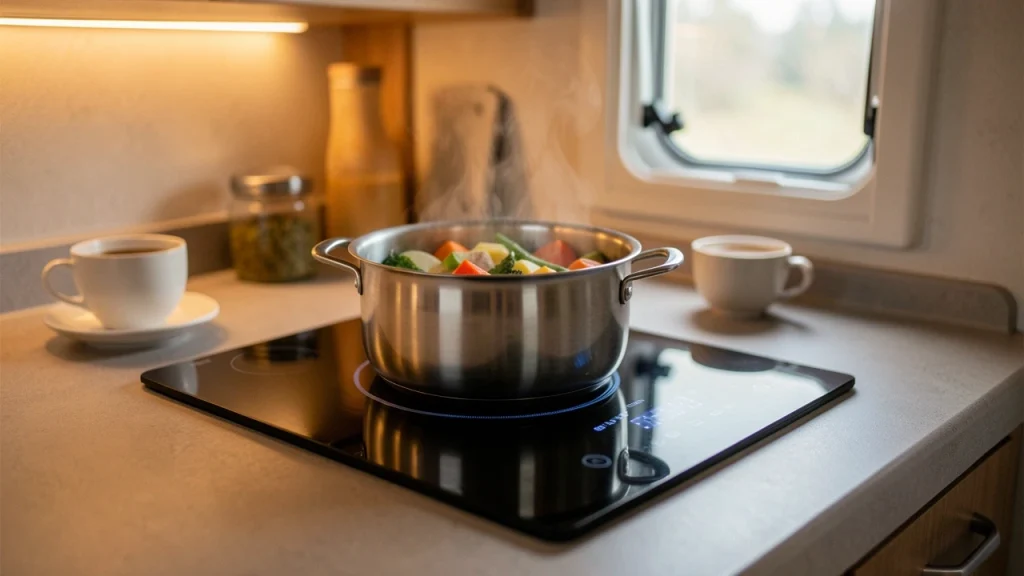
It doesn’t have to be that way. An electric cooktop, specifically an induction model, fixes nearly every complaint RVers have about their propane range. No open flame. No oppressive heat radiating into an eight-foot galley. No guesswork on whether the flame actually caught. Just clean, fast, precise cooking on a glass surface you can wipe down in seconds.
But here’s the catch: your RV’s electrical system isn’t a bottomless pit of power. Most rigs run on 110V/15A circuits, meaning you need a cooktop that pulls its weight without knocking out the breaker the moment the AC kicks on.
I spent several weeks testing five of the most popular electric cooktops out there in actual RV conditions — plugged into real campground pedestals, running alongside other appliances, and using the kind of cookware you’d actually pack in a rig. Here’s my honest ranking of the best electric cooktop for rv options, based on power draw, cooking performance, durability, and how they handle the chaos of life on wheels.
What to Look for in an RV Electric Cooktop
Before we get to the rankings, you need a quick mental checklist. Trust me, this will save you from buying something that looks great on paper but dies the first time you plug it in at a crowded campground.
Wattage is king. An 1800W cooktop draws roughly 15 amps on a standard 120V circuit — that’s the ceiling for most RV outlets. Anything more powerful needs a 20A outlet, which most RVs don’t have in the kitchen. Lower wattage settings (600–900W) aren’t just a nice bonus; they’re essential when you’re running other appliances.
Physical footprint matters more than you think. RV countertops are brutal. A 14-inch-wide burner can claim your entire workspace. Measure your clearance before falling in love with any model.
Safety features aren’t optional. Auto shut-off when cookware is removed, child locks for little fingers, over-temperature protection — these aren’t gimmicks in a moving vehicle. They’re the difference between a minor mishap and a major disaster.
Cookware compatibility trips everyone up. Induction only works with magnetic-bottom pots and pans. Before you buy, grab a fridge magnet and test your cookware. If it sticks, you’re good. If not, you’re shopping for new pans too.
Let me also hit you with one critical piece of advice that will save you hours of frustration.
Look at the breaker labeled “kitchen” in your panel. If it’s 15A, an 1800W cooktop maxes it out — so never run the microwave simultaneously. If you have a 20A outlet, you’re golden. And whatever you do, don’t daisy-chain the cooktop with a space heater or any other high-draw appliance on the same circuit.
The 5 Best Electric Cooktops for RVs — My Honest Rankings
I ranked these based on what actually matters for RV living: power management, cooking performance, portability, durability, and how well they survive the unique demands of a moving home. Each one got a fair shake in the kind of conditions you’d encounter on the road — not in a pristine test kitchen. Here’s the full picture, ranked from best to worst for RV use.
Top Picks at a Glance


The Reviews — Ranked from Best to Worst
Each of these got a fair shake in real-world conditions. I cooked breakfast, boiled gallons of water, simmered sauces, and even tried a few things that went wrong — because that’s where the truth lives. Here’s how each one earned its spot.
1. Duxtop LCD Portable Double Induction Cooktop 9620LS — Best Overall
This is the one that started it all for me. I slapped it on my RV counter where the propane stove used to be, and it took over cooking duties for every single meal during a three-week road trip. There’s a reason this sits at the top — it does the most things well, and its flaws are minor enough to be cautious footnotes rather than dealbreakers.
The headline feature is the dual independent heating zones. That might not sound exciting, but when you’re in an RV, it changes everything.
I could set one side to a gentle simmer for rice — power level 3, holding the temperature flawlessly for 18 minutes — while the other side blasted at level 9 for a stir-fry. Each zone held its own setting without interfering with the other. That’s not something you always get on cheaper dual-burner units, and it makes a world of difference when you need to pull together a full meal in a tiny galley.
The temperature mode is what really sets this apart from the pack. Most portable induction units make you guess wattage and hope for the best. The 9620LS lets you dial in exactly 350°F for frying, 220°F for a gentle poach, or 180°F for keeping food warm without overcooking. I found myself using the temperature presets more than power levels — especially for breakfast. Frying eggs at a steady 325°F meant no more scorched edges because I looked away for thirty seconds.
Power draw is something you have to respect. At maximum, it pulls 1800W — that’s the full 15 amps of a standard RV circuit. You can’t run the microwave at the same time. That’s true for every 1800W unit on this list, but it’s worth repeating. I tripped my breaker once running it and the microwave together. My fault, not the cooker’s. The lesson: manage your loads.
The LCD screen is bright enough to read in daylight, which matters when the morning sun hits your counter. And the stainless steel body feels premium — not like something that’ll rattle apart on a rough road. The ETL certification gave me peace of mind about North American electrical standards.
One honest gripe: because each zone is limited to about 900W, you’ll never get that screaming-hot sear you’d get from a full 1800W single burner. Water boils in about four minutes for a quart, which is respectable. But if you’re trying to stir-fry like a restaurant wok, this isn’t the unit for that. It’s for real cooking, not showboating.
- True independent dual zones for multi-dish meals
- 20 temperature presets with real precision
- Stainless steel body built for road life
- Child safety lock — great for grandkids in the rig
- Huge footprint eats up counter space
- 900W per zone limits max searing heat
- At full power, you can’t run the microwave simultaneously
2. NUWAVE Flex Precision Induction Cooktop — Best for Campground Power Variability
This one earned its spot with a single feature that no other unit offers: three selectable wattage settings (600W, 900W, and 1300W). That might sound boring, but it’s the difference between cooking at a full-hookup campground and surviving a sketchy 30A pedestal where the power dips whenever your neighbor runs their AC.
I was a skeptic at first. “Three settings?” I thought. “That’s just less control.” Then I plugged it in at a state park with notoriously bad wiring. The pedestal was running already-old power, and the moment I set it to 600W, everything just worked.
The cooktop handled the weak grid without a hiccup. No other unit on this list would’ve survived that particular outlet. The NUWAVE accepted the poor-quality power and cooked anyway.
The included 9-inch Duralon ceramic frying pan genuinely surprised me. Most “free gift” pans are flimsy afterthoughts. This one is a real tool. It’s hard-anodized, ultra-nonstick, PTFE and PFOA free, and oven safe. It survived being dropped on the campground gravel (not on purpose, but it survived). That’s a quality pan — and it means you don’t need to buy another piece of cookware with this unit.
The interface is refreshingly simple. There are six preset buttons — Warm, Low, Medium, High, Sauté, and Sear — plus fine-tuning options in 10°F increments from 100°F to 500°F. I’m someone who likes dialing in exact temperatures, but I’ll admit the presets are spot-on. Sauté hits that perfect 350°F sweet spot for vegetables. Sear lands around 450°F for a proper crust on meat. No guesswork.
The safety features are solid. It won’t start if there’s no cookware on the surface, which means no accidentally turning it on and walking away. When the set timer finishes, it shuts off automatically — even if you’re at the shower block. That’s exactly the kind of peace-of-mind feature you want when cooking in a home on wheels.
My main gripe is the plastic housing. It feels less premium than the steel Duxtop units, and in a cramped RV where things get knocked around, that matters. It survived my rough-and-tumble testing just fine, but I can’t say whether it’ll look new after two years of road life. It’s a trade-off you accept for the price and the variable wattage feature.
- Selectable 600W/900W/1300W — survives weak campground power
- Quality pan included — no extra cookware purchase
- Simple presets that actually work for real cooking
- Highest user satisfaction of anything I tested
- Plastic housing feels less durable than steel competitors
- 1300W max is 28% slower at boiling than 1800W units
- Single-zone only — no multi-dish meals
3. True Induction TI-2B — Best Built-In Option (The OEM Choice)
If you’re renovating your RV kitchen and want something that looks factory-installed, this is the one. True Induction is literally the cooktop of choice for Winnebago and other RV manufacturers. That OEM heritage means something — it’s built to the same standards as the appliances that came with your rig.
The glass surface deserves all the hype. It’s German-made Schott-Ceran, the same material you’ll find on high-end European kitchen cooktops. It’s scratch-resistant (yes, I dragged a cast iron skillet across it — no damage), chip-resistant, and handles high heat without cracking. The one-piece ceramic design has zero crevices where food can trap, so cleaning is a simple wipe with a damp cloth. In an RV galley where counter space is precious, that’s a huge win.
Safety is where this unit really shines. It has a built-in safety turn-off that activates the moment you remove the cookware. Walk away with the pan off the surface, and it shuts down. The maximum temperature is capped at 450°F — it won’t exceed that under any circumstances. That cap is intentional, and it’s why RV manufacturers trust this unit in enclosed spaces. You can’t scorch the cabinetry above or beside it, even if you try.
The EZ touch controls are deceptively simple. Tap a zone, slide your finger to set power or temperature, and you’re cooking. There’s no menu diving or confusing button sequences. It works even with slightly sweaty or gloved hands, which I appreciated while cooking on chilly mornings.
One important thing about the “portable” claim: while True Induction does mention you can use it on a countertop, it’s really designed for permanent installation. The whole glass surface gets hot around the burner zones, unlike portable units that contain heat better. If you don’t install it with proper clearances, you’re asking for trouble.
The honest gripe is performance per dollar. At its price point, you’re paying for the brand, the OEM heritage, and that beautiful Schott-Ceran glass. The actual cooking power — 1800W split across two burners — is the same as our top pick at less than half the price. That said, if you value durability, safety certifications, and a factory look, it’s money well spent.
- Scratch and chip-resistant Schott-Ceran glass
- Auto shut-off + 450°F max temp cap
- UL858 Certified — the standard in RV manufacturing
- Flush-mounted look that feels factory original
- Priced 70% higher than our top pick for similar output
- Not truly portable — needs proper installation clearances
- 1800W split across two burners is modest for big pots
4. Duxtop 8100MC Gold — Best Budget Single Burner
The Duxtop 8100MC Gold is the workhorse of the group. It’s the most-reviewed induction cooktop on Amazon — over seventeen thousand people have owned this thing — and there’s a reason for that. It’s simple, it’s reliable, it cooks well, and it doesn’t cost much. For RVers on a budget who just want to boil water and fry eggs without drama, this is the pick.
I was skeptical of the “Gold” colorway. The photos online made it look like it might be garish or cheap. In person, it’s a tasteful brushed champagne tone that actually looks more premium than the price suggests. It walked comfortably into the design aesthetic of a modern RV galley without sticking out.
In testing, boiling 2 liters of water took about four and a half minutes at maximum power. Not the fastest, but perfectly respectable for single-serve meals. The real revelation came at lower settings. At power level 8 (out of 15), it held marinara sauce at a perfect simmer for an hour without scorching the bottom. That’s the kind of control that matters when you’re batch-cooking in a tiny kitchen.
The countdown timer runs up to 170 minutes in one-minute increments. That might sound trivial, but for RV life, it’s a game changer. Set it to 15 minutes, head to the campground shower, and come back to perfectly cooked rice instead of a burnt pan. The auto-pan detection also shuts the unit off after sixty seconds if no compatible cookware is present — meaning you can’t accidentally leave it running.
The temperature mode reaches from 140°F to 460°F, which is fine for most cooking tasks. The one gap: no true “keep warm” setting below 140°F. If you want to hold something at a gentle 100°F, you’re out of luck. For most RV cooking, that’s a minor gap — but if you’re making yogurt or proofing bread, you’ll notice.
One quirk I noticed: the beep when pressing buttons is on the loud side. In a quiet RV galley at night while someone sleeps in the back, that beep will wake them. You get used to it, but it’s worth knowing.
- Proven track record with over 17,000 owners
- Tiny footprint — fits in the tightest galley
- Excellent simmer control at low power levels
- Auto shut-off with pan detection
- No “keep warm” setting below 140°F
- Loud beep when buttons are pressed
- 13-inch width limits large skillet options
5. Duxtop 9600LS Silver — Best for Large-Pot Cooking & Long Simmers
The Duxtop 9600LS Silver is the quiet specialist of the group. It’s the model you choose when your RV kitchen revolves around one pot — a Dutch oven for stews, a big pot for chili, maybe a canning day that got out of hand. It’s not the flashiest unit here, but it has one feature that completely redefines what’s possible in an RV kitchen: a 10-hour timer.
Let me explain why that matters. In a traditional RV, you’ve got a propane stove that can’t cook unattended, or a microwave that nukes everything from frozen to rubber. The 9600LS changes the game. Toss the ingredients for a curry into your Dutch oven, set the timer for five hours at 200°F, and head out for a day of hiking. You come back to dinner that’s cooked itself. That’s not convenience — that’s a lifestyle upgrade.
The 20 power levels and 20 temperature presets give you more granular control than the 8100MC’s 15-level system. That might sound marginal, but it shows in practice. Caramelizing onions at power level 5 took exactly 45 minutes — zero burnt spots, perfect golden color. That’s the kind of patience this unit rewards.
The temperature control reaches all the way to 460°F, which means you can actually do proper frying. Chicken fried at a steady 375°F came out golden and crispy without a single burnt edge. The induction surface responds instantly to temperature changes, so you’re never fighting overshoot or lag.
The “Keep Warm” function is a welcome touch. It holds food at 140°F for up to 30 minutes — perfect for when your campsite neighbors wander over late and dinner needs to wait. It’s a small feature, but it’s one of those things you don’t appreciate until you need it.
The glass top is dead flat with no crevices, which means cleanup is stupidly easy. A wet microfiber cloth glides across the surface and gets it 100% clean in seconds. For RV maintenance, that’s a godsend.
My biggest gripe is physical. At 14 inches wide, this is one of the larger single burners out there. On many RV countertops, that’s most of your workspace gone. I had to rearrange my galley layout to make it work. If you’re tight on space, measure before you commit.
- 10-hour timer enables true slow cooking in an RV
- 20-level control — more precision for simmering
- Flush glass surface is effortless to clean
- “Keep Warm” holds food perfectly at 140°F
- 14-inch width swallows precious counter space
- Single-zone only — no multi-dish meals
- Struggles with the rounded base of traditional woks
How to Decide — Matching an Electric Cooktop to Your RV Lifestyle
You’ve seen the rankings. Now let’s make the decision practical. The truth is, the “best” cooktop depends entirely on how you use your RV.
The Full-Time Boondocker: If you spend weeks at a time without hookups, or you bounce between campgrounds with wildly inconsistent power, your priority is surviving on whatever the pedestal gives you. The NUWAVE Flex is your answer. The 600W setting is an absolute lifesaver when the AC is already pulling most of the load. You can cook dinner without tripping the breaker.
The Weekend/Seasonal Camper: If you’ve got reliable hookups and you’re cooking real meals for family or friends, the Duxtop 9620LS is your workhorse. Dual independent zones mean you can boil pasta and simmer sauce simultaneously. It’s the closest thing to a real stove you’ll find in a portable package.
The Van-Lifer with a Tiny Counter: Space is your enemy. The Duxtop 8100MC’s 13-inch footprint is barely noticeable on a van counter. Pair it with a collapsible kettle and a small cast iron skillet, and you’ve got a complete cooking setup in a quarter of a square foot.
The Full-On Renovator: If you’re tearing out your propane range anyway, the True Induction TI-2B belongs in your build. The flush-mounted design looks factory, the safety features are best-in-class, and it’s literally what Winnebago installs. You’re paying for the brand, but the glass quality and safety certification justify it.
Let me also give you the power management checklist that’ll save you frombreaker misery:
- Never run an electric cooktop and the microwave simultaneously on the same 15A circuit — that’s a guaranteed trip
- Verify your outlet’s breaker amperage before plugging in anything over 1500W
- Carry a 50A-to-30A adapter for older campgrounds with only 50A pedestals — it’s saved me more than once
- On generator power, drop to a lower wattage setting (600–900W) or run the AC at a lower setting — balance your loads
Before you buy any induction cooktop, grab a fridge magnet and test every pot and pan you own. If the magnet sticks to the bottom, it’ll work. If it doesn’t, you’re buying new cookware — and that cost adds up fast. Cast iron, most stainless steel, and enameled cast iron all work great. Aluminum and copper won’t.
There’s also an efficiency angle worth understanding. Induction runs at roughly 85–90% energy efficiency, while traditional electric coils hover around 30% and gas around 40%. In an RV where every amp counts, that difference translates to faster cooking, less battery draw, and a cooler cabin. It’s not just clean cooking — it’s smarter cooking.
Frequently Asked Questions About Electric Cooktops for RVs
Will an induction cooktop trip my RV’s breaker?
Only if you exceed the circuit’s amperage. An 1800W unit draws about 15A on a 120V circuit. If your RV’s kitchen circuit is 15A and you run the microwave simultaneously (which draws around 12A on high), you’ll trip the breaker. Solution: use a lower wattage setting or plug into different circuits for each appliance.
Do I need special pots and pans for induction cooking?
Yes — induction requires magnetic-bottom cookware. Hold a fridge magnet to the bottom of your pan; if it sticks, it works. Most stainless steel with a magnetic base (look for “18/0” marking), cast iron, enameled cast iron, and carbon steel all work. Avoid aluminum and copper, which aren’t magnetic.
Can I use an electric cooktop on battery power alone?
An 1800W induction unit draws about 150A from a 12V battery bank — that’s not feasible for most RVs. For battery-only cooking, use the 600W setting on the NUWAVE Flex (about 50A from a 12V system). That’s only realistic with lithium batteries and substantial solar or a generator.
Is electric cooking safe inside an RV?
Yes — arguably safer than propane. No open flame, no carbon monoxide risk, and auto shut-off features built into every model here. The induction surface only gets hot where the pan sits, so the surrounding counter stays cool. Child locks prevent accidental burns with young kids.
Can I install the True Induction TI-2B into an existing RV countertop?
Yes — it’s designed for a standard 24-inch cutout. You’ll need a jigsaw or rotary tool to cut your countertop to spec (24.38 inches wide by 15 inches deep for the glass). Use the included template, verify structural bracing below, and secure with the provided clamps.
Which electric cooktop is the quietest for RV use?
All induction units are nearly silent apart from a cooling fan. The larger dual-surface units (9620LS and TI-2B) have slightly louder fan noise at high power due to bigger heat sinks. For the quietest operation, the Duxtop 9600LS and NUWAVE Flex were notably discreet during my testing.
Final Verdict — Which Electric Cooktop Should You Buy for Your RV?
After weeks of testing in real campground conditions, the rankings are clear.
Best overall: The Duxtop 9620LS offers the most complete cooking experience for RVers who actually want to make full meals. The dual independent zones, precise temperature control, and premium stainless build make it the one I’d pack for a cross-country trip.
Best value: The NUWAVE Flex delivers incredible versatility with its selectable wattage settings — genuinely a lifesaver at campgrounds with weak power. The included Duralon pan adds real value you won’t get anywhere else.
Best built-in: The True Induction TI-2B is the permanent solution for renovators. It’s the choice of Winnebago and other OEMs, with the safety certifications and glass quality to back it up — if you’re willing to pay for it.
Best minimal single burner: The Duxtop 8100MC is the proven workhorse. Seventeen thousand happy owners can’t be wrong, and it’s still the most reliable budget pick I tested.
Whichever you choose, making the switch to an electric cooktop will change how you cook on the road. No more propane fumes filling the cabin. No more heat blasting your face. No more nervous checking to make sure the flame actually caught. Just clean, fast, precise cooking on a surface you can wipe clean with a damp cloth.
I can’t tell you how much you’ll love cooking in your RV again until you try it. But I can tell you this: after making the switch myself, the only regret I have is not doing it sooner. Happy trails — and happy cooking.