 Reina
As an Amazon Associate, I earn from qualifying purchases.
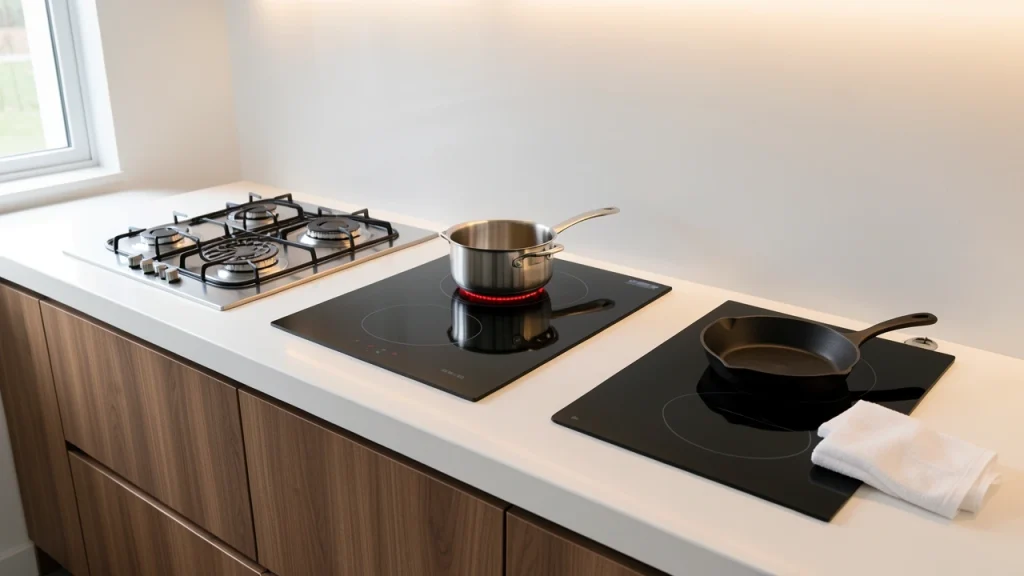
If you’re wondering which electric cooktop is easiest to clean, the verdict is actually clearer than most appliance debates.
Induction wins, smoothtop radiant finishes second, and coil burners trail by a wide margin.
But the why behind that ranking is what matters, because it determines what your weekly kitchen routine looks like for the next decade.
Before you spend a dime, though, you need to understand one thing: the cleanability of a cooktop isn’t determined by the brand or the price tag.
It’s determined entirely by how the surface handles heat. Once you see that connection, the choice becomes obvious, and you’ll know exactly what kind of maintenance to expect.
Induction Tops the Cleanability Chart, Here Is Your Quick Verdict
Induction is the easiest electric cooktop to clean. The glass surface never gets hot enough to bake spills on, so a damp cloth handles almost everything.
Smoothtop radiant cooktops come second — flat and seamless, but the glass heats directly and food will burn onto it. Coil burners are a distant third, with recessed drip pans and exposed metal that trap grease and require soaking to truly clean.
The maintenance time gap between these three is staggering. A typical induction cooktop needs about 30 seconds of wiping after most meals.
A smoothtop radiant unit will have you pulling out a scraper and ceramic cleaner at least a few times a week. And with coil burners?
Plan on 15 to 20 minutes of disassembly and scrubbing whenever something boils over, because the mess gets pulled down into the drip pans by gravity and heat.
That’s not an exaggeration, either. The difference between a surface that stays cool and one that reaches 600 degrees Fahrenheit is the difference between wiping and scrubbing.
Let me show you why in terms of the actual physics at play.
How Heat Transfer Physics Decides Whether You Scrub or Wipe
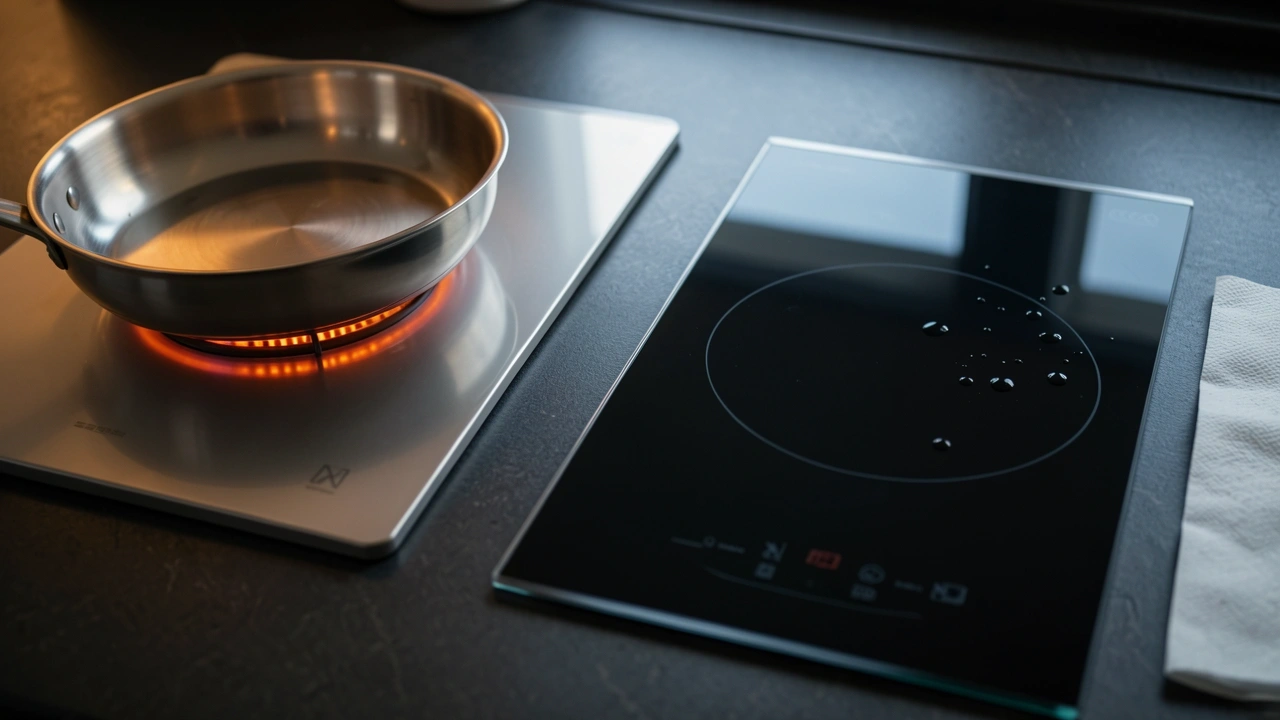
The fundamental difference between these cooktops comes down to what actually gets hot. Induction heats the pan directly through a magnetic field, leaving the glass surface mostly cool to the touch.
Radiant smoothtops heat the glass itself, which then transfers that heat to your pan. And coil burners are essentially exposed electric heating elements sitting above reflective metal drip pans.
Spills stay liquid on the surface. Wipe and done.
Spills bake on the glass instantly. Scraping required.
Grease collects in drip pans and coil gaps.
That cool-zone effect on induction is why it’s the most effortless surface to maintain.
When pasta water boils over onto an induction cooktop, it just sits there as lukewarm liquid on a smooth glass sheet. You can literally wipe it up with a paper towel and move on with your life.
There’s no baking, no carbonizing, no baked-on residue that requires chemical intervention.
Smoothtop radiant units have what engineers call thermal inertia.
The glass stays hot for a long time after you switch the burner off, which means that bit of soup or sauce that splattered during cooking gets cooked onto the surface.
You end up using a razor scraper and a ceramic cleaner far more often than you’d like. It’s manageable, but it’s a recurring chore that induction simply doesn’t have.
Coil burners have the double problem of heat and geometry. The heating element itself gets red-hot, so anything that touches it carbonizes instantly.
And because the coils sit recessed in a well with a drip pan underneath, grease and food particles travel downward into places you can’t reach with a sponge.
There’s a reason vintage coil stoves came with replacement drip pans as a standard accessory — they’re meant to be swapped out and cleaned in batches.
Coil vs. Smoothtop vs. Induction — A Side-by-Side Cleaning Process Comparison
Let’s make this concrete with a direct comparison of what the actual cleaning process looks like for each type. These are realistic times and tools based on everyday cooking, not ideal scenarios.
Those times assume you’re keeping up with spills in real-time, which is the smartest habit for any cooktop.
The one scenario where coil burners actually gain a small advantage is durability — a metal coil and porcelain drip pan will shrug off physical abuse that would shatter glass.
But that’s a toughness trade-off, not a cleanliness one.
There’s also a hidden time cost with coil burners that rarely gets mentioned: you have to wait for the surface to cool completely before you can even touch the mess.
Smoothtop units have a residual heat indicator light, but the glass still takes 30 to 40 minutes to drop to a safe temperature.
Induction is cool enough to touch almost immediately after you remove the pan, so you can clean as you go without interrupting your cooking flow.
The Critical Trade-Off Scratch Resistance vs. Stain Resistance
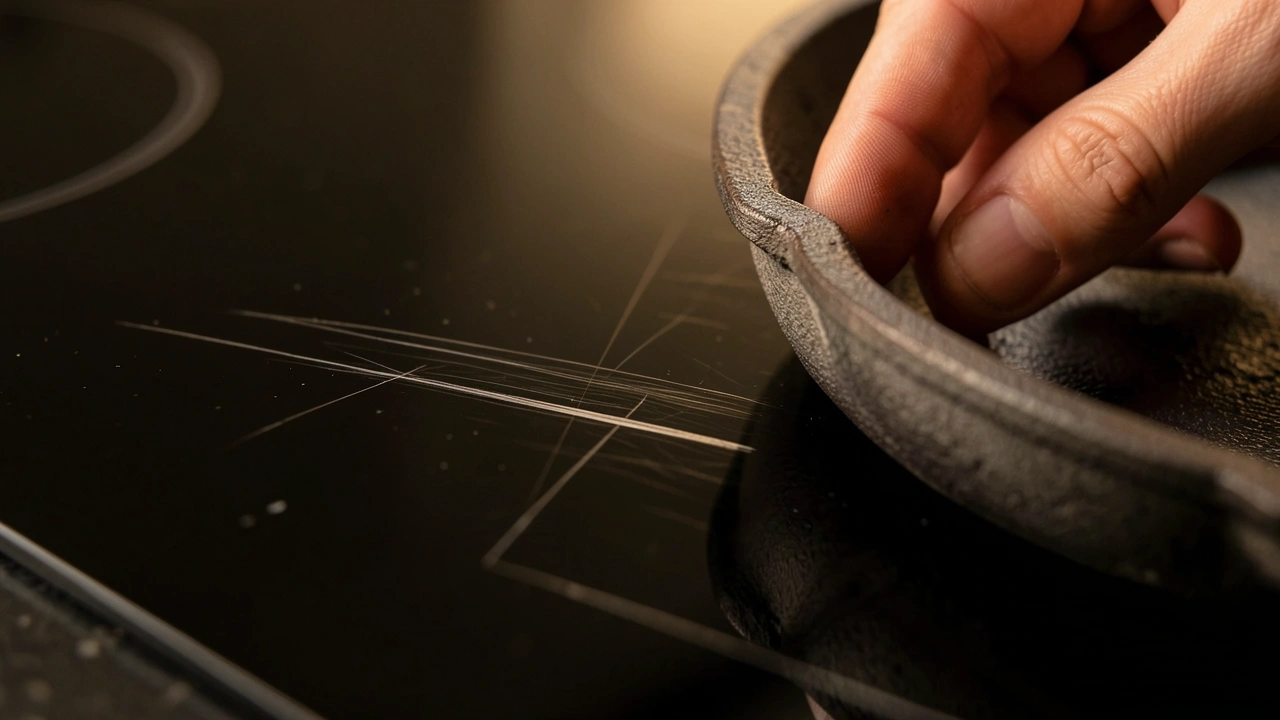
Here’s where the conversation gets honest, because there’s no free lunch. The easiest-to-clean surfaces — induction and smoothtop glass — are also the ones most vulnerable to scratches.
A coil burner will never streak or etch, but it will look grimy every single day.
A glass cooktop looks pristine after every wipe, but one careless slide of a rough-bottomed Dutch oven can leave a permanent mark.
- Wipes clean with a single pass, no scrubbing or soaking
- No recessed edges where food particles can hide
- Flat surface works with razor scrapers for the rare stubborn spot
- Less time bent over the stove means the surface actually stays cleaner longer
- Drip pans accumulate baked-on grease that requires disassembly to clean
- Exposed heating coils carbonize anything that touches them
- Food particles fall into the burner well, out of reach of wipes
- Durable metal surface survives abuse, but it never looks truly clean
Here’s the pattern I see in real kitchens: people who own glass cooktops and complain about scratches are usually using the wrong tools or the wrong cookware.
The glass itself is a toughened ceramic material called glass-ceramic — it’s not delicate.
But it will scratch if you slide a pan with a rough, gritty bottom across it, or if you use an abrasive steel wool pad instead of a proper cooktop scraper.
Follow these three rules and your glass cooktop will stay looking new for the life of the appliance:
- Lift, don’t slide. Always pick pans straight up when you move them. Sliding is the number one cause of micro-scratches that dull the surface over time.
- Use a dedicated ceramic scraper. The cheap plastic-handled scrapers sold next to cooktop cleaner work better than any sponge for removing burned-on bits, and they won’t scratch.
- Keep the bottom of your pans clean. Grit or stuck food on the underside of a pan acts like sandpaper when the pan is placed on the glass.
If you already own a glass cooktop and it has scratches, stop using abrasive pads immediately. Switch to a ceramic cleaner and a soft sponge. Existing scratches won’t disappear, but you can prevent new ones from piling on.
Your Cookware Choices Are the Hidden Variable in Cooktop Maintenance
Most people buy a cooktop and then think about cookware compatibility afterward. But the pots and pans you use have a bigger impact on cleanability than the cooktop itself.
This is especially true for glass surfaces, where the wrong pan bottom will leave residue that takes real elbow grease to remove.
Bare cast iron is the classic glass-cooktop killer. The rough bottom of traditional cast iron skillets acts like sandpaper against the smooth ceramic surface.
Even worse, if you move a heavy cast iron pan even half an inch while it’s sitting on the glass, you can drag a visible arc across the surface.
Enameled cast iron is the safe alternative because the glassy enamel bottom is smooth and non-abrasive.
Aluminum and copper bottoms are a different kind of problem. When these soft metals heat up on a glass cooktop, tiny particles can transfer onto the glass and fuse in a silver or gray residue.
It’s not a scratch, but it’s nearly as annoying — it resists regular cleaners and needs a dedicated residue remover.
The worst case is melting aluminum foil or a thin aluminum pan, which can permanently weld itself into the glass.
For induction cooktops specifically, you also need to pay attention to whether your cookware is compatible at all. If a magnet doesn’t stick to the bottom of your pan, induction won’t heat it.
That’s worth checking before you fall in love with an induction range, because your favorite stainless pots might not work.
Daily Maintenance Arsenal vs. Deep-Clean Rescue Arsenal
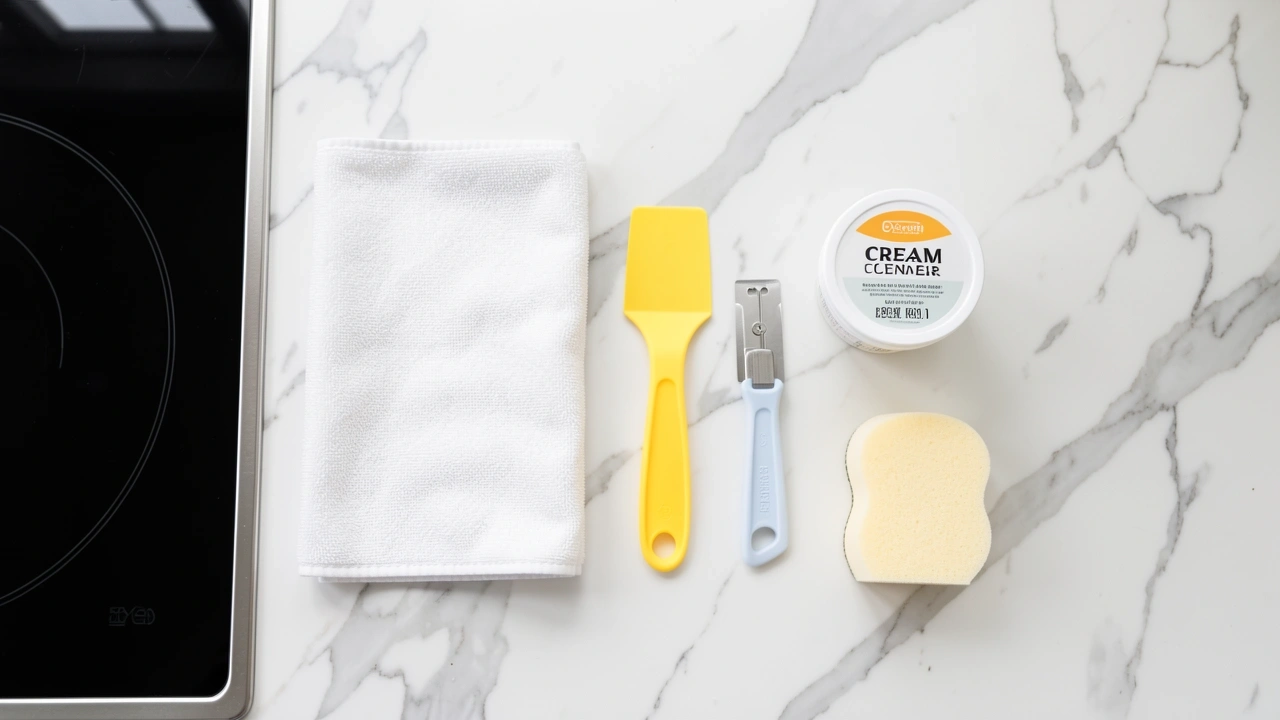
Once you’ve picked the right cooktop and the right pans, the last piece of the puzzle is having the right tools on hand.
I’ve seen people ruin a perfectly good glass cooktop by scrubbing it with the same green-scour pad they use on their sink. That’s not a cleaning failure — it’s a tool failure.
Here’s what actually works, split by scenario.
- Microfiber cloth — one damp, one dry, kept near the stovetop
- Plain water or daily cooktop spray — enough for light smudges and fingerprints
- Silicone scraper — for the rare spill that managed to dry before you noticed
- CeramaBryte or Weiman cooktop cleaner — applied evenly, buffed to a gloss
- Razor blade scraper — held at a 45-degree angle for stubborn carbon spots
- White vinegar + water spray — for drying mineral deposits from hard water overflows
The daily routine is genuinely enough if you clean while the surface is still warm — not hot, but warm. Residual heat helps lift food particles without the need for chemical cleaners.
On induction, you can actually clean immediately after cooking because the glass is barely warm. On smoothtop, wait until the residual heat indicator goes off, which usually takes 20 to 30 minutes.
Never use abrasive powders, scouring pads, or metal scrubbers on a glass cooktop. They leave micro-scratches that dull the surface and make it harder to clean over time. Also avoid ammonia-based glass cleaners like Windex — the ammonia attacks the ceramic coating and can cause it to cloud permanently.
One last habit that pays off big: wipe down the cooktop after every single use, even if you don’t see a mess. A thin film of grease from splattering bacon or sautéing mushrooms builds up invisibly.
When that film cooks onto the glass, it turns into a cloudy haze that’s much harder to remove than a fresh spill. Thirty seconds of preventive wiping saves you a full deep-clean session down the line.
Frequently Asked Questions
Can I use a razor blade on an induction top?
Yes, but only the angled scraper designed for ceramic cooktops, not a standard utility blade. Hold it at a 45-degree angle with light pressure so the edge lifts the debris rather than digging into the glass. The plastic-handled scrapers sold next to cooktop cleaner are the safest option.
Do smoothtop electric stoves require special cookware to be easier to clean?
No, but you should look for pans with flat, smooth bottoms. Rough or warped pan bases trap food and create uneven heating that leads to more splatter and burned-on residue. Tri-ply stainless and enameled cast iron are the best choices, while bare cast iron and thin aluminum should be avoided.
Why do my ceramic pans leave a gray residue on the glass top?
That gray film is actually fine particles from the ceramic pan coating transferring onto the hot glass as the pan heats up. It’s not a stain in the glass itself. A dedicated ceramic cooktop cleaner will usually lift it off with a little buffing. If it keeps coming back, switching to stainless or enameled cookware eliminates the problem entirely.
Is there a difference in cleaning between a radiant smoothtop and an induction smoothtop if they both look identical?
A dramatic difference. They look the same because both use a glass-ceramic surface, but radiant heats the glass directly while induction keeps it cool. Spills on a radiant smoothtop bake on and require scraping and ceramic cleaner. Spills on induction stay liquid and wipe off with a cloth. The visual similarity hides two completely different cleaning realities.
What is the safest daily cleaner to use on a glass ceramic cooktop?
Plain water on a microfiber cloth is the safest and, for most days, the only thing you need. When you want a bit more cleaning power, choose a dedicated ceramic cooktop spray like Weiman or CeramaBryte. Stay away from ammonia-based cleaners, vinegar in concentrated form, and any abrasive powders — all of them can damage the glass-ceramic surface over time.

