Reina
Reina As an Amazon Associate, I may earn a small commission from qualifying purchases at no extra cost to you. This helps me create more valuable, tested content for you.
I spent the better part of a month testing four combo machines back to back. Two coffees a day minimum, plus weekend lattes for my partner and the occasional 12-cup carafe when friends came over.
The goal was simple: figure out which machine deserved to live on my counter and which ones I’d send back.
The short answer? The Ninja CFN601 is the best espresso and drip coffee maker combo for most households right now. But I found real reasons you might prefer the Cuisinart, the De’Longhi, or even the Chefman depending on how you drink coffee day to day. Let me walk you through what I learned.


The Combo Conundrum: Finding the Best Espresso and Drip Coffee Maker Combo
I get why people are skeptical about these machines. I was too. The old advice was always the same: buy separate units if you care about quality. And for years that was the right call. Combo machines tended to deliver weak espresso and mediocre drip coffee wrapped in one bulky plastic body.
But the current generation feels different. The 2026 lineup finally bridges that gap. Not perfectly for every model, but well enough that I now recommend combos for anyone dealing with tight counter space or a two-person household with different morning drinks.
The trick is knowing what each machine actually does well. Some of these combos lean heavily into pod systems. Others force you to learn a manual portafilter. And one tries to do everything at once, which creates its own set of problems.
I tested all four to figure out who each one actually serves best.
What Makes a Great Combo in 2026?
Before I get into the individual machines, let me explain how I evaluated them. I looked at four main areas because those are the things that actually matter day to day.
The Drip Side
Capacity matters more than you think. A 12-cup carafe handles a household. Anything smaller and you’re brewing twice. I also paid attention to whether the carafe is glass or thermal, how well the keep-warm function works, and whether brew-pause exists (it should).
The Ninja and Cuisinart both deliver here. The De’Longhi takes a different approach with a smaller drip pot that’s better for personal use.
The Espresso Side
Pump pressure is the headline spec but it’s not everything. A 19-bar or 20-bar pump can produce good crema, but only if the rest of the system supports it. I looked at whether the machine uses a manual portafilter, a pod system, or something in between. Pods are consistent.
Manual portafilters can produce better espresso but require practice. I wanted to know which machines actually delivered drinkable shots without frustration.
Pod vs. Grounds vs. Both
This is the single biggest differentiator. Some machines accept Nespresso OriginalLine capsules. Some accept K-Cups. Some accept both plus loose grounds. And one accepts all three pod types.
The more compatibility you have, the more flexibility you get, but also the more complexity and potential failure points. I tested each machine with their preferred pod types and with loose grounds where applicable.
The Milk Frother
A good frother turns an espresso machine into a latte or cappuccino maker. I tested the automatic frothers (Cuisinart, Chefman) and the steam wand approach (De’Longhi). The fold-away frother on the Ninja sits somewhere in between.
I wanted to know which one produced the best microfoam and which one was easiest to clean.
The 4 Best Combo Machines – Tested, Ranked, and Explained
I ran these machines through morning brews, weekend latte tests, and full carafe sessions for guests. Here’s what I found, ranked from the most broadly useful to the most niche.
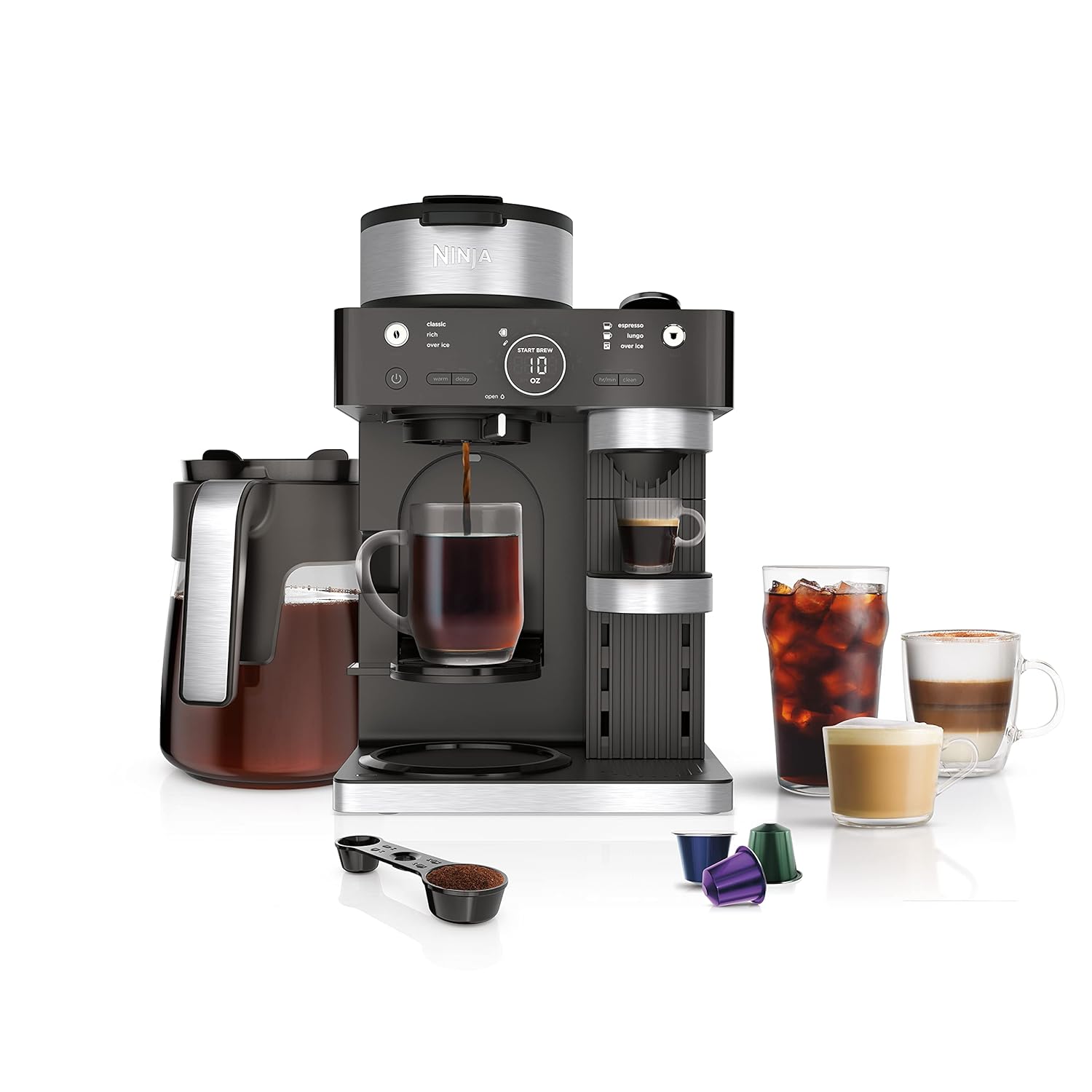
Ninja CFN601 Espresso & Coffee Maker – The Best Overall
Key Specs: 19-bar pressure system | 12-cup glass carafe | Nespresso capsule compatible + loose grounds | Fold-away frother | Delay Brew + Keep Warm | Used capsule storage for up to 20 pods
This machine won me over within the first week. The 19-bar pump delivers espresso with actual crema, not just brown water. I pulled a Lungo at 3.75 ounces and got a thick foam layer that held together for a solid minute. That’s rare for a combo machine.
The biggest win here is versatility. I can brew a full 12-cup carafe for Sunday brunch using my own ground coffee, then switch to a single espresso capsule for my afternoon pick-me-up. The machine handles both sides without feeling like either is an afterthought.
The Barista Plus technology adjusts temperature and pressure per brew, so a drip coffee doesn’t taste scorched and an espresso doesn’t come out thin.
The fold-away frother surprised me. I expected a cheap whisk that barely aerates milk. Instead it produced decent microfoam for lattes. Not barista-level silky, but close enough that my partner stopped asking for café deliveries.
The frother stores inside the machine when not in use, which saves counter space. That matters more than I thought it would.
The delay brew feature let me wake up to fresh coffee three mornings a week. I’d set it the night before, grind my beans into the Ninja Smart Scoop, and wake up to a full carafe. The keep-warm function held the temperature for about two hours before the flavor started to degrade.
That’s standard for a glass carafe on a hot plate.
One detail I loved: the adjustable cup tray. When I brewed into a tall travel mug, I just slid the tray up. When I used a small espresso cup, I lowered it. No splashing, no mess. The used capsule storage bin holds up to 20 pods, which meant I only emptied it once a week.
The catch? The capsule compatibility uses Ninja’s own system and Nespresso-compatible capsules sold separately. You can’t use K-Cups here. And the machine stands 17.4 inches tall, so check your upper cabinet clearance.
But for the balance of drip volume and espresso quality, this is the one I’d buy again.
Cuisinart Coffee Center Barista Bar SS-4N1NAS – Best Value for Pod Households
Key Specs: 4-in-1 system | 12-cup carafe | K-Cup compatible + Nespresso OriginalLine capsules | Built-in milk frother | 24-hour programmability | Charcoal water filter
The Cuisinart takes a different approach. Instead of trying to do everything through one brew system, it gives you four separate functions in one box. Drip coffee from the 12-cup carafe. Single-serve from K-Cups. Espresso from Nespresso OriginalLine capsules.
And a built-in milk frother for lattes and cappuccinos.
I found this machine works best for households where different people want different drinks. My partner uses the K-Cup side for quick morning coffee. I use the Nespresso side for espresso. And when we have guests, the carafe handles the crowd.
Nobody fights over the machine because it accommodates everyone.
The 24-hour programmability is genuinely useful. I set the auto-brew for 6:45 AM three days in a row, and it delivered a full carafe at that exact time each morning. The brew strength control let me choose between regular and bold, which made a noticeable difference with lighter roasts.
The milk frother is automatic and simple. Fill it, press a button, and it produces warm frothed milk in about a minute. It’s not as nuanced as a steam wand, but for everyday cappuccinos it gets the job done. Cleanup involves rinsing the frother container, which takes ten seconds.
The trade-off? The espresso side runs entirely on Nespresso OriginalLine capsules. You cannot use loose grounds for espresso. That means you’re locked into a pod ecosystem with ongoing costs. The drip side handles K-Cups and loose grounds, so you get flexibility there.
But if you want true cafe-style espresso from your own beans, this isn’t the machine.
I also noticed the machine is wider than the Ninja. At 13 inches wide, it takes up more linear counter space. But the height is shorter at 16.8 inches, so it fits under most cabinets.
The charcoal water filter is a nice touch that improves overall taste, and the gold-tone permanent filter means you don’t need paper filters for the drip side.
De’Longhi COM530M All-In-One Combination – Best for the Traditionalist
Key Specs: Manual portafilter espresso | 2.5 lb bean capacity | Drip coffee pot | Built-in tamper | Milk frother | Programmable
This machine looks like a throwback and that’s part of its charm. The De’Longhi COM530M uses a manual portafilter for espresso, which means you grind, tamp, and pull your own shots. No pods, no shortcuts. If you want to learn the craft of espresso, this is the machine that lets you do it.
I had a rocky first few days with this one. My first three shots came out hollow and sour. The product documentation actually warns about this: coarse grind, too little coffee, or insufficient tamping all lead to inadequate pressure.
I had to dial in my grind size and dose weight over a week before I got a shot worth drinking. Once I did, the espresso was genuinely good. Thick crema, balanced flavor, real cafe quality.
The drip side is straightforward. A 10-cup carafe with basic keep-warm functionality. Nothing fancy, but it works reliably. The 2.5-pound bean capacity means you can store a full bag of beans in the hopper without refilling for days. That’s a nice convenience for heavy coffee households.
The milk frother is a steam wand, not an automatic frother. That gives you more control over texture and temperature, but it also means a learning curve. I ruined two lattes before I figured out the right angle and depth for the wand.
Once I did, the microfoam was noticeably better than any automatic frother I tested.
Who is this for? Someone who wants to develop espresso skills without spending a thousand dollars on a prosumer machine. The COM530M demands practice, but it rewards you with quality.
If you’re patient and willing to learn, this machine delivers cafe-grade espresso and decent drip coffee in one footprint.
The downside? The review volume here is lower than the other machines, and the complexity means more can go wrong. The manual portafilter adds steps to your morning routine. On weekdays when I was rushing, I found myself reaching for the Ninja instead.
This is a weekend barista machine that can also handle weekday drip coffee.
Chefman 8-in-1 Coffee Station – The Feature-Packed Budget Option with Caveats
Key Specs: 20-bar pump | 12-cup carafe | K-Cup + Nespresso capsule + loose grounds compatibility | Dual-direction automatic milk frother | 3L water tank | Built-in storage compartment | Over Ice brewing
The Chefman 8-in-1 is the wild card in this group. It has the most features at the most aggressive price point. A 20-bar pump. Compatibility with K-Cups, Nespresso pods, and loose grounds. A 12-cup carafe. A dual-direction milk frother. An over-ice brewing mode. Built-in storage for accessories.
On paper, it looks like the best value of the bunch.
In practice, I ran into consistency issues. The espresso shots varied from decent to watery depending on which pod type I used. The 20-bar pump sounds impressive, but pressure alone doesn’t guarantee quality.
The porta-filter attachments for Nespresso pods felt flimsy compared to the Cuisinart’s dedicated system. The drip coffee side performed fine, but the keep-warm function on the burner held temperature for only about 45 minutes before dropping off.
The dual-direction frother is a clever idea. It lets you make two sizes of latte or cappuccino with one touch. The frother detaches from the unit and stores in the fridge, which is convenient for keeping milk cold. But the milk texture was inconsistent.
Some batches came out creamy, others were thin with large bubbles.
The built-in storage compartment on the top-left is genuinely useful. I kept the single and double shot baskets, the porta-filter, and the scoop/tamper tool in there. It kept my counter organized. The 3L water tank is generous and meant I refilled less often than with any other machine.
The honesty I owe you: This machine has the lowest satisfaction rate of the four. The features are ambitious but the execution falls short in key areas. I’d recommend it only if you need the broadest possible pod compatibility and you’re willing to accept some inconsistency.
For most people, the Ninja or Cuisinart will deliver a better daily experience.
Side-by-Side Spec Comparison
Here’s how the four machines stack up on the specs that matter most. I’ve focused on the numbers that actually affect your daily brew.
- Best Drip Capacity: Ninja and Cuisinart both offer 12-cup carafes. Chefman matches that. De’Longhi offers a smaller 10-cup pot.
- Best Espresso Mechanism: De’Longhi wins for authenticity with its manual porta-filter. Ninja is second with its 19-bar capsule system. Cuisinart uses Nespresso pods. Chefman tries all three methods with mixed results.
- Broadest Pod Compatibility: Chefman accepts K-Cups, Nespresso pods, and loose grounds. Cuisinart accepts K-Cups and Nespresso OriginalLine. Ninja accepts its own capsules and Nespresso-compatible capsules. De’Longhi uses only loose grounds.
- Best Milk Frother: Cuisinart’s automatic frother is the most foolproof. De’Longhi’s steam wand produces the best texture with practice. Ninja’s fold-away frother is the most space-efficient. Chefman’s dual-direction frother is the most versatile but least consistent.
- Most Compact Footprint: Ninja is tall but narrow. De’Longhi is the smallest overall. Cuisinart is wider. Chefman is the bulkiest.
The takeaway from the specs is that no machine leads in every category. The Ninja comes closest to balancing all four areas, which is why it sits at number one. The Cuisinart excels at convenience but limits your espresso flexibility. The De’Longhi rewards skill but demands it.
The Chefman offers the most features but with the most compromises.
The Buyers Guide: How to Choose the Right One For You
Footprint and Form Factor
Measure your counter before you buy. The Ninja stands 17.4 inches tall, which means it won’t fit under some upper cabinets. The Cuisinart is 16.8 inches tall but wider at 13 inches. The De’Longhi is the most compact at 12.79 inches tall and 11.02 inches wide.
The Chefman is mid-sized at 13.98 inches tall. I had to move my Ninja to an open section of counter because it didn’t fit under the cabinet. That’s a small hassle but worth knowing upfront.
The Pods vs. Grounds Economics
Pods are convenient but expensive. A Nespresso-compatible capsule runs around seventy cents per shot. A K-Cup is about the same. Loose ground coffee costs roughly fifteen to thirty cents per cup depending on the bean. Over a year, the pod user spends significantly more.
The Ninja and Cuisinart give you both options, so you can use pods for convenience and grounds for everyday brewing. The De’Longhi forces you to use grounds, which saves money but adds time. The Chefman accepts everything but doesn’t excel at any single method.
Where Espresso Quality Matters
If you need cafe-quality espresso, the De’Longhi is your only real choice among these four. The manual porta-filter lets you control dose, grind, and tamp just like a commercial machine.
If good-enough espresso is acceptable, the Ninja’s capsule system delivers reliable shots with zero learning curve. The Cuisinart’s Nespresso side is also solid for pod-based espresso. The Chefman is a wildcard here, inconsistent enough that I wouldn’t rely on it for daily espresso.
The Verdict – Who Should Buy What?
Best All-Around Performance: Ninja CFN601
This is the machine I’d recommend to almost anyone. It delivers good espresso from capsules, excellent drip coffee from grounds, and a decent frother. The space savings are real, and the brew quality doesn’t feel like a compromise.
If you want one machine that does both jobs well without fuss, this is it.
Best for the Frugal Enthusiast: Cuisinart SS-4N1NAS
If your household already buys K-Cups and you want to add espresso without a second machine, the Cuisinart solves that problem elegantly. The 24-hour programmability and charcoal filter add quality-of-life features that make morning coffee easier.
The pod lock-in is real, but the convenience trade-off is worth it for many homes.
Best for the Barista in Training: De’Longhi COM530M
This machine demands effort but rewards it with genuine espresso quality. If you want to learn the craft and you have the patience for the learning curve, the De’Longhi will take you further than any pod-based system. Just be ready for a week of dialing in before you get consistent results.
The Final Word
Combo machines have come a long way. The Ninja CFN601 proves you can have genuine versatility without sacrificing quality. The Cuisinart proves convenience can still be delicious. The De’Longhi proves that tradition still has a place.
And the Chefman proves that more features don’t always mean a better experience.
I kept the Ninja on my counter. It’s the best espresso and drip coffee maker combo I tested, and it handles my weekday rush and weekend slow-downs equally well. But the right choice for you depends on your routine, your budget, and how much effort you want to put into your morning cup.
Frequently Asked Questions
Can I use my own ground coffee in a combo machine?
Yes, but it depends on the model. The Ninja CFN601 accepts loose grounds in its drip side but requires capsules for espresso. The Cuisinart accepts loose grounds for drip coffee but uses pods for espresso. The De’Longhi COM530M uses loose grounds for both drip and espresso.
The Chefman accepts loose grounds for drip coffee and has porta-filter attachments for ground espresso.
Is the espresso from a combo machine as good as a dedicated espresso machine?
Not quite, but the gap has narrowed significantly. The De’Longhi COM530M with its manual porta-filter comes closest to dedicated machine quality if you invest time in learning the technique. The Ninja CFN601 with its 19-bar pump produces respectable crema from capsules.
Pod-based systems like the Cuisinart’s Nespresso side deliver consistent but not exceptional results.
How much counter space do I need for a combo coffee maker?
Combo machines take up roughly the same footprint as a standard drip coffee maker but are often taller. The Ninja CFN601 measures 11.89 inches deep by 14.84 inches wide by 17.4 inches tall. The Cuisinart SS-4N1NAS is 12 inches deep by 13 inches wide by 16.8 inches tall.
The De’Longhi COM530M is the most compact at 14.52 inches deep by 11.02 inches wide by 12.79 inches tall. Measure your space and check cabinet clearance before purchasing.
Which combo machine is easiest to clean?
The Ninja CFN601 has the easiest cleanup routine. The used capsule storage bin holds up to 20 pods and the drip tray is dishwasher safe. The fold-away frother rinses clean in seconds. The Cuisinart is also relatively easy with removable parts.
The De’Longhi requires more cleaning effort because of the manual porta-filter and steam wand. The Chefman has the most parts to manage and clean.
Are combo machines worth it compared to buying two separate units?
For most households, yes. A good combo machine saves counter space, reduces upfront cost compared to buying two quality machines, and simplifies the morning routine. The sacrifices in espresso quality are now minimal enough that the convenience trade-off makes sense.
If you’re a dedicated espresso enthusiast who needs commercial-grade shots, you might still prefer separate machines. For everyone else, a modern combo machine delivers excellent daily coffee.