Reina
Reina 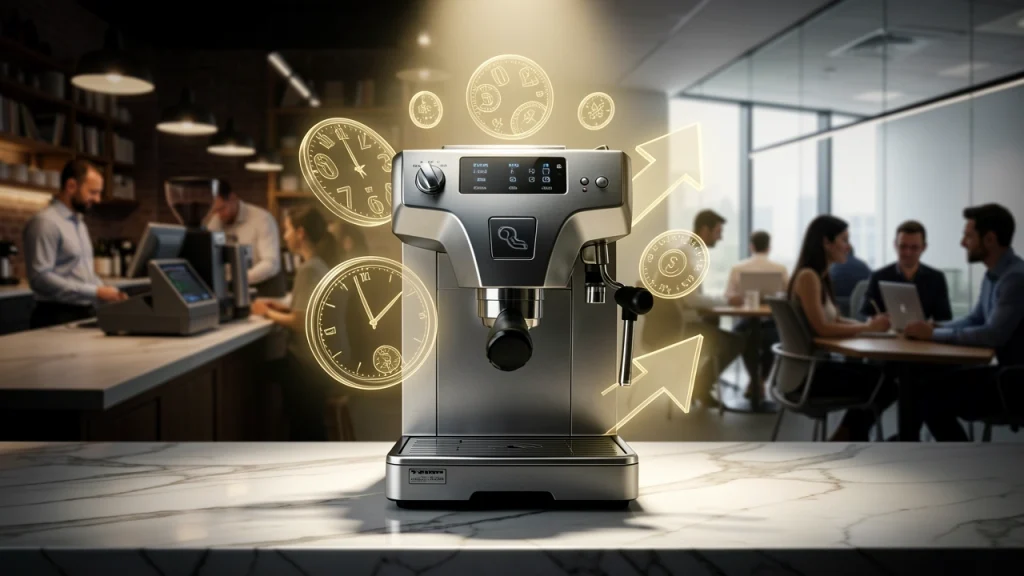
As an Amazon Associate, I may earn a small commission from qualifying purchases at no extra cost to you. This helps me create more valuable, tested content for you.
For most offices, a good quality coffee machine pays for itself in 6 to 18 months — but only if you measure the right things. Office coffee ROI is not a sales equation.
It is a cost-avoidance and time-reclamation equation. That is the first thing your CFO needs to understand.
Over the past few years, I have helped several offices run this exact calculation. The numbers surprise almost everyone.
This article walks you through the hard math, the hidden variables, and the mistakes that can wipe out your returns.
Why office coffee ROI is a cost-avoidance equation, not a sales equation
The fundamental difference between a café profit center and an office cost center
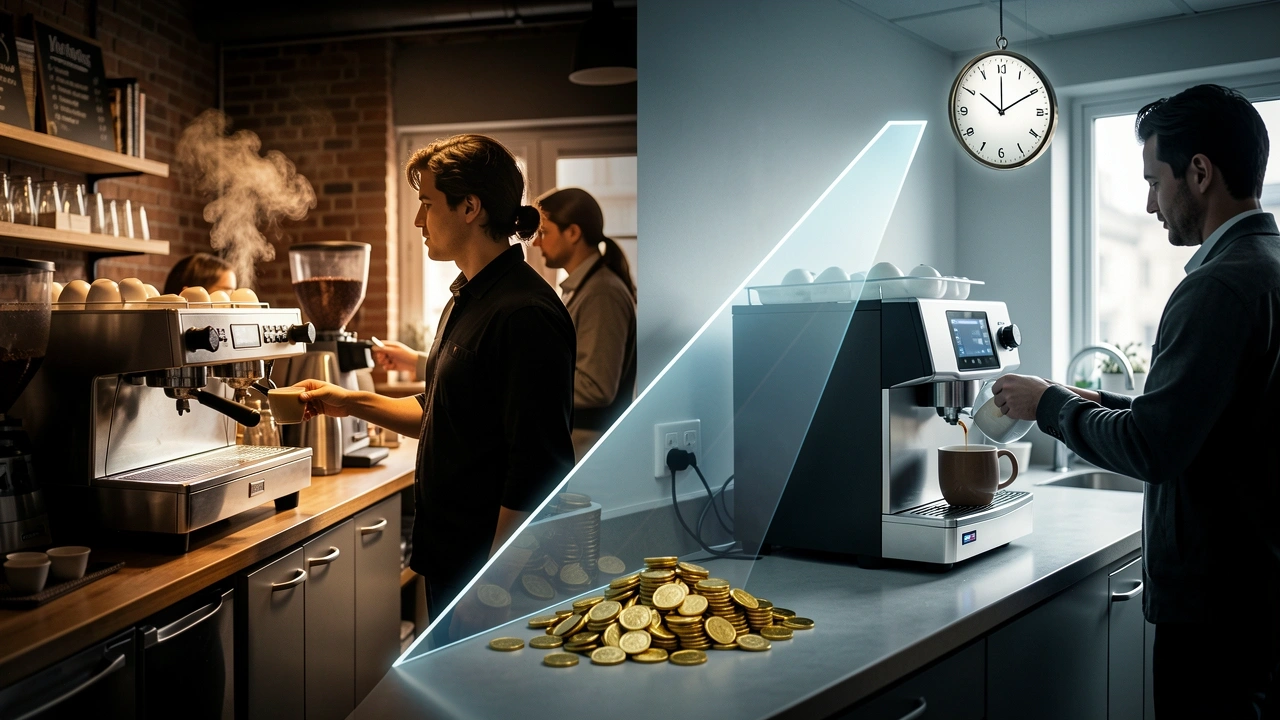
A café sells drinks. Every cup generates revenue. The machine is a profit center. An office does not sell coffee. It provides coffee. The machine is a cost center. That shifts how you measure return.
Instead of asking “how much money does this machine make?”, you ask “how much money does this machine save?”.
The savings come from two places: avoided external coffee purchases and reclaimed employee time.
I have run the numbers for a 30-person marketing agency, a 60-person legal firm, and a 200-person tech startup. In every case, the time side of the equation was bigger than the coffee side.
The two ROI buckets — hard numbers and soft signals
We can split office coffee ROI into two categories.
- Hard ROI — dollars you can count: cheaper cost per cup at the office vs. a café, and the value of time saved when people stay in the building.
- Soft ROI — things that matter but resist easy measurement: higher job satisfaction, better retention, a stronger reason to come back to the office.
The rest of this article builds a framework for both. You will get a calculation you can copy and paste into a spreadsheet, and a persuasive argument for the people who sign the purchase order.
Building the true cost-per-cup calculation for an office machine
The components most calculators forget
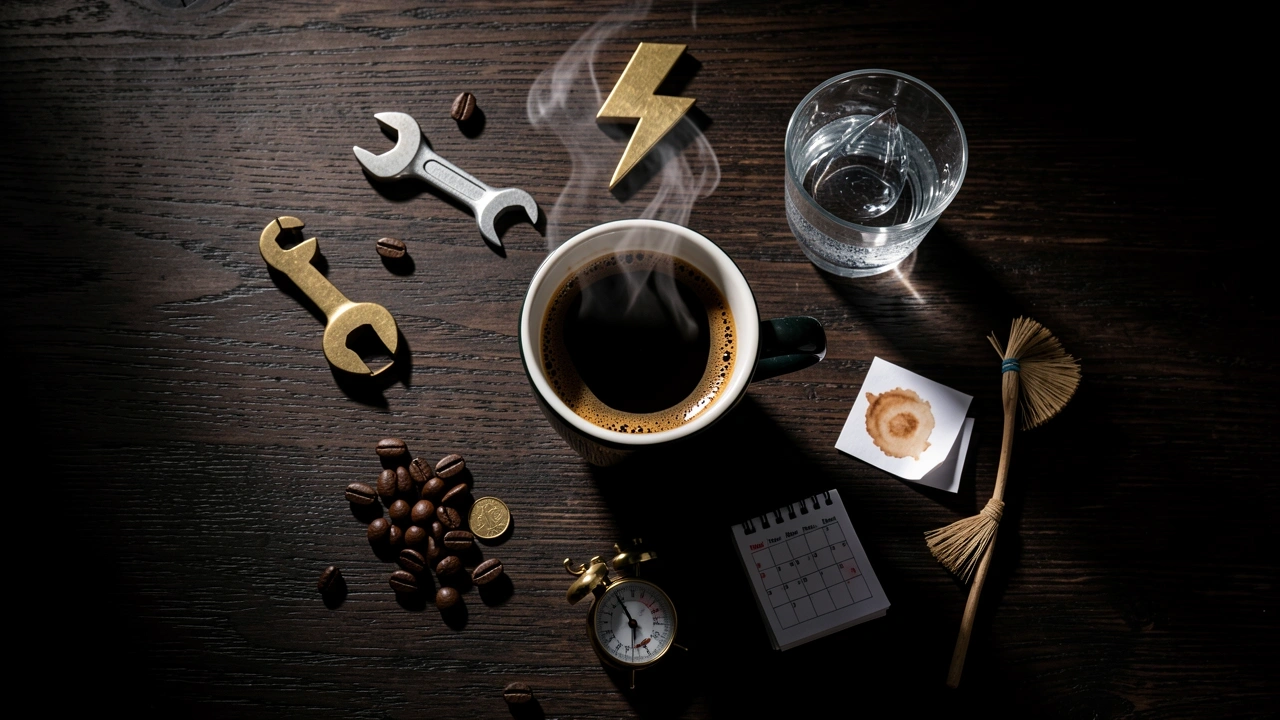
When offices estimate their coffee cost, they usually think of beans or pods plus milk. That is a mistake. The real cost per cup includes these items:
- Machine depreciation (divide the purchase price over its expected life, typically 5 to 7 years for a mid-range bean-to-cup machine).
- Cost of coffee (grams per cup × price per kilogram).
- Milk and alternatives.
- Sweeteners and stirrers.
- Cups and lids if you use disposable ones.
- Electricity (the machine runs all day).
- Water filtration and descaling chemicals.
- Annual servicing and repairs.
- Wastage — people pour drinks they do not finish, or grind settings waste coffee.
I will use a real example from a 30-person office that bought a $4,500 bean-to-cup machine. Over 5 years, that is $900 per year in depreciation.
They make about 40 drinks per day. That works out to roughly $0.09 per cup for the machine alone.
Add $0.25 for coffee (8g per shot, good beans at $30/kg), $0.15 for milk, $0.05 for sweetener and cup, $0.03 for electricity and water, and $0.03 for annual servicing. The total: $0.60 per cup.
Comparing against the $5–$7 café visit
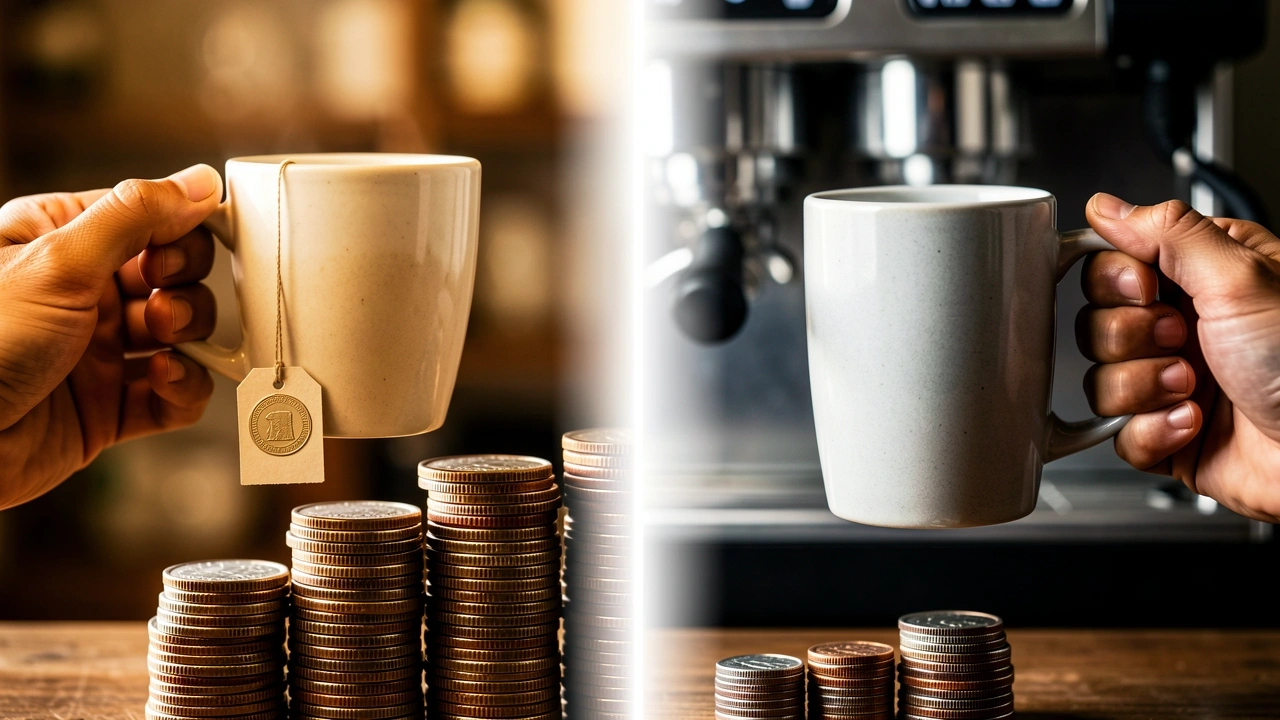
Assume an employee buys a café coffee three times a week. Each trip costs $5.50 on average. That is $16.50 per week, or $858 per year per person.
At $0.60 per cup for the office machine, the same 156 drinks per year cost $93.60. The annual saving per employee: $764.40.
For a team of 30 people, that alone adds up to $22,932 per year — more than enough to pay for the machine plus consumables.
| Item | Cost per cup (office) | Cost per café visit |
|---|---|---|
| Machine depreciation | $0.09 | — |
| Coffee, milk, extras | $0.45 | $5.00 |
| Power, water, servicing | $0.06 | — |
| Total per drink | $0.60 | $5.50 |
| Annual per person (156 drinks) | $93.60 | $858 |
These are the hard dollars. But there is a bigger number hiding just below the surface.
The time tax your CFO isn’t tracking
Quantifying the 10-minute coffee run
Every time someone leaves the office to grab a coffee, they are not working. A typical round trip — walk to the café, wait in line, order, walk back — takes at least 10 minutes. Often more.
What is that time worth?
Take an employee with a total loaded cost (salary + benefits + overhead) of $50 per hour — a common number for a mid-level role.
Ten minutes is $8.33 of lost productivity per trip. Three trips per week? That is $25 per week, or $1,300 per year per employee.
Notice something: the time tax per employee ($1,300) is actually larger than the coffee savings we calculated earlier ($764.40).
Combined, bringing coffee in-house saves roughly $2,064 per person per year.
A 20-person team example
Twenty employees, each saving $2,064 in coffee cost plus time. That is $41,280 per year.
Against a $4,500 machine plus $9,000 in annual consumables (based on $0.60/cup × 40 cups/day × 250 working days), the net saving is $27,780 in the first year.
The machine pays for itself in under two months.
If you only look at coffee cost savings, the payback is about six months. Include the time tax, and it drops to two months. That is the insight every competitor article misses.
Which office coffee setup delivers the fastest payback
Bean-to-cup machines — the high-entry, low-per-cup option
Bean-to-cup machines cost $2,500 to $6,000 upfront. But per-cup costs are low — around $0.30 to $0.50 including beans and maintenance.
For offices with more than 15 employees who drink coffee regularly, the break-even usually happens within 4 to 9 months.
Pod and capsule systems — the medium-entry, higher-per-cup option
Pod machines cost $200 to $800 upfront. But each pod runs $0.60 to $1.20. Over a year, the total cost per drink is significantly higher than bean-to-cup.
For a 20-person office, that difference can be $2,000 to $4,000 annually. Payback still happens, but it takes 8 to 16 months because the ongoing margin is thinner.
The “free machine” trap hidden in service contracts
Many vendors offer to install a machine at no cost. Sounds appealing. But the catch lands in the per-cup price — often $1.50 to $2.50 per drink, plus a monthly minimum volume.
Over five years, a leased contract for 40 drinks per day can cost $40,000 to $60,000.
Buying the same machine and buying beans separately might cost $15,000 to $20,000 total. The “free” machine is often the most expensive option.
I once advised a 50-person accounting firm that had a managed service contract. They were paying $1.85 per cup.
After switching to a $5,000 bean-to-cup machine, their annual coffee spend dropped from $23,000 to $7,500.
The machine paid for itself in three months.
Payback timeline comparison
| Setup | Upfront cost | Per-cup cost | Payback (20 employees) | Payback (50 employees) |
|---|---|---|---|---|
| Bean-to-cup | $4,000 | $0.40 | 5–8 months | 2–4 months |
| Pod system | $500 | $0.90 | 8–14 months | 5–9 months |
| Managed service (leased) | $0 | $1.85 | Never pays back | Never pays back |
How to run the ROI calculation for your own office
The five inputs you need
- Headcount — number of employees who drink coffee at least occasionally.
- Daily consumption rate — average drinks per person per day (for many offices 0.8 to 1.2 is typical).
- Café visit cost — average price per purchased coffee plus any tip or add-on.
- Loaded hourly rate — annual salary + benefits + overhead divided by 2,080 hours.
- Machine TCO — purchase price plus annual consumables and maintenance, all divided by drinks per year.
A worked example from a 30-person office
Let me fill in the numbers for a real 30-person office I worked with last year. They had 25 coffee drinkers, averaging 1.2 drinks per day. Their nearby café charged $5.50 per drink.
Average loaded hourly rate was $45. They bought a $4,500 bean-to-cup machine and spent $2,500 per year on beans, milk, and maintenance.
First, the coffee cost savings:
- Annual café spend: 25 drinkers × 1.2 drinks × 250 working days × $5.50 = $41,250
- Annual office coffee cost: 25 × 1.2 × 250 × $0.60 = $4,500
- Savings: $36,750
Then the time tax savings:
- Assume each café trip takes 12 minutes (round trip). 25 drinkers × 1.2 trips × 250 days = 7,500 trips per year. At 12 minutes each, that is 90,000 minutes, or 1,500 hours.
- Value of time: 1,500 hours × $45 per hour = $67,500
Total annual return: $36,750 + $67,500 = $104,250. Minus the machine cost ($4,500) and consumables ($2,500) gives $97,250 net savings in year one.
ROI = $97,250 / $4,500 = over 2,000%. That is not a typo. The machine pays for itself in under a month when time is counted.
Soft returns that refuse to show up on a spreadsheet
The retention math that justifies almost any coffee budget

Replacing a single employee costs 50% to 200% of their annual salary, depending on role and seniority.
If your annual coffee budget is $15,000 and even one key employee stays an extra year because of the office coffee experience, the retention savings alone cover the program for years.
I have seen it happen. A senior developer at a client once told me the office coffee machine was one of three reasons she turned down a competing offer.
That one person cost the firm $6,000 per year to keep caffeinated. Her replacement cost would have been $60,000 in recruiting, onboarding, and lost productivity.
Coffee as a return-to-office draw
In the hybrid work era, employees need reasons to commute. A quality office coffee machine sends a signal: we invest in the small things that make daily life better.
It is not a luxury line item.
It is part of the package that says “this is a good place to work.” You cannot put a dollar sign on that, but you can argue that every perk that increases office attendance justifies itself through better collaboration and fewer empty desks.
Frequently Asked Questions
Does free office coffee affect employee wage expectations?
Rarely. Employees see free coffee as a standard perk, not a substitute for salary. In surveys, coffee ranks below health insurance, flexible hours, and paid leave.
It is a hygiene factor — expected, not a differentiator for pay negotiations.
How often does an office espresso machine need servicing?
Most bean-to-cup machines need a professional service every 6 to 12 months. Daily cleaning (backflushing, drip tray) and weekly descaling are required.
Frequent breakdowns usually indicate heavy use beyond the machine’s rating — consider a higher-duty model if you exceed 40 drinks per day.
Which is cheaper for 50 employees: pods or bean-to-cup?
Bean-to-cup wins decisively at that volume. For 50 people making 60 drinks per day, pods cost roughly $0.90 per drink or $13,500 per year.
Bean-to-cup at $0.40 per drink totals $6,000 per year.
Even factoring a $5,000 machine, the bean-to-cup option saves $2,500 in year one and $7,500 per year after.
Should a large office hire a coffee service instead of buying a machine?
For offices with 100+ employees, a managed service can make sense if you negotiate hard on per-cup price and avoid volume commitments.
But for most offices under 50 people, buying outright and managing refills internally is cheaper. The break-even occurs around 60–80 daily drinks — below that, own your machine.
Can office coffee ROI be measured if the department is a cost center?
Yes. Treat it as a budget line item with a clear justification. Map the savings to avoided café spend and recovered time.
Even a cost center can show return by comparing “with machine” costs to “without machine” alternative. Use the time tax as your strongest argument — it turns an expense into an investment.
The bottom line on office coffee ROI
A well-chosen office coffee machine returns its investment in 6 to 18 months when you count cost avoidance, time saved, and soft signals like retention.
The wrong service contract can erase those gains.
Run the math with your own numbers — include the time tax — and you will likely find the machine pays for itself faster than almost any other office amenity. Do not guess. Measure.