Reina
Reina 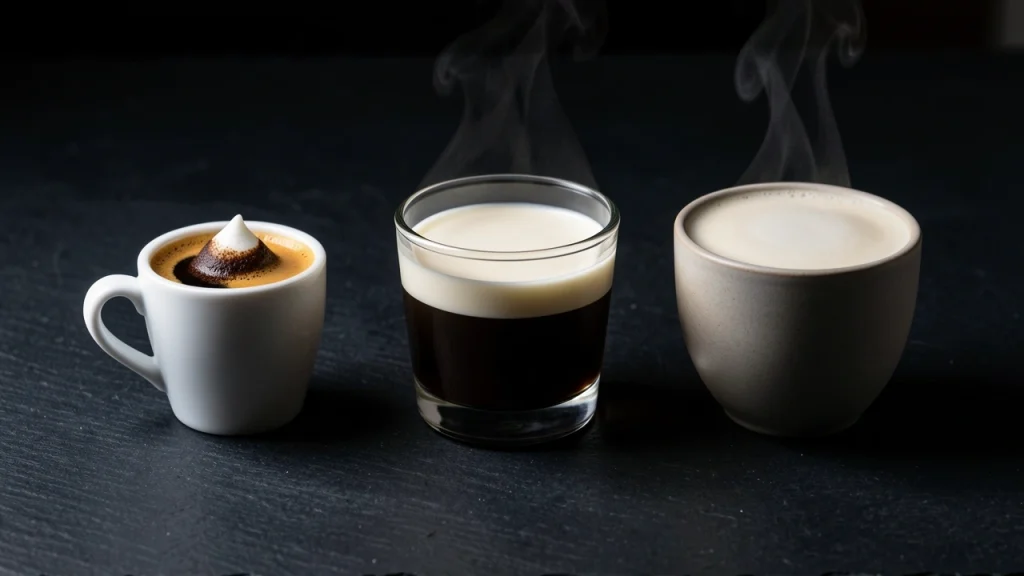
As an Amazon Associate, I may earn a small commission from qualifying purchases at no extra cost to you. This helps me create more valuable, tested content for you.
I’ve lost count of how many times I watched someone stare at a menu, caught between these three drinks. They all look like small cups of brownish milk.
The barista says something about foam, but the words blur. Every guide lists definitions separately. That doesn’t help when you’re trying to decide what to taste.
So here’s the exact breakdown, from someone who has made and drunk all of them more times than I can count.
Forget the Italian or Spanish translations—the real difference lives in the ratio of milk to espresso and, more importantly, in how that milk is prepared.
The Shortest Path to Your Answer

Imagine a line. On the left end, milk is a garnish. On the right, milk is the bulk of the drink. The macchiato sits far left, the flat white sits far right, and the cortado lands in the middle.
The macchiato is a shot of espresso stained with a spoonful of stiff foam. The cortado is espresso cut with an equal volume of warm, smooth milk that has no foam.
The flat white is a double ristretto diluted with a high volume of velvety microfoam that blends completely into the coffee.
If you want the strongest coffee taste with a tiny hint of creaminess, order a macchiato.
If you want a balanced cup where the milk softens the espresso’s acidity without watering down the body, order a cortado.
If you want a smooth, sweet, milky drink that still lets the coffee shine, order a flat white.
The Ratio Rulebook
Volume is the first variable, but it’s not just the numbers—it’s what the ratio does to your tongue.
The cortado uses a 1:1 ratio of espresso to steamed milk. That means a 4.5-ounce glass holds roughly two ounces of espresso and two ounces of milk.
The milk cools the espresso slightly and cuts the sharp acidity. You still feel the full body of the coffee, but the bitterness is tamed.
I noticed that when I pour a cortado, the milk sinks and mixes almost instantly, leaving no thick foam cap. The texture is dense and slightly heavy.
Every sip tastes like a stronger version of what you’d expect from a straight espresso with a bit of dairy—not a latte.
The flat white flips that ratio. It’s usually one part espresso to two or even three parts milk.
A standard flat white is 5 to 6 ounces total, with a double shot (or ristretto) at the base and about 4 ounces of milk.
The milk doesn’t just sit on top; it blends into the coffee, creating a homogeneous, creamy liquid. Because there is more milk, the espresso flavor is stretched.
The flat white tastes less intense than a cortado, but the richness of the microfoam gives it a silky mouthfeel that a cortado lacks.
The macchiato has no fixed ratio in the traditional sense. A single espresso shot is about 1.5 ounces. The milk added is maybe a tablespoon or two, mostly foam.
That’s a ratio of roughly 4:1 espresso to milk. The milk is a condiment, not an ingredient.
The foam floats on top, so the first sip is pure espresso, and as you drink, you occasionally get a dollop of sweet foam.
The Milk Paradox
Most people think the difference is just how much milk you pour. It’s not. The texture of the milk is the hidden key. This is the gap I see in almost every other article.
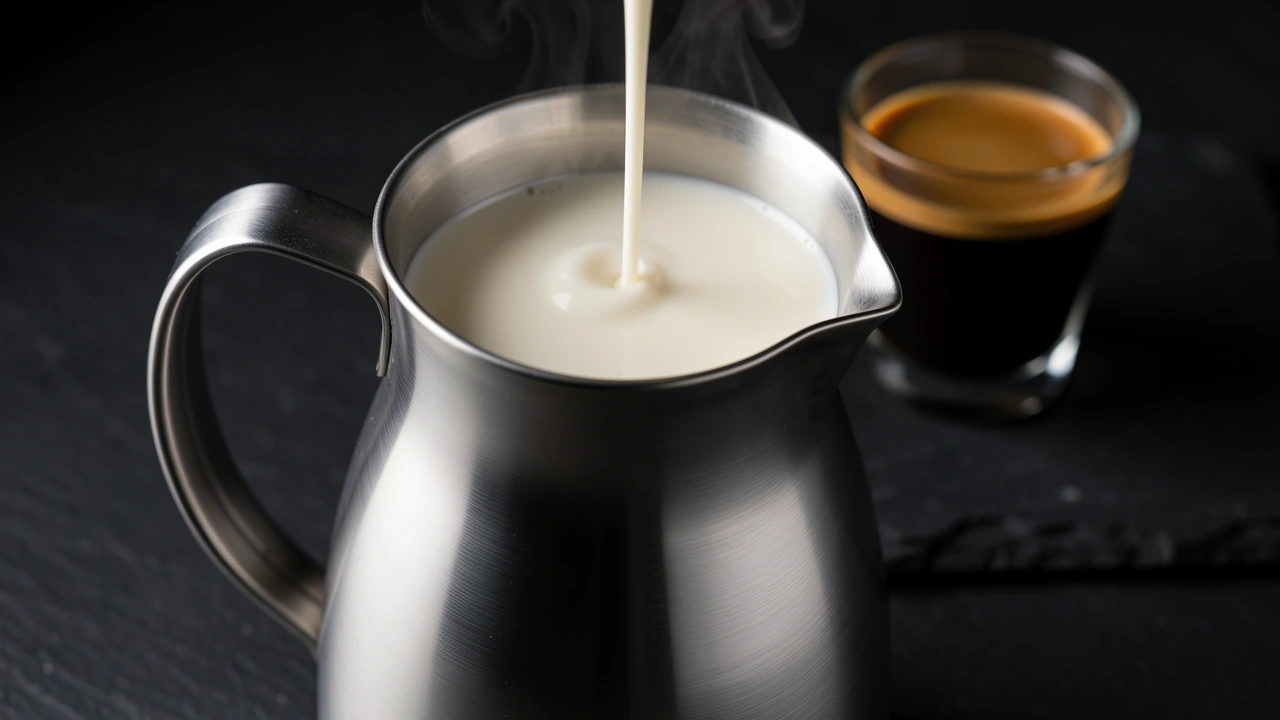
Cortado milk: flat and silky
When I steam milk for a cortado, I keep the wand just below the surface for only a second or two to stretch the milk, then I submerge it fully to heat the milk without introducing big bubbles.
The goal is a smooth, shiny liquid with no visible foam. The milk should pour like warm cream.
It separates from the espresso if you let it sit—the coffee stays at the bottom, the milk forms a thin lighter layer on top. But because there is no foam to hold it apart, a quick swirl blends them.
The drink feels heavy and velvety but not airy.
Flat white milk: microfoam that integrates
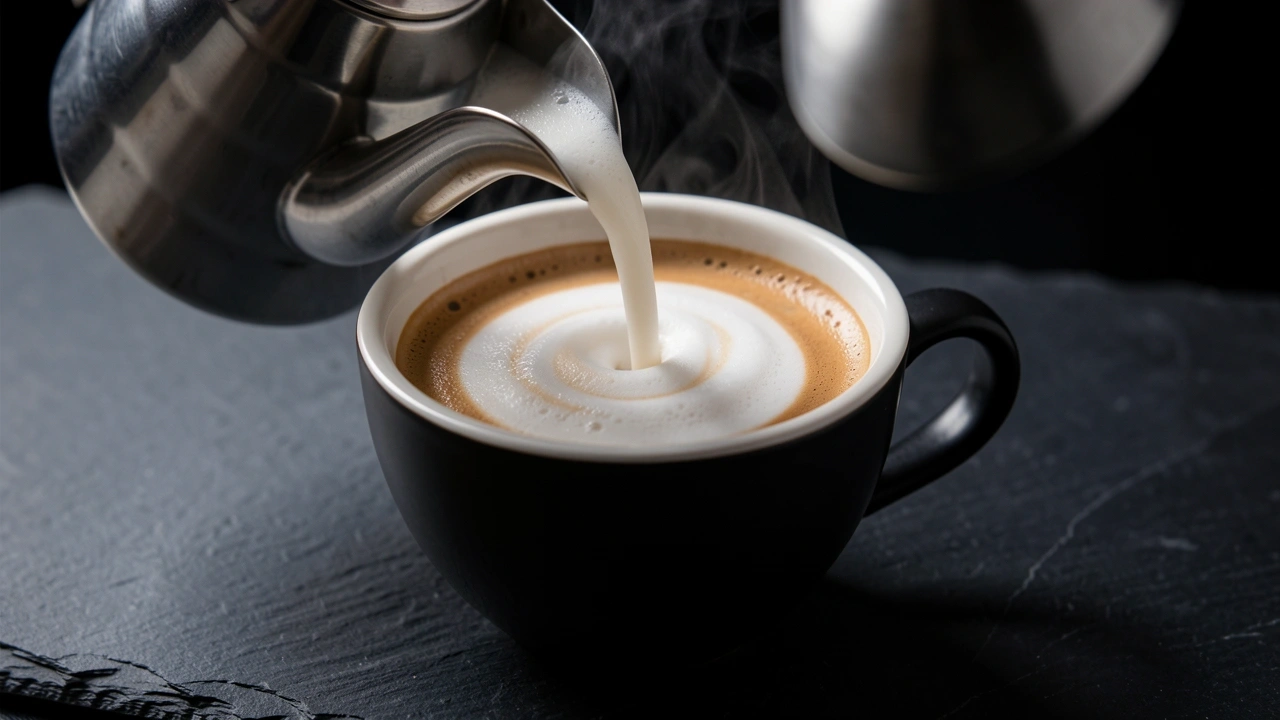
Flat white milk is steamed differently. You stretch the milk a bit longer, about three to five seconds, to create microfoam—thousands of tiny bubbles so fine you cannot see them individually.
The milk becomes thick enough to coat the back of a spoon. When you pour it into the ristretto, it does not float. It mixes into the coffee, turning the whole drink a uniform light brown.
The foam is still there, but it is suspended throughout the liquid, not resting on top.
That is why a flat white feels creamy and consistent from first sip to last, whereas a cortado has a slight change in texture as the milk and coffee settle.
Macchiato milk: a dollop, not a pour
Traditional macchiato technique uses a spoon to scoop a small amount of thick foam from the top of the steaming pitcher. The foam is stiff enough to sit proudly on top of the espresso.
It is not poured in. That means the milk barely mixes with the coffee. You taste the espresso first, then a burst of sweet foam.
The drink does not become milky—it becomes espresso with a creamy afterthought.
The Espresso Trap
Here is something most people get wrong. Not all espresso is the same. The flat white traditionally uses a ristretto shot, not a standard espresso.
A ristretto uses the same amount of coffee grounds but half the water. It is a shorter, more concentrated shot that extracts less bitterness and more sweetness and acidity.
This is why a flat white can taste sweeter than a cortado, even though it has more milk. The coffee itself is already less bitter.
A cortado and a macchiato, on the other hand, are almost always made with a standard espresso shot. That shot has more water, which pulls out more bitter compounds.
The milk in a cortado balances that bitterness; the foam in a macchiato only touches it briefly. If you ever thought a flat white was oddly sweet compared to a cortado, this is why.
It is not just the milk—it is the espresso base.
The ‘Starbucks Trap’ – Why Your Macchiato Isn’t a Macchiato
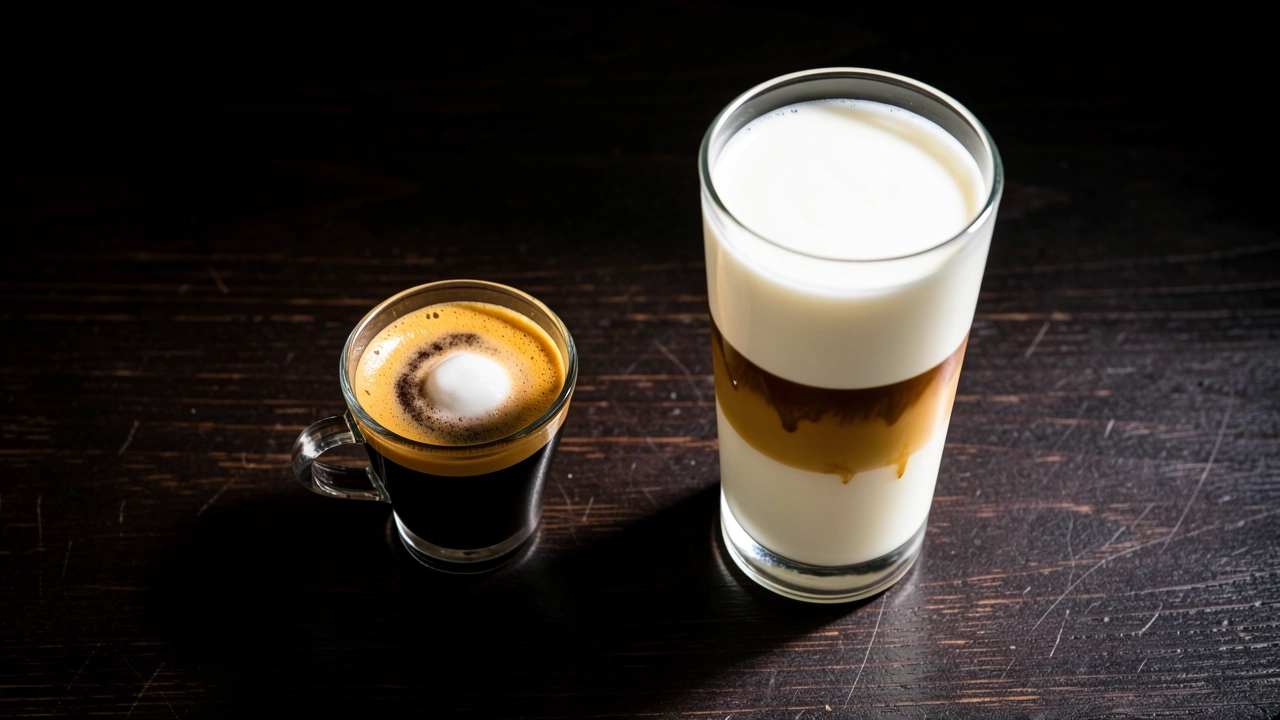
If you have ever ordered a macchiato at a chain coffee shop and received a tall layered drink with vanilla syrup, you have been deceived—but pleasantly.
That drink is a latte macchiato, which is essentially a latte with the espresso poured on top of the milk.
It has nothing to do with the traditional espresso macchiato I have described.
I used to work at a shop where people came in furious that their macchiato was “too small.” They expected a 12-ounce cup. I had to explain that a traditional macchiato is a tiny drink—about 2 ounces.
The confusion is widespread. So when you browse a menu and see “macchiato,” ask the barista: “Is this an espresso macchiato or a latte macchiato?” The latte version is a completely different beverage.
It is closer to a flat white or even a latte in terms of milk volume. For this article, I have been referring only to the original espresso macchiato.
If you want the tiny, strong version, say “espresso macchiato.” Chains almost always serve the latte version unless you specify otherwise.
Similarly, some cafes serve a flat white that is just a small latte with no foam, and some serve a cortado that is a flat white with less milk. That inconsistency is maddening.
The definitions I gave here are the traditional, widely accepted standards among specialty coffee circles. Use them as your baseline, and adjust for the shop.
Frequently Asked Questions
Can I make these without an espresso machine?
You can approximate them, but it is not the same. Use a moka pot for strong concentrated coffee, then steam or heat milk. For a cortado, heat milk without frothing.
For a flat white, froth the milk lightly to create fine bubbles. For a macchiato, spoon a little frothed milk on top.
The taste will be close but the texture will differ because moka pot coffee is not under the same pressure as espresso.
Which one has more caffeine?
All three contain about the same amount of caffeine if they use a double shot of espresso. A macchiato often uses a single shot, but many shops use a double.
The flat white uses a double ristretto (same caffeine as a double shot but less volume). So caffeine-wise, they are a tie. The difference is all in the milk volume and texture.
Why does my cortado look different every time?
Baristas vary in how they steam the milk and how much headroom they leave. Some shops serve a cortado with a tiny amount of foam on top, which defeats the purpose.
Others serve it with a 1:2 ratio of milk to espresso. The true cortado should have equal parts and zero visible foam on top. If it looks like a mini latte, the barista missed the point.
Is a cortado just a small latte?
No. A latte uses a 1:3 or 1:4 ratio of espresso to milk, and the milk has a thick layer of microfoam on top, about half an inch. A cortado uses a 1:1 ratio with no foam.
The mouthfeel is completely different. A latte is airy and milky; a cortado is dense and coffee-forward.