Reina
Reina As an Amazon Associate, I may earn a small commission from qualifying purchases at no extra cost to you. This helps me create more valuable, tested content for you.
If you’re standing in a kitchen aisle or staring at a recipe that calls for a “medium saucepan,” you’ve probably asked yourself: how many quarts is a saucepan actually? The short answer: most saucepans range from 1 quart to 5 quarts. The most common sizes you’ll see in stores are 2 quarts, 3 quarts, and 4 quarts. But the exact number depends on what you’re cooking and how much you need to make.
Here’s a quick-reference table I keep on my fridge. It shows standard saucepan sizes, their typical diameter, and what they handle best.
| Saucepan Size | Typical Diameter | Best For |
|---|---|---|
| 1 quart | 6 inches | Melting butter, heating a single cup of soup, tiny sauces |
| 1.5 quart | 6.5 inches | One serving of rice, reheating leftovers |
| 2 quart | 7 inches | Sauces for two, steaming vegetables, small batches |
| 3 quart | 7.5 inches | Family-sized sauces, rice for four people |
| 4 quart | 8 inches | Small soups, pasta for two, batch cooking |
| 5 quart | 8.5 inches | Larger soups, stews, works as a mini stockpot |
What Each Quart Size Means for Your Cooking
Knowing the numbers is one thing. Understanding how they play out in your kitchen matters more. I’ve owned saucepans in every size from 1 to 5 quarts over the years, and here’s what I’ve learned.
1 Quart and 1.5 Quart Saucepans
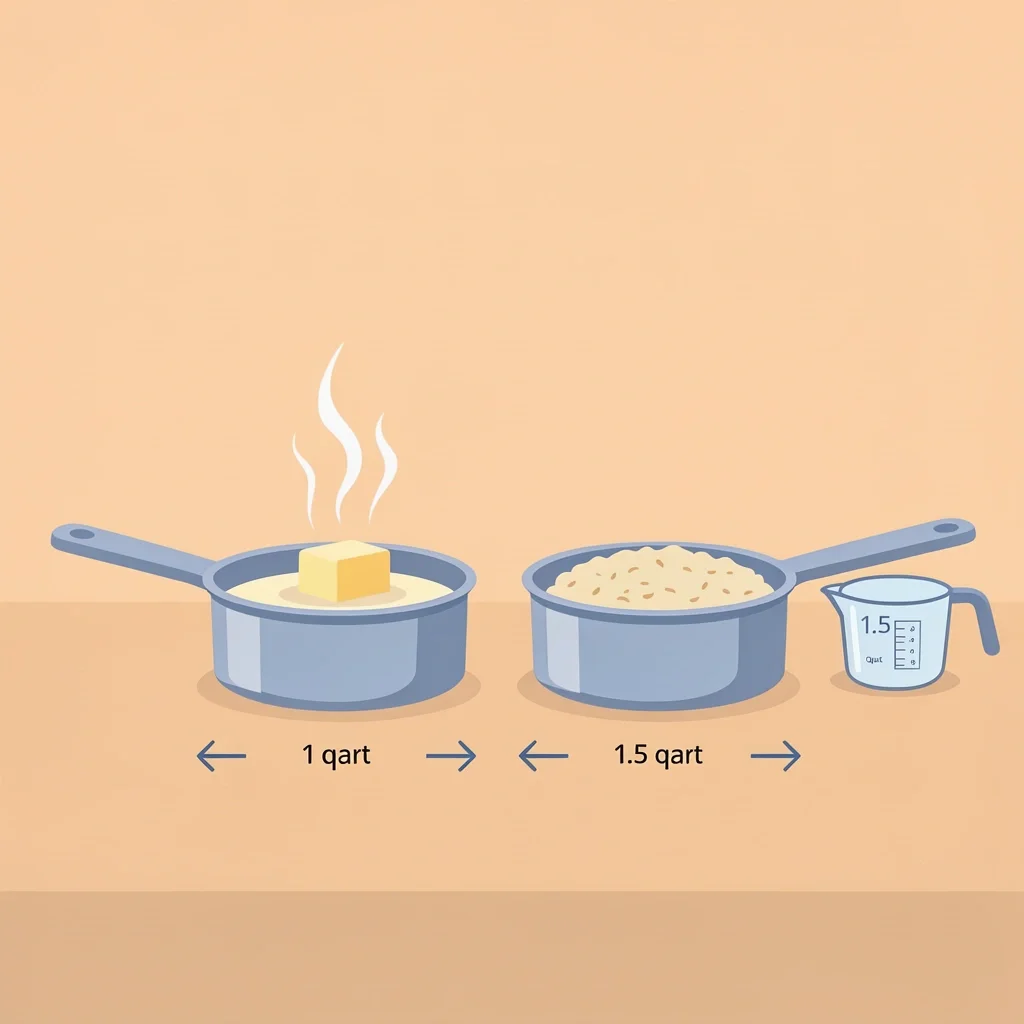
These are your small-task specialists. A 1‑quart saucepan is perfect for melting a stick of butter without scorching it, or warming a single bowl of soup. It heats up fast, which makes it great for reductions — you boil off liquid quickly. But it’s easy to overflow. Fill it more than three-quarters full and anything bubbly will climb over the rim. I use my 1.5‑quart for cooking a single serving of oatmeal or reheating one cup of leftover chili. If you cook for just yourself most of the time, a 1.5‑quart is more useful than a 1‑quart because it gives you room to stir.
2 Quart Saucepans
This is the most versatile small size. A 2‑quart saucepan handles sauces for two, a small batch of rice (about one cup dry), or steaming broccoli. I reach for mine when I’m making a quick cheese sauce for macaroni or heating up canned soup for two. It’s also good for boiling a couple of eggs. The downside: you can’t cook a full package of pasta in it. And if you’re making a reduction, you’ll need to watch it closely because the pan is wide enough that liquid evaporates quickly.
3 Quart Saucepans
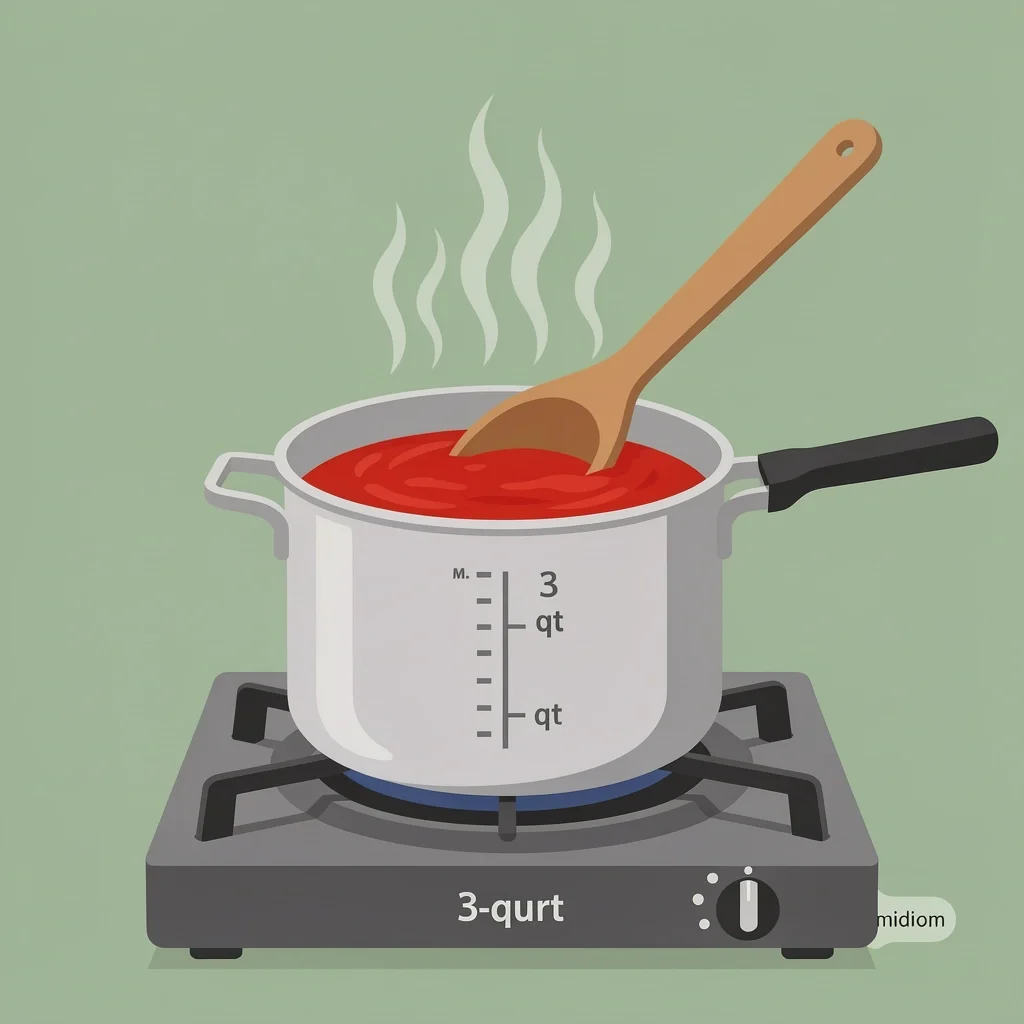
If I could own only one saucepan, it would be a 3‑quart. It’s the sweet spot. It’s large enough to cook rice for three or four people, simmer a decent amount of tomato sauce, or make a small batch of soup. Yet it’s not so big that it takes forever to heat. I use mine for everything from risotto to chili. Many recipes that call for a “medium saucepan” assume a 3‑quart pan. It’s also wide enough to brown meat in batches without overcrowding.
4 Quart Saucepans
A 4‑quart saucepan is basically a small pot. It’s what you grab when you want to cook pasta for two, make a large batch of soup, or boil vegetables for a crowd. I use mine for Sunday meal prep — cooking a big batch of quinoa or lentil soup that lasts all week. The extra volume also means less risk of boil‑over. The trade‑off: it takes longer to heat up, and if you’re only making a cup of sauce, the liquid will evaporate more slowly because of the larger surface area.
5 Quart Saucepans
A 5‑quart saucepan is often called a “saucepot” in stores. It’s tall and narrow, closer to a stockpot in shape. I use mine for soups that start with sautéed vegetables, or for cooking a whole pound of pasta. It can even double as a deep fryer for small batches. But it’s heavy and takes up significant cabinet space. Most home cooks don’t need a 5‑quart unless they regularly cook for five or more people.
How to Measure the Quart Size of Your Saucepan
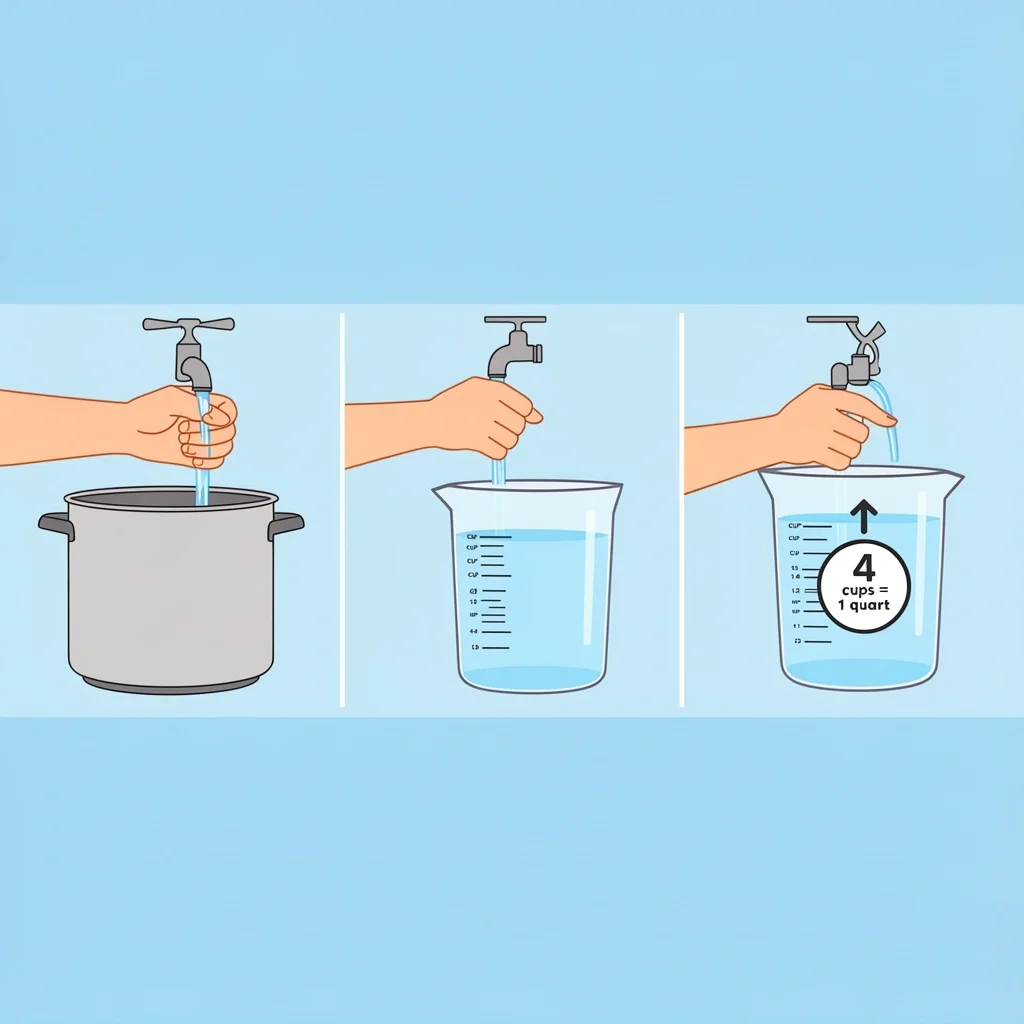
Many saucepans don’t have the quart size printed on the bottom. I’ve pulled out an unlabeled pan more times than I can count. Here’s how to figure it out in under a minute.
- Fill the saucepan to the very brim with water. Don’t pile it higher — stop when the water is level with the rim.
- Pour that water into a large measuring cup, or use a pitcher with liter markings. If you don’t have a large measuring cup, use a 4‑cup (1‑quart) measuring cup and pour it in batches.
- Count the total cups. One quart equals 4 cups. So if you get 8 cups of water, your pan is 2 quarts. If you get 12 cups, it’s 3 quarts. If you’re using liters, 1 quart is about 0.95 liters — close enough to treat them as equal for this purpose.
One important note: this gives you the brim capacity. In real cooking, you never fill a saucepan past two-thirds to three-quarters full, because boiling liquid will overflow. So if your pan holds 3 quarts to the brim, its working capacity is about 2 to 2.5 quarts. Keep that in mind when a recipe says “use a 3‑quart saucepan.” They mean the total size, not the amount you pour in.
Does Quart Size Affect How Food Cooks?
Yes, and it’s not just about how much food fits. The size of the pan changes how heat behaves.
Small saucepans (1 to 2 quarts) heat up fast but cool down quickly if you add cold ingredients. They also evaporate liquid fast because the small volume means a high ratio of surface area to liquid. That’s great for reductions — you can thicken a sauce in minutes. But it’s bad for anything that needs gentle simmering, because you’re at higher risk of scorching.
Medium saucepans (2.5 to 3.5 quarts) offer balance. They heat up reasonably fast, hold heat well, and evaporation is moderate. That’s why the 3‑quart is the workhorse of most kitchens.
Large saucepans (4 quarts and above) are slow to heat, but they hold temperature steady once hot. Evaporation is lower because the volume is large relative to the surface area. So if you’re making a soup that needs to simmer for an hour, a 4‑quart pan is better than a 2‑quart — you won’t have to keep adding liquid.
I learned this the hard way. I once tried to make a slow-simmered marinara in a 1.5‑quart pan. It reduced to a thick paste in twenty minutes. Now I know: big jobs need big pans.
Saucepan or Saucepot? Understanding the Shape-Volume Relationship
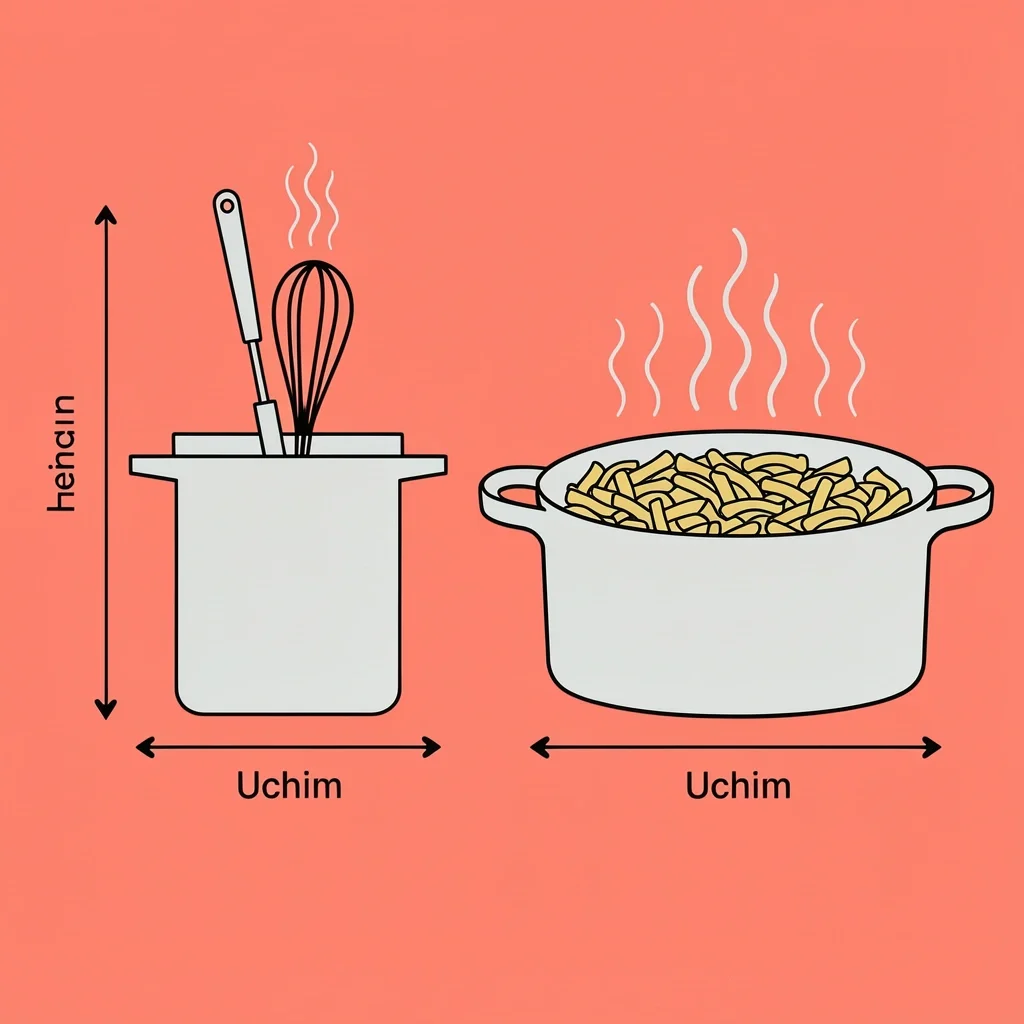
People often mix up saucepans with saucepots. A true saucepan has tall sides and a relatively small diameter — the height is usually greater than the width. A saucepot is wider and shorter. Both can hold the same volume, but they cook differently.
A 4‑quart saucepan is tall and narrow. That shape traps steam, which keeps food moist and reduces evaporation. It’s great for cooking rice, grains, or anything that needs a gentle simmer. The narrow opening also makes it easier to make a roux or whisk a sauce without spattering.
A 4‑quart saucepot is shorter and wider. More surface area means more evaporation, which is useful for boiling pasta or reducing stocks. But it’s harder to whisk in a wide, short pot without flinging sauce everywhere.
When you’re shopping, look at the ratio of height to diameter. If it’s taller than it is wide, it’s a saucepan. If it’s about the same or shorter, it’s a saucepot. The quart size alone doesn’t tell you which shape you’re getting.
Myth – You Don’t Need Every Size
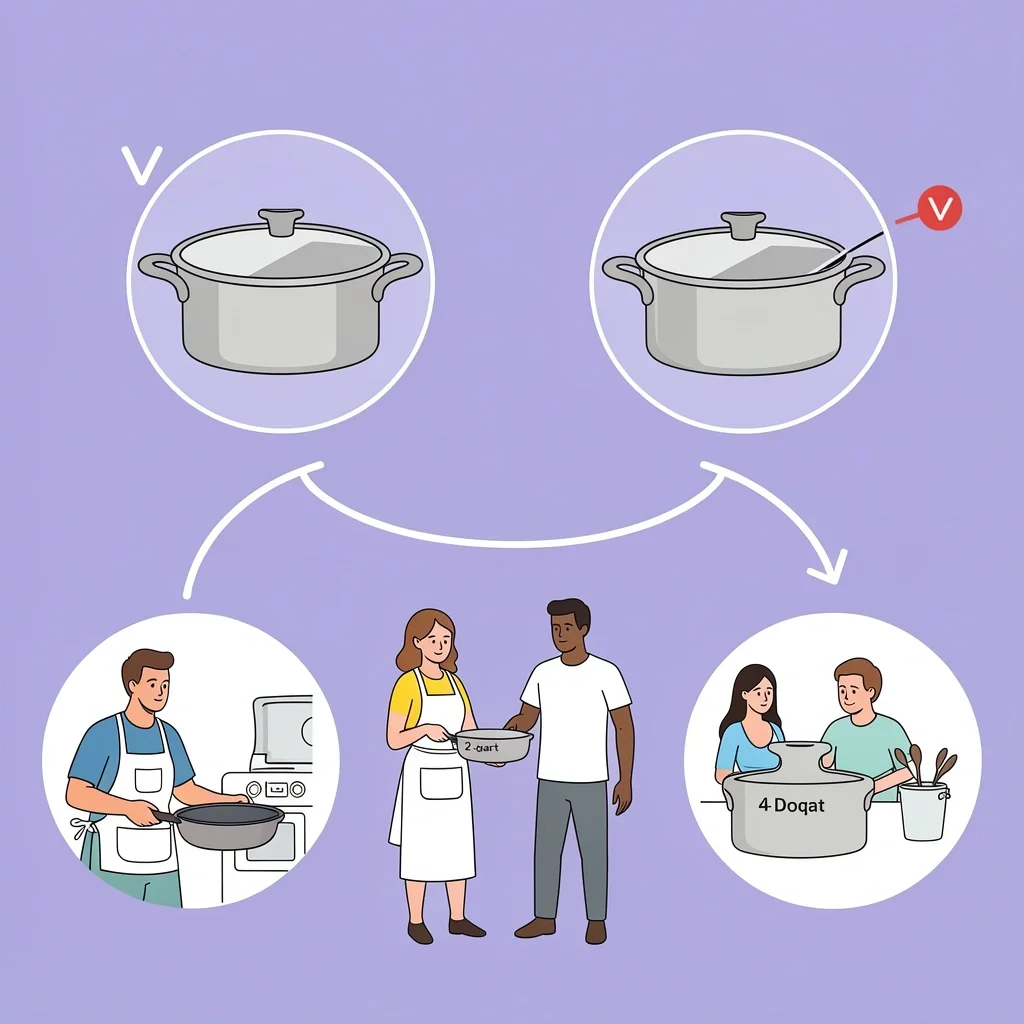
I’ve seen articles that say you need a different saucepan for every task. That’s nonsense. You can get by with two sizes.
If you’re a solo cook with a small kitchen, buy a 2‑quart and a 3‑quart. The 2‑quart handles small jobs: eggs, butter, a single portion of rice. The 3‑quart handles everything else: sauces, soup for two, pasta for one. I lived on those two sizes for years.
If you cook for a family or meal prep, get a 3‑quart and a 4‑quart. The 3‑quart becomes your small pan, and the 4‑quart does the heavy lifting. A 1‑quart is optional — useful but not essential.
Here’s a simple decision flow:
- Solo cook, small kitchen: 2‑quart + optional 1‑quart for eggs and butter.
- Couple, occasional guests: 3‑quart (workhorse) + a 2‑quart for small tasks.
- Family, meal prepper: 4‑quart (primary) + 2‑quart (small jobs).
Don’t feel pressured to buy a full set. One or two well-chosen saucepans will cover ninety percent of your cooking.
The Quart-Liter Conversion Trap
If you follow international recipes, you’ll often see capacities in liters. A recipe might call for a “2‑liter saucepan.” That’s roughly 2.1 quarts. Close enough for most cooking, but there’s a catch.
Many European pans are sold with liter markings only. A 2‑liter pan is slightly smaller than a 2‑quart pan. When you use an American recipe that calls for a 2‑quart saucepan, the 2‑liter pan will have about half a cup less space. That extra half cup could be the difference between a comfortable simmer and a boil‑over.
Here’s a quick conversion to save you trouble:
- 1 quart ≈ 0.95 liters (so 1 quart is a hair less than 1 liter)
- 2 quarts ≈ 1.9 liters
- 3 quarts ≈ 2.8 liters
- 4 quarts ≈ 3.8 liters
- 5 quarts ≈ 4.7 liters
When in doubt, round up. If a recipe says 3‑quart and you have a 3‑liter pan, that’s fine (3 liters ≈ 3.17 quarts). But if you have a 2‑liter pan, it’s too small — go up a size.
Frequently Asked Questions
How many quarts is a small saucepan?
Typically 1 to 1.5 quarts. Some brands label 2‑quart as “small,” but culinary standards consider anything up to 1.5 quarts as truly small. A 1‑quart is best for butter warming or single servings.
How many quarts is a medium saucepan?
Usually 2.5 to 3.5 quarts. The most common medium size is 3 quarts. That’s the one you’ll find in most recipe instructions when they say “medium saucepan.”
How many quarts is a large saucepan?
4 quarts and above. A 5‑quart is often labeled as a saucepot or hybrid piece. If you see a “large saucepan” in a store, check the label — it could be 4 or 5 quarts.
Is a 3‑quart saucepan the same as a 3‑quart pot?
No. A “pot” usually refers to a stockpot or Dutch oven, which has lower sides and a wider diameter. A 3‑quart stockpot is much shorter and wider than a 3‑quart saucepan. Use the saucepan for sauces, the pot for stews.
What happens if I use a saucepan that’s too small for the recipe?
Liquids will boil over, ingredients won’t fit, and you’ll get uneven cooking. Always leave at least 1 to 2 inches of headroom from the top of the food to the rim. If your 2‑quart is filled to the brim with pasta, you’re asking for a burned stove.
Can I cook pasta in a 2‑quart saucepan?
Only for single servings of short pasta like macaroni. Long shapes like spaghetti need enough water to fully submerge the noodles — that requires at least a 4‑quart pan. I’ve tried spaghetti in a 3‑quart and ended up with half the noodles sticking out the top.
Why are non‑stick saucepans often smaller (1–2 quarts)?
Non‑stick coatings degrade under high heat. Smaller pans are used for low‑heat tasks like eggs and delicate sauces, where non‑stick shines. Larger non‑stick saucepans exist but are rare, and I wouldn’t recommend one for searing or high‑heat cooking because the coating won’t last.
If you’re still wondering how many quarts is a saucepan after reading this, you’re overthinking it. Grab a 3‑quart for your everyday cooking, and a 2‑quart for small jobs. That’s all most home kitchens need.