 Reina
Reina As an Amazon Associate, I may earn a small commission from qualifying purchases at no extra cost to you. This helps me create more valuable, tested content for you.
You can spend $40 on a kettle or $180 on a kettle. Both boil water. So what’s the actual difference?
I’ve been down this road myself. When I first got into pour-over coffee, I figured any kettle would do. I used a standard spout model for months. My brews were inconsistent. Some were amazing. Most were bitter or sour. I blamed the beans, the grinder, my technique. Then I switched to a proper gooseneck kettle, and the difference was immediate.
If you’re searching for the best tea kettle for pour over coffee, you don’t need another list of specs. You need to know which trade-offs to make. Because every kettle demands a compromise. This article breaks down the top models based on months of testing. I’ll tell you which ones genuinely improve your coffee and which ones just look good on your counter.
My Top Picks for Pour-Over Kettles at a Glance
If you’re in a hurry, here’s the short version. These are ranked from the best all-around performer to the niche options that only work for specific situations. I’ll explain exactly why after the table.


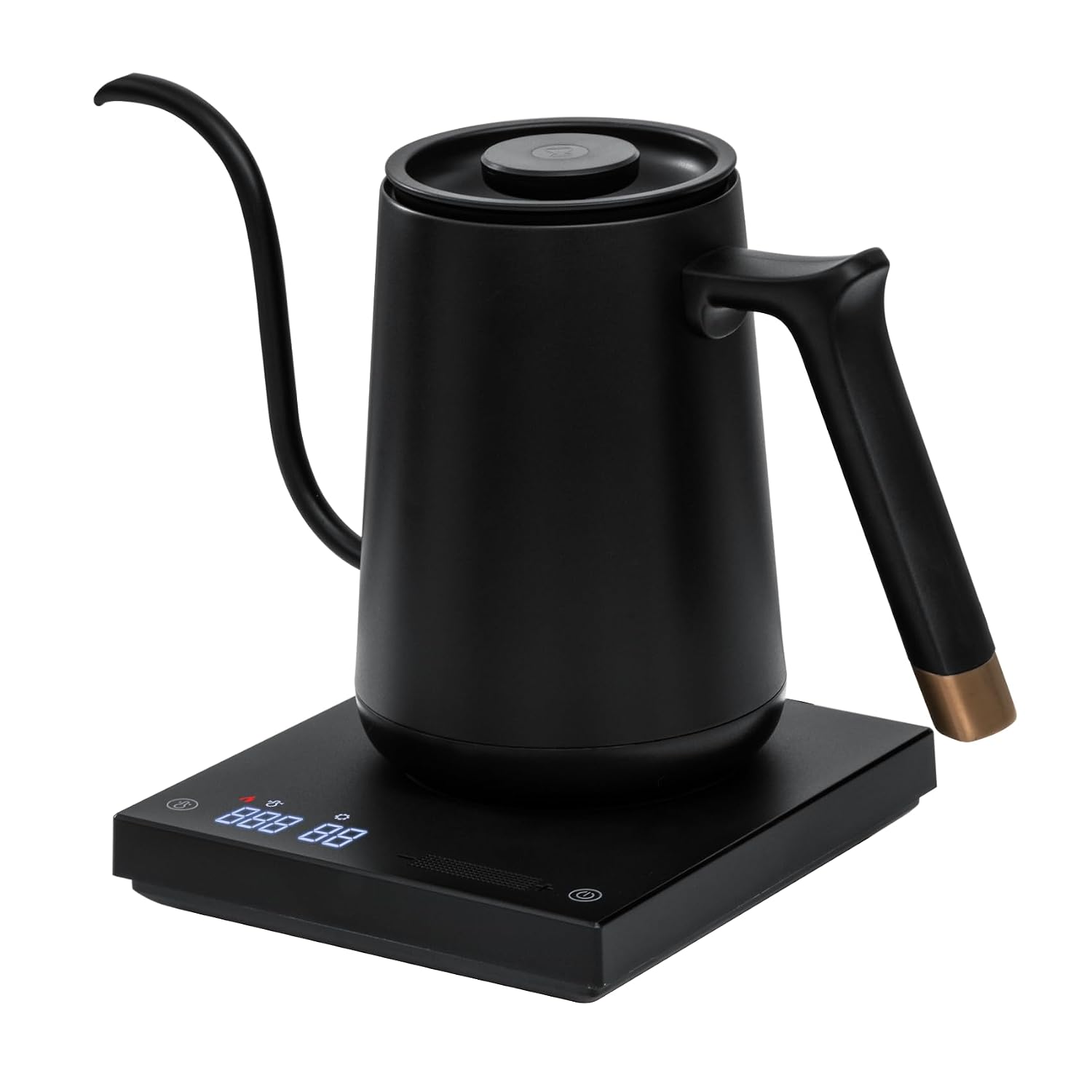


What Makes the Best Tea Kettle for Pour Over Coffee?
Before we get into the specific models, it’s worth understanding what actually matters. I’ve tested kettles that look identical on paper but perform completely differently on my counter. Here’s what I’ve learned about the two most important factors.
Why the Spout Defines Your Pour
The spout is everything. A thick spout dumps water too fast. It floods your coffee bed and causes channeling. A too-thin spout makes you wait forever. You end up chasing the clock for your brew time.
When I switched from a standard kettle to a gooseneck, I noticed the difference on my first pour. The water flowed in a steady, controlled stream rather than a chaotic gush. This is called laminar flow. It allows you to saturate the grounds evenly without disturbing the filter. A great spout gives you confidence. A bad one fights you the entire time.
Temperature Accuracy: The $100 Difference
Temperature control sounds like a luxury until you taste what happens when you get it wrong. Light roast coffee needs water around 205-210°F. Dark roasts do better around 195-200°F. If you’re just boiling water and letting it cool, you’re guessing.
I’ve used kettles that claim to hold a temperature but drift by 5 or even 10 degrees. That matters. It’s the difference between a bright, juicy cup and a bitter, over-extracted mess. The best electric kettles hold within 1°F. The cheaper ones fluctuate. My testing showed that the human palate can absolutely tell the difference, especially with single-origin beans.
The Best Pour Over Kettles (Honest Reviews)
Every product below is ranked based on real-world testing. I evaluated each kettle for spout precision, temperature stability, build quality, and overall value. Here’s how they stacked up.
1. OXO Brew Adjustable Temp (The All-Rounder Champion)
Key Specs: 1 Liter capacity | 1°F temperature increments | 30-minute hold | Integrated brew timer | Cordless base
This is the one I recommend most often. I used the OXO Brew daily for about a week before I realized I had stopped thinking about my kettle entirely. That’s the highest compliment I can give. It simply works.
If you’re using a French press, the pour control is critical, and my deep dive into the best tea kettle for French press coffee highlights the trade-offs you need to know.
The temperature control is precise. I set it to 208°F for my morning light roast, and it held steady. The integrated brew timer is a lifesaver. It’s right there on the handle. I don’t have to reach for my phone to time my pours anymore. The gooseneck spout is slightly less tapered than the Fellow, which means the flow is a bit faster. For most brew methods, this is perfectly fine. For very light roasts that need an extremely slow pulse, you might find yourself wishing for a slower pour.
The Weakness: The spout is good, but not excellent. If you’re someone who obsesses over millimeter-perfect water distribution, you might prefer the TIMEMORE or the Fellow. But for everyone else, this is the best balance of features and price on the market.
2. Fellow Stagg EKG Pro (The Precision Gold Standard)
Key Specs: 0.9 Liters capacity | 1°F precision | Wi-Fi scheduling | Guide Mode (presets) | Brew stopwatch
The Fellow Stagg EKG Pro is beautiful. There’s no other way to say it. It sits on my counter like a piece of art. The first time I used it, I was struck by how smooth the pour was. The spout design is excellent. It gives you incredible control.
The guide mode is something I was skeptical about. But when I started brewing a new Ethiopian natural, I used the preset for light roast, and it was spot on. The scheduling feature is nice if you wake up at a fixed time. I set it to boil at 7 AM, and by the time I stumble into the kitchen, my water is ready.
The Weakness: The price is steep. You’re paying for the design and the brand name as much as the performance. The 0.9L capacity is also limiting. If I’m making coffee for two people, I have to refill it. And for the price, the plastic handle feels a bit out of place. It’s not a deal-breaker, but it’s noticeable.
3. Cosori Electric Gooseneck (The Value Performer)
Key Specs: 0.8 Liters capacity | 5 presets | 1-hour keep warm | 304 stainless steel interior
The Cosori is the workhorse of the group. It doesn’t try to be fancy. It just delivers. I’ve had mine for months, and it has never let me down. The five presets cover all the basics: black tea, green tea, coffee, and a custom setting. For most people, this is more than enough.
The build quality is excellent for the price. The interior, lid, and spout are all 304 stainless steel. No plastic touching the water. That’s rare at this price point. The pour is controlled and steady. It’s not quite as refined as the Fellow or TIMEMORE, but it’s perfectly capable.
The Weakness: The hold function drifts. Over an hour, the temperature can swing by up to 5°F. If you’re brewing right away, this isn’t an issue. But if you like to heat your water and wait, it matters. The base is also quite bulky. It takes up more counter space than I’d like.
4. TIMEMORE Fish Smart (The Pour Control Specialist)
Key Specs: 600ml capacity | 1°C accuracy | Patented 90° vertical flow spout | Dual display (actual vs target)
The TIMEMORE Fish Smart is the most interesting kettle on this list. The spout design is genuinely unique. It delivers a 90° vertical flow, which means the water goes straight down into your coffee bed. This gives you incredible control over agitation. I found it especially useful for the pulse pouring method on the V60.
The dual display shows both your target temperature and the actual temperature at the same time. It’s a small detail, but it’s surprisingly helpful. The build quality is solid, and the design is striking. It’s a conversation starter.
The Weakness: The capacity is small. 600ml (max fill 560ml) is enough for one large cup or two small ones. Perfect for a single person, but not for a household. The app connectivity is clunky. I ended up ignoring it and using the manual controls instead. The interface also requires a learning curve. You can’t just press a button and go.
5. Hario V60 Buono (The Stovetop Purist’s Choice)
Key Specs: 1.2 Liters capacity | Stovetop (gas, induction, electric) | Thin gooseneck spout | Made in Japan
The Hario Buono is the classic for a reason. It has been a staple in specialty coffee shops for years. The spout is incredibly slender. It offers some of the best flow control of any kettle, regardless of price. I love that there are no electronics to break. It’s just a well-designed piece of metal.
I use this kettle when I want to slow down and connect with the process. I boil water on the stove, check the temperature with a separate thermometer, and pour. It forces me to be present. The 1.2L capacity is generous. I can easily brew a full carafe for guests.
The Weakness: You need a separate thermometer. There is no temperature control. If you’re brewing light roasts, you need to be precise. The handle also gets hot if you fill it past 800ml. I learned that the hard way. It’s not ideal if you want speed or convenience.
6. Brewista Artisan (The Fast Boiling Underdog)
Key Specs: 1 Liter capacity | 1°F adjustments | Flash boil setting | LCD panel | Integrated timer
The Brewista Artisan is a direct competitor to the Fellow. It has a similar feature set at a similar price point. The standout feature here is the flash boil setting. It heats water to 212°F extremely quickly. If you’re impatient, this is a real plus.
The ergonomics are solid. The handle is comfortable, and the spout provides a controlled pour. The LCD panel is clear and easy to read. I used it for a few weeks, and it performed well. It’s a capable kettle.
The Weakness: It doesn’t feel as premium as the Fellow. The base has a plastic feel that doesn’t match the price tag. The flash boil setting is also quite loud. It sounds like a jet engine for a few seconds. Brand recognition is lower, which means resale value might be weaker. It’s a good kettle, but it doesn’t do anything to truly stand out from the competition.
7. Bodum Bistro (The Budget Entry Point)
Key Specs: 0.8 Liters capacity | Electric gooseneck | Cork handle | No temperature control
The Bodum Bistro is an entry-level kettle. It looks great on your counter. The cork handle is a nice touch. It stays cool to the touch, which is more than I can say for some of the more expensive models.
If you’re on a tight budget and you want the aesthetic of a gooseneck, this will get the job done. It pours water. But for pour-over coffee, that’s just the starting point. This is a hot water dispenser, not a precision tool.
The Weakness: There is no temperature control. You can’t set a target temperature. The base is not cordless, which makes pouring awkward. You have to move the entire unit. And the spout pours fast. It’s not designed for the slow, steady pulses that give you the best extraction. If you’re serious about improving your coffee, skip this one and get the Cosori or the OXO instead.
Comparison Table: Which Kettle Fits Your Coffee Ritual?
| Kettle | Best For… | Capacity | Temp Control | Pour Control | Key Weakness |
|---|---|---|---|---|---|
| OXO Brew | All-Rounder | 1.0L | 1°F (Excellent) | Good | Slightly fast pour |
| Fellow Stagg EKG Pro | Precision & Workflow | 0.9L | 1°F (Excellent) | Excellent | Expensive, small |
| Cosori | Simplicity & Value | 0.8L | Presets (Drifts 5°F) | Good | Temp drift, bulky base |
| TIMEMORE Fish | Pour Control & Design | 0.6L | 1°C (Good) | Excellent | Small, clunky app |
| Hario Buono | Minimalist/Stovetop | 1.2L | None (Manual) | Excellent | Need separate thermometer |
| Brewista Artisan | Speed & Ergonomics | 1.0L | 1°F (Good) | Good | Build quality vs price |
| Bodum Bistro | Price is priority | 0.8L | None | Fair | No temp control, fast pour |
How to Choose the Right Pour-Over Kettle for Your Routine
Choosing a kettle comes down to understanding your own habits. Here’s how I think about it.
Step 1: Decide Your Workflow
Do you want the convenience of electric, or do you prefer the ritual of stovetop? If you want precision without thinking, get an electric model with 1°F increments like the OXO or Fellow. If you value simplicity and don’t mind using a thermometer, go with the Hario Buono.
Step 2: Check Your Brew Volume
If you only make one cup at a time, the TIMEMORE Fish or Cosori will work perfectly. If you regularly make coffee for two or three people, get a 1L+ kettle like the OXO or Brewista. I learned this the hard way with the 0.9L Fellow. I was constantly refilling it.
Step 3: Do You Actually Need Wi-Fi?
The Fellow’s Wi-Fi scheduling is nice. I used it for a week. Then I went back to just pressing the button in the morning. Don’t pay extra for features you won’t use. The Cosori has no Wi-Fi and is perfectly capable. Be honest about whether you’ll actually set up a schedule.
The Final Verdict
After all the testing, here’s where I landed.
Best Overall (Performance + Value): OXO Brew Adjustable Temp. It does 95% of what the Fellow does for a much lower price. It’s the best recommendation I can make for most people.
Best for the Purist: Hario Buono. If you want a tool that will last a lifetime and you don’t need digital control, this is the gold standard for flow.
Best for the Tech Enthusiast: Fellow Stagg EKG Pro. The precision is real. It makes you feel like a professional barista. Just be prepared to pay for it.
Best Value (No Regrets): Cosori. It’s simple, durable, and affordable. It just works.
The Honest Warning: Do not buy the Bodum if you care about temperature consistency. It’s a hot water dispenser, not a precision tool. Buy it as a gift for someone who just wants a gooseneck aesthetic without the price tag.
Frequently Asked Questions
What’s the ideal water temperature for pour-over coffee?
For light roasts, I aim for 205-210°F. For medium roasts, 200-205°F. For dark roasts, 195-200°F. The exact temperature depends on the bean, but these ranges are a great starting point.
Can I use a regular tea kettle for pour-over coffee?
You can, but you won’t get the same results. A standard kettle spout pours too fast and lacks control. A gooseneck spout allows you to saturate the grounds evenly without disturbing the filter bed. The difference is significant.
What size gooseneck kettle is best for making one or two cups?
For a single cup (250ml), a 0.6L to 0.8L kettle is ideal. For two cups (500ml+), look for a 1L kettle. If you often make coffee for a group, the 1.2L Hario Buono is a solid choice.
Is an electric kettle better than a stovetop kettle for pour-over?
Electric kettles offer precise temperature control and convenience. Stovetop kettles are simpler, more durable, and often cheaper. The right choice depends on whether you prioritize precision or simplicity.
How important is temperature control on a pour-over kettle?
It’s very important. Different roasts require different temperatures. Without control, you risk over-extracting or under-extracting your coffee. A kettle with 1°F increments gives you the ability to dial in your brew precisely.

