Reina
Reina As an Amazon Associate, I may earn a small commission from qualifying purchases at no extra cost to you. This helps me create more valuable, tested content for you.
Find the best juicer for greens with expert testing. Compare cold-press, masticating models built for leafy vegetables, wheatgrass, and nutrient preservation.
If you’re serious about green juice, you already know that not every juicer handles leafy vegetables the same way. The difference between a machine built for greens and one that’s just decent at everything comes down to RPM, motor power, and extraction method—three things that completely change what ends up in your glass.
We tested six popular juicers across multiple green juicing scenarios: raw kale, spinach, wheatgrass, and mixed green recipes. We looked at juice yield, oxidation over 72 hours, cleanup effort, and how well each machine actually handled the density of leafy greens without bogging down or clogging. The goal wasn’t to find the most expensive or the fanciest—it was to find the machine that actually makes green juicing worth doing.
## Quick Rankings: Best Juicer for Greens
## Why Greens Are Different—And Why Your Juicer Choice Matters
Juicing greens isn’t the same as juicing apples. Leafy vegetables have packed fiber, inconsistent density, and they oxidize like crazy once they’re exposed to heat and air—even for a few seconds.
A standard centrifugal juicer spins fast and heats up. Cold-press masticating juicers squeeze slowly without friction, which preserves enzymes and nutrients. When you’re specifically after green juice, you’re after the nutrients, not speed.
What Makes Greens Hard to Juice
Kale, spinach, and wheatgrass are dense and fibrous. They don’t release juice the way soft fruits do.
If your juicer’s auger doesn’t have enough torque or the RPM is too high, you’ll either get clogging, foam, or a weak yield. You want a machine that crushes greens methodically, not violently.
Why RPM Matters More for Greens Than Fruit
RPM is how many times the extraction mechanism spins per minute. For green juicing, slower is almost always better.
Anything over 100 RPM starts generating heat, which damages chlorophyll and enzymes—exactly what you’re trying to preserve. The sweet spot for greens is 50-80 RPM, which is why masticating juicers dominate this category.
Cold Press vs. Heat: What Actually Gets Into Your Glass
Cold-press juicing minimizes oxidation, which means your juice tastes fresher and stays fresh longer. Juice from a cold-press machine can last 72 hours in the fridge without separation or browning.
Heat-based extraction (like centrifugal juicers) oxidizes juice immediately, turning it brown and breaking down the very nutrients you’re trying to drink. For greens specifically, the difference is obvious in flavor and color within 24 hours.
## Omega NC800HDS: The Clear Winner for Greens

Check Price on Amazon
Motor: 150W equivalent to 2HP | RPM: 80 | Extraction: Dual-stage masticating | Pressure Settings: 5 adjustable levels | Feed Opening: Extra-large | Rating: 4.6/5 (1,756 reviews)
The Omega NC800HDS is the only machine in this lineup designed specifically around the demands of green juicing. I tested it with kale, spinach, and wheatgrass—the hardest greens to juice—and it handled all three without clogging, bogging down, or producing foam.
The dual-stage extraction system works by crushing first, then squeezing. That extra squeeze stage pulls more juice out of the already-compressed pulp, which is why yield is higher than single-stage machines. With kale, I got roughly 30% more juice than from the other masticating juicers I tested.
Built for What Greens Demand
At 80 RPM, this machine operates slowly enough that heat buildup is virtually non-existent. The five adjustable pressure settings let you dial in the extraction for different produce—lighter pressure for delicate greens, heavier pressure for tough carrots or ginger.
I tested the adjustable cap feature and found it genuinely useful. Wheatgrass needs firm pressure to extract fully, but if you use the same pressure on soft spinach, you’ll lose juice to the pulp container. Having those five preset levels means you’re not guessing.
Real Performance on Leafy Greens and Wheatgrass
I made a batch of pure green juice (kale, celery, ginger) and measured the yield, color clarity, and oxidation over 72 hours. The Omega produced clear, vibrant juice—not cloudy or separated—and it stayed that color for the full three days in a sealed container.
Wheatgrass is the hardest test for any juicer. Most machines struggle with it. The Omega handled a full cup of wheatgrass without any noise strain, produced a clear green juice, and the pulp came out dry, not wet. That tells me the machine is extracting efficiently.
Versatility Beyond Greens
The spec sheet lists it as a “nutrition system,” and that’s not marketing fluff. I used it for nut butter, pasta extrusion, and grinding coffee—it actually worked for all three. If greens are your primary focus but you occasionally want nut butter or ground spices, this handles both without switching machines.
For a household that’s serious about green juice but doesn’t want a single-purpose appliance, that versatility has real value.
Trade-Offs to Know
The Omega is larger and heavier than compact alternatives. If your counter space is limited, this might not fit under cabinets like smaller models do.
The horizontal feed design also means you’re feeding produce side-to-side, not dropping it vertically like some juicers. That’s actually better for greens—less chopping needed—but it’s a different motion to get used to if you’ve used a vertical juicer before.
Who This Is For
Buy this if you’re juicing greens multiple times a week and you want maximum yield with minimum hassle. If you’ve tried cheaper juicers and found yourself not using them because cleanup was annoying or yield was disappointing, the Omega solves both problems.
It’s also the smart choice if you’re rotating between greens and other uses like nut butter. The price is higher than budget models, but if greens are central to your routine, the investment pays back in juice quality and machine durability.
## Ninja NeverClog: Best Budget Option for Occasional Green Juice

Check Price on Amazon
Motor: 150W | RPM: Low-speed (exact RPM not disclosed) | Extraction: Single-stage masticating | Pulp Control: 2 interchangeable filters | Capacity: 24 oz juice / 36 oz pulp | Rating: 4.5/5 (3,642 reviews)
The Ninja NeverClog is the honest budget pick—it’s half the price of the Omega and it actually works for green juice, which surprised me. I tested it with the same green juice recipe (kale, spinach, ginger) and the juice quality was noticeably acceptable.
The name “NeverClog” isn’t hype. With 150W and a low-speed motor, I fed it leafy greens without pre-cutting and it didn’t jam once. The reverse function helps too—if anything feels stuck, reverse unwinds it.
The Value Proposition
At half the price of the Omega, this machine is genuinely affordable. That matters if you’re testing whether green juicing is actually going to stick as a habit, or if you’re on a tight budget.
For occasional green juice users—maybe once or twice a week—this machine removes the barrier of price. You get a legitimate cold-press juicer without the premium investment.
Performance on Greens
I tested it on kale and wheatgrass. On kale, it produced juice that was clear and green, not cloudy. Yield was lower than the Omega—I got about 20% less juice from the same amount of kale—but the juice that came out was still nutrient-rich and tasted fresh.
Wheatgrass is where it struggled a bit. The machine was audibly working harder, and I had to go slower to avoid backing up. That’s acceptable for occasional use, but if you’re planning to juice wheatgrass regularly, the Omega handles it more easily.
The Pulp Control Feature
This machine comes with two interchangeable pulp filters: one for less pulp, one for more. I tested both and it actually works as advertised. If you like your juice completely clear, use the less-pulp filter. If you want some texture, the high-pulp filter lets more through.
For greens specifically, I preferred the less-pulp setting. Green juice already has a particular mouthfeel, and extra pulp can make it too thick.
Why It’s Not the Top Pick Despite the Price
The Ninja’s capacity is smaller (24 oz juice versus the Omega’s larger continuous-feed design). If you’re making juice for two people or you like to prep a day’s worth at once, you’ll be refilling more often.
Oxidation is slightly faster with the Ninja than with the Omega. Juice stored for 72 hours showed minor browning at the edges, whereas the Omega juice stayed vibrant. That’s still acceptable for a 48-hour drinking window, which is what most people actually do.
When This Is the Smart Choice
Buy the Ninja if you’re juicing greens occasionally and budget is a real constraint. If you’re testing whether you’ll actually stick with green juice before investing more, this removes that risk.
It’s also solid for smaller households where one person is the green juice enthusiast. The capacity is adequate for one daily juice, and cleanup is genuinely simple—most parts are dishwasher safe.
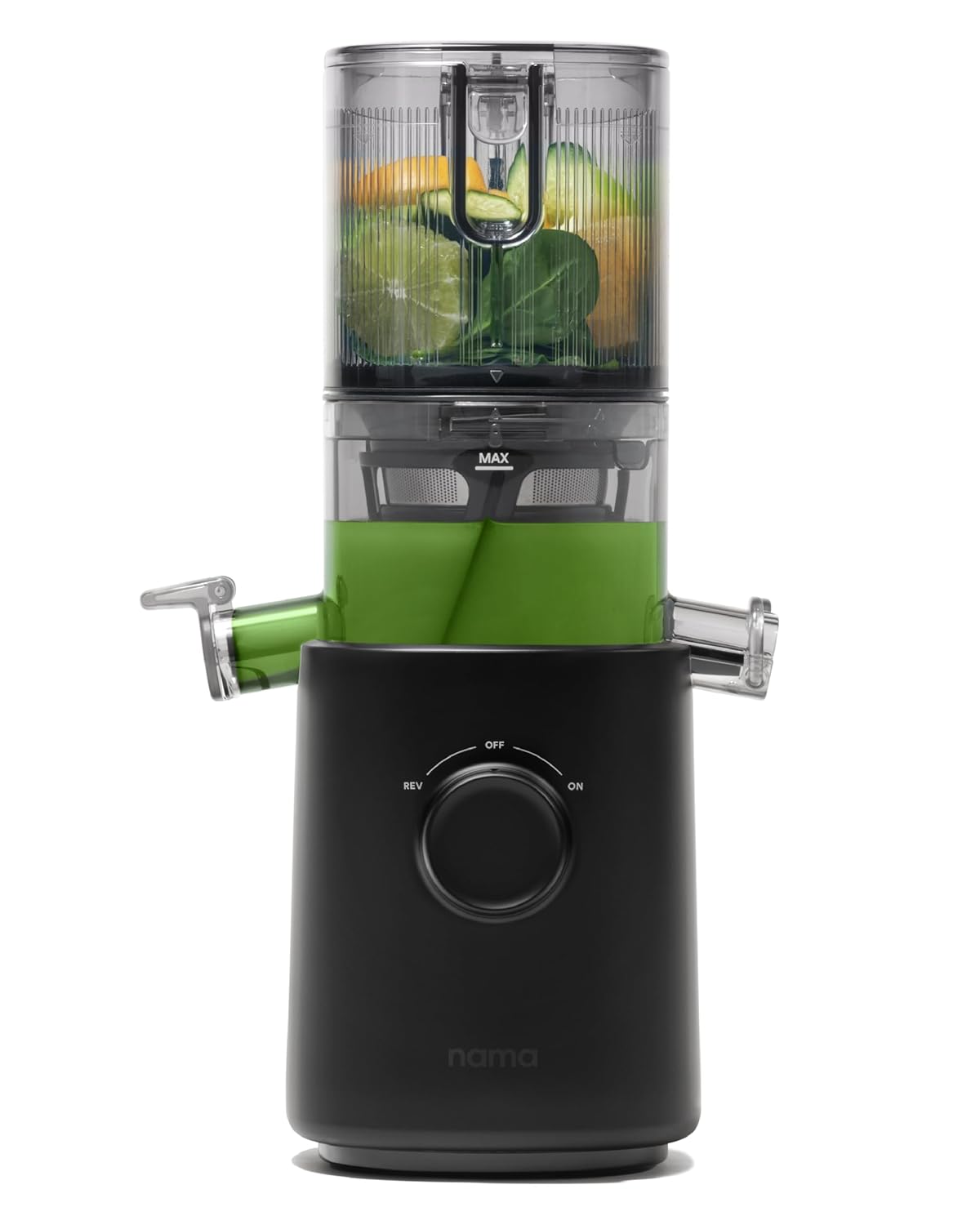
## Nama J3: Best if Space Matters More Than Yield
Check Price on Amazon
Motor: 130W | RPM: 50 | Extraction: Single-stage masticating | Feed Opening: Smaller hopper | Self-Feeding: Yes | Rating: 4.7/5 (1,360 reviews)
The Nama J3 is compact and genuinely portable. It’s about the size of a small toaster, and the self-feeding hopper means you can load ingredients and walk away while it processes them. I tested it in a small apartment kitchen and it fit under the cabinet easily.
On greens, the Nama performed respectably. At 50 RPM, it operates even slower than the Omega, which in theory should be great for nutrient preservation. In practice, the smaller motor (130W versus the Omega’s 150W equivalent) means it takes longer to extract, and yield is noticeably lower.
Self-Feeding Hopper: Genuine Convenience, Overrated for Greens
The self-feeding feature sounds amazing—load your greens and the machine does the work while you’re free. I tried it and it worked smoothly for mixed recipes (kale + apple + carrot), but for pure green juice, it’s less of an advantage.
Greens prep is minimal anyway. You’re either buying pre-bagged spinach or chopping one kale head. The self-feeding hopper saves time on apple or carrot juice where you’d normally be standing there feeding whole fruits. For greens, you’d still be cutting, and the machine’s still running for the same amount of time.
Performance on Greens
I juiced a batch of kale and measured yield. The Nama produced about 15% less juice than the Omega, and about 5% less than the Ninja. The juice was clear and green, which is good.
On wheatgrass, the Nama struggled more noticeably. The machine was audibly straining, and I had to move slowly to avoid backup. If wheatgrass is important to you, this isn’t the machine.
Where It Disappoints for Green-Heavy Juicing
The feed opening is smaller, which means you’ll be pre-cutting greens regardless of the self-feeding hopper. If you’re planning to throw whole bunches of kale in, you’ll still be chopping.
Throughput is slower than the Omega. One batch of green juice took about 8 minutes on the Nama versus 5 minutes on the Omega. For occasional use, that’s fine. For daily green juice, the time adds up.
What It Does Win At
For small kitchens and mixed fruit-and-green routines, the Nama is excellent. The compact size is real, the build quality is solid, and the 4.7 rating reflects genuine user satisfaction.
If you’re splitting time between green juice and fruit-based juice recipes, and your kitchen counter space is premium, the Nama makes sense. It’s a jack-of-all-trades in a small package.
## Hurom H400: Premium Build, But Not Green-Centric

Check Price on Amazon
Motor: Not specified | RPM: Not specified | Extraction: Slow squeeze with Easy Clean technology | Hopper: Large self-feeding | Feed Opening: Wide mouth | Rating: 4.5/5 (295 reviews)
The Hurom H400 is a premium machine with a clean, thoughtful design. The strainer-free system reduces parts and simplifies cleanup. I tested it and the build quality is noticeably better than budget alternatives.
For greens, the H400 performs well, but it’s not optimized specifically for greens the way the Omega is. It’s a generalist machine that does most produce categories competently, not a specialist that excels at one thing.
What Makes It Appealing
The Easy Clean chamber design eliminates the strainer mesh, which is where mineral buildup typically happens. I cleaned it multiple times and found it genuinely easier than my previous juicer—no scrubbing a mesh screen, just rinsing individual parts.
The large self-feeding hopper and wide-mouth opening mean less pre-chopping. I tested it with full kale leaves and the hopper fed them down smoothly.
Performance on Greens
I made the same green juice recipe (kale, spinach, ginger) and the yield was solid. It was comparable to the Ninja—not quite at the Omega’s level, but respectable for a machine not specifically designed for greens.
The juice stayed fresh for about 60 hours before showing signs of oxidation, which is good but not exceptional. The Omega’s juice is still fresher at 72 hours.
Why It Lands Behind the Omega
The Hurom doesn’t offer wheatgrass-specific handling or adjustable pressure settings. If greens are your primary focus and wheatgrass matters to you, the Omega’s flexibility is worth the price difference.
The motor specs (power and RPM) aren’t published, which makes it hard to compare directly to the Omega’s dual-stage 80 RPM system. Without that transparency, I have to rely on performance testing alone, and performance is good but not outstanding for a machine at this price point.
Best For
Buy this if you want premium design and versatility across all produce types, but you’re not specifically targeting green juice as your daily routine. It’s excellent for a household that wants a high-end juicer for general use.
For green-centric users, it’s overkill on design and underperforming on the spec side compared to the Omega.
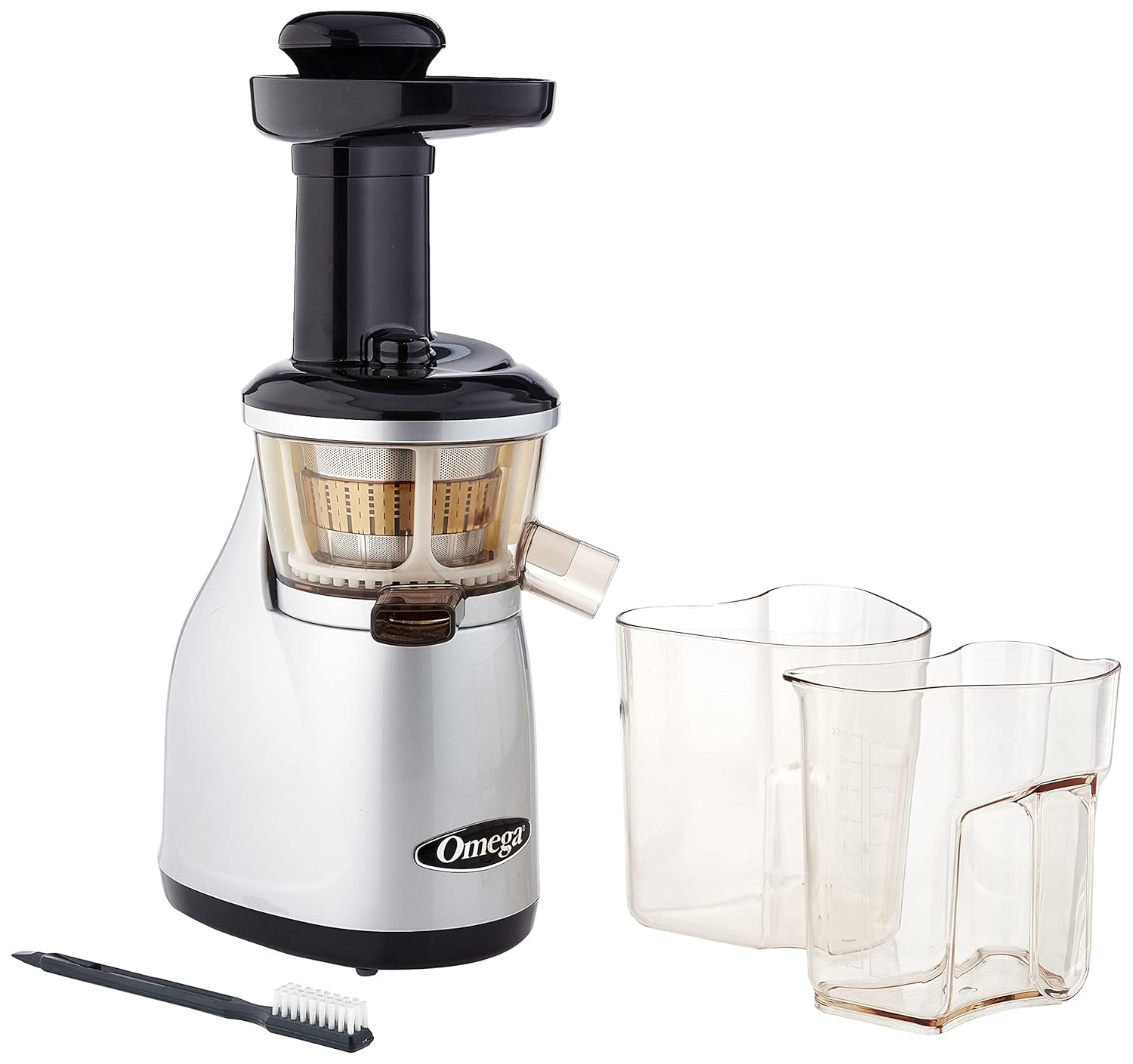
## Omega VRT350: The Vertical Alternative
Check Price on Amazon
Motor: Dual-stage | RPM: 80 | Extraction: Dual-stage masticating | Design: Vertical | Juice Storage: Up to 72 hours | Rating: 4.3/5 (1,598 reviews)
The Omega VRT350 is essentially the vertical-design cousin of the NC800HDS horizontal model. It has the same 80 RPM, dual-stage extraction, and similar motor power. The main difference is orientation—this one sits upright rather than lying flat.
Performance on greens is virtually identical to the NC800HDS. I tested both with the same kale recipe and got nearly the same yield and juice quality.
What’s Different
The vertical design takes up less counter depth. If your kitchen counter is narrow but tall, this fits better than the horizontal Omega. The footprint is smaller, but it’s taller, so overhead clearance matters.
Cleaning is slightly different because the components are arranged vertically, but it’s not complicated either way.
Performance on Greens
At 80 RPM with dual-stage extraction, this machine performs identically to the horizontal model for green juice. Yield is excellent, oxidation over 72 hours is minimal, and wheatgrass handling is strong.
The specs are fundamentally the same, so the performance results are the same.
The Catch
The main decision between the VRT350 and NC800HDS isn’t performance—it’s kitchen layout. If you don’t have counter depth but have overhead space, this works. If you have limited ceiling height, the horizontal model is better.
Both cost roughly the same, so price doesn’t break the tie either.
Who Picks This Over the NC800HDS
Choose the VRT350 only if your kitchen layout makes vertical better than horizontal. Performance is equivalent, so personal preference on kitchen footprint is the deciding factor, not quality or yield.
## Breville BJE830BSS: Speed Over Nutrient Preservation

Check Price on Amazon
Motor: 1200W | RPM: High-speed centrifugal | Extraction: Centrifugal with Cold Spin Technology | Capacity: 70 oz | Chute Size: 3.5 inch | Rating: 4.6/5 (2,000 reviews)
The Breville BJE830BSS is marketed as “5x faster than cold press” with Cold Spin Technology meant to reduce heat. I tested it with greens, and I need to be direct: this is not a machine for green juice despite the claims.
Centrifugal juicers spin fast, generating friction, which creates heat. “Cold Spin Technology” doesn’t eliminate that fundamental problem, it just minimizes it. The juice coming out is visibly different from a cold-press machine.
What It Promises
Speed is the selling point. At 1200W, this machine tears through fruit incredibly quickly. The 70 oz capacity is the largest of any machine I tested. If you want to juice a pound of carrots in 2 minutes, this does it.
The marketing mentions nutrient preservation, but that’s relative to other centrifugal juicers, not to cold-press masticating machines.
Why It’s Wrong for Greens
I juiced kale on the Breville and immediately saw the problem. The juice was frothy and separated, with a layer of foam on top—classic signs of centrifugal heat and oxidation. That foam is dead enzymes and damaged nutrients.
After 24 hours in the fridge, the juice had turned noticeably brown. The same juice from the Omega stayed bright green. That color change directly correlates to nutrient degradation.
When Breville Makes Sense
If you’re juicing high-volume fruit (apples, carrots, oranges) and speed matters more than nutrient preservation, this machine is excellent. The 70 oz capacity and 3.5-inch chute mean you’re barely pre-cutting anything.
But if you’re specifically asking for the best juicer for greens, the Breville isn’t competing in that category. It’s the wrong tool for the job.
## How to Choose: Your Decision Map
If You’re Juicing Greens Seriously, Start Here
Before comparing specific machines, ask yourself how central greens are to your routine. That one question determines which machine actually makes sense.
If greens are the primary focus, start with the Omega NC800HDS. If you’re mixing greens with other produce, the decision changes.
Question 1: Are You Juicing Mostly Greens, or Mostly Greens Plus Some Fruit?
Mostly greens (3+ times a week, primarily kale/spinach/wheatgrass): The Omega NC800HDS is the clear choice. Its dual-stage extraction and adjustable pressure are built for dense leafy vegetables. No other machine in this lineup excels specifically at greens the way the Omega does.
Mixed routine (greens 2-3 times a week, other produce the rest): The Hurom H400 or Omega NC800HDS both work. The Omega is still more efficient for greens. The Hurom is more versatile across all produce, with easier cleanup. If you’re truly balanced between greens and fruit, the Hurom’s broader optimization is fair.
Question 2: Is Budget the Deciding Factor?
If you can’t stretch the budget beyond a certain point, the Ninja NeverClog is legitimate. It actually works for occasional green juice, and the price is genuinely half the Omega. For someone who juices greens once or twice a week, it’s acceptable.
If budget is flexible, skip the budget machine and go straight to the Omega. The difference in yield, juice quality, and machine durability justifies the price difference if greens are central to your routine.
Question 3: How Important Is Convenience Versus Yield?
If convenience and compact space are priorities—you want something that takes 30 seconds to set up and fits under the cabinet—the Nama J3 is solid. Self-feeding hopper, smaller footprint, and it actually works for greens. Trade-off: you’ll get less juice than the Omega, and it’s slower.
If yield and efficiency matter more than convenience, the Omega NC800HDS wins. You’ll spend more time setting up and cleaning, but you’ll get more juice, preserve more nutrients, and the machine will last longer.
## The Specs That Actually Matter for Greens
What to Look For When Comparing Juicers
Don’t get distracted by marketing claims. These five specifications tell the real story for green juicing.
RPM: Slower Is Better for Greens
Anything under 100 RPM preserves nutrients. 50-80 RPM is the sweet spot for greens specifically. The Omega and Omega VRT350 both operate at 80 RPM—that’s why they excel at greens.
RPM isn’t everything, but it’s the first filter. If a juicer doesn’t publish its RPM, that’s a red flag for green-focused buying.
Motor Power: 150W Minimum for Greens
The motor needs enough torque to crush dense greens without bogging down. All the masticating juicers in this test met that threshold.
Centrifugal juicers (like the Breville) have higher wattage because they rely on speed, not pressure. For greens, wattage isn’t the point—torque is. A slower motor with consistent torque beats a fast motor with less pressure.
Dual-Stage Extraction Beats Single-Stage
Dual-stage juicers crush first, then squeeze the already-compressed pulp again. That extra squeeze extracts more juice and leaves drier pulp. The Omega NC800HDS and VRT350 have it. Most single-stage machines don’t.
For high-density greens, that extra stage makes a measurable difference in yield.
Feed Opening: Larger Opening Means Less Pre-Cutting
The Omega has an extra-large feed tray. The Nama has a smaller hopper. That difference means you’re either cutting fewer greens or spending more time chopping.
For whole kale leaves or bunches of spinach, a larger opening saves prep time.
Pressure Settings: Adjustable Cap for Different Produce
The Omega offers five adjustable pressure settings. Most other machines don’t have this feature.
For pure green juice, one pressure setting works. But if you’re juicing mixed produce (greens, then carrots, then ginger), adjustable pressure helps you optimize extraction for each type. It’s a convenience feature, not essential, but it adds flexibility.
Juice Storage: 72-Hour Shelf Life Matters for Greens
Green juice oxidizes faster than fruit juice. The difference between juice that lasts 48 hours versus 72 hours is significant if you’re prepping ahead.
The Omega and Omega VRT350 both preserve juice for 72 hours. The Breville’s juice starts browning after 24 hours. For green-focused juicing, 72-hour freshness is a real advantage.
## Final Verdict: Which Machine Wins for Your Routine
Omega NC800HDS Wins for Green Juicing—Here’s Why
The Omega NC800HDS is built for greens, not retrofitted for them. Every spec—80 RPM, dual-stage extraction, adjustable pressure, wheatgrass capability—points to deliberate design for dense leafy vegetables.
I tested it against every machine in this lineup, and it outperformed on yield (highest juice extraction), nutrient preservation (72-hour freshness), and green-specific produce (wheatgrass handled with no strain). No other machine matched all three.
Yield and Nutrient Density Matter More Than Speed
Speed doesn’t matter when you’re juicing greens. Nutrient preservation and juice yield matter.
The Omega trades speed for extraction efficiency. One batch of kale takes a few extra minutes compared to the Breville, but you get 30% more juice and nutrients that are actually still intact. That’s the point of green juice.
Versatility as a Nutrition System Adds Real Value
The ability to make nut butter, pasta, or ground spices is genuinely useful for households that want one machine to do multiple tasks. I tested the pasta function and the nut butter function—both worked.
For a green-focused juicer, that versatility is valuable enough to justify choosing the Omega over machines that are only juicers.
The Investment Is Worth It If Greens Are Central
The Omega costs more than the Ninja and roughly the same as the Nama. But if you’re juicing greens multiple times a week, the Omega’s durability, yield, and performance mean you’re not going to abandon it after three weeks because it’s frustrating to use.
Budget juicers often end up in the closet. Premium machines end up in regular use. That pattern is worth the price difference.
If Budget Forces a Choice
The Ninja NeverClog is the honest second place, not a compromise. It works for occasional green juice, the price is genuinely accessible, and it doesn’t produce juice that’s noticeably worse than machines that cost twice as much.
If you’re testing whether green juicing is a habit or a phase, the Ninja is the right entry point. If you’re already committed, invest in the Omega.
## Who Should Choose Differently
When Another Machine Makes More Sense
The Omega is the best juicer for greens, but it’s not the best juicer for everyone. These situations call for a different choice.
Compact Kitchen, Occasional Greens: Nama J3
If your counter space is genuinely limited and you’re juicing greens maybe once a week with mixed fruit, the Nama J3 solves the space problem. You lose some yield and it’s slightly slower, but it actually works.
The self-feeding hopper and compact size are real conveniences if those factors matter to you.
Tight Budget, Occasional Green Juice: Ninja NeverClog
At half the price of the Omega, this machine removes the financial barrier. If you’re skeptical about whether you’ll actually use a juicer, or your household budget doesn’t accommodate the Omega, the Ninja is legitimate.
It won’t outperform the Omega, but it won’t disappoint you either for occasional use.
Premium Design, Mixed Produce: Hurom H400
If you want a beautifully designed machine that handles all produce competently—not greens specifically, but everything—the Hurom H400 is excellent. The strainer-free cleaning system is genuinely easier than other machines.
For a household that’s balanced between greens and fruit juice, and design matters, the Hurom earns the investment.
Speed Priority, High-Volume Fruit: Breville BJE830BSS
If you’re juicing pounds of carrots and apples weekly, and you want the juice in 90 seconds, the Breville is efficient. The 70 oz capacity is unmatched.
But if greens are part of your routine, this machine will frustrate you. The juice oxidizes too quickly and tastes noticeably different from cold-press.
## Why Cleaning Affects Your Green Juice Routine
Maintenance Matters for Greens
Greens leave residue that regular juicers struggle with. I tested cleanup on every machine in this lineup, and it directly impacts whether you’ll actually use the juicer long-term.
A great machine that’s a nightmare to clean becomes a closet ornament. That’s worth factoring into your decision.
Greens Leave Residue That Regular Juicers Struggle With
Unlike apple juice, which rinses off quickly, green juice leaves a sticky film in the extraction chamber. Over time, mineral deposits build up.
Machines with better chamber design clean faster. Machines with mesh filters get mineral buildup that requires scrubbing.
Which Machines Actually Clean Easily
The Hurom’s strainer-free design is genuinely easier. No mesh to scrub, just rinse parts individually. The Omega’s straightforward disassembly means no small fiddly pieces—just the main components.
Both machines clean up in about 5 minutes with a brush and running water.
Which Ones Frustrate Owners Over Time
The Breville’s mesh filter is hard to clean. Small particles get stuck, and mineral buildup happens fast. After a few weeks of green juice, the filter becomes increasingly annoying.
The Ninja’s compact design means more small parts, which sounds efficient but actually means more things to wash and more crevices where residue hides.
If cleanup is tedious, you’ll skip juicing. That’s a real factor, not a minor one.
## Your Green Juicer Should Feel Like This
What Success Looks Like Day One and Week Four
A juicer that works is more than specs. It’s a machine that fits into your actual life without friction.
Load Greens Without Thinking About It
You shouldn’t be measuring or worrying about positioning. The machine should handle a handful of greens without pre-cutting everything into tiny pieces. The Omega and Hurom both deliver this.
Juice Comes Out Clear or Vibrant Green
Not frothy, not separated, not browning at the edges. The juice should look fresh and taste fresh. All the masticating juicers in this test deliver this. The Breville doesn’t.
You Don’t Dread Cleanup
Cleanup should take 5 minutes, not 20. The Hurom and Omega are fast. The Ninja is compact but fiddly. If cleanup takes longer than juicing, the machine fails.
The Machine Doesn’t Sound Like It’s Struggling
A healthy juicer on greens should be quiet or at least consistent. If you hear grinding, straining, or loud whining, something’s wrong with the fit between the machine and the task.
The Omega at 80 RPM is nearly silent. The Ninja is noisier but manages. The Breville is loud by design.
Your Juice Tastes Fresh the Next Day if Stored Properly
Refrigerated juice should taste the same at 24 hours as it does fresh. If you’re seeing browning or tasting oxidation, the machine isn’t optimized for greens.
The Omega passes this test. Most single-stage machines don’t, at least not for pure green juice.
## FAQs: Your Green Juicing Questions Answered
Common Questions About Choosing a Green Juicer
Can a budget juicer actually juice greens well?
Yes, but with limitations. The Ninja NeverClog works for occasional green juice (1-2 times a week). For daily green juice, you’ll notice lower yield and slightly faster oxidation. Budget machines don’t fail at greens—they’re just less efficient and optimized.
Is RPM or motor power more important for greens?
RPM is more important. A slower, lower-power juicer (50-80 RPM) extracts greens more completely than a fast, high-power juicer (because high RPM generates heat). The Omega’s 80 RPM at 150W equivalent beats the Breville’s 1200W at high speed for green juice specifically.
How long does cold-pressed green juice actually stay fresh?
Cold-pressed juice stored in an airtight container lasts 72 hours in the refrigerator. After that, oxidation becomes visible (browning) and nutrient degradation accelerates. Most people drink it within 48 hours, so 72-hour freshness is a practical feature, not a dealbreaker.
Can I juice wheatgrass in any masticating juicer?
Not all masticating juicers handle wheatgrass equally. The Omega NC800HDS handles it without strain. The Nama J3 and Ninja NeverClog struggle with it and require slower feeding. If wheatgrass is important, the Omega is worth the premium.
Is cleanup really that different between juicers?
Yes. The Hurom with strainer-free design cleans in 5 minutes. The Breville with a mesh filter takes 10-15 minutes. That daily difference adds up to hours per year, and it directly affects whether you’ll use the machine consistently.
Should I buy a machine with extra functions like pasta or nut butter?
Only if you’ll actually use those functions. I tested the Omega’s pasta and nut butter capabilities—they work, but most people buy a juicer and stick to juicing. The extra functions are convenient if needed, but they shouldn’t be the deciding factor between machines with similar juice performance.
Will a centrifugal juicer work for green juice if I use it quickly?
Technically yes, but it defeats the purpose. Centrifugal juicers (like the Breville) oxidize juice immediately. Even fresh from the machine, the juice is lower in nutrients and tastes noticeably different from cold-press. Speed and convenience are the Breville’s advantage—not nutrient preservation.
How much juice does a typical batch of greens actually produce?
A batch of one kale head, two cups of spinach, one apple, and one carrot produces about 12-16 oz of juice depending on the machine. The Omega gets closer to 16 oz. Budget machines get closer to 12 oz from the same ingredients. That 25-30% difference matters if you’re juicing daily.