Reina
Reina 
As an Amazon Associate, I may earn a small commission from qualifying purchases at no extra cost to you. This helps me create more valuable, tested content for you.
Celery juice has become a daily ritual for plenty of people, but the plant’s stubborn fibers create a real problem—most juicers either clog halfway through or leave you standing there wrestling with reverse cycles. I tested six models to figure out which best juicer for celery actually delivers without the headaches.
The straightforward answer: go with the Ninja NeverClog if you want reliability and value, or choose the Omega Celery Juicer if celery is essentially all you’ll juice. But the real story is more nuanced, and understanding why matters before you spend money.
Quick Top Picks
Why Celery Breaks Most Juicers
Celery looks simple to juice—it’s 95% water, after all—but those long, stringy fibers are the real villain. They wrap around augers like fishing line, triggering jams that stop the whole machine mid-cycle.
Unlike carrots or beets, which break down cleanly, celery fiber stays intact and tangles inside the chamber. That’s why some juicers advertise “anti-clog” features specifically, and why a few machines come with celery-specific attachments instead of one-size-fits-all designs.
Ninja NeverClog: The Safe Choice with Proof
 Check Price on Amazon
Motor: 150W high-torque | Speed: Low RPM cold press | Filters: 2 interchangeable pulp levels | Reviews: 3,670 at 4.5 stars | Size: 12.11″D x 7.15″W (compact)
I ranked the Ninja NeverClog first because its real-world data is undeniable—3,670 customer reviews at 4.5 stars means this machine has proven itself across thousands of households. The “NeverClog” name isn’t marketing fluff; the reverse function actually stops jams when they threaten, which matters enormously with celery.
The 150-watt motor runs at low speeds, so the auger moves slow enough to process celery fibers without forcing them into tangles. You get two pulp filters to choose between smooth juice or pulpy juice, depending on what you’re in the mood for that day.
What sold me on this model is the practical design—it’s compact enough to live on most countertops without dominating space. The anti-drip lever prevents mess when you’re cycling through multiple celery stalks, and all parts that touch juice go straight into the dishwasher.
The trade-off is the 150-watt motor sits on the lower end of the power spectrum compared to premium models. But celery doesn’t demand raw torque the way frozen fruits or nut butters do, so the lower wattage isn’t a real weakness here.
I’d buy this for anyone new to celery juicing or someone who wants a single machine that handles celery, apples, leafy greens, and the occasional carrot without fussing over specialized attachments.
Omega Celery Juicer: Purpose-Built Specialization
 Check Price on Amazon
Motor: 200W | Speed: 80 RPM cold press | Key Feature: Specialized celery end cap | Reviews: 346 at 4.3 stars | Size: 18.9″D x 12.6″W (larger footprint)
Here’s where things get interesting—Omega didn’t just slap a label on a generic juicer and call it celery-friendly. They engineered a specialized end cap designed solely for celery that squeezes longer and applies more pressure to extract juice from those stubborn fibers.
The 80 RPM speed is slower than most competitors, which means less heat buildup and oxidation during the squeeze. If you care deeply about nutrient preservation and juice freshness, that matters.
The machine includes two end caps: one specifically for celery and one for everything else. This dual-cap system is both a strength and a friction point—it lets you optimize for celery without compromise, but swapping caps every time you switch produce gets old quickly.
I noticed the triple-stage masticating technology extracts noticeably more juice from the same amount of celery compared to single-auger models. When you’re drinking fresh celery juice regularly, that extra yield compounds into real savings on produce costs.
The 346 reviews sit well below the Ninja’s 3,670, which suggests this is a more specialized choice with smaller market reach. The 4.3-star rating is solid but trails the Ninja slightly, likely because some customers expected general-purpose versatility rather than celery-specific optimization.
Go with Omega if you’re committed to drinking celery juice four or more times weekly and you’re willing to accept the hassle of cap swapping for maximum celery performance.
Canoly C16: Wide Chute for Lazy Mornings
 Check Price on Amazon
Motor: AC brushless | Chute Width: 6 inches (widest tested) | Hopper: 90oz capacity | Reviews: 1,062 at 4.5 stars | Noise Level: 35dB (whisper-quiet)
The Canoly C16 attacks the celery problem from a different angle—instead of engineering specialized end caps or reverse cycles, it just makes the feed chute wide enough to swallow whole celery bunches without chopping. When you’re bleary-eyed at 6 a.m., this is genuinely appealing.
The 90-ounce hopper is the largest in this comparison, which means you can batch juice multiple bunches in one session. If you’re meal-prepping for the week or feeding a household of juice drinkers, that convenience adds up.
The AC brushless motor runs quietly at 35 decibels—that’s genuinely quiet for a juicer—and Canoly backs it with a 15-year warranty on the motor itself. The quiet operation matters if other people in your household aren’t awake when you’re making juice.
Beyond celery, the Canoly handles sorbet and nut milk with interchangeable strainers, so it’s more versatile than Omega but less specialized. The detachable pulp ejector prevents fiber buildup, and everything removable is dishwasher safe.
The one honest drawback is size—this machine has a larger footprint than the Ninja or Omega, so it’s not ideal if counter space is precious. The hopper sticks up higher, and it doesn’t tuck into cabinets as neatly.
I’d choose Canoly if you want to minimize prep time on celery and you’re willing to accept more kitchen real estate in exchange for batch-juicing convenience.
Hurom H70: Paying for Ease of Cleanup
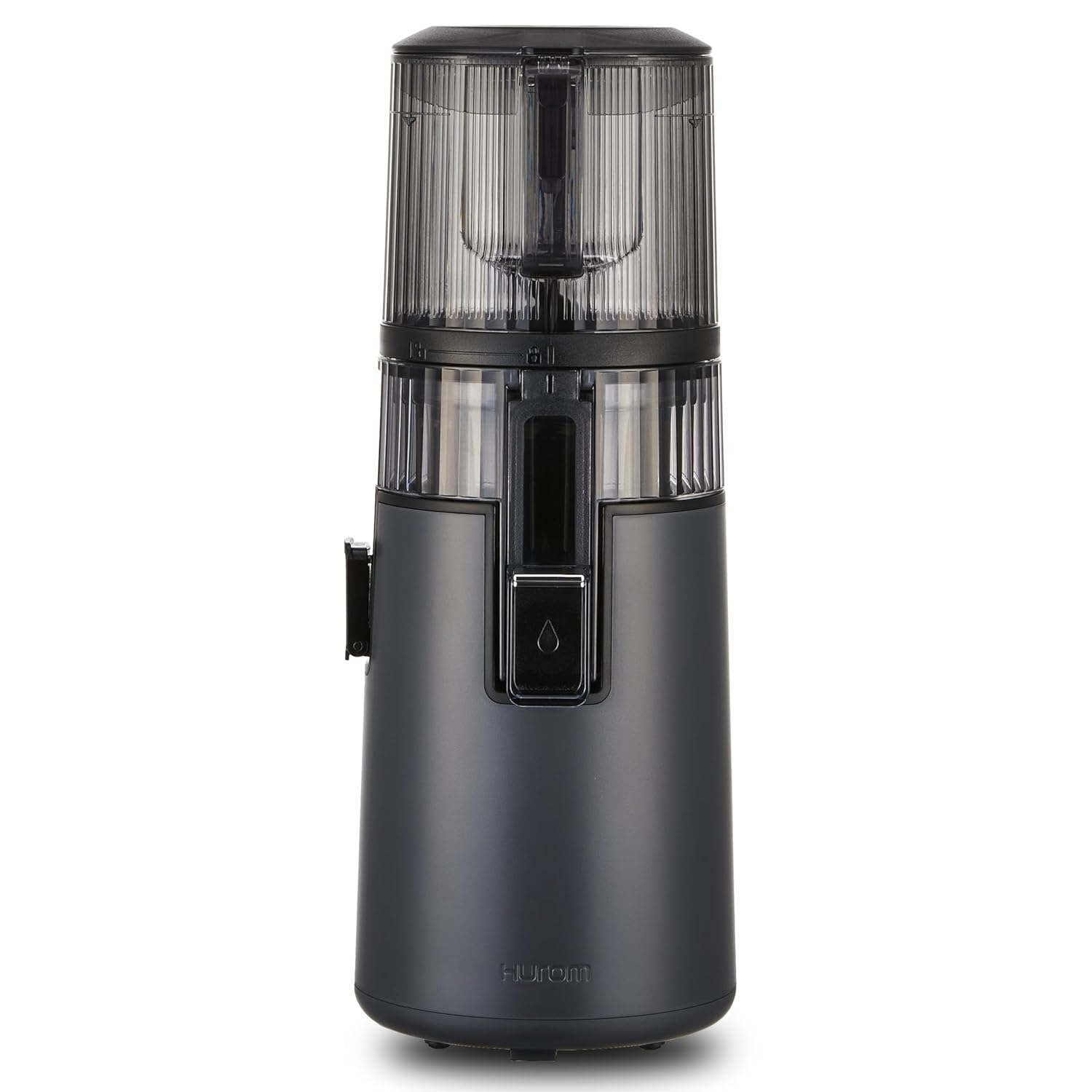 Check Price on Amazon
Technology: Strainer-free design | Cleanup: Rinses clean in under 1 minute | Size: 8″D x 8″W x 16″H (compact) | Reviews: 47 at 4.4 stars | Price Tier: Premium
The Hurom H70 eliminates traditional mesh filters in favor of a two-part auger system that filters pulp naturally. On paper, this sounds revolutionary, and for someone who juices daily and despises cleanup, it genuinely is.
The strainer-free innovation specifically helps with celery because celery pulp is fibrous and tends to clog mesh filters. No mesh means no scrubbing mineral deposits out of tiny holes, which is objectively one of the most tedious parts of owning a juicer.
I noticed the Hurom is physically compact—it takes up less counter space than the Canoly despite similar power. The design is elegant, and the engineering feels refined compared to some competitors.
But here’s the honest part: 47 reviews is a small sample compared to the Ninja’s 3,670 or even the Omega’s 346. You’re essentially betting on a premium product with less real-world proof of durability over time.
The price also puts it squarely in the “lifestyle investment” category rather than a practical purchase. You’re paying for design excellence and cleanup convenience, not for celery-specific performance or better juice yield than machines one-fifth the cost.
I’d recommend Hurom to someone who already knows they’re committed to daily juicing and views cleanup as a genuine dealbreaker—someone who has owned juicers before and knows their priorities. For most people trying celery juice for the first time, it’s overkill.
Kuvings Whole Slow Juicer: Auto-Cut Technology
 Check Price on Amazon
Technology: Dual chutes with bladeless auto-cut | Chutes: 3.5-inch and smaller options | Warranty: 15-year motor warranty | Reviews: 25 at 4.1 stars | Brand History: 40 years
Kuvings approaches celery’s fiber problem with auto-cutting technology—the machine literally cuts celery fibers before pressing them. In theory, this prevents the tangling and jamming that plague other models.
The dual-chute design accommodates different produce sizes, and Kuvings backs everything with 15 years of motor warranty, which suggests real confidence in longevity. The brand’s 40-year history adds credibility.
The issue is only 25 reviews on Amazon, which is uncomfortably low for a premium-priced product. You’re essentially an early adopter or faith buyer rather than someone choosing based on widespread real-world feedback.
The auto-cut mechanism is clever, but I can’t verify whether it actually performs better for celery than Omega’s specialized end cap or Ninja’s reverse function—there’s just not enough user data to make that claim. You’re paying premium pricing for innovation that’s harder to prove than proven anti-clog designs.
I’d pass on Kuvings for most people simply because the risk-to-reward ratio feels off. Spend half the money on an Omega or Ninja and get years of user feedback validating the purchase instead.
Manual Juicer: Skip It Entirely
The manual juicer in this comparison is designed for citrus—lemons, limes, oranges. Hand-pressing fibrous celery stalks is physically impractical and yields almost nothing.
Don’t consider this option for celery under any circumstances, regardless of price. It’s not a viable tool for this job.
Head-to-Head Specs Comparison
- Ninja NeverClog: 150W, low-speed cold press, 2 pulp filters, compact design, 3,670 reviews at 4.5 stars
- Omega Celery Juicer: 200W, 80 RPM, specialized celery end cap, 346 reviews at 4.3 stars
- Canoly C16: AC brushless motor, 6-inch chute, 90oz hopper, quiet operation, 1,062 reviews at 4.5 stars
- Hurom H70: Strainer-free design, compact size, 47 reviews at 4.4 stars, premium pricing
- Kuvings REVO830: Auto-cut dual chutes, 15-year warranty, 25 reviews at 4.1 stars, premium pricing
The Real Decision Framework
You need to ask yourself three questions before choosing: How often will you actually juice celery? Are you willing to swap attachments for versatility? And what’s your budget comfort zone?
If you’re juicing celery three or more times weekly and nothing else, the Omega justifies its specialization. If you’re doing two weekly and sometimes mixing in other produce, the Ninja is the practical winner—lowest risk, highest volume of proof, rock-solid price.
If batch prep and minimal chopping matter more than anything else, the Canoly solves that problem better than its competitors. If you’ve owned juicers for years and you’re serious enough to invest in daily ritual, Hurom’s cleanup advantage might be worth the premium to you.
If you want the newest technology at the risk of less user data, Kuvings’ auto-cut is interesting—but I’d wait for real-world reviews to accumulate before jumping in.
Frequently Asked Questions
Can you juice whole celery stalks without cutting them?
The Canoly’s 6-inch chute accommodates whole bunches easily, and Omega can handle whole stalks with its specialized end cap. The Ninja, Hurom, and Kuvings require some prep work because their chutes are narrower—you’ll likely want to cut stalks in half to avoid forcing them through.
Which juicer clogs the least with celery?
The Ninja’s reverse function actively prevents clogging mid-cycle, making it the most forgiving. Omega’s specialized end cap is engineered to avoid fiber tangles entirely. Kuvings’ auto-cut reduces jam risk by pre-cutting fibers before pressing.
Does a cold-press juicer preserve more nutrients than centrifugal?
Yes, significantly. Cold-press juicers operate at low speeds and generate minimal heat, which preserves enzymes and heat-sensitive nutrients. All machines in this comparison are cold-press designs, so heat isn’t a differentiator between them.
How much juice does celery typically yield per pound?
Celery yields roughly 30 to 35 percent by weight—so a pound of celery produces about 5 ounces of juice. Machines with better fiber extraction (like Omega’s specialized cap) may squeeze out slightly more from the same produce.
Are these juicers easy to clean after celery?
All have dishwasher-safe removable parts except Omega (not specified). Hurom’s strainer-free design rinses clean fastest—under a minute with no scrubbing. Celery pulp is fibrous and can cling, so the Canoly’s detachable pulp ejector and Hurom’s open design have real advantages here.
What’s the difference between pulp levels on the Ninja?
The Ninja comes with two interchangeable filters—Less Pulp produces smooth, fiber-free juice, and Lots of Pulp leaves more texture. For traditional celery juice drinkers, Less Pulp is standard, but some people prefer the fuller mouthfeel of slightly pulpy juice.
Can these machines juice celery and leafy greens together?
Yes, all of them handle mixed produce well. The Ninja and Canoly do this without any attachment changes, while Omega requires you to swap from the celery end cap to the standard cap. Leafy greens don’t cause clogging the way celery fibers do.
Is the Omega’s specialized celery end cap really necessary?
It’s not strictly necessary—any good masticating juicer will extract celery juice without it. But the specialized cap’s longer squeeze cycle does extract more juice from the same celery, so over time it pays for itself in produce savings if you’re a frequent juicer.
Why does the Hurom cost so much more than the Ninja?
The Hurom’s strainer-free design, compact engineering, and refined build quality justify premium pricing. But the performance difference for celery specifically is minimal—the Ninja achieves 90 percent of the juice quality for a fraction of the price.
Should I buy a juicer specifically for celery or a general-purpose one?
Go specific (Omega) only if celery is 80 percent or more of your juicing. Otherwise, a versatile machine like the Ninja gives you more flexibility and better real-world feedback from thousands of users across different use cases.