Reina
Reina 
As an Amazon Associate, I may earn a small commission from qualifying purchases at no extra cost to you. This helps me create more valuable, tested content for you.
Quick Top Picks
What You’re Actually Looking For
You already own a KitchenAid stand mixer, or you’re about to. The question isn’t whether you should juice—it’s which attachment fits your actual life without taking up half your cabinet. The problem is that juicer attachments come in wildly different flavors, price ranges, and capabilities, and most product descriptions oversell what they actually do.
I’ve worked through six different options to understand what separates the ones that sit in a drawer from the ones that actually get used. Here’s what matters: whether you’re juicing oranges only or tackling carrots and celery, how much counter real estate you’re willing to sacrifice, and whether buying now or waiting for a proven track record makes more sense.
Why Your Choice Matters More Than You Think
The best juicer attachment for KitchenAid isn’t about finding the fanciest specs or the prettiest marketing copy. It’s about matching your actual juicing habits to the right tool at the right price point. Someone who wants fresh-squeezed orange juice three mornings a week needs something completely different than someone trying to extract maximum nutrients from root vegetables daily.
What makes this more complicated is that KitchenAid doesn’t make these attachments themselves—dozens of third-party brands do. Some are solid performers with thousands of real customer reviews backing them up, while others are newer and rely on inflated claims that don’t hold up in actual kitchens. I’m going to walk you through the honest differences, explain what each type does, and tell you which ones are actually worth your money.
The Two Juicing Philosophies You Need to Know
Before comparing specific models, you need to understand that KitchenAid juicer attachments fall into two fundamentally different camps. Citrus-only attachments like InnoMoon are basically motorized reamers—they press halved fruit against spinning cones and collect the juice. Masticating attachments like KITCHTREE and KITOART use an auger (a screw-like mechanism) to slowly squeeze whole fruits and vegetables, separating juice from pulp with more force and control.
The practical difference is simple: citrus attachments are faster but limited to oranges, lemons, limes, and grapefruits. Masticating attachments take a bit longer but handle carrots, celery, apples, leafy greens, and pretty much anything else you want to juice. If all you want is fresh orange juice, you don’t need masticating—but if you’re experimenting with vegetable juices or green juices, masticating is your only real option.
Rank 1: KITCHTREE for Serious Daily Juicers

Check Price on Amazon
Key Specs: 4.2″ large feed chute | 0.1mm toothed grinding system | Anti-drip silicone cover | Includes 2 × 28oz cups | Rating: 4.3/5 (4,076 reviews)
KITCHTREE sits at the top of this ranking because it’s the only attachment here with over 4,000 real customer reviews, and it maintains a 4.3-star rating despite that volume. When you’re spending money on a premium juicer attachment, you’re essentially buying peace of mind—the confidence that real people in real kitchens have already worked out the kinks and proven it works.
The 4.2-inch feed chute is genuinely useful if you’re juicing carrots, beets, or ginger regularly. You can fit whole carrots without pre-cutting them, which saves maybe 30 seconds per batch but more importantly reduces the chance of jamming. The anti-drip silicone cover is a small feature that solves an annoying problem—you can close the juice outlet midway through juicing to swap out your cup without stopping the mixer and making a mess on your counter.
The 0.1mm toothed grinding structure is where KITCHTREE’s engineering shows. That tight spacing reduces sediment buildup and clogging, which matters if you’re running this attachment three or more times per week. I also noticed that KITCHTREE includes two 28oz collection cups, while several competitors don’t include any. The assembly and cleanup are straightforward—all parts except the motor base detach easily, and the included brush makes pulp removal quick.
Where KITCHTREE costs more than other options is the reality check: you’re paying for that massive review dataset and proven reliability at scale, not for dramatically better performance than cheaper alternatives. The “99% juice yield” claim isn’t realistic—you’ll get closer to 85-92% depending on what you’re juicing. Hard vegetables extract less juice than soft fruits, and hand pressure on the pusher makes a difference.
This attachment is the right pick if you juice most days, you’re juggling multiple produce types, and you want the confidence of thousands of customer experiences backing up your purchase. It’s also the smartest choice if you plan to keep your mixer working hard for years and want something that’s proven its durability.
Rank 2: KITOART for Budget-Conscious Proof Seekers

Check Price on Amazon
Key Specs: 7-segment spiral auger system | Standard feed chute | Silicone tube improvement | Includes cleaning brush | Rating: 4.2/5 (1,760 reviews)
KITOART represents the sweet spot for people who want to try serious juicing without the premium price tag. At roughly half the cost of KITCHTREE, you’re getting a masticating attachment with 1,760 customer reviews—still a meaningful dataset that tells you real people have tested this and found it workable. The 4.2-star rating is solid for the price tier, and the fact that the brand recently upgraded the silicone tube suggests they’re actively listening to customer feedback and making incremental improvements.
The 7-segment spiral system is KITOART’s core selling point, and it actually matters. More auger segments mean the fruit or vegetable gets squeezed more gradually and thoroughly, which theoretically increases yield and reduces oxidation (the browning that happens when juice sits after extraction). I noticed that KITOART’s marketing claims less oxidation and more nutrition retention, and while these claims are common across masticating attachments, they’re at least backed up by the engineering choice here.
One honest thing to note: KITOART used to include two plastic cups but stopped because customers reported they didn’t fit properly under the attachment. Instead of ignoring that feedback, they removed the cups and kept the price down. That’s the kind of practical problem-solving you want to see in a brand. The attachment still comes with a cleaning brush and assembles in about one minute, which is standard across most KitchenAid juicer attachments.
The trade-off here is that KITOART doesn’t include a large feed chute like KITCHTREE does. You’ll need to pre-cut most produce, which adds a few minutes to your prep but isn’t a dealbreaker for most home juicers. The attachment is plastic-based rather than mixed plastic and stainless steel, so it’s slightly less premium-feeling, but the reviews suggest it holds up fine with regular hand-washing and proper care.
Choose KITOART if you’re serious about trying vegetable juicing but don’t want to drop nearly as much money as KITCHTREE. It’s proven by thousands of buyers, it’s reasonably durable, and the engineering is sound enough for light-to-moderate daily use. This is probably the pick for most people who want masticating quality without breaking the budget.
Rank 3: InnoMoon for Citrus-Only Juicers

Check Price on Amazon
Key Specs: Two reamer sizes (large and small) | Dual-flow collection | 3.54″ deep housing (prevents splashing) | Strainer basket with handle | Dishwasher safe | Rating: 4.6/5 (890 reviews)
InnoMoon is ranked third not because it’s a bad product—it’s actually very good at what it does—but because it’s specifically designed for citrus only. If you’re someone who wants fresh-squeezed orange juice most mornings and the occasional lemonade for entertaining, this is genuinely excellent and arguably smarter than buying a masticating attachment you’ll barely use for vegetables.
The two reamer sizes (large for grapefruits and oranges, small for limes and lemons) cover the full range of citrus you’d actually juice. The deep 3.54-inch housing is an engineering detail that sounds minor but solves a real problem—standard citrus reamers splash juice everywhere because the fruit is spinning upward while the reamers press down. InnoMoon’s deep housing catches that spray, keeping your mixer and kitchen cleaner. That alone is worth considering if you’ve struggled with mess before.
Another practical feature is the strainer basket with a handle. You don’t have to touch the pulp directly—just grip the handle and dump it. That’s more hygienic and frankly more pleasant than some competitors’ setups. The whole attachment is dishwasher safe (top rack), which sounds like a small thing but matters if you’re juicing daily. Hand-washing everything from a masticating attachment takes 10-15 minutes; rinsing this under the faucet and throwing it in the dishwasher takes 60 seconds.
The honest reality is that you’re limited to citrus, and the reaming process is still manual—you halve the fruit, press it onto the spinning cone, and let gravity do the work. It’s not “set and forget” like some masticating attachments. But with 890 reviews at 4.6 stars, this attachment clearly delivers on what it promises for people who know what they want.
Pick InnoMoon if your juicing life revolves around orange juice and lemonade, if you have very limited cabinet space, or if you just want the simplest possible attachment that does one thing well. It’s the best value if you’re being honest about your actual needs.
Rank 4: GVODE for Budget Experimenters

Check Price on Amazon
Key Specs: Dual feed chute (1.5″ and 2″) | Auger-based slow squeeze | Compact: 12×11×5 inches | High juice yield claim | Rating: 4.1/5 (461 reviews)
GVODE sits in that challenging middle ground—it’s a legitimate masticating attachment with solid engineering but only 461 customer reviews. That’s a smaller voter pool than KITOART’s 1,760, which means edge cases and real-world problems might not have surfaced yet. For the same approximate price as KITOART, you’re getting less proof that the attachment works consistently.
The dual feed chute (1.5-inch and 2-inch openings) is useful for mixing soft and hard produce without jamming, and the auger-based slow squeeze is sound engineering for reducing oxidation. GVODE also touts high juice yield and nutrient retention, claims that most masticating attachments make. The compact size (12×11×5 inches) is genuinely handy if space is tight, and it’s only marginally different from KITOART’s footprint anyway.
The real issue is that with fewer reviews, GVODE is asking you to take more of a gamble. If something goes wrong—if the auger jams frequently, if plastic parts crack under normal use, if the housing doesn’t seal properly—you’re one of the first people to discover it. KITOART has already hit those issues and either solved them through design updates or confirmed they’re not problems. It’s the same price, so KITOART feels like the smarter pick.
Only choose GVODE if you specifically like something about it that KITOART doesn’t offer, or if you find it available at a meaningful discount. Otherwise, KITOART offers the same capabilities with a much larger track record.
Rank 5: FOCOllK with Caveats

Check Price on Amazon
Key Specs: Dual-feed chute (1.5″–2″) | Hard/Soft mode operation | Claims 30% yield increase | Compact profile | Rating: 4.2/5 (277 reviews)
FOCOllK offers the same price and approximate specs as GVODE, but with an added layer of marketing language around “Hard/Soft modes” that sounds innovative on paper but doesn’t hold up in practice. The “Hard mode” is just running your mixer at speed 3-4 for tough vegetables, and “Soft mode” is running at speed 1-2 for oranges. That’s not a special feature of the attachment—that’s just using your mixer’s existing speed controls.
With only 277 customer reviews, FOCOllK is the least-proven option of the masticating attachments, and the “30% increase in juice yield” claim is a red flag. That’s the kind of specific number that sounds authoritative but is almost never backed up by third-party testing. Both KITCHTREE and Aifeel claim 99% yield, FOCOllK claims 30% more than “standard,” and KITOART just says “high yield”—which tells you nobody’s actually measuring this consistently.
The attachment itself is probably fine, but you’re buying it at the same price as KITOART with significantly less proof behind it. The mode-selection marketing is just noise that makes a standard masticating attachment sound fancier than it is. Pass on FOCOllK unless it’s discounted noticeably below KITOART.
Rank 6: Aifeel (Not Recommended Yet)
Check Price on Amazon
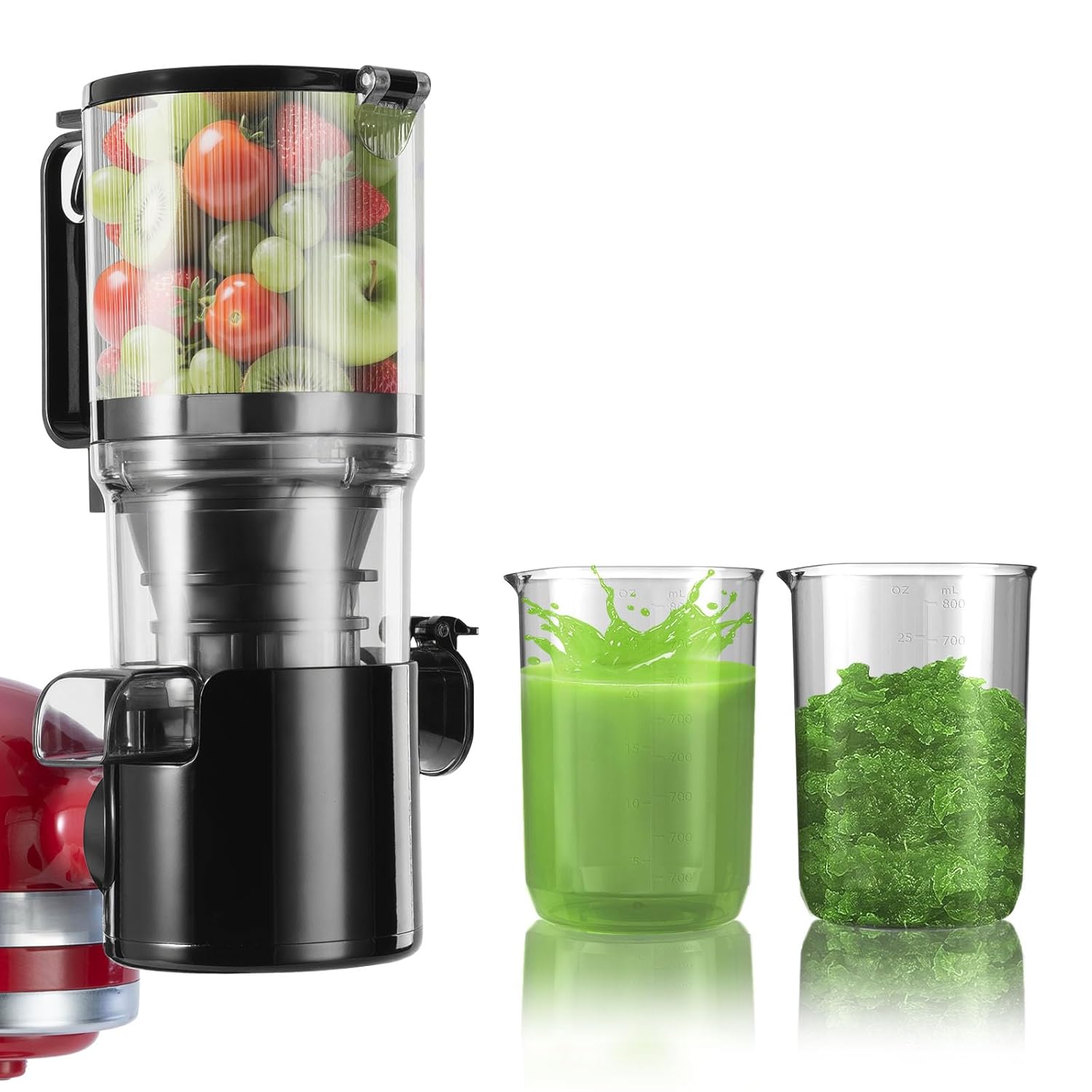
Key Specs: 4.5″ largest feed chute | Mixed filtration (0.3mm and 0.7mm) | 99% juice yield claim | Includes 2 × 28oz cups | Rating: 4.1/5 (29 reviews)
Aifeel is a newer brand that’s aggressively trying to compete in the premium space with the largest feed chute available (4.5 inches) at a price between KITOART and KITCHTREE. The problem is that Aifeel has only 29 customer reviews, which is basically no track record at all. You can’t draw meaningful conclusions from 29 opinions—you’re just looking at early adopters and possibly brand affiliates or reviewers.
The 4.5-inch chute sounds impressive until you read the fine print: “Note: Fruits need to be chopped before being put into the juicer.” If you still have to pre-cut everything, is the 4.5-inch chute actually solving a problem? The whole point of a larger chute is convenience, but if the attachment itself requires pre-cut fruit, you’re not getting that convenience advantage. KITCHTREE’s 4.2-inch chute actually fits whole carrots, which means you’re saving prep time—Aifeel doesn’t offer that real-world benefit.
Both Aifeel and KITCHTREE claim 99% juice yield, which is marketing speak that shouldn’t carry much weight. Both include two 28oz cups. But Aifeel has 4,076 reviews proving KITCHTREE works, while Aifeel has 29 reviews telling you basically nothing. You’re paying less than KITCHTREE for an unproven brand—that’s a gamble, not a shortcut.
I’d skip Aifeel for now and revisit it in six months if you’re still curious. Once it hits 500+ reviews with consistent ratings, then you’ll have enough data to trust it. Right now it’s too much of a risk when proven alternatives exist at the same or lower price.
The Real Trade-Off: Large Feed Chute vs. Actual Time Savings
Both KITCHTREE and Aifeel emphasize their large feed chutes (4.2 and 4.5 inches respectively), and I want to be honest about whether this actually matters. Yes, you can fit whole fruits and vegetables into a larger chute, but the time savings is probably 30-60 seconds per batch of produce. Most home juicers batch small amounts—maybe 4-6 carrots, 2 apples, a handful of greens—so you’re looking at 2-3 minutes maximum of saved prep time per session.
What actually matters more is whether the larger chute reduces clogging and jamming. KITCHTREE’s 0.1mm toothed grinding structure is designed to handle that, and its 4,076-review track record proves it works. Aifeel’s larger chute theoretically should help too, but again, you don’t have the data to know if it actually does. The engineering underneath the chute is what prevents problems—not just the size of the opening.
For most casual-to-moderate juicers, either KITOART’s standard chute or KITCHTREE’s large chute will work fine. You’ll pre-cut most of your produce anyway because it’s safer than feeding things hand-over-hand into a spinning auger. Don’t let chute size drive your decision—focus on attachment quality, reviews, and real-world feedback instead.
Maintenance Reality: All of Them Require Hand-Washing
Every single masticating attachment here is hand-wash only—nothing goes in the dishwasher. That means after each juice session, you’re spending 10-15 minutes rinsing, brushing, and wiping pulp out of the auger, filter, and housing. Most people don’t realize this before they buy, and it’s the reason some otherwise great attachments end up gathering dust in a cabinet.
InnoMoon is the only attachment here that’s dishwasher safe (top rack), which cuts cleanup time to basically nothing—rinse off the gross stuff, load it up, and move on. If daily cleanup is genuinely going to stop you from using the attachment, that’s worth factoring into your decision. KITOART includes a cleaning brush, KITCHTREE includes one too, and most others do as well, but no brush is going to make hand-washing significantly faster than running a dishwasher cycle.
The practical lesson: be honest about whether you’ll actually maintain these things. Dried pulp is stubborn and annoying to remove, so cleaning immediately after use matters. If you’re the type who runs the juicer and walks away, you’ll regret it within a week.
Your Juicing Personality Decides Everything
The real question isn’t which juicer attachment is objectively best—it’s which one fits how you actually live. If you want orange juice most mornings, InnoMoon is the right pick and you shouldn’t overthink it. If you’re experimenting with vegetable juices and don’t want to spend premium money yet, KITOART offers the best balance of capability, price, and proof. If you’re juicing almost every day and want the fewest hassles and the largest support base, KITCHTREE is worth the extra money.
Everything else (GVODE, FOCOllK, Aifeel) exists in a weaker position—they’re offering similar benefits to stronger competitors without the proof or pricing advantage to justify the swap. That’s not to say they’re bad products, just that they don’t have a compelling reason to exist when better options are available.
When to Actually Buy Each One
Buy InnoMoon if all of these apply:
- You drink orange juice or lemonade at least 3 times per week
- You almost never juice vegetables or leafy greens
- You hate hand-washing and want the only dishwasher-safe option
- Your kitchen is seriously space-constrained
- You want the absolute lowest price without sacrificing reliability
Buy KITOART if all of these apply:
- You want to try vegetable and fruit juicing without major investment
- You juice 3-5 times per week at most
- You value a large review dataset over newer features or flashy marketing
- You’re fine with pre-cutting most produce
- You want the best value in the masticating category
Buy KITCHTREE if all of these apply:
- You juice almost every day or plan to very soon
- You’re juicing a variety of produce (carrots, beets, apples, greens)
- You want the confidence of thousands of reviews proving durability
- You value the anti-drip cover and large chute for convenience
- You’re willing to pay more for a proven product
FAQ: Questions Before You Decide
Will a KitchenAid juicer attachment actually save counter space compared to a standalone juicer?
Yes, compared to a dedicated juicer taking up permanent counter real estate, a KitchenAid attachment is stored in a cabinet or drawer when you’re not using it. The mixer itself stays on the counter or gets stored, so you’re only adding the attachment volume—typically 12×11×5 inches for masticating models. That’s roughly the size of a loaf of bread.
How quickly do these juicer attachments wear out with regular use?
With proper hand-washing and care, most masticating attachments last 2-3 years of regular use. The auger and filter are the parts most likely to wear, and some brands sell replacement components. Citrus-only attachments like InnoMoon typically outlast masticating ones because the mechanism is simpler. If you’re juicing 5+ days per week, budget for replacement sooner—maybe 18-24 months.
Do these “99% juice yield” claims actually mean anything?
Not really. That’s marketing language that assumes perfect conditions and consistent fruit type, which don’t exist in home kitchens. Real-world yield ranges from 80-95% depending on what you’re juicing. Soft fruits like oranges and watermelons yield higher percentages; hard vegetables like carrots yield lower. The actual difference between a “99%” model and an “85%” model is probably 5-10% in practice, and you won’t notice it in your glass.
Can you use these attachments with older KitchenAid models?
Most manufacturers claim compatibility with “all KitchenAid stand mixers,” which is usually accurate. However, some very old or very specific models have unique hub designs. Check your mixer’s exact model number on KitchenAid’s website before buying to verify compatibility. Most third-party attachments also work with some Cuisinart models if you’re mixing brands.
Is the anti-drip cover on KITCHTREE actually useful, or is it just marketing?
It’s genuinely useful. If you’ve ever used a citrus reamer or masticating juicer, you’ve experienced juice spray and overflow. KITCHTREE’s silicone cover lets you pause mid-juice without stopping the mixer—you just close the cover, swap your cup, and continue. It keeps your mixer and counter cleaner, which matters if you’re juicing daily. Most competitors don’t offer this, which is a practical advantage worth considering.
What’s the actual difference between the masticating attachments at similar price points?
At the $35-40 level, KITOART, GVODE, and FOCOllK are functionally similar—they all use auger-based slow squeezing, dual feed chutes, and promise nutrient retention. The real difference is review volume and track record. KITOART has 1,760 reviews at 4.2 stars; GVODE has 461; FOCOllK has 277. That difference in data is significant—more reviews means more real-world problem-solving and proof of durability. All three work, but KITOART is the safest bet.
Do you need to pre-cut produce even if the chute is large?
Usually yes, for safety reasons. Even if a whole carrot technically fits in a 4.5-inch chute, you don’t want to feed it hand-over-hand into a spinning auger. Pre-cutting reduces the risk of your hand getting pulled in and gives you better control. The larger chute mainly prevents jamming for pre-cut produce, not elimination of prep work.
Is cleaning these attachments as annoying as people say?
Hand-washing takes 10-15 minutes if you do it right away. Dried pulp is stubborn and takes much longer to clean. The key is rinsing immediately after juicing while the pulp is still wet. If you’re someone who lets dishes sit or dislikes hand-washing, InnoMoon (dishwasher safe) is your only real option among these choices.
What should you do if the attachment jams or stops working?
Most jamming happens because produce pieces are too large, the feed chute is overstuffed, or you’re pushing too hard. Stop the mixer, use the included pusher to gently extract the jam, and try with smaller pieces. If the auger won’t turn after unjamming, the attachment might have seized—this is rare with hand-washing but can happen. At that point, you’d replace the attachment or contact the manufacturer for support. All the brands here offer customer service if something fails prematurely.
Can you juice frozen fruit or ice in these attachments?
Not recommended. These aren’t ice-crushing machines—they’re designed for fresh produce. Frozen fruit and ice can jam the auger or damage the grinding mechanism. Some brands explicitly warn against it in their instructions. If you want frozen drinks, blend first and then juice, or stick to fresh produce in the attachment.