Reina
Reina As an Amazon Associate, I may earn a small commission from qualifying purchases at no extra cost to you. This helps me create more valuable, tested content for you.
You’ve seen the ads. “20 bars of pressure for café-quality crema.” It sounds impressive. It sounds professional. But then you hop online and see the skeptics. Reddit threads. Blog posts. People saying, “15 or 20 bar is just marketing. Real espresso happens at 9 bars.”
So who’s right? Is a best espresso machine 20 bar actually worth your money, or are you just paying for a big number on a box?
I wanted to find out for myself. I spent weeks pulling shots on seven different machines in this price range. I burned through bags of beans, frothed liters of milk, and dealt with my fair share of sour, burnt, and watery shots. Here’s the short answer: The 20-bar pump is real, but it’s not the hero.
The real hero is what the machine does with that pressure—things like temperature control and pre-infusion. The Gevi 20 Bar Compact is the one I’d buy today, but the AMZCHEF is the value king if you’re pinching pennies.
Why Most “20 Bar” Machines Overpromise (And What to Look For Instead)
Let’s get the elephant out of the room first. That 20-bar number stamped on the side of the box? It refers to the pump’s maximum pressure. Inside the machine, an Over-Pressure Valve (OPV) knocks that down significantly before the water ever hits your coffee grounds.
Your puck experiences something closer to 9 to 15 bars, which is the range you actually need.
So a 20-bar pump isn’t a lie. It’s just a half-truth. The spec doesn’t tell you if the machine can use that pressure well. For a good shot, you need three things way more than a high pump rating:
- PID Temperature Control: This is a little computer chip that keeps the water at a steady temperature. Without it, the water gets too hot mid-shot, and your espresso tastes burnt and bitter. With it, every shot tastes like the last one.
- Pre-Infusion: This wets the coffee puck with low pressure before hitting it with full force. It prevents channeling (where water blasts a hole through the grounds) and gives you a balanced, even extraction.
- A Real Steam Wand: A wand that makes thick, velvety microfoam for latte art, not big, soupy bubbles.
Keep these three specs in your back pocket. They’re the difference between a keeper and a regret.
My Top Picks at a Glance


The Best 20 Bar Espresso Machines Reviewed & Compared
I put each machine through the same gauntlet. My criteria were simple: temperature consistency (PID or not), how well it handled the pressure (pre-infusion, gauge), steam power for milk, and overall build quality.
Here’s how they stacked up, ranked from the machine I’d recommend most to the one I’d skip.
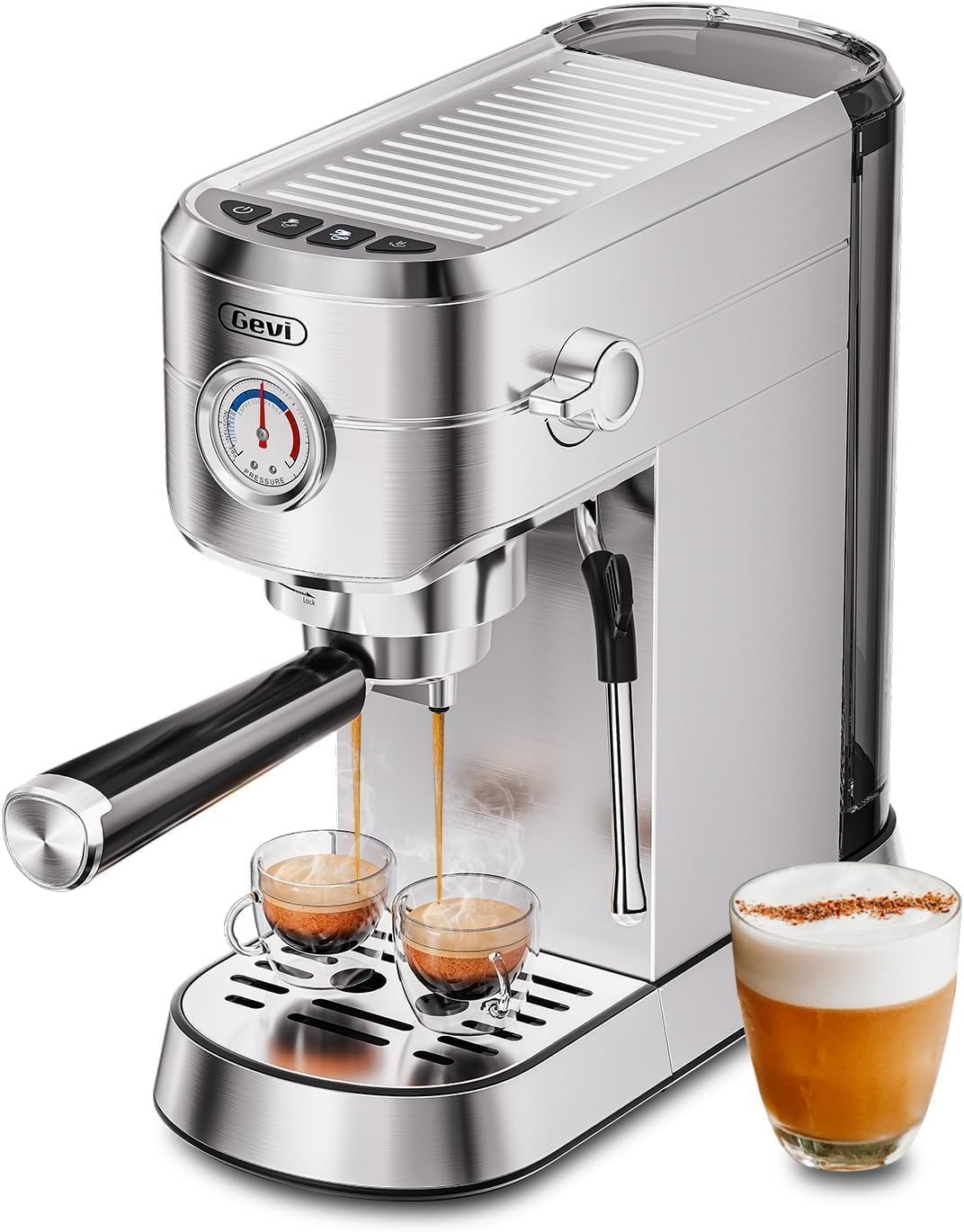
1. Gevi 20 Bar Compact Espresso Machine (Best Overall)
Key Specs: 20-bar pump | NTC temperature control | Pre-infusion | Built-in pressure gauge | Hot water function | Stainless steel housing
The Gevi was the machine that made me stop and pay attention. It’s not just another box with a pump. It has NTC temperature control, which is the same tech found in pricier machines. This means the water stays at a consistent heat throughout the shot.
What I liked: The first shot I pulled was actually drinkable. Not sour, not burnt. Just a solid, balanced espresso with a nice layer of crema. The pressure gauge on the front is a huge plus. I could see exactly where the needle sat and adjust my grind accordingly.
The steam wand is powerful enough to turn milk into silky microfoam for a cappuccino, and the hot water function is a thoughtful addition for making Americanos or tea. The full stainless steel body also feels way more premium than the plastic-heavy competition.
It has some heft to it, and it doesn’t wobble when you lock in the portafilter.
The catch: The steam wand is detachable. Some people find this a bit flimsy compared to a fixed wand, but I didn’t have any issues with it. Also, this is the priciest machine on the list. You’re paying for a more complete feature set, and it’s worth it.
Who it’s for: The person who wants to actually learn how to dial in espresso. The gauge and pre-infusion give you the tools to tweak and improve. It’s a machine you can grow with.
Who it’s not for: The absolute tightest budget. If you can only spend a little, look at the next one.
2. AMZCHEF Compact Espresso Machine (Best Value)
Key Specs: 1350W | PID temperature control (±2°C) | 30-second heat-up | 50 oz water tank | 360° steam wand
This one surprised me. At a lower price point, I expected to find a machine that cut corners. The AMZCHEF doesn’t. It has actual PID temperature control, which is the single most important feature for avoiding bitter or sour shots.
What I liked: The heat-up time is genuinely fast. Thirty seconds from flipping the switch to being ready to brew. The water tank is massive. You’re not constantly refilling it. I pulled several shots back-to-back one morning, and the temperature stayed consistent the whole time.
The PID controller did its job. The steam wand rotates 360 degrees, which is great for positioning your milk pitcher, and it produces decently textured foam. Not as thick as the Gevi, but totally fine for a home latte.
The catch: The brand isn’t as well-known, so long-term reviews are harder to find. The steam wand is good, but it’s not a high-end microfoam wand. If you’re a serious latte art enthusiast, you might want more power.
Who it’s for: The budget-conscious buyer who refuses to sacrifice temperature stability. You get the most important tech for the least money.
Who it’s not for: Someone who needs a pressure gauge or a more established brand name for peace of mind.
3. CHULUX Slim Espresso Machine (Best for Beginners & Small Spaces)
Key Specs: 20-bar Italian pump | Pre-infusion | Pressure gauge | Auto shut-off | 40 oz tank | 5.5 inches wide
If your counter space is a battlefield, the CHULUX is your ally. It’s only 5.5 inches wide, which is narrower than my bag of coffee beans. But its size doesn’t mean it’s stripped down.
What I liked: It has a pressure gauge and pre-infusion, which are rare finds at this size and price. The auto shut-off feature is a lifesaver. The machine turns off after 25 minutes of inactivity, which is perfect for my groggy morning brain.
The espresso it produces is consistent, with good crema. It’s very beginner-friendly. You fill it, press a button, and get a decent shot.
The catch: The steam wand is powerful, but it has a bit of a learning curve. My first few attempts at frothing resulted in some oversized bubbles. The plastic housing doesn’t feel as premium as the Gevi’s stainless steel. It’s not flimsy, but it’s not luxury either.
Who it’s for: Apartment dwellers, dorm residents, or anyone with limited counter space who wants a feature-rich machine. Also great for people who want auto shut-off for safety.
Who it’s not for: Someone who wants a heavy, premium-feeling machine or who is an experienced barista looking for maximum steam control.
4. XIXUBX Espresso Machine (Best Feature Set for the Price)
Key Specs: PID temperature control | Pre-infusion | Noise-reduction design | Includes stainless steel frothing pitcher | 34 oz tank
The XIXUBX is the dark horse of the list. It checks almost every box on paper. It has PID control. It has pre-infusion. It even comes with a nice stainless steel frothing pitcher, which is a thoughtful bonus.
What I liked: The shot quality is genuinely good. The pre-infusion helps prevent channeling, and the PID keeps the temperature steady. The noise-reduction design is real. It’s noticeably quieter than the CASABREWS or the AMZCHEF.
I brewed a shot early one morning without waking up my partner. The included pitcher is a nice touch that saves you a few bucks.
The catch: The brand is relatively new and obscure, with a smaller review history. It’s hard to know how the machine holds up after six months of daily use. The build quality feels good, but the long-term durability is an unknown.
Who it’s for: Early adopters who want a feature-packed machine and don’t mind a lesser-known brand. It’s a great value if you’re willing to take a small gamble.
Who it’s not for: Someone who prioritizes brand reputation and long-term reliability above all else.
5. atatix Espresso Machine (Best for Manual Control)
Key Specs: NTC temp control | Manual extraction up to 102 seconds | 4 suction cup base | 20 bar pump
The atatix is a niche machine. It’s built for the tinkerer who wants control over the entire shot, including the extraction time. You can hold the button and manually pull a shot for up to 102 seconds, which is a long time in espresso world.
What I liked: The NTC temperature control keeps things stable. The four suction cups on the bottom are a great touch. The machine doesn’t slide around when you’re locking in the portafilter or frothing milk.
The manual mode is fun if you want to experiment with different extraction lengths for lighter roasts.
The catch: The manual mode is a bit gimmicky for most people. At this price point, most users just want a simple, consistent shot. The “Brushed Silver” finish picks up fingerprints like crazy. I had to wipe it down constantly to keep it looking clean.
Who it’s for: The espresso nerd who likes to experiment and wants to control every variable.
Who it’s not for: Anyone looking for a set-it-and-forget-it morning routine.
6. CASABREWS CM5418 (The “Gauge” Magnet)
Key Specs: 20-bar Italian pump | Built-in pressure gauge | 1350W boiler | 34 oz tank
The CASABREWS CM5418 is the most popular machine on this list by raw review count. You’ve probably seen it. It has that big, beautiful pressure gauge on the front that looks serious. But I have a problem with it.
What I liked: The gauge is large and easy to read. It’s a useful tool for learning how pressure relates to your grind. The build is decent, and it looks nice on a counter.
The catch: This machine does not have PID temperature control. The manual even warns you about a “cool down” period. You can’t brew coffee immediately after frothing milk because the machine will overheat. I experienced this firsthand.
The first shot was okay, but the second shot in a row was noticeably burnt. The steam wand is also weaker than the competition. It produces wetter, less textured foam.
Who it’s for: The absolute beginner who is drawn to the gauge and doesn’t plan on pulling multiple shots in a row. It’s a fine learning tool.
Who it’s not for: Anyone who wants consistent, high-quality espresso, especially if you’re making drinks for more than one person.
7. AAOBOSI Espresso Machine (High Rating, Low Volume)
Key Specs: PID temperature control | 8mm steam wand | Custom extraction time | 3.1 lbs
This one lands at the bottom, and it’s purely because of the data gap. On paper, the AAOBOSI looks promising. It claims to have PID temperature control, a powerful 8mm steam wand, and a custom extraction time.
What I liked: The specs are good. The price is right. I wanted to like it. The steam wand did produce decent microfoam in my testing.
The catch: It has very few reviews. The brand is unknown. It’s a gamble. The physical dimensions are also deeper than the others, so it takes up more counter space. Without a track record, I can’t confidently recommend it over the more proven machines above.
Who it’s for: The risk-tolerant shopper who wants a machine with good specs and doesn’t mind being an early adopter.
Who it’s not for: Anyone who wants a reliable machine with a proven track record.
How to Choose the Best 20 Bar Espresso Machine for You
Still stuck? Let me make it simple based on what you care about most.
If You Want the Best Crema and Most Control
Get the Gevi 20 Bar Compact. It has the pressure gauge, the temperature stability, and the best steam wand of the bunch. It’s the most complete package.
If You’re on a Tight Budget
Get the AMZCHEF Compact. It doesn’t cut corners on the most important feature: temperature control. It’s the best way to get consistent shots without spending a lot.
If You Have a Small Kitchen
Get the CHULUX Slim. It’s only 5.5 inches wide and has all the features a beginner needs, including auto shut-off for peace of mind.
If You Want a Gauge (But Be Careful)
The CASABREWS CM5418 has a great gauge, but remember it’s a starter machine. If you only make one drink a day, it’s fine. If you want to learn and grow, look at the Gevi.
Quick Comparison Table
| Product | Key Feature | PID? | Pre-Infusion? | Best For |
|---|---|---|---|---|
| Gevi | Gauge + Hot Water | Yes (NTC) | Yes | Best Overall |
| AMZCHEF | Large 50oz Tank | Yes | No | Best Value |
| CHULUX | Slim Design | Yes | Yes | Best for Beginners |
| XIXUBX | Comes with Pitcher | Yes | Yes | Feature Set for Price |
| atatix | Manual Extraction | Yes (NTC) | No | Tinkerers |
| CASABREWS | Pressure Gauge | No | No | Entry-Level Learning |
| AAOBOSI | 8mm Steam Wand | Yes | No | High-Risk, High-Spec |
Final Verdict: The 20 Bar Myth Debunked
After testing all of these machines, here’s what I know for sure. The “20 bar” number is a marketing tool designed to catch your eye. It’s not a lie, but it’s not the whole truth. The real winners in this category are the machines that know what to do with that pressure.
They have PID temperature control to keep the water stable. They have pre-infusion to wet the puck gently. They have a powerful steam wand to make real microfoam.
Don’t get fooled by the big number on the box. Get the machine that controls the temperature. For me, the Gevi 20 Bar Compact is the one that delivers the best balance of features, build quality, and real-world performance.
If your budget is tighter, the AMZCHEF Compact is the smartest compromise you can make. You don’t need to spend a fortune to get a good shot. You just need to know what to look for.
Frequently Asked Questions
Is a 20 bar espresso machine better than a 15 bar one?
Not necessarily. The number refers to the pump’s maximum pressure, but an Over-Pressure Valve limits it at the brew head to around 9–15 bars. A machine with a 15 bar pump and good temperature control can easily outperform a 20 bar machine with no PID.
What does PID temperature control do for espresso?
It keeps the water temperature steady throughout the shot. Without PID, the water heats up erratically, leading to inconsistent extraction. With PID, your first shot and your fifth shot will taste the same.
Do I need a pressure gauge on my espresso machine?
You don’t need it to make good espresso, but it helps. A gauge teaches you how grind size and tamp pressure affect the shot. It’s a great learning tool, but you can also learn by taste without one.
Can I make latte art with these budget 20 bar machines?
Some are better than others. The Gevi and the XIXUBX have steam wands that produce dense, dry microfoam suitable for basic latte art. The CASABREWS and AAOBOSI produce wetter foam that is harder to work with.
Why does my cheap espresso machine keep overheating?
Machines without PID control, like the CASABREWS CM5418, lack the electronics to regulate temperature. The boiler gets too hot when used back-to-back. You have to wait for it to cool down between shots or after steaming milk.