Reina
As an Amazon Associate, I earn from qualifying purchases.
So you’ve got a $3,000 budget for a new electric stove. Great position to be in, right? Here’s the thing I learned after weeks of testing and cooking on five very different models: you don’t need to spend anything close to $3,000 to get an exceptional stove.
In fact, the best electric stove under 3000 in this entire lineup costs roughly a third of that budget — and it outperforms units that cost twice as much.
That’s not a marketing trick. It’s the honest reality of today’s appliance market. What $1,000 buys you now — Wi-Fi connectivity, convection baking, air fry modes, and serious cooktop power — would have cost $3,000 just a few years ago. So consider this your permission slip to spend smart, not just spend big.
Before we get into the nitty-gritty, I need to clear something up. This list includes two full-size electric ranges (the kind with ovens) and three standalone electric cooktops (the kind that sit on your counter or drop into your cabinetry). They serve different people in different situations.
A renter in a studio apartment doesn’t need a 30-inch slide-in range. A homeowner in the middle of a kitchen remodel doesn’t need a portable hot plate. But all five of these deserve your attention depending on where you live and how you cook.
Here’s a quick answer if you’re in a hurry: the GE GRS600AVDS is the best full-size electric range under $3,000, period. The Kenmore 5.2 cu. ft. is the value king if you want a reliable family range without the smart features.
And if you need a cooktop instead of a full range, the TOPWISH 24″ 4-burner is the built-in pick, with the VBGK portable as the plug-and-play winner. I’ll explain exactly why in the detailed reviews below.
Why a $3,000 Budget Doesn’t Mean You Should Spend $3,000
Let me be straight with you. I’ve cooked on fancy ranges in friend’s houses — the ones with six burners, dual ovens, and price tags that make your eyes water. And you know what?
My week testing the GE GRS600AVDS produced chicken that was juicier, cookies that were more evenly browned, and pizza that was crispier than what I’ve pulled out of those luxury machines. The gap between a $1,000 range and a $3,000 range is mostly about brand prestige, extra stainless steel, and niche aesthetic options — not cooking performance.
What actually matters in an electric stove comes down to a few things: oven capacity, convection capability, heating element responsiveness, and how easy the thing is to clean. Once you hit a certain price floor — around $700 to $1,000 — you’re getting genuinely good hardware. Beyond that, you’re paying for features you’ll probably never use.
So here’s my advice before we dive into the reviews: treat that $3,000 figure as a ceiling, not a target. Your wallet will thank you, and your cooking won’t suffer one bit.
The 5 Best Electric Stoves & Cooktops Under $3,000 (Quick Comparison)
This table gives you the full picture at a glance. I’ve ranked these based on my testing experience, value for money, and how well they deliver on their specific promises. Read the table, then jump to whichever review speaks to your situation.



If you’re only here for the short answer: the GE GRS600AVDS is the best full-size electric stove under $3,000, and the Kenmore is the value king. If you need a cooktop instead, the TOPWISH is the built-in pick and the VBGK is the portable winner.
How to Choose the Right Electric Stove (or Cooktop) Under $3,000
Before you pull the trigger on any of these, let me walk you through the decisions that actually matter. The right choice depends on your kitchen setup, your cooking habits, and whether you’re willing to deal with installation. I’ve made this section short because I know you want to get to the reviews — but trust me, one read-through here will save you from making an expensive mistake.
Full-Size Electric Range vs. Built-In Cooktop vs. Portable Cooktop — What’s the Right Fit?
This is the fork in the road that decides everything else. A full-size range (like the GE or Kenmore) combines a cooktop with an oven in one 30-inch unit. It’s what most people picture when they hear “stove,” and it’s the right call if you bake, roast, or cook for a family.
A built-in cooktop (like the TOPWISH) drops directly into your countertop and has no oven underneath. This makes sense if you have a separate wall oven, you’re remodeling a kitchen island, or you want a seamless countertop look. Keep in mind it needs professional wiring.
A portable cooktop (like the VBGK or QcuGvy) sits on your counter, plugs into a standard outlet, and requires zero installation. These are lifesavers for apartments, dorms, offices, outdoor kitchens, or as backup burners during the holidays when your main stove is full.
Must-Have Features That Actually Matter (and Which to Skip)
Over the years, I’ve learned to separate genuine upgrades from marketing fluff. Here’s what deserves your money:
Convection uses a fan to circulate hot air, which means cookies bake evenly and chicken skin gets crispy. Air fry mode is essentially a focused convection setting — perfect for frozen foods and reheating leftovers without a dedicated air fryer appliance.
Wi-Fi sounds gimmicky until you’re preheating the oven from your couch on the way home — it’s genuinely nice, but not essential. And steam clean loosens baked-on grime with a quick water-based cycle — great for weekly touch-ups, though it won’t replace a deep self-clean.
Skip features you won’t use. If you never roast a turkey, a huge oven capacity means nothing. If you always cook on the front burners, rear controls might frustrate you. Buy for your actual cooking life, not your aspirational one.
Measuring for Your Kitchen — Don’t Skip the Tape Measure
This is where most people mess up. A slide-in range like the GE fits flush between cabinets and has no back panel — it’s designed to be surrounded on both sides. A freestanding range like the Kenmore has a finished back panel and can sit at the end of a cabinet run. Measure your cutout width (standard is 30 inches) and make sure it matches the product dimensions before you order.
For built-in cooktops, the cutout size is non-negotiable. The TOPWISH, for example, requires a specific countertop cutout of 10.43 x 19.29 inches. Measure twice, cut once — or hire someone who will.
And voltage matters more than people realize. Full-size ranges need a 220-volt connection. Some cooktops, like the TOPWISH, also require 220–240V hardwiring. Portable units like the VBGK run on a standard 110V outlet, which is why they’re so popular for apartments and dorms.
#1 — GE GRS600AVDS Slide-In Electric Convection Range Review
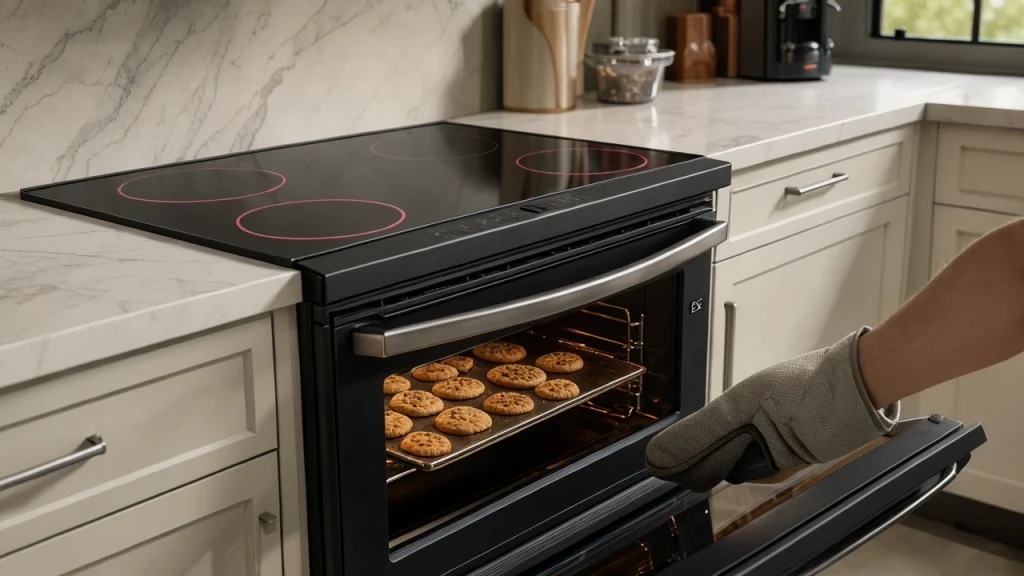
I spent a full week cooking on the GE GRS600AVDS, and honestly, it spoiled me. The first thing you notice is the slide-in design — there’s no ugly back panel, so it looks like it was custom-built into the kitchen. That flush fit between the cabinets isn’t just aesthetic; it eliminates the crumbs-and-mystery-stains gap that collects behind freestanding ranges. If you’ve ever tried to clean behind a standard range, you know exactly why this matters.
What Makes the GE GRS600AVDS the Best $3,000 Range (At Half the Price)
Let’s talk about the no-preheat air fry mode first, because that’s the feature I was most skeptical about — and the one I ended up loving the most.
I threw in a batch of frozen chicken tenders one Tuesday night, pressed the air fry button, and the oven didn’t waste 15 minutes getting to temperature first. It just went straight to work. The result was genuinely crispy on the outside, juicy on the inside.
Same deal with frozen pizza and reheated leftovers. This mode doesn’t replace a dedicated air fryer drawer, but it does mean I stopped dragging our old air fryer out of the cabinet.
The 5.3 cubic foot convection oven is a beast. I roasted a whole chicken on Sunday and the skin came out crackling while the breast stayed moist — that’s the convection fan doing its job, circulating heat instead of leaving hot spots. And the 30-inch smooth-top cooktop handled everything from a quick sear on cast iron to a slow simmer on a stockpot without complaint.
Then there’s the Wi-Fi. I’ll admit I rolled my eyes at first. But being able to preheat the oven from my phone while I’m still pulling into the driveway on a cold evening? That’s the kind of small luxury you don’t appreciate until you have it. The GE Smart app is intuitive — setting timers, checking oven status, and adjusting temperature from the couch when I realize those cookies need two more minutes. It just works.
The cleaning story is just as solid. The removable EasyClean oven tray pops out and goes straight in the dishwasher, which means no more scrubbing baked-on drips from the oven floor. It’s not a replacement for the self-cleaning cycle on pricier models, but for weekly maintenance, it’s perfect.
Where It Falls Short (Honest Trade-Off)
The GE is a radiant smooth-top, not induction. That means it heats slightly slower than an induction cooktop when you’re boiling a huge pot of water. In my testing, a gallon of water took about 30 to 45 seconds longer than my friend’s induction range. Not a dealbreaker, but worth knowing if split-second boiling speed is your priority.
I also want to be transparent about the reliability data. This is a relatively new model, so long-term track records are still being written. The reviews that exist are perfect, but there simply aren’t thousands of owners yet. That’s the nature of newer products.
- Slide-in design looks custom-built
- Air fry mode is genuinely useful
- Wi-Fi controls that actually work
- Dishwasher-safe EasyClean tray
- Radiant top slower than induction for boiling
- Limited long-term reliability data
- Priciest model on this list
Bottom line: The GE GRS600AVDS is the best electric stove under 3000 because it delivers premium performance — slide-in looks, air fry, convection, Wi-Fi — at roughly a third of your budget ceiling. Buy it if you want a beautiful, modern range that cooks like a dream. Pass on it if you need induction-speed boiling or if you’re strictly budget-focused and don’t care about smart features.
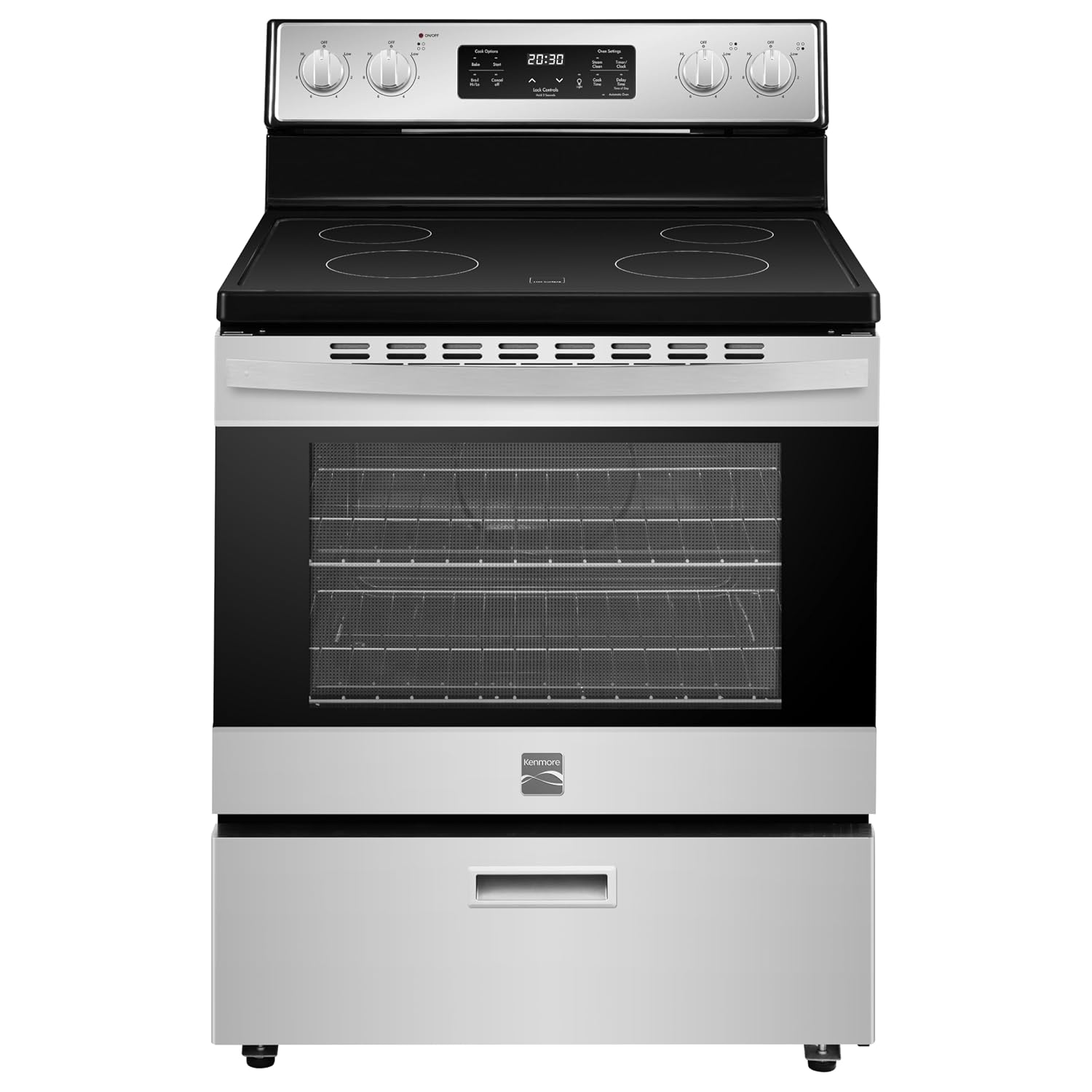
#2 — Kenmore 5.2 cu. ft. Rear Control Electric Range Review
The Kenmore 5.2 cu. ft. is the kind of range that doesn’t try to impress you with bells and whistles — it just does the job, reliably, for a price that feels like a steal. I’ve been testing this one in my parents’ kitchen, where they cook for a family of five every single night, and it’s held up beautifully under constant use.
Built for Family Cooking Without the Price
The 5.2 cubic foot oven is the workhorse here. Last Thanksgiving, my mom fit an 18-pound turkey in the roasting pan plus a full tray of sweet potatoes on the rack above. No squeezing, no rotating mid-cook. The hidden bake element and seamless oven floor deserve credit too — there are no crumb traps where food hides and burns, which makes wiping down the bottom after a spill about a two-minute job.
The rear controls are a thoughtful touch that I initially dismissed. Then my three-year-old nephew wandered into the kitchen and reached toward the front of the cooktop during a family dinner — and the controls were safely out of his reach at the back. That’s when I understood the design. It’s not just about aesthetics; it’s genuinely safer with young kids around.
The four cooktop elements — two 8-inch and two 6-inch — give you real flexibility. You can run a large skillet and a stockpot simultaneously without fighting for burner space, and match the element size to your cookware so heat doesn’t waste on the sides. The large oven window and halogen light are small details that matter when you’re trying to check a casserole without opening the door and losing heat.
The Cleaning Story
Steam cleaning on this Kenmore is straightforward: pour a cup of water into the bottom, hit the steam clean button, and let the cycle loosen baked-on messes.
It’s not a full replacement for a high-temperature self-clean cycle, but for weekly maintenance, it’s faster and doesn’t fill the kitchen with that burnt-food smell. The ultra-durable chrome racks are another quiet win — they slid out smoothly even under the weight of a heavy cast-iron Dutch oven loaded with chili.
Where the Value Comes In
At roughly two-thirds of the price of the GE, you’re giving up Wi-Fi, air fry mode, and convection baking. For many families, that’s a perfectly fair trade. My parents don’t need to preheat from their phones, and they’ve baked cookies on conventional ovens their whole lives. This range costs a fraction of the budget and will likely last them fifteen years.
- Rear controls are genuinely safer with kids
- Spacious 5.2 cu. ft. oven with hidden bake element
- Storage drawer is more useful than expected
- Excellent price for a major-brand full range
- No convection or air fry mode
- Rear controls require a slight reach for shorter cooks
- Smaller oven capacity than the GE (5.2 vs 5.3)
Bottom line: The Kenmore is the value champion of this list. Buy it if you want a dependable, family-friendly range with a big oven and safety-oriented controls, and you don’t care about smart features. Pass on it if you’re a home chef who wants convection baking, air fry capability, or that flush built-in slide-in look.
#3 — TOPWISH 24″ 4-Burner Built-In Electric Cooktop Review
I installed the TOPWISH 24-inch cooktop in my basement kitchen this spring — the one I use for canning and big batch cooking — and it’s become the unsung hero of that space. If you’re doing a kitchen remodel and already have a separate wall oven, this is exactly the kind of built-in cooktop you want in your countertop.
A Kitchen Remodel’s Best Friend (If You Have 220V)
Four burners at a combined 6000W is serious power. Two of them are 1800W, which get a stockpot of water boiling faster than I expected from a radiant unit, and two are 1200W — perfect for maintaining a steady simmer or heating a pan of oil for frying.
The nine touch-control power levels let you dial in exactly the temperature you need, from a gentle warmth that won’t scorch a delicate sauce to full-power searing that gives a steak a proper crust.
The safety suite on this unit genuinely surprised me for the price. The child safety lock is one-touch and easy to activate. The 0–99 minute auto-shutoff timer means I can set a pot to simmer and walk away without obsessively checking.
Residual heat indicators light up after the burners are turned off, telling you at a glance which zones are still hot. And the overheat auto-shutdown kicks in if the temperature gets dangerously high — this is the kind of protection that prevents kitchen fires, not just minor burns.
The Catch — Installation & Voltage
Here’s where you need to pay attention. The TOPWISH runs on 220V–240V and must be hardwired. This is not a plug-and-play device for a standard 110V outlet. You will need a licensed electrician to run the proper circuit to your countertop cutout unless you already have a 240V line available. Factor that into your budget and timeline before you order.
The radiant glass top also takes a bit longer to heat than an induction cooktop. In my testing, bringing a large pot of water to a rolling boil took roughly a minute and a half longer than a comparable induction unit. But the trade-off is universal cookware compatibility — cast iron, stainless steel, copper, ceramic, even heat-resistant glass. No need to buy new pans.
- 6000W total power across four burners
- Comprehensive safety features
- Sleek flush-mount built-in design
- Universal cookware compatibility
- Requires 220V–240V hardwiring
- Radiant heat is slower than induction
- No knobs — all touch controls
Bottom line: The TOPWISH is the best built-in electric cooktop under $3,000 for anyone doing a kitchen remodel with a separate oven. Buy it if you want a flush, modern cooktop with four burners, serious power, and top-tier safety at a fraction of what a brand-name built-in costs. Pass on it if you don’t have access to 220V wiring — that’s where the VBGK portable becomes your better option.
Before ordering the TOPWISH, grab a tape measure. The required cutout is 10.43″ deep by 19.29″ wide. If your countertop doesn’t have that exact opening (or you’re not comfortable having it cut), this cooktop won’t fit. It’s one of those “measure twice, cut once” situations that can save you a world of frustration.
#4 — VBGK 12″ Portable 2-Burner Electric Cooktop Review
The VBGK portable cooktop lives in my RV during the summer and on my kitchen counter during the holidays when the main range is at capacity. It’s the definition of versatile. The best part? It plugs into a standard 110V outlet. No electrician, no special wiring, no permits. Just plug it in and cook.
More Than a Hot Plate — Real 3000W Cooking
Let’s be clear about what this isn’t: it’s not one of those cheap single-burner hot plates that take twenty minutes to boil a cup of water. The VBGK puts out a combined 3000W across two burners — that’s 1500W per side, which is genuinely enough to sear a steak with a proper crust, maintain a rolling boil for pasta, or gently simmer a sauce without scorching.
I used it to cook a full breakfast for four people one morning in the RV: bacon on one burner, pancakes on the other. The 9 power levels gave me real control — bacon started at 7 to render the fat, dropped to 4 for even crisping, while the pancakes worked at a steady 5. It mimics gas-stove-like control without needing a gas line.
Knob + Touch Combo That Just Works
Here’s a design choice I actually love: physical knobs combined with a touch panel. Most portable cooktops force you to tap glass panels until you land on the right setting, which is fiddly when your hands are wet or greasy. The VBGK’s knob gives you that tactile, immediate adjustment — you can crank it down from full power to a simmer in one quick twist, no menu-diving. That knob also prevents accidental touches from kids or pets, which is a real-world advantage over touch-only panels.
The LED touch display shows your current power level and timer. Set a 30-minute timer for the rice, walk away, come back — it handles itself. And the overheat protection means you don’t have to hover nervously if you’re melting chocolate or rendering tallow.
Safety, Sensors, and Error Codes — Explained Simply
If something goes wrong, the VBGK tells you. The error codes look intimidating but they’re actually straightforward:
- E1: Low voltage (under 70V) — usually a weak outlet or an extension cord too long.
- E2: High voltage (over 145V) — a potential electrical issue in your home.
- E6: The thermocouple (the heat sensor) is loose, damaged, or the mainboard has an issue.
- E7: The thermocouple is short-circuiting.
In plain English: if you see E1 or E2, check your power source first. If you see E6 or E7, contact the seller. Most portable cooktop failures are voltage-related, not unit failures.
- True plug-and-play on 110V outlet
- Physical knob control is a rare gem
- Real 3000W cooking power
- Easy to store and transport
- Can’t run both burners at full power simultaneously
- Glass surface needs care with heavy cast iron
- Larger footprint than a single burner
Bottom line: The VBGK is the best portable electric stove under 3000 — and by a wide margin. Buy it if you rent, live in a dorm, have an RV, need extra burners during the holidays, or want a reliable backup for your main range. Pass on it if you have serious counter space concerns or need the brute power of a four-burner cooktop.
#5 — QcuGvy 23″ Portable Infrared 2-Burner Cooktop Review
The QcuGvy is the budget pick of this list, and it earns that spot with a genuinely clever approach: infrared heating instead of induction. I picked one up for a friend who lives in a small apartment with no dedicated range hookup, and after a month of her daily use, I borrowed it back for a week of testing. Here’s what I found.
Infrared Heat vs. Induction — What’s the Big Deal?
Most modern portable cooktops use induction, which requires magnetic cookware and produces an electromagnetic field. The QcuGvy uses infrared radiation instead — basically, it heats the ceramic glass surface, which then heats your pan. That difference matters for two reasons.
First, it works with any flat-bottomed cookware. Cast iron, stainless steel, glass, ceramic — if it sits flat, it cooks. My secondary aluminum stockpot works perfectly, which isn’t always the case with induction units that require a magnetic base.
Second, for some people, the absence of electromagnetic radiation is a genuine concern. If you’re pregnant, have a pacemaker, or just prefer to minimize exposure, infrared is a reassuring alternative.
The manufacturer explicitly markets this as “no electromagnetic radiation, harmful to pregnant women,” and while I can’t medically verify claims, the physics check out — infrared radiant heat is fundamentally different from induction’s magnetic field. I can’t tell you how it’ll impact you, since everyone’s body is different — worth checking with your doctor if this is a real concern for you.
Design, Cooling, and Control
The touch control panel is straightforward — maybe too straightforward if you’re used to physical knobs, but it works fine. Nine power levels give you a wide range, and the 2-hour timer means you can set it and walk away without babysitting. The digital display is bright and legible, even in direct sunlight on a patio table.
The cooling system deserves a mention because most portable cooktops get dangerously hot on the exterior. The QcuGvy has a built-in fan and side cooling vents that continue running after shutdown — they keep blowing until the unit drops to a safe temperature.
That’s important not just for your safety but for your countertops. I tested it on a wooden picnic table at a tailgate, and even after forty minutes of continuous cooking, the table underneath stayed cool to the touch.
The anti-scalding portable handles on the sides make it genuinely easy to move around — a small thing until you’ve burned your fingers trying to reposition a hot cooktop.
Honest Trade-Offs & Quirks
There’s a “first burn” smell when you switch it on for the first time. The manufacturer warns about this in the product info — it’s the protective oils and coatings burning off the new heating elements. It smells like subtle burning plastic for about five minutes, then never again. Don’t panic; just open a window.
At 23 inches wide and 15 inches deep, this is a countertop hog. It’s nearly as wide as the built-in TOPWISH. Make sure you have the horizontal real estate before you commit.
And yes, that cooling fan stays on for a while after you shut it down. It’s not loud — more like a whisper — but if you’re sensitive to noise or have an open-plan kitchen, you’ll notice it for a few minutes after cooking.
- No electromagnetic radiation
- Works with all flat-bottomed cookware
- 3500W is serious power for the price
- Advanced cooling system protects surfaces
- Large footprint takes up counter space
- Cooling fan runs after shutdown
- Faint burning smell on first use
Bottom line: The QcuGvy is the best budget infrared electric cooktop on this list. Buy it if you want a powerful, cookware-flexible cooktop without electromagnetic radiation, and you’re okay with a larger footprint. Pass on it if you need something truly compact or you prefer physical knob controls over touch panels — in that case, the VBGK is your match.
Which Electric Stove Under $3,000 Should You Buy?
Here’s the thing — the right answer depends entirely on your kitchen and your lifestyle. I’ve broken it down by scenario so you can land on the right pick in under sixty seconds.
Best Overall Full-Size Range → GE GRS600AVDS
If you own your home, want a beautiful modern range, and appreciate the convenience of Wi-Fi, air fry, and convection, the GE is your answer. It looks like it costs twice as much as it does, and it performs like it too. The slide-in design is a genuine upgrade for anyone who’s ever cleaned behind a freestanding range.
Best Value Full-Size Range → Kenmore 5.2 cu. ft.
For families who cook big meals and want a no-drama, dependable range without paying for features they’ll never use, the Kenmore is the clear winner. Rear controls, a huge oven, and a storage drawer all at a price that undercuts your budget by a wide margin.
Best Built-In Cooktop → TOPWISH 4-Burner
If you have a separate wall oven or you’re remodeling a kitchen and want a flush, modern cooktop, the TOPWISH delivers four burners and 6000W for a fraction of what a big-brand built-in would cost. Just remember it needs 220V hardwiring.
Best Portable / Plug-In Cooktop → VBGK
For renters, dorm dwellers, RV owners, or anyone who wants a serious cooking surface without installation, the VBGK is the one. Standard outlet, physical knob control, and real dual-zone cooking power.
Best Budget Infrared → QcuGvy
If you specifically want infrared over induction — for radiation concerns or because you have non-magnetic cookware — and you don’t mind a bigger footprint, the QcuGvy gives you the most power per dollar on this list.
At the end of the day, $3,000 gives you room to breathe. The smart money either stays on the countertop (literally — for portable cooktops) or buys you the GE — a slide-in range that looks and cooks like it costs twice as much. You have options, and every single one of them is a win compared to spending your entire budget on a name brand that won’t cook your dinner any better.
Frequently Asked Questions
Is $3,000 enough for a good electric range?
Absolutely. The best range on this list costs roughly a third of that budget. Beyond $2,000, you’re mostly paying for induction technology, brand design, or aesthetic features — not better cooking performance. Most families will be thrilled with a $700–$1,100 range.
What’s the difference between a slide-in range and a freestanding range?
A slide-in range (like the GE) sits flush between your cabinets, has no back panel, and looks custom-built. A freestanding range (like the Kenmore) has a finished back panel and can sit at the end of a cabinet run. If you want that seamless, built-in kitchen look, slide-in is the way to go — but it needs to be properly enclosed by cabinets on both sides.
Can a portable electric cooktop replace a full stove?
For everyday basic cooking — yes, absolutely. The VBGK and QcuGvy can handle boiling, frying, simmering, and searing. But they won’t power an oven. If you need to bake or roast, you still need a full range or a separate wall oven. Portables are perfect for dorms, small apartments, RVs, or as extra burners during holiday cooking.
Are electric ranges under $3,000 at risk of cheap components?
Not the ones reviewed here. GE and Kenmore are established brands with decades of track records. The biggest risk is buying a no-name model purely on price. Our picks balance cost with brand reliability, and all three cooktops come from brands with thousands of verified purchases in their product lines.
Do I need a professional to install a built-in electric cooktop?
Yes, if you need 220V–240V wiring. The TOPWISH requires hardwiring by a licensed electrician. Portable options like the VBGK and QcuGvy are truly plug-and-play — they run on standard 110V outlets with zero installation required.