Reina
As an Amazon Associate, I earn from qualifying purchases.
I’ve cooked on all three major cooktop technologies over the years—gas, radiant electric, and induction—and I can tell you the answer isn’t as simple as picking a side.
The real problem is that most people compare “gas versus electric” without realizing they’re actually comparing gas against two wildly different electric technologies that barely resemble each other in how they cook.
Let me clear that up right now. If you’re reading this because you’re weighing appliance options, here’s what you actually need to know before you spend a dime.
- Induction is the real star: Induction electric outperforms gas on speed, precision, and safety for the vast majority of home cooks.
- Radiant electric loses to gas: Traditional coil or smooth-top electric falls behind gas on control and can end up costing similar money long-term.
- Your final answer depends on three things: cookware, electrical setup, and cooking style—not brand loyalty or trend-following.
The Verdict No One States Clearly — It Depends on Which “Electric” You Mean
Here’s the confusion that derails every conversation about cooktops.
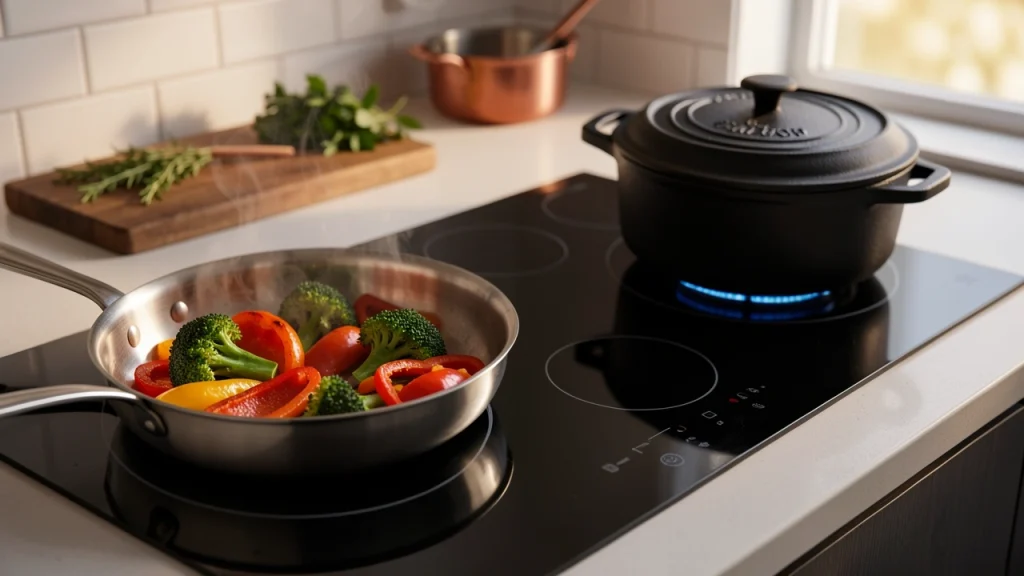
When people say “electric,” they’re usually picturing either a radiant cooktop (the smooth glass surface or exposed coils that get red-hot) or an induction cooktop (which uses a magnetic field to heat the pan directly).
These are so different that lumping them together is like comparing a microwave to a conventional oven just because both plug into the wall.
Gas burns natural gas to create an open flame. That flame transfers heat to your pan through direct contact and convection.
Radiant electric passes current through a metal element that glows hot, and that heat moves through the glass surface to your pan.
Induction uses electromagnetism to generate heat inside the pan itself, so the surface stays relatively cool and the pan becomes its own burner.
Ask yourself: does the cooktop get hot, or does the pan get hot? If the surface glows red, it’s radiant. If the pan heats while the surface stays cool, it’s induction. This single observation tells you everything about performance differences.
Once you understand that distinction, the verdict becomes clear. Induction electric beats gas on nearly every measurable cooking metric that matters to home cooks. Radiant electric doesn’t.
So the honest answer to “are electric cooktops better than gas” is: the induction kind is, and the radiant kind isn’t.
Anyone who tells you otherwise without making this split is giving you half the story.
Performance Face-Off — Speed, Precision, and Heat Consistency
Let me walk you through what actually happens when you cook on each technology, because the numbers tell a story that gut instinct often gets wrong.
Boiling speed is where induction shocks everyone the first time they use it. A liter of water that takes 10 to 12 minutes on gas climbs to boiling in about 5 to 7 minutes on induction.
Radiant electric waits the longest at 12 to 15 minutes because it has to heat the glass first before the pan even starts warming. That difference changes how you plan meals.
You stop putting water on while you prep because it’s already boiling.
Temperature response latency is the next battleground. When you reduce heat on induction, the pan cools within two seconds. Gas takes three to five seconds—still respectable.
Radiant electric is the laggard by far; those coils stay hot for three to five minutes after you turn them down.
If you’ve ever tried to rescue a sauce that was boiling over on a radiant cooktop, you know exactly how frustrating that residual heat can be.
Low-simmer precision is where radiant electric completely falls apart. That technology cycles on and off to maintain temperature, which causes the pan to swing through wide temperature ranges.
Stocks, sauces, and delicate reductions that need steady low heat suffer badly on radiant. Induction holds within a couple degrees.
Gas sits in between, with the flame producing a steady heat but the ambient air currents still causing minor drift.
There are two cooking scenarios where gas irrefutably wins. Wok cooking is one.
The flame wraps around the sides of the wok, generating that smoky char called wok hei that stir-fry enthusiasts obsess over. No electric technology replicates that flame contact.
Flambé and techniques requiring an open flame are the other. If you’re setting brandy on fire for a dessert sauce or charring peppers directly over fire, only gas delivers.
Radient electric has a heat distribution advantage over gas, though. Because the entire pan bottom sits on a flat heating surface, the heat spreads more evenly than a flame’s hot spots.
Soups and sauces don’t scald on one side as easily as they can on gas burners with uneven flame patterns.
One detail people rarely consider until they’ve lived with all three: kitchen heat. Gas and radiant both release a substantial amount of heat into the room.
Induction doesn’t because the pan absorbs the energy directly. In summer, that keeps your kitchen noticeably cooler, which matters if you’re cooking multiple dishes for a crowd.
The Cookware Reality Check — What Works, What Fails, and What It Costs
The compatibility issue is the number one worry people carry when they consider switching to induction, and it’s also the most overstated concern in every kitchen conversation I’ve had.
Here’s the entire test: hold a fridge magnet to the bottom of your pan. If it sticks, the pan works on induction. If it doesn’t, it won’t. Cast iron sticks. Carbon steel sticks.
Most stainless steel with a magnetic base sticks. Enameled cast iron sticks. But pure aluminum and copper don’t, because they aren’t ferromagnetic metals.
Some cheaper stainless steel pans in the 300-series also fail because the manufacturer added nickel, which kills magnetism.
Gas and radiant accept every type of cookware without exception. That’s their built-in advantage.
If your kitchen drawers are full of aluminum non-stick pans and copper-bottomed French cookware, induction will reject a meaningful portion of them until you replace those pieces.
“You’ll need to replace all your pans with expensive special induction cookware.”
Most household cookware already passes the magnet test. Cast iron and magnetic stainless steel dominate average kitchens. Run the test before assuming you have a problem.
If you do need to replace cookware because you’re moving to induction, the expense is real but not catastrophic.
A quality 10-piece induction-compatible set runs between $200 and $800 depending on brand and materials.
Budget-conscious buyers can find usable cast iron and carbon steel pieces for modest prices, and those items perform beautifully on induction.
There’s a workaround for the aluminum and copper pans you refuse to give up.
A $20 induction interface disc sits between the cooktop and the pan, providing the ferromagnetic bridge the induction coil needs.
It works, but it cuts thermal efficiency by roughly 15 percent because heat transfers through the disc first. Treat it as a temporary solution, not a permanent lifestyle.
Traditional wok enthusiasts face a special challenge with induction.
The rounded bottom of a classic wok doesn’t sit flat against the glass surface, which reduces contact and triggers thermal shutdown in some models.
Flat-bottomed woks or induction-specific wok designs solve this, but they don’t replicate the flame-wrapping experience of gas.
“Induction burns food more easily because it heats so fast.”
Induction’s fine power granularity makes burning less likely once you learn the scale. You get more control at low temperatures, not less.
One more compatibility nuance matters for induction owners. Some induction cooktops emit a high-pitched buzzing sound when using pans with thin or uneven bases.
This isn’t a defect—it’s the electromagnetic field vibrating the metal. Better cookware with thicker, flatter bottoms minimizes or eliminates this.
What Gas Stoves Do to Your Indoor Air — The Evidence You Deserve
This is the part that convinced me personally to leave gas behind, and I think it should weigh heavily in your decision too.
The conversation about gas versus electric used to be purely about cooking performance. Then the research started coming out, and it changed everything.
Stanford University published a study in January 2022 that measured methane emissions from gas stoves. The findings were unsettling: gas stoves leak methane even when completely turned off.
That means the pollutant source is continuous, not just during cooking.
The same study found that nitrogen dioxide (NO₂) levels exceeded EPA outdoor air quality standards within minutes of cooking on a gas burner without adequate ventilation.
A separate meta-analysis published in the International Journal of Environmental Research and Public Health in 2021 attributed 12.7 percent of childhood asthma cases in the United States to gas stove usage.
That’s a direct line between the appliance in your kitchen and a respiratory condition affecting millions of kids.
If your kitchen hood recirculates air instead of exhausting it outdoors—which applies to roughly half of U.S. homes—gas cooking pollution stays in your living space no matter how well you ventilate. Hold a sheet of paper under a running hood. If the paper flaps but you can’t feel air being pulled from the room, your hood is likely recirculating rather than removing. That means every gas meal you cook is filling zones where your family lives and sleeps with combustion byproducts.
Electric induction produces zero combustion byproducts because there’s no flame and no burning gas. Radiant electric has the same advantage. The pollutants simply don’t exist.
For households with children, elderly residents, or anyone with respiratory sensitivities, this alone can tip the decision.
Burn safety adds another layer. Radiant surfaces reach 700 degrees Fahrenheit and stay dangerously hot for minutes after you turn them off. Anyone who brushes against the glass gets burned.
Induction surfaces stay cool because they don’t generate heat—the pan does. A fingertip resting on the glass next to a boiling pot registers barely warm.
The residual danger is the hot pan itself, so you still exercise caution, but the cooktop surface won’t brand you.
The Cost Numbers That Change the Decision — Total Ownership Math
Purchase price is the headline number everyone compares, but it’s a fraction of the story. Let me take you through the full ledger.
A gas cooktop runs $300 to $2,500 depending on features. Radiant electric spans $400 to $1,500. Induction commands a premium at $800 to $3,000.
That gap scares people away from induction before they understand the other side of the spreadsheet.
Installation costs flip the equation. If you already have a gas line and just need a hookup, installation is minimal.
But if you’re converting from electric to gas, you’ll pay $300 to $800 to run a new gas line.
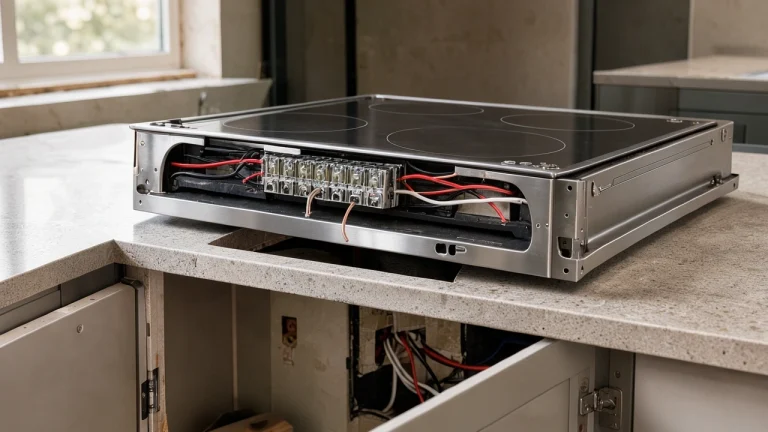
Converting from gas to induction requires the opposite: a 240V dedicated circuit costs $300 to $800 if your panel has space. If your panel is full, adding a subpanel jumps $1,000 to $2,000.
That’s the hidden cost nobody mentions on appliance store websites.
Capping the abandoned gas line adds another $100 to $300, or $400 to $1,200 with permits in some jurisdictions. Cookware replacement for induction converters runs $200 to $800.
Annual operating costs show another flip: gas costs $70 to $120 per year to cook with, radiant electric runs $60 to $110, and induction operates at just $40 to $80 annually due to superior efficiency.
vs 40% for gas and 74% for radiant — gas wastes over half the heat it generates.
Half the energy a gas burner produces escapes around the pan as room heat.
The Inflation Reduction Act softens the induction conversion sting.
Income-qualified households can access rebates up to $840 for an electric cooktop purchase plus an additional $500 to $2,500 for necessary wiring upgrades.
Those rebates trickle through state programs, so availability varies but the frame is real. That can erase half the installation cost for many families.
The honest bottom line on money: an induction cooktop that costs $1,500 looks expensive next to a $600 gas unit.
But when you account for installation, annual energy bills, and the efficiency gap, induction usually wins within five years.
The gas cooktop’s lower sticker price turns into a decade-long tax on your utility bills and your indoor air quality.
The Three User Profiles That Decide the Winner
I’ve laid out a lot of data, and now it’s time to translate it into a decision for your specific kitchen.
These profiles cover the realistic scenarios I’ve encountered repeatedly, and each points to a different recommendation.
Profile A is the wok enthusiast or flame traditionalist. Your cooking style demands open fire.
You char peppers directly over the burner, flambé with abandon, and own a wok with a round bottom that lives on the stove. For you, no electric technology replicates the experience.
Gas isn’t just a preference here—it’s the only tool for the job. The health concerns and efficiency gaps are real, but your technique defines your cooking, and flame defines your technique.
Choose gas and mitigate the air quality issue with proper outdoor-vented exhaust.
Profile B is the budget-conscious renter or first-time homeowner. You don’t own the walls, you have limited capital, and you can’t justify tearing out functional appliances.
The smart move is buying whatever technology already exists in the space and focusing your money on better pans.
Add a $40 portable induction hotplate as an experiment to learn whether you’d want induction in a future home. This costs almost nothing and gives you firsthand experience with the technology curve.
Profile C is the renovation-ready homeowner who prioritizes health and performance. You’re planning a remodel, have electrical budget, and cook a variety of cuisines. Induction is the clear winner.
It delivers the fastest boil, most precise simmer, safest surface, and cleanest air. The cookware swap is a one-time cost. The learning curve is two weeks.
And the day you boil a pot of water in under six minutes, you’ll understand why gas loyalists haven’t switched only because they haven’t tried it.
- Choose induction if you cook a wide repertoire and prioritize air quality with retrofit funds available.
- Pick radiant electric or gas if you’re renting and can’t modify the kitchen infrastructure.
- Run the fridge magnet test on every pan you own before making any decisions.
- Don’t choose induction if wok-charring is your signature technique or your cookware is 70% aluminum.
- Don’t select radiant electric expecting fast response or fine temperature control.
- Don’t compare sticker prices alone—the installation ledger shifts five-year totals dramatically.
Notice what I’m not saying. I’m not declaring one technology universally superior for every human on earth.
I’m giving you the framework to see which profile you fit, and that decision will point to your answer with confidence instead of guesswork.
Before You Buy — The Pre-Installation Checklist
Once you’ve made your decision, the installation process has its own set of steps. I’ve watched too many people buy a beautiful cooktop and then hit an unexpected electrical or plumbing wall.
This checklist prevents that.
Check your panel load and confirm whether a 240V/40A dedicated breaker exists. Secure an electrician quote for the run and budget for a subpanel if slots are full.
Run the magnet test on every pan. Decide which pieces stay, which get replaced, and which earn an interface disc for induction compatibility.
Identify whether your hood exhausts outdoors or recirculates. If it recirculates and you’re buying gas, plan for an outdoor-vent retrofit.
Visit the IRS Inflation Reduction Act portal or your state’s electrification rebate page to see if your household qualifies for income-based funding.
Schedule the plumber (gas line capping) and electrician on the same day. Experienced techs increasingly perform gas-to-electric conversions routinely.
Installation itself typically takes four to six hours of combined plumbing and electrical work.
The coordination of trades is often the trickiest part, since plumbers and electricians work on different schedules.
Book both before you finalize the appliance purchase to lock in a realistic timeline.
One last thought. If you’re on the fence and can afford only one experiment, buy the portable induction hotplate. Cook your normal meals on it for two weeks.
If the speed and precision win you over, commit to the full unit. If you miss the flame, you’ve learned that lesson for the price of a dinner out.
Frequently Asked Questions
Do electric cooktops work during a power outage?
No. Both induction and radiant electric cooktops are completely grid-dependent and shut down instantly when power fails. Gas ranges with pilot ignition can be lit manually during outages in some cases, though modern electronic ignition systems also fail without electricity. If outage cooking matters to you, that points toward gas.
Is induction safe for people with pacemakers?
Modern pacemakers are generally shielded against induction cooktop electromagnetic fields, and the field strength drops significantly with distance. Most manufacturers and cardiologists recommend keeping at least 2 feet between the cooktop and the device. If you or someone in your household has a pacemaker or defibrillator, consult your physician before installation to confirm.
Can I test induction cheaply before committing to a full installation?
Absolutely. Portable induction hotplates cost between $40 and $60 and plug into a standard outlet. Cook your regular meals exclusively on it for two weeks. That experiment tells you whether you adapt to the technology comfortably, saves you from an expensive mistake, and costs less than a single nice dinner out.
Do electric cooktops need a dedicated circuit?
Yes. Most full-size induction and radiant cooktops require a 208/240V, 40A dedicated line. There are a small number of 120V models, but they’re rare, slower to heat, and generally limited to apartment or small-space setups. Plan for the dedicated circuit as a non-negotiable part of installation costs.
Does the oven portion also differ between gas and electric?
Yes, and it matters for anyone buying a full range rather than a separate cooktop. Electric ovens generally bake more evenly because their heat distribution is more consistent. Gas ovens excel at broiling and introduce moisture that helps with certain breads and roasting. Buyers should evaluate cooktop and oven technologies separately before choosing a combined unit.
Are there induction cooktops that work with aluminum pans?
No induction cooktop directly heats aluminum because aluminum isn’t ferromagnetic. A ferromagnetic interface disc solves the problem by bridging the magnetic field, allowing the aluminum pan to heat through the disc. That workaround costs about $20 and reduces thermal efficiency by roughly 15 percent, but it keeps your existing aluminum cookware functional.