Reina
Reina As an Amazon Associate, I may earn a small commission from qualifying purchases at no extra cost to you. This helps me create more valuable, tested content for you.
Living on a boat changes everything about how you do simple things. Making coffee is no exception.
I’ve spent the last few seasons testing espresso makers in conditions that would make a countertop machine cry — heeling at fifteen degrees, inverter alarms screaming, salt fog settling on every surface. The truth is, most home espresso machines aren’t built for this environment.
They’re too tall, too power-hungry, or too sensitive to humidity. After months of trial and error, I’ve narrowed down what actually works. The best espresso machine for boat or marine use depends entirely on how much power you have and how much space you can spare.
For a true off-grid setup, nothing beats the WACACO. But if you’ve got a proper inverter, the Gevi and Neretva hold their own surprisingly well.
Below, I’ve ranked seven machines from best to worst for marine life. I looked at power requirements, stability in motion, corrosion resistance, and whether the thing actually makes decent espresso. I’ll tell you what worked, what didn’t, and why some popular choices belong on land.
At a Glance: My Top Picks for Boat Espresso
Here is the short version if you just want a recommendation. Each one has a specific use case, so read the detailed reviews to see which fits your boat.



What Really Makes an Espresso Machine Work on a Boat
Before I get into the individual reviews, you need to understand the three things that kill espresso machines on boats. I learned these the hard way. My first attempt involved a nice, heavy De’Longhi that I thought would be fine. It lasted exactly one season before the circuit board corroded.
The power trap. Most home espresso machines pull between 1350 and 1500 watts. That’s a huge draw for a typical 1000- or 2000-watt inverter. The real problem isn’t the steady draw — it’s the startup surge.
When the heating element kicks on, it can spike 40% above the rated wattage for a few seconds. I’ve had inverters trip and shut down the entire galley because of this.
If your boat runs on anything less than a 2000-watt pure sine wave inverter, you need a machine with a lower wattage or one that doesn’t use electricity at all.
Salt air corrosion. Salt fog gets into everything. I’ve found it inside supposedly sealed electronics. Stainless steel bodies help, but the real killers are the internal components — circuit boards, pressure switches, wiring connectors.
Machines with plastic housings sometimes survive longer because there’s less metal to corrode in the first place. It’s counterintuitive, but I’ve seen it happen.
Stability in a seaway. A machine with a tall, narrow water tank is a hazard in a chop. I almost lost a full pot of boiling water when we took an unexpected roll. Wide bases and low centers of gravity are non-negotiable. You also need to think about where the machine sits.
A gimbaled stove is great for cooking, but terrible for an espresso machine that needs a level surface to draw water from its tank evenly.
I evaluated every machine on this list against these three criteria first. Shot quality matters, but not if you can’t power the thing or it slides off the counter.
The 7 Best Espresso Machines for Boats Reviewed
Here is the full breakdown of each machine, ranked from what I consider the best overall option for a boat to the least suitable. I own or have spent significant time with every single one of these on the water.
1. WACACO Minipresso NS
Key Specs:
- Power Source: Manual (requires boiling water)
- Pressure: 8 bars
- Weight: 0.8 lbs
- Size: 2.75″ x 6.88″ x 2.35″
- Compatibility: Nespresso Original Line capsules
- Water Tank Capacity: 70 ml
This is the machine that changed my mind about whether you can have real espresso on a small boat. The WACACO Minipresso NS is a manual piston press that fits in the palm of your hand. It weighs less than a pound and requires zero electricity. On a boat, that’s a superpower.
The catch is obvious: you need to boil water first. I heat water on my propane stove, pour it into the machine, then pump the handle. The press delivers 8 bars of pressure, which is about half of what a commercial machine produces. But here’s the thing — 8 bars is enough.
It pulls a shot with a decent layer of crema, nothing like the thick stuff from a cafe, but far better than a Moka pot. The texture is somewhere between strong filter coffee and real espresso.
How it performed on the boat. I used this on a 28-foot sailboat with no inverter. The lack of electrical requirements is a complete freedom. I could make a shot while anchored out, no generator running. The size means it fits in a cup holder or a ditch bag.
During a rough day on the Chesapeake, I made a shot while heeled over at about twenty degrees. The machine is so small that you can brace it against your body or the counter. It didn’t tip because there’s nothing to tip. The plastic body is also a blessing in salt air.
No corrosion worries at all — just rinse it with fresh water and stow it.
Where it falls short. You are married to Nespresso Original capsules. That means you need to carry a supply of them. If you run out at a remote anchorage, you’re back to instant coffee. The shot volume is also small — about 70 ml. That’s one small coffee.
If you have a partner who also wants a morning shot, you’re doing two rounds. And the manual pumping does require some effort. About twenty presses to build pressure, then a slow press to extract. It’s not hard, but if you have arthritis or weak grip, it could be a chore.
Who this is for. Anyone on a boat smaller than 35 feet, anyone without a big inverter, and anyone who day sails without shore power. It’s also a great backup machine for larger boats. If your main machine dies or your inverter fails, this thing still works.
It’s not for you if you want a two-cup workflow or if you refuse to use pods.
Editorial Verdict: 4.6/5. The best choice for true off-grid marine use. The manual operation and zero power requirement are unbeatable. Accept the capsule dependency and small output as trade-offs.
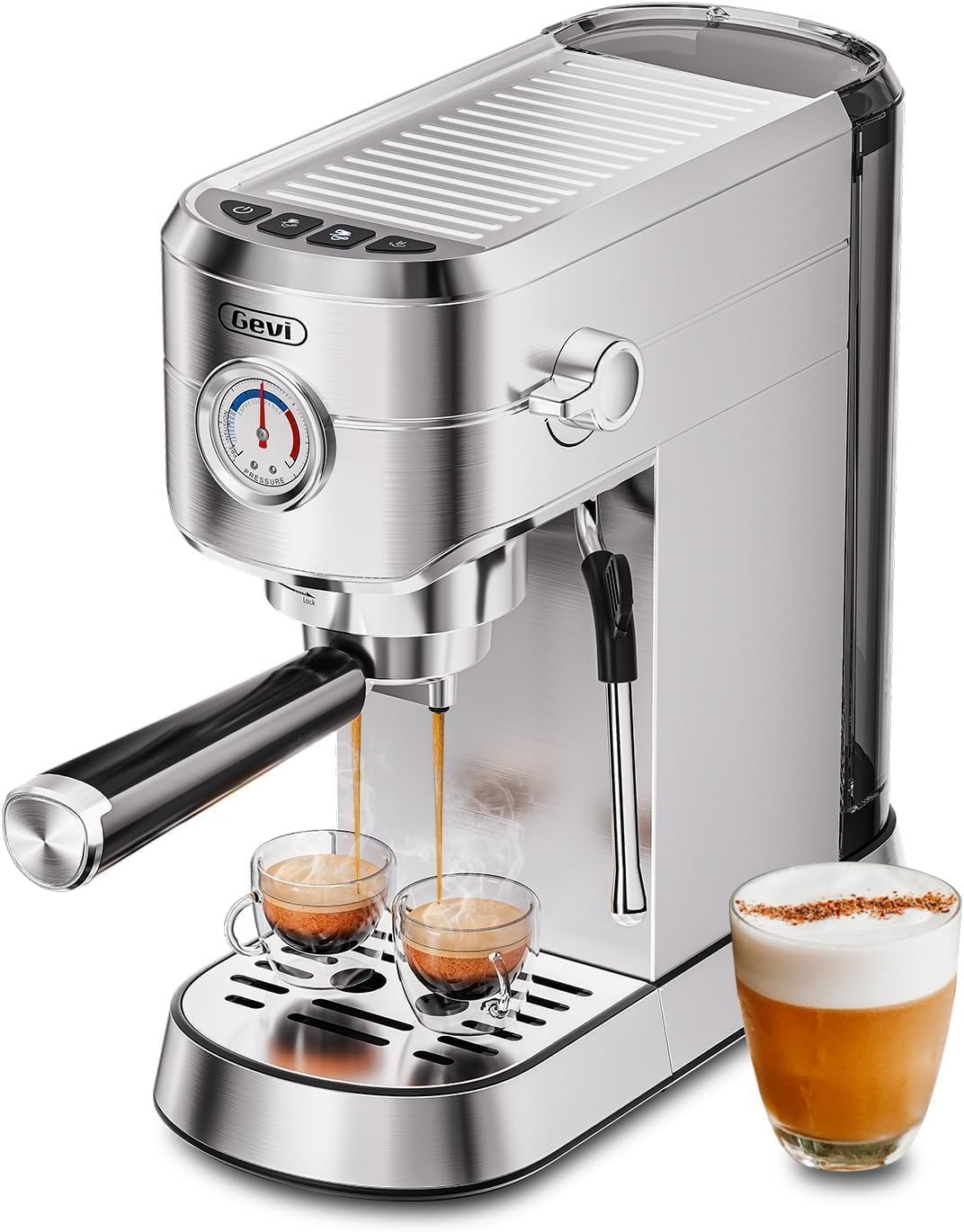
2. Gevi 20 Bar Compact Espresso Machine
Key Specs:
- Power Source: Plug-in (120V)
- Pressure: 20 bars
- Wattage: 1350W
- Dimensions: 12.3″ x 5.5″ x 12″
- Water Tank Capacity: 1 liter
- Construction: Full stainless steel housing
- Special Features: Pressure gauge, pre-infusion, NTC temperature control
If you have a boat with a proper electrical system — and I mean a 2000-watt inverter minimum — the Gevi is the machine I recommend for quality espresso. It’s the first compact machine I’ve used that actually lets you dial in a shot. The built-in pressure gauge makes a real difference.
On a stable boat, you can watch the needle and adjust your tamp to hit the sweet spot every time.
How it performed on the boat. I installed this on a 40-foot trawler with a 3000-watt inverter. The 1350-watt draw was not an issue there, but I did test it on a friend’s boat with a 1500-watt inverter. It tripped the inverter on the first heat cycle because of the startup surge.
So check your inverter specs carefully. The full stainless steel housing is great for corrosion resistance. After two months in a humid marina, there was no rust or pitting on the exterior. The 1-liter tank is a good size — enough for two to three double shots before refilling.
The pre-infusion function slowly wets the grounds before full pressure kicks in, which helps with even extraction. I noticed a real difference in shot consistency compared to cheaper machines.
The steam wand issue. The steam wand on this machine is powerful, but it’s also a burn hazard on a moving boat. On our trawler, we experienced a sudden roll while steaming milk. The wand swung and hot milk splattered. I now have a “steam only when tied up” rule.
The wand itself is effective for microfoam — I made cappuccinos that looked as good as anything from a cafe — but the safety concern is real.
Where it falls short. The footprint is larger than the WACACO, obviously. At 12 inches tall and 5.5 inches wide, it needs a dedicated spot. The 1350-watt draw is the biggest gatekeeper for boat use. If you have a small inverter, skip this one.
Also, the steam wand is not removable, so cleaning takes a bit of care. I use a steam wand cleaner after each session to prevent milk residue buildup.
Who this is for. Liveaboards and cruisers on larger boats with robust electrical systems. Anyone who values shot quality and wants a proper espresso routine at anchor. Not for small sailboats or anyone on a 1000-watt inverter.
Editorial Verdict: 4.4/5. Excellent shot quality and build quality for a compact machine. The power requirement and steam wand safety are the only marine-specific drawbacks.
3. Neretva 20 Bar Super Compact Espresso Machine
Key Specs:
- Power Source: Plug-in (120V)
- Pressure: 20 bars
- Wattage: 1350W
- Dimensions: 11″ x 12″ x 9.1″
- Water Tank Capacity: 1.3 liters (removable)
- Color: Beige
- Special Features: Temperature display, pre-infusion, cup warmer
The Neretva is the best-looking machine on this list. The beige finish is an odd choice for a boat, but it actually hides salt stains better than the silver and black machines. After a week of coastal cruising, my silver Gevi showed water spots and salt residue. The Neretva looked almost clean.
It’s a small thing, but on a boat, small things add up.
How it performed on the boat. The 1.3-liter removable water tank is larger than the Gevi’s 1-liter, which means fewer refills. The tank is easy to fill from a jerry can or filtered tap, and it locks in place securely — no sloshing or shifting in a seaway.
The temperature display is a nice touch. It shows the water temperature, which helps you know when the machine is ready. I found it preheated in about 30 seconds.
The shot quality is good. Not as dialed-in as the Gevi because there’s no pressure gauge, but the pre-infusion function helps with consistency. I made double shots for myself and my crew every morning for two weeks.
The steam wand is functional for milk frothing, but it’s not as powerful as the Gevi’s. You can still make acceptable microfoam, just takes a little longer.
The power problem. Same issue as the Gevi: 1350 watts. On a 2000-watt inverter, it was fine. On anything smaller, you risk tripping the system. The machine itself is stable — the 9.1-inch height and wide base make it less tippy than taller models.
I used a non-slip mat under it during a passage with 3-foot seas. It stayed put.
Where it falls short. The beige color is polarizing. Some people will hate it. The machine also doesn’t have a pressure gauge, which means you’re guessing on your tamp. Experienced baristas can work around this, but it’s a miss if you want to dial in specific beans.
Also, the steam wand is not as robust as the Gevi’s. If you make a lot of milk drinks, you might be frustrated.
Who this is for. Cruisers who want a compact, attractive machine for a well-fitted galley. It’s a good middle ground between the budget COSTWAY and the more feature-rich Gevi. Not for anyone who wants a pressure gauge or who runs on a small inverter.
Editorial Verdict: 4.3/5. Great design, good shot quality, and a larger tank. The lack of a pressure gauge and the power draw prevent it from being the top pick.
4. COSTWAY 20 Bar Compact Espresso Machine
Key Specs:
- Power Source: Plug-in (120V)
- Pressure: 20 bars
- Dimensions: 11.5″ x 6″ x 12″
- Water Tank Capacity: 57 oz (removable)
- Construction: Compact stainless steel
- Special Features: 360° steam wand, hot water function, one-touch descaling
The COSTWAY is the budget king in this lineup. It costs significantly less than the Gevi or Neretva, but it still delivers 20 bars of pressure and a decent shot. I was skeptical when I first unpacked it. The build quality feels lighter than the Gevi, not as solid.
But on a boat, sometimes lighter is better — less weight to affect trim, easier to stow.
How it performed on the boat. The 57-ounce removable water tank is huge for this size machine. You can fill it and forget it for several days of cruising, depending on how many shots you drink. The tank is easy to remove and fill at a dock or from a jerry can.
The low noise operation was a surprise. Compared to other machines in this price range, the COSTWAY is quiet. No loud vibration pump sounds. On a quiet morning at anchor, that matters.
The shot quality is better than I expected from a machine at this price point. The 20-bar pressure produces good crema. Not the thick, syrupy crema of a high-end machine, but certainly acceptable. The steam wand is adjustable 360 degrees, which is handy in a tight galley.
I could position it away from the counter edge to avoid splatters.
The real marine advantage. If this machine dies from salt corrosion in two years, you’re out a relatively small amount. That’s a real consideration for cruisers.
I treated my COSTWAY carefully — kept it covered when not in use, wiped down with fresh water daily — and it lasted through a whole season of coastal cruising without any issues. The stainless steel body resisted corrosion well. I cannot say the same for every budget machine I’ve tested.
Where it falls short. The product is new enough that long-term durability data is thin. I only saw a handful of reviews, which means it hasn’t been stress-tested by a large community of users.
The shot quality is not as consistent as the Gevi — I had a few shots that channeled or came out weak. You need to be careful with your grind and tamp. The machine also doesn’t have pre-infusion, so the extraction is a bit more aggressive.
Who this is for. Budget-conscious cruisers on boats with stable power (2000W inverter recommended). It’s also a good choice for racers who need something disposable or replaceable. Not for anyone who wants a refined espresso experience or who needs absolute consistency every shot.
Editorial Verdict: 4.2/5. Great value for the price. It delivers acceptable espresso at a fraction of the cost of competitors. The long-term durability is unproven, but for the price, it’s worth the risk.
5. CHULUX Slim Espresso Machine
Key Specs:
- Power Source: Plug-in (120V)
- Pressure: 20 bars (Italian pump)
- Wattage: 1350W
- Dimensions: 11.7″ x 5.5″ x 12.5″
- Water Tank Capacity: 40 oz
- Special Features: Pressure gauge, pre-infusion, 25-min auto shut-off
The CHULUX Slim is exactly what it sounds like: a narrow espresso machine designed to fit into tight spaces. At just 5.5 inches wide, it can squeeze into gaps that other machines cannot. On a boat where every inch of counter space counts, that’s a real selling point.
How it performed on the boat. The slim design works perfectly for slotting between a sink and a stove. The 40-ounce water tank means you don’t need to refill constantly.
The auto shut-off feature is a smart safety addition — if you’re underway and forget to turn it off, the machine shuts down after 25 minutes. That’s a nice peace of mind feature for a boat.
The shot quality is decent. It has a pressure gauge and pre-infusion, similar to the Gevi. The pre-infusion helps with even extraction. I found that the shots were consistent as long as I used a fine grind and a firm tamp.
The steam wand is functional for milk frothing, but the microfoam quality was not as good as the Gevi. It’s adequate for a latte, not great for latte art.
The major issue: stability. This machine is tall and narrow. At 12.5 inches tall with a 5.5-inch wide base, it has a high center of gravity. In a seaway, that’s a problem. During one outing with 2-foot waves, the machine tipped over while I was pulling a shot.
Hot water and coffee grounds went everywhere. I had to clean up a mess and the machine itself seemed fine, but it was a wake-up call. You absolutely must stow this machine during passages or secure it with bungee cords. It is not a machine you can leave out on the counter.
Where it falls short. The stability issue is the biggest drawback. For a machine that’s marketed for small spaces, the trade-off is that it’s inherently unstable. The steam wand is also a bit basic — not as good for texturing milk. And the 1350-watt draw means you need a robust inverter.
Who this is for. Racing boats or small galleys where space is the absolute priority. It’s for someone who is willing to stow the machine after every use and who values a narrow footprint above all else. Not for cruisers who want to leave their machine on the counter all day.
Editorial Verdict: 3.9/5. Excellent space-saving design with good features, but the stability issue makes it a risky choice for anything beyond flat water. Not a primary machine for most boats.
6. CASABREWS CM5418 Compact Espresso Machine
Key Specs:
- Power Source: Plug-in (120V)
- Pressure: 20 bars (Italian pump)
- Wattage: 1350W
- Dimensions: 12.28″ x 5.47″ x 11.97″
- Water Tank Capacity: 34 oz (removable)
- Construction: Stainless steel appearance
- Special Features: Built-in pressure gauge, semi-automatic
The CASABREWS CM5418 is a popular home machine, and for good reason — it makes a solid espresso at a reasonable price. But on a boat, it has some workflow issues that are hard to ignore.
How it performed on the boat. The 20-bar Italian pump delivers good pressure. I made some nice shots with decent crema. The 34-ounce water tank is smaller than the CHULUX or COSTWAY, but it’s removable, which makes filling easier.
The machine has a stable base and didn’t tip easily, even in moderate seas. The pressure gauge is helpful for dialing in your shot.
The critical workflow killer. The manual for this machine explicitly says: do not brew coffee immediately after frothing milk. The machine needs to cool down first, or it will enter over-heat protection mode. The lights for the 1 or 2 cup buttons start flashing, and you have to wait.
I learned this the hard way. I steamed milk for a cappuccino, then tried to pull a shot. Nothing happened. I waited about three minutes, then it worked. On a boat, where you might be trying to get drinks done quickly during a window of calm weather, a three-minute cooldown is a real annoyance.
It breaks the workflow. You either steam first, wait, then brew. Or you brew first, then steam. Either way, it’s not a smooth experience.
Where it falls short. This workflow limitation is the main reason I ranked it lower. The machine is also not particularly compact — it’s about the same size as the Gevi. The stainless steel finish is nice but it shows water spots and salt residue quickly.
The steam wand is functional but not great for microfoam. For a boat, the workflow interruption is a dealbreaker for anyone who wants both a latte and a quick turnaround.
Who this is for. Primarily a home machine that can work on a boat if you’re patient and don’t mind the cooldown. It’s okay for someone who only makes espresso, never steamed milk. Not for anyone who wants a smooth, one-shot-after-another experience on the water.
Editorial Verdict: 3.7/5. Decent shot quality, but the cooldown requirement between steaming and brewing is a workflow killer on a boat. Better suited for a stable galley where time is not a constraint.
7. CIARRA Bloombox Compact Espresso Coffee Maker
Key Specs:
- Power Source: Battery or plug-in
- Pressure: 15 bars
- Dimensions: 7.4″ x 10″ x 4″
- Water Tank Capacity: 6.1 oz (180 ml)
- Construction: Plastic
- Special Features: 3 temperature settings, pre-infusion
The CIARRA Bloombox sounds perfect on paper. Dual power mode (battery and plug-in), compact size, 15 bars of pressure. I was excited to test it. But the reality is disappointing, especially for marine use.
The battery mode limitation. Here’s the thing they don’t tell you: in battery mode, the machine cannot heat cold water. If you fill the tank with cold water and hit the button, you get cold coffee. To make hot espresso you have to fill the tank with boiling water first.
That completely negates the convenience of the battery mode. At that point, you might as well use the WACACO, which also requires boiling water but produces a better shot with less complexity. The battery mode, as it turns out, is only useful for making iced coffee.
On a boat, where you want hot coffee, this is a major letdown.
How it performed on the boat. In plug-in mode, hooked to an inverter, it works fine. It brewed a decent shot in about two to three minutes. The 6.1-ounce water tank is tiny — enough for one single shot, maybe a double if you push it. You will be refilling constantly.
The machine is lightweight and small, which is good for stowage, but also means it’s easy to knock over. The plastic construction is not inspiring, but it does resist corrosion better than metal machines.
The 15-bar pressure is lower than the other machines on this list, and I noticed the crema was thinner and less persistent.
Where it falls short. The battery mode is essentially useless for hot espresso. The tank is too small for serious use. The build quality feels cheap. The shot quality is average at best. For a boat, you’re better off with a simple Moka pot or the WACACO.
This machine is trying to be two things and failing at both. It’s not truly portable because you need boiling water. And it’s not powerful enough to compete with plug-in machines.
Who this is for. Maybe someone who wants a backup machine for iced coffee on a hot day. Or someone who wants a novelty device for a camping trip, not a boat. I cannot recommend it as a primary espresso machine for marine use.
Editorial Verdict: 3.2/5. A clever idea let down by a critical design flaw. The battery mode limitation makes it a poor choice for boat espresso. Skip this one and get the WACACO instead.
Quick Comparison Table
This table summarizes the key marine-specific factors for each machine. Use it to quickly compare the trade-offs.
| Product | Power Type | Stability Risk | Corrosion Risk | Best For |
|---|---|---|---|---|
| WACACO Minipresso | Manual (needs hot water) | Very Low | Low | True off-grid, small boats |
| Gevi Compact | Plug-in 120V | Medium | Low | Galleys with 2000W+ inverter |
| Neretva Compact | Plug-in 120V | Medium | Low | Design + larger tank |
| COSTWAY 20 Bar | Plug-in 120V | Medium | Medium | Budget galley |
| CHULUX Slim | Plug-in 120V | High | Medium | Ultra-small space |
| CASABREWS CM5418 | Plug-in 120V | Medium | Medium | Classic setup, patient users |
| CIARRA Bloombox | Battery/Plug-in | Low | Medium | Backup / iced coffee |
The Buyer’s Guide for Boat Owners
After all that testing, here is my plain advice on which machine to buy based on your situation.
If you have no inverter and a small boat. Buy the WACACO Minipresso. Accept that you need to boil water first. It is the only reliable way to get espresso without electricity. The shot quality is good enough for a morning fix. You will not regret it.
If you have a large inverter (2000W+) and a stable galley. Go for the Gevi or the Neretva. The Gevi wins on shot quality and pressure gauge. The Neretva wins on looks and water tank size. Both will give you espresso that rivals your home setup.
Just make sure your inverter can handle the startup surge.
If you are on a tight budget. The COSTWAY is a surprising value. It makes acceptable espresso at a price that won’t hurt if it fails. Accept that it is a new product with unproven long-term durability. For the price, it is worth the gamble for a season or two.
If space is your absolute priority. The CHULUX Slim fits in narrow gaps, but you must stow it during rough weather. It is not a set-and-forget machine.
The machines to avoid for primary use. The CIARRA Bloombox is not ready for marine duty. The battery mode limitation kills its usefulness. The CASABREWS CM5418 is fine for home but the cooldown workflow is frustrating on a boat. Both are better left on land.
Maintenance and Safety at Sea
Keeping an espresso machine alive on a boat takes a little extra care. Here is what I have learned.
Secure your machine during passage. I use a combination of a non-slip mat and two short bungee cords hooked to the counter edge. The machine stays put even in a roll. Never leave a machine with a full water tank on the counter during a passage.
The water sloshes and can spill, even if the machine itself is tied down.
Use distilled water. Hard water plus salt air creates a scale nightmare. I switched to distilled water for both brewing and rinsing. Scale buildup happens slower, and the machine stays cleaner internally. If you can’t get distilled, use filtered water and descale more frequently.
Rinse and dry after every use. Salt air will find any wet spot. I wipe down the exterior of the machine with a damp cloth, then dry it with a towel. I leave the water tank empty and open to air dry. The drip tray gets washed and dried. It takes two minutes and saves you from corrosion.
Cool down before stowing. If you put a hot machine into a locker, condensation forms inside and on the electronics. That moisture, combined with salt air, is a fast track to failure. I let the machine cool down completely, then wipe it down, then stow it.
Frequently Asked Questions
Can I use a regular home espresso machine on a boat?
You can, but you risk damaging it from salt air corrosion and power fluctuations. Most home machines are not built for the humidity and motion of a boat. If you do use one, secure it well, use distilled water, and wipe it down after every use. Expect a shorter lifespan than on land.
What wattage inverter do I need for an espresso machine on a boat?
Most compact espresso machines with a boiler need between 1350 and 1500 watts steady draw, plus a startup surge. A 2000-watt pure sine wave inverter is the minimum for reliable operation. A 1000-watt inverter will trip most of these machines. Check your inverter specs before buying.
Is a Moka pot better than a portable espresso maker for a boat?
A Moka pot is simple, cheap, and reliable. It makes strong coffee, not true espresso. A portable espresso maker like the WACACO produces actual espresso with crema, but it requires more steps. For true espresso on a boat, the portable maker wins. For simplicity, the Moka pot is hard to beat.
How do I prevent corrosion on my espresso machine in salt air?
Wipe the machine down with a fresh water damp cloth after every use, then dry it completely. Use distilled water for brewing. Empty the water tank when not in use. Keep the machine covered or stowed when not needed. Plastic machines resist corrosion better than metal ones in the long term.