 Reina
Reina 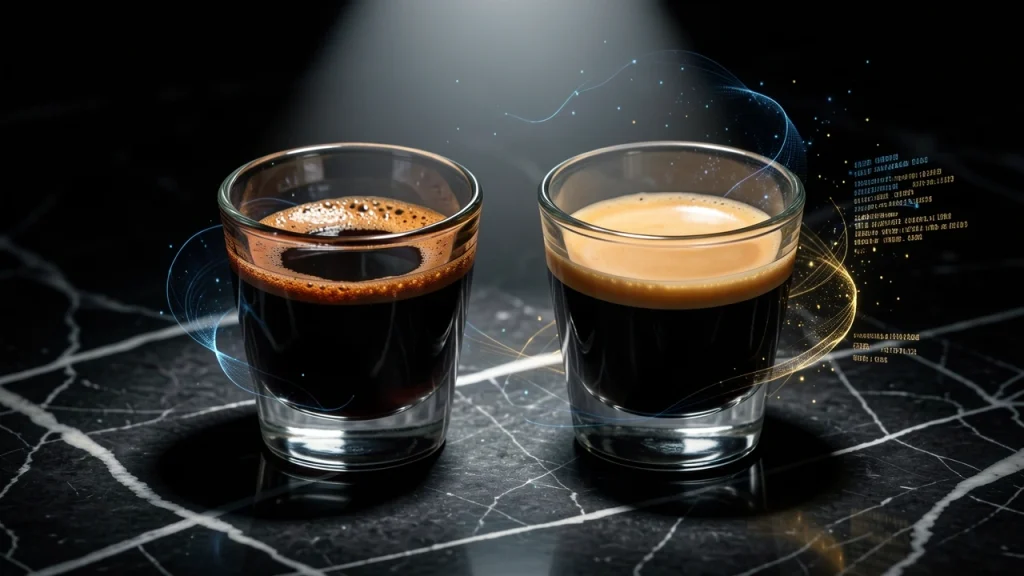
As an Amazon Associate, I may earn a small commission from qualifying purchases at no extra cost to you. This helps me create more valuable, tested content for you.
If you have ever ordered a coffee drink and noticed the barista asking if you want a ristretto shot, you have likely wondered what the actual difference is.
After years of pulling shots at home and in cafés, I have found that most people assume a ristretto is simply a smaller, stronger espresso.
That is partly true, but the real story involves extraction chemistry and a common caffeine myth that even some baristas get wrong.
The short answer – sweeter taste, stronger concentration, similar caffeine
Here is what you need to know right away: a ristretto shot uses the same amount of coffee grounds as a regular espresso, but with less water pushed through.
The result is a smaller, more concentrated drink that tastes noticeably sweeter and less bitter. The total caffeine is nearly identical because the caffeine extracts early in the brewing process.
The main difference is in the flavor and mouthfeel, not the buzz.
| Characteristic | Espresso | Ristretto |
|---|---|---|
| Brew ratio (coffee to liquid) | 1:2 to 1:2.5 | 1:1 to 1:1.5 |
| Extraction time | 25–30 seconds | 15–20 seconds |
| Flavor profile | Balanced, can be bitter | Sweeter, less bitter, more syrupy |
| Caffeine per shot | ~60–70 mg (single) | ~60–70 mg (single) |
| Concentration | Lower | Higher |
Defining the two shots – ratios and parameters
To understand the difference, you need to know the standard recipes. A regular espresso uses about 18 grams of finely ground coffee and yields 36 to 45 grams of liquid in 25 to 30 seconds.
That ratio of coffee to liquid is usually 1:2 or slightly more.
A ristretto, which means “restricted” in Italian, uses the same 18 grams of coffee but yields only 18 to 27 grams of liquid. The extraction stops earlier, usually between 15 and 20 seconds.
The dose of coffee is the same, but the water volume is cut by roughly half. This is the core mechanical difference.
I have pulled hundreds of both shots on my home machine. The ristretto always comes out with a thicker, more syrupy texture. The crema is darker and richer.
When I first started, I thought I had made a mistake because the flow looked slow, but that is exactly what you want.
Why ristretto tastes sweeter and less bitter – the extraction science
The secret lies in how coffee compounds dissolve in water during brewing. In the first few seconds of extraction, the water pulls out bright acids and natural sugars.
These give coffee its fruity, sweet notes. As the extraction continues, the water starts pulling out chlorogenic acids and other bitter compounds.
By the 25-second mark, those bitter flavors become dominant.
Ristretto cuts the extraction right when the sugars are at their peak and before the bitterness has a chance to enter the cup. That is why it tastes sweeter even though there is no added sugar.
The Total Dissolved Solids (TDS) are also higher in a ristretto because less water has diluted the coffee. More solids per sip means a fuller body and a more intense flavor.
Think of it like squeezing a lemon. The first squeeze gives you bright, tart juice. If you keep squeezing, you get the bitter oils from the pith. Ristretto stops at that first squeeze.
A practical example from my kitchen
I once experimented by pulling three shots from the same batch of beans: a ristretto at a 1:1.5 ratio, a standard espresso at 1:2, and a lungo (long shot) at 1:3.
The ristretto tasted like dark chocolate with a hint of cherry. The espresso was more balanced but had a slight dry finish. The lungo was bitter enough that I dumped it.
The difference was dramatic, and it all came down to how long the water touched the coffee.
Setting the record straight on caffeine – same dose, different concentration
This is where most online articles get it wrong. Many claim that ristretto has less caffeine because less water is used. That logic ignores the chemistry of caffeine extraction.
Caffeine is highly soluble and dissolves quickly in hot water. In the first 10 to 15 seconds of brewing, most of the caffeine has already left the coffee grounds and entered the water.
Since ristretto uses the same amount of coffee grounds as espresso, the total caffeine content is nearly identical.
Laboratory tests consistently show ristretto contains roughly 60 to 70 milligrams of caffeine per single shot, the same as a standard espresso.
The difference is that ristretto packs that caffeine into a smaller volume of liquid.
| Drink | Total caffeine | Caffeine per ounce |
|---|---|---|
| Single ristretto (1 oz) | ~65 mg | ~65 mg |
| Single espresso (2 oz) | ~65 mg | ~32 mg |
When you sip a ristretto, you get more caffeine per swallow, which makes it feel stronger. That is why many baristas and drinkers describe it as more potent.
But if you are trying to limit your caffeine intake, switching from espresso to ristretto will not help. You would need to reduce the number of shots you drink.
The real-world impact – ordering ristretto at a café vs. brewing at home
Knowing the science is great, but how does it affect your daily coffee habit? I have ordered ristretto shots in hundreds of café visits and brewed them at home on several machines.
Here is what I have learned.
In milk drinks
Ristretto changes a latte or flat white significantly. The sweetness of the ristretto cuts through the milk without needing added sugar. The milk does not mask the delicate fruity or chocolaty notes.
I always order a flat white with a double ristretto when I want a dessert-like drink that is not sickly.
The texture is silkier because the higher concentration of coffee solids blends better with microfoam.
Starbucks uses ristretto shots as the default for their Flat White. They do this specifically to enhance sweetness and reduce bitterness, which is why that drink tastes different from a standard latte.
Brewing ristretto at home
On a standard espresso machine, making ristretto is simpler than many people think. You keep the same dose of coffee, the same grind size, and the same tamp pressure.
The only change is that you stop the extraction earlier. Watch the scale or the shot glass. When the liquid reaches about 1.5 times the weight of your coffee dose, cut it off.
If your machine has a pre-programmed button labeled ristretto, that usually works fine. But I have found that manual control gives better results.
Adjust the grind slightly finer if the flow seems too fast, but do not go too fine or you will choke the machine.
When to choose ristretto
- For milk-based drinks like flat whites, cortados, and lattes when you want more sweetness.
- For black espresso shots when you want a punchy, syrupy flavor without bitterness.
- For light-roast beans that can taste acidic when extended too long.
When to stick with regular espresso
- When you want a larger volume of coffee, such as in an Americano.
- When you are using dark-roast beans that already have low acidity and lower bitterness.
- When you want a more balanced, familiar espresso taste.
Frequently Asked Questions
Is a ristretto shot stronger than a regular espresso?
In taste, yes. Ristretto is more concentrated, so it hits your palate harder. In terms of total caffeine, no. They are nearly identical.
The confusion comes from people using “strong” to mean both flavor intensity and caffeine content.
Can I make a ristretto with a Nespresso machine?
Only if your machine has a dedicated ristretto button. Standard Nespresso pods are designed for specific water volumes.
Using a lungo pod and stopping early might not work because the pod is designed for a longer extraction. Some third-party pods advertise ristretto compatibility, but results vary.
Why do Starbucks baristas say ristretto has more caffeine?
Starbucks baristas sometimes use the phrase “stronger flavor” to mean ristretto, and customers interpret that as more caffeine.
The company’s official recipe for the Flat White uses a ristretto shot specifically for sweetness purposes, not for caffeine content.
In my experience, baristas at high-volume shops may simplify the explanation for speed.
Does ristretto work with light-roast beans?
Absolutely. Light roasts are naturally more acidic. A ristretto captures their bright fruit notes without pulling out the grassy or harsh flavors that can appear in longer extractions.
I often use a light Ethiopian single origin for ristretto and the result is like drinking berry syrup.
How do I adjust my recipe for ristretto at home?
Start with the same dose you use for espresso. Keep your grind setting the same. Pull the shot and stop the water when the yield reaches about 1.5 times your coffee weight.
For example, if you use 18 grams of coffee, stop at 27 grams of liquid. The extraction should take around 15 to 20 seconds. Taste it and adjust from there.

