Reina
Reina 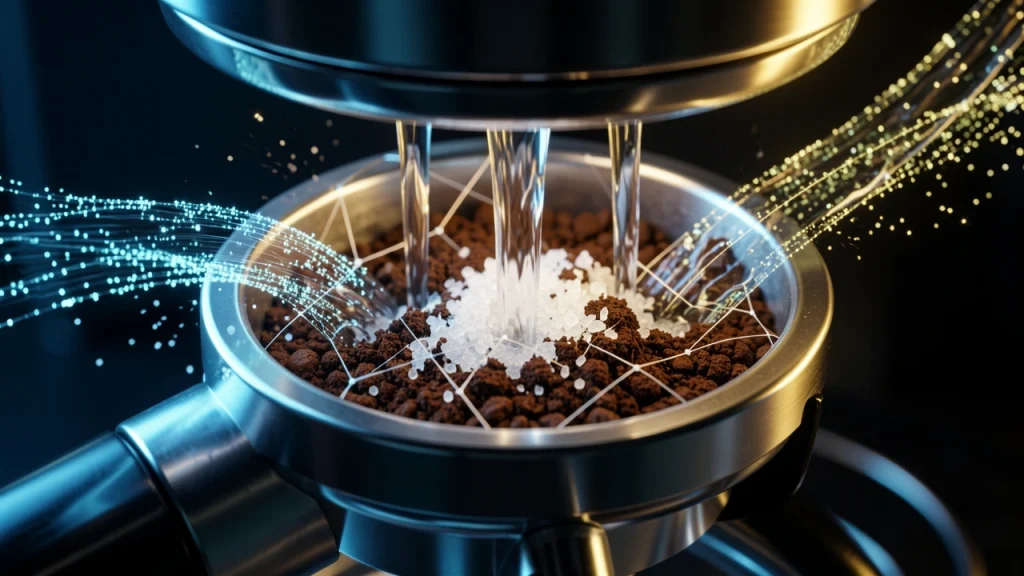
As an Amazon Associate, I may earn a small commission from qualifying purchases at no extra cost to you. This helps me create more valuable, tested content for you.
You can absolutely use regular pre-ground coffee in an espresso machine, but only if your machine has a pressurized portafilter basket.
Without one, you will get a thin, sour, watery mess that tastes nothing like espresso.
I have tested this dozens of times with different grind sizes and machines, and the results are consistent: the hardware makes or breaks the shot.
Here is the straightforward truth. If you grab the standard grocery store bag labeled “Automatic Drip” or “Filter Grind,” and you have a single-wall basket, do not even try.
You will waste coffee and end up frustrated. But if your machine came with a dual-wall (pressurized) basket, you have a fighting chance to get a passable shot.
Let me walk you through exactly what is happening inside the machine and how to work with what you have.
The Relentless Problem: Regular Ground Coffee is Ground for Gravity, Not Pressure
The central conflict here is physics, not opinion. Drip coffee makers use gravity and atmospheric pressure (about 1 bar) to push water through coffee grounds.
Espresso machines use 9 bars of pressure, which is roughly nine times the pressure of a car tire. Water under that kind of force behaves completely differently when it hits coffee particles.
The Texture Comparison
Espresso grind should feel like table salt or fine sand between your fingers. Regular pre-ground coffee meant for drip machines feels like sea salt or coarse sugar.
The particles are much larger and more irregular.
Why Pressure Destroys Coarse Grounds
When high-pressure water meets large coffee particles, it follows the path of least resistance.
The water rushes through the gaps between the big particles instead of extracting flavor from the inside of each particle.
The result is a shot that runs through in 5 to 10 seconds, comes out pale and thin, and tastes sour or hollow.
The coffee inside the puck remains partially dry because the water never penetrated the core of those large grounds.
The One Exception to the Rule
If your pre-ground coffee bag has “Fine Grind” or “Espresso Grind” printed on it, you are in a different category.
Brands like Illy, Lavazza, and some store-brand espresso blends actually grind their coffee finer because they know people use it in espresso machines. Check your bag right now.
If you see “Automatic Drip,” “Filter,” or “Cafetiere,” you need the pressurized basket solution below.
Key takeaway: If the bag says “Automatic Drip” or “Filter” grind, proceed to the next section for the only workaround.
The Workaround That Saves This (And the Physics of Pressurized Baskets)
This is the single most important mechanical detail that most articles gloss over. The pressurized basket exists precisely to solve the problem of coarse, pre-ground coffee.
Understanding how it works will save you a lot of bad shots.
What the Pressurized Basket Does
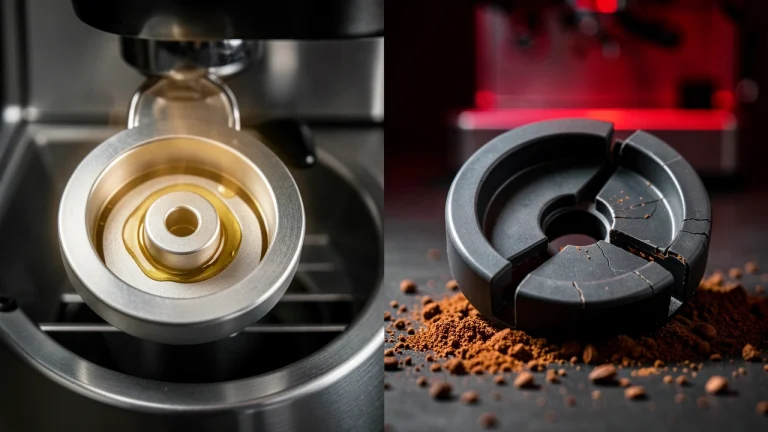
A pressurized basket has only one tiny hole in the bottom, surrounded by solid metal. A normal single-wall basket has dozens of holes across the entire surface.
That single hole creates back-pressure inside the basket before the water even touches the coffee.
This means the water is forced to build up pressure inside the chamber, which mimics the resistance that a fine, properly-tamped puck would normally provide.
The Two Basket Types
| Feature | Single-Wall (Unpressurized) | Dual-Wall (Pressurized) |
|---|---|---|
| Bottom appearance | Dozens of small holes | One single hole in the center |
| Best for | Freshly ground, fine espresso | Pre-ground or coarse coffee |
| Result with coarse grind | Thin, watery, sour shot | Drinkable, with fake crema |
| Technical difficulty | High (requires dialing in) | Low (very forgiving) |
The Taste Cost You Need to Accept
I want to be honest with you. Pressurized baskets force a fizzy, light-colored foam onto the top of your shot. This is not real crema. Real crema is dense, golden, and lasts for minutes.
Pressurized basket crema is bubbly, pale, and disappears within 30 seconds. The coffee underneath will also be less sweet and less complex than what you would get with freshly ground espresso.
But here is the trade-off: it is drinkable, it can form the base of a decent latte, and it does not require any special equipment beyond what you already own.
How to Brew It: Step-By-Step for Regular Pre-Ground Coffee
Now you know your basket type. Here is the exact procedure that has worked for me every time with pre-ground coffee in a pressurized basket.
- Install the pressurized basket. This is non-negotiable. If you have the regular basket installed, swap it. You will find the pressurized basket usually has a solid bottom with a single pinprick hole. Some machines call it a “dual-wall” basket.
- Dose correctly. Use 14 to 16 grams of coffee for a double shot, depending on your basket size. Do not overdose. Coarse grounds do not compress the same way fine grounds do, and overfilling can cause the basket to overflow or the puck to explode.
- Tamp lightly and level. Because the pressurized basket does most of the resistance work, you do not need a hard tamp. Apply gentle, even pressure. Over-tamping coarse grounds can push them into the walls of the basket and cause channeling along the edges.
- Pull the shot. Aim for 20 to 25 seconds of extraction. If the shot runs in 10 seconds and comes out pale immediately, increase the dose by 1 gram. If it drips slowly and chokes, decrease the dose slightly.
- Look for the visual signs. You should see a thin layer of foam (fake crema) that is tan or light brown. The liquid should be dark and opaque, not watery or transparent. If you see water running through like weak tea, the coffee is too coarse for even the pressurized basket to handle.
The Reality Check: What This Espresso Will Taste Like (and What It Won’t)
Let me spare you the disappointment of unrealistic expectations. The shot you are about to pull is not going to taste like a $5 café espresso. Here is what you can actually expect.
Flavor Limitations
Grocery store pre-ground coffee has been exposed to oxygen for weeks or months before you open it. The volatile aromatic oils that give coffee its sweetness and complexity evaporate over time.
What remains is a more flat, earthy, or even cardboard-like flavor. The shot will lack the bright acidity or deep caramel sweetness you might hope for.
The Crema Illusion
As I mentioned, the foam from a pressurized basket is not true crema. It is a forced foam that contains less flavor and texture. Think of it like foam on a soda versus foam on a well-pulled beer.
One disappears quickly, the other lingers and adds to the experience.
The Latte Redemption Arc
This is the most practical advice I can give you. If you are determined to use this pre-ground coffee, use it for milk-based drinks.
Steam some milk, add a generous pour of your shot, and the milk will mask the flatness and bitterness. A straight shot of this coffee will likely disappoint you.
A latte or cappuccino will still taste fine, especially if you use a medium to dark roast pre-ground coffee.
The Espresso Flavored Trap
Many supermarket bags say “Espresso Roast” or “Espresso Flavored” on the front. This is a marketing trick. It means the beans were roasted dark, not ground finely.
Open the bag and feel the grounds. If they feel like coarse sand, they are not espresso grind. Do not be fooled by the label. Check the grind consistency before you brew.
You Used Coarse Grounds and It Gushed Through. Here is the Salvage Play.
I have been there. You pulled the shot, it ran in 7 seconds, and you are staring at a cup of brown water. Do not pour it out yet. You have three options to salvage that coffee.
Option 1: The Moka Pot Pivot
A stovetop moka pot is designed for coarser grounds. It uses steam pressure, which is lower than espresso but higher than drip, and does not require a fine grind.
Use the same coarse pre-ground coffee in your moka pot, and you will get a concentrated, espresso-like brew that works well for lattes or straight.
Option 2: Cold Brew Conversion
Coarse grounds are actually ideal for cold brew. Combine 1 part coffee with 4 parts cold water in a jar, let it sit in the refrigerator for 12 to 24 hours, then strain through a fine mesh.
The result is a smooth, concentrated coffee that you can dilute with hot water or milk for an Americano or latte that has zero bitterness.
Option 3: The Single Purchase That Fixes Everything
A basic manual burr grinder from a reputable brand costs about $30. That is a one-time purchase that will convert any bag of whole beans into the correct grind size for your espresso machine.
Once you have a grinder, you can buy fresh whole beans, grind them yourself, and use the single-wall basket. That single $30 investment will solve 100% of the problems described in this article.
Frequently Asked Questions
Will regular pre-ground coffee damage the espresso machine’s internals?
No. Coffee cannot break the machine’s pump, heating element, or motor. The only risk is that stale pre-ground coffee leaves behind old oils that can build up in the group head and basket.
Regular backflushing with a cleaning tablet and periodic descaling will keep your machine running fine regardless of what coffee you use.
Can I use steel-cut pre-ground coffee or extra-specialty grinds from grocery bulk bins?
Bulk bin coffee is a better bet than pre-bagged filter coffee. Many bulk bins offer a “shop espresso” grind option that is fine enough for pressurized baskets.
Ask the store employee to verify the grind setting. If they say it is for espresso machines, that is a safe bet.
Does Turkish grind or powdered coffee count as espresso?
No. Turkish grind is much finer than espresso grind, closer to powdered sugar or even talcum powder.
This can clog the tiny hole in a pressurized basket, cause the machine to choke, or produce a shot that is overwhelmingly bitter and muddy. Do not use Turkish grind in an espresso machine.
Why does my pre-ground espresso taste bitter, even from a pressurized basket?
Bitterness usually means the water is too hot or the coffee is too oxidized. Dark roasted pre-ground coffee is already close to being over-extracted.
Check your machine’s water temperature; it should be between 195 and 205°F. If you cannot adjust that, try using a slightly lower dose.
Also, if the bag has been open for more than two weeks, the beans are stale, which can taste harsh and bitter rather than smooth.
How should I store opened pre-ground coffee to keep it usable for espresso?
Transfer it to an airtight, opaque container immediately after opening. Do not store it in the refrigerator, as moisture and food odors will seep in.
Storing it in the freezer can slow down staling, but only if you use an airtight container and let it come to room temperature before opening.
Even with perfect storage, pre-ground coffee loses most of its volatile flavor within two weeks of opening.