Reina
Reina 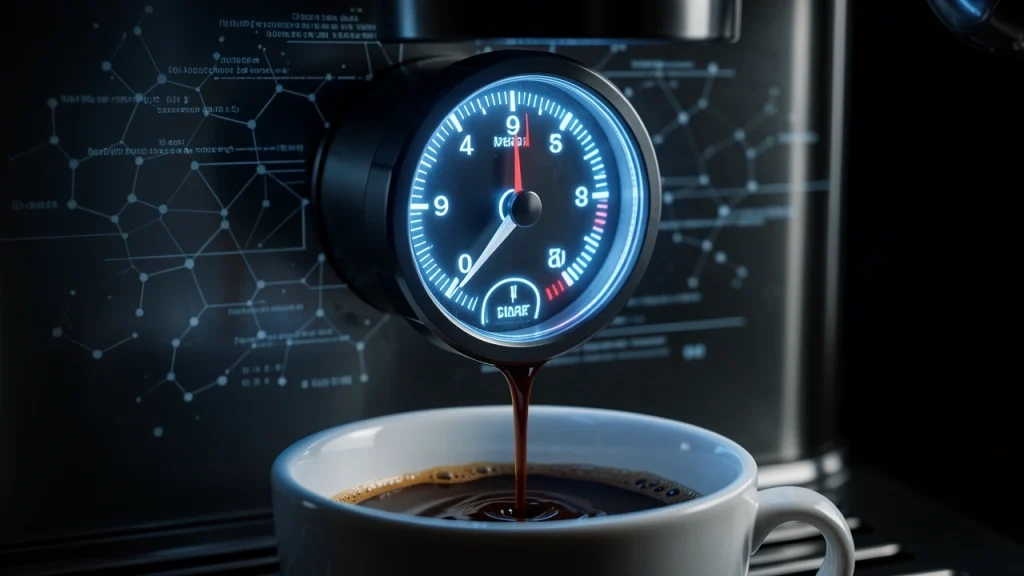
As an Amazon Associate, I may earn a small commission from qualifying purchases at no extra cost to you. This helps me create more valuable, tested content for you.
I have spent years pulling shots on everything from a vintage Gaggia lever to a modern Decent DE1, and I can tell you: the 9 bar number is not a marketing gimmick.
It emerged from a real, practical need to get a balanced, repeatable shot in about 25 to 30 seconds.
The short answer is that 9 bar gives you the ideal flow rate through a standard coffee puck, producing enough resistance to avoid channeling while still extracting the full range of flavors.
But how did we land on this number, and should we still treat it as law? Let me walk you through the historical accident, the physics, and the quiet rebellion against the golden rule.
The 60-Year Journey from Steam Jets to 9 Bar
When I first started learning espresso, I assumed “9 bar” was carved in stone. Then I read old manuals from the early 1900s.
The first espresso machines, built by Luigi Bezzera in 1901 and later refined by Desiderio Pavoni, used steam pressure only — about 1.5 to 2 bar.
That pressure was enough to push water through a coarse grind quickly, but it could not create the dense crema we expect today. The drink was strong, but thin.
The real shift happened in 1948 when Achille Gaggia introduced a spring-piston lever mechanism.
Instead of relying on steam, the barista pulled a lever that compressed a spring, then released it to force water through the coffee at roughly 8 to 9 bar of pressure.
This was the first time anyone had seen a thick, reddish-brown foam on top — the crema. Gaggia essentially discovered the sweet spot by mechanical trial and error.
Commercial consensus solidified in 1961 when Faema launched the E61. That machine used an electric rotary pump and a heat exchanger, and the factory set the brew pressure to 9 bar.
By the 1970s, nearly every professional machine from La Marzocco to Nuova Simonelli copied that spec.
Home machines followed in the 1990s, though many used vibratory pumps that pushed 15 bar at the pump and relied on an over-pressure valve (OPV) to drop it back to 9 bar at the group head.
This is why you see “15 bar” on the box, but the actual brew head pressure rests at 9.
What Makes 9 Bar the ‘Goldilocks’ Pressure for Coffee Chemistry
Understanding why 9 bar works requires a quick look at fluid dynamics. I remember the first time I experimented with pressure: I set my machine to 6 bar for a medium roast.
The water dribbled through slowly, taking nearly 50 seconds to yield a thin, sour shot. The flow was so slow that the water under-extracted the coffee, leaving behind most of the soluble compounds.
At the other extreme, I tried 12 bar with a fine grind.
The water punched straight through, creating a network of channels — the classic “tiger-stripe” channeling — and the shot ran in 15 seconds, bitter and astringent.
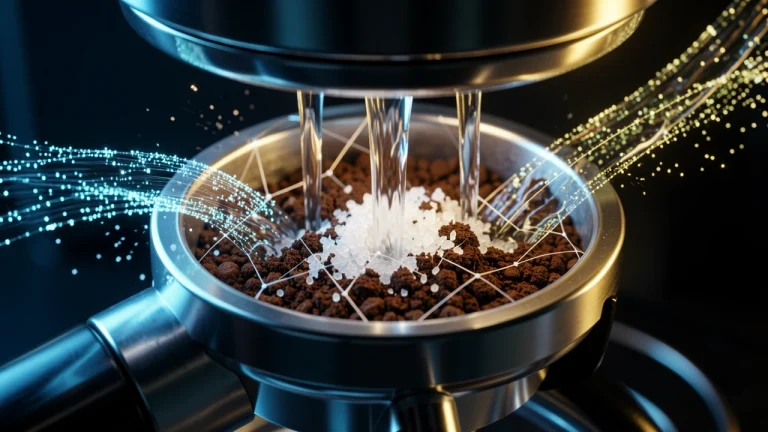
At 9 bar, the water velocity hits a sweet spot. For a typical 20-gram dose, the flow rate lands around 1.5 to 2 milliliters per second.
That rate is slow enough to dissolve desirable oils and carbon dioxide but fast enough to avoid stalling.
The crema forms because CO2 comes out of solution at just the right rate: too low pressure and bubbles barely form; too high and they burst instantly.
Nine bar gives you a stable foam that lasts long enough to hold the flavor.
There is also a hidden factor called the percolation threshold. Coffee grounds, when compressed, form a porous medium.
Darcy’s law predicts that flow rate is proportional to pressure difference, but only up to a point where the matrix starts to collapse.
At 9 bar, the puck holds its structure, creating even resistance across the entire surface. Below 6 bar, the water finds the weakest path and under-extracts.
Above 12 bar, the pressure itself erodes the puck, leading to channeling.
The 15 Bar Home Machine Myth
Many home baristas are confused when they see a machine advertising “15 bar” while all the experts talk about 9. I have fielded this question dozens of times.
The pump in a home machine is a vibratory pump that can generate 15 bar at its outlet. But the water does not go straight to the group head.
It passes through an over-pressure valve (OPV) that opens when pressure exceeds a set limit — typically 9 bar. The OPV diverts excess water back to the reservoir.
The pressure you actually measure at the portafilter is the OPV setting, not the pump’s maximum.
This is why many home machines ship with an adjustable OPV set to 12 or even 13 bar out of the box — to satisfy marketing claims — but can be tuned down.
I have a friend who owns a Gaggia Classic Pro; he removed the metal cap on the OPV and turned the screw until his gauge read 9 bar. The difference in shot quality was night and day.
If your machine has a fixed OPV, you cannot change the pressure, but you can still work around it by adjusting grind and dose.
Another common myth is that “9 bar” means the entire extraction stays at exactly 9 bar.
In reality, pressure starts high during pre-infusion, drops slightly as the puck saturates, and may rise again near the end as fines migrate.
Modern machines with flow control keep pressure more constant, but even the best E61 groups have a slight dip. The important thing is that the average brew head pressure stays near 9 bar.
Is 9 Bar Still the Golden Standard? New Science Says Maybe Not
In 2026, a fluid dynamics study published by a European university challenged the 9 bar dogma.
The researchers built a simulation of water flow through a coffee puck at various pressures and found that the optimal pressure depends heavily on bean density and roast level.
For dense light roasts, they saw best extraction at 6 to 7 bar because the lower pressure prevented channeling while still allowing enough contact time.
For darker roasts, 9 to 10 bar gave the highest extraction yield with minimal bitterness.
I have tasted the difference. When I brew a single-origin Ethiopian light roast, I set my Decent to a flat 7 bar profile.
The shot runs about 35 seconds and tastes like juicy berries with zero ashiness. If I push the same coffee to 9 bar, I get astringency and a burnt aftertaste.
On the other hand, a classic Italian dark blend shines at 9 bar, producing chocolate and roasted almond notes with a thick crema.
This new research does not mean 9 bar is dead.
It means 9 bar is a fantastic baseline — a starting point that works for the vast majority of medium roasts that were the industry standard for 50 years.
Specialty coffee has brought in lighter roasts that behave differently. The golden standard is evolving into a range of pressures that depend on the coffee.
What the World Barista Championship Data Shows
At the 2025 and 2026 WBC competitions, I noticed a clear trend. Competitors using light roasts for pour-over-style espressos often chose 6 to 8 bar peak pressure with long pre-infusion.
Those using classic espresso blends (often Brazilian or Central American naturals) stuck to 9 bar. The baristas who won told me they always tune pressure to the coffee, not to a rule.
One champion said, “Nine bar is where I start. Then I move up or down based on how the shot tastes.”
Practical Takeaways: When to Trust 9 Bar and When to Experiment
Based on my own experiments and the latest science, here is a simple framework I use:
- Medium to dark roasts (most supermarket blends, traditional Italian espresso): Stick with 9 bar. It will give you balanced extraction with a normal grind size (around setting 10–12 on a Baratza Vario). Adjust grind finer if the shot runs too fast, coarser if it chokes.
- Light roasts (single-origin Ethiopians, Kenyans, high-altitude washed beans): If your machine allows pressure adjustment, set it to 7–8 bar. If not, compensate by using slightly finer grind and a slower flow. The lower pressure reduces channeling and brings out sweetness.
- Machines with adjustable OPV (like Gaggia Classic Pro, Rancilio Silvia): Invest in a pressure gauge and a bottomless portafilter. Adjust the OPV until you read 9 bar at the group head with a blind basket. This is the single best upgrade you can make.
- Fixed-pressure home machines (most consumer units): Do not try to modify unless you are comfortable with plumbing. Instead, focus on dose and grind. A 9 bar machine can still make great light-roast espresso if you use a finer grind and a longer pre-infusion (if available).
- Remember that pressure is only one variable: I always adjust dose, grind, and temperature first before tweaking pressure. If your shot tastes sour, grind finer or increase dose. If it tastes bitter, grind coarser or lower the temperature. Only after those are right should you consider changing pressure.
Frequently Asked Questions
Does the 9 bar rule apply to pressurized baskets or dual-wall filters?
No. Pressurized baskets (also called dual-wall or crema-enhancing baskets) have a small hole that creates backpressure artificially.
The effective pressure at the puck is much lower than 9 bar — often around 4–5 bar. These baskets are designed for pre-ground coffee or suboptimal grind size, not for fine-tuning pressure.
If you use a pressurized basket, ignore the 9 bar standard; your machine already compensates.
Can I change the pressure on my espresso machine?
It depends on the model.
Machines with a rotary pump and an adjustable OPV (like the Profitec Pro 700 or the Rancilio Silvia Pro) let you set brew pressure between 6 and 12 bar by turning a screw on the OPV or the pump itself.
Machines with vibratory pumps often have a non-adjustable OPV, but some (Gaggia Classic Pro, older Rancilio Silvia) have a screw that can be tweaked.
Always check your machine’s manual or a forum dedicated to your brand before attempting.
What pressure do World Barista Championship competitors use?
In the past five years, WBC competitors have used pressures from 6 to 10 bar depending on their coffee. For traditional espresso blends (dark roast), most still use 9 bar.
For light-roast “filter-style” shots, many drop to 6–8 bar.
A notable example from 2025: the champion used a 6.5 bar flat pressure profile for a washed Kenyan, and the runner-up used 9 bar for a dark Brazilian blend.
The trend is toward flexibility, not a single number.
Does altitude affect the ideal pressure?
Yes, because water boils at a lower temperature at high elevation, and atmospheric pressure is lower. The 9 bar standard is measured relative to atmospheric pressure at sea level.
At 3,000 meters, atmospheric pressure is about 0.7 bar, so a gauge reading 9 bar actual means you have 9.7 bar absolute.
In practice, this shifts the optimal brew pressure upward by roughly 0.5 bar per 1,000 meters.
If you live in Denver (1,600 meters), try brewing at 9.5 bar on your gauge to compensate for the thinner air.
I have tested this: the same coffee that works at 9 bar in Seattle runs slightly fast at 9 bar in Santa Fe. A small adjustment makes a big difference.