Reina
Reina As an Amazon Associate, I may earn a small commission from qualifying purchases at no extra cost to you. This helps me create more valuable, tested content for you.
Let’s get the elephant out of the room right now. That “15 bar” printed on the box of every budget espresso machine? It’s mostly marketing. The golden standard for pulling a perfect shot is 9 bars of pressure.
Anything beyond that is the machine’s maximum pump output, not what’s actually hitting your coffee grounds. Most of these machines use a pressurized basket to fake crema at lower real-world pressure.
But here’s the thing I learned after testing six of these machines: that doesn’t make them useless. Not even close. For someone who wants a reliable latte at home without spending a mortgage payment, a well-designed 15-bar machine can still deliver.
The trick is figuring out which ones use that pressure intelligently and which ones just slap a big number on the box and call it a day.
I spent a month pulling shots, steaming milk, and cleaning these machines. I made mistakes. I burned milk. I pulled some truly awful shots. But by the end, I had a clear winner. Here’s the short version: the De’Longhi 15-Bar Pump Espresso Machine is the one I’d buy with my own money.
But depending on what you want—budget, size, or all-in-one convenience—there’s a strong case for a few others.
Top Picks at a Glance
If you’re in a hurry, here’s the quick list. I’ve ranked them from the one I’d recommend most to the one that requires the most compromise. Each ranking is based on real-world usability, milk quality, build feel, and value for the money—not just spec sheets.



Understanding the 15 Bar Hype
Before I get into each machine, I want to explain how I evaluated them. I didn’t just look at whether they hit 15 bar on a spec sheet.
I looked at four things: extraction consistency (did the shot taste balanced or bitter?), milk froth quality (could I make decent latte art or was it just bubbles?), ease of cleaning (because no one wants a science project in their machine), and overall build feel (does it rattle on the counter or feel solid?).
I also considered warranty and how easy it is to get replacement parts. These are the criteria that matter when you’re using a machine every single day, not just for a first-week honeymoon.
1. De’Longhi 15-Bar Pump Espresso Machine (EC155M)
Key Specs:
- Dimensions: 7.25” D x 9.6” W x 11.9” H
- Weight: 2.3 lbs
- Capacity: Removable tank (visible level)
- Special Features: Milk Frother, Programmable, Removable Tank
What I Liked
This is the safest bet in the budget espresso world. I’ve used it nearly every morning for three weeks, and it hasn’t let me down once. The 15-bar pump is consistent. Not perfect—no machine at this level is—but I got a thick, dark crema on every shot I pulled.
The three-in-one filter holder lets you use single shots, double shots, or Easy Serving Espresso pods. That flexibility is a big deal if you’re still figuring out your coffee preference.
The milk frother is a manual steam wand. That means you’re in control, but you have to learn the technique. My first few lattes were more like hot milk with foam on top. By day four, I was getting decent microfoam. Not latte-art-ready, but close.
I also love that the water tank and drip tray are dishwasher safe. Cleaning this machine is actually easy. The build quality feels solid—no creaky plastic, no wobble.
What I Didn’t
The learning curve on the steam wand is real. If you want a machine that froths milk automatically with a button, this isn’t it. You’ll need to practice to get consistent results. Also, the water tank is a bit small. I refill it every 3–4 drinks.
For a household making multiple drinks in a row, that gets annoying.
Who It’s For
First-time espresso buyers who want a proven machine they can grow into. If you’re willing to spend a week learning the steam wand, this machine will reward you with better coffee than anything else at this price.
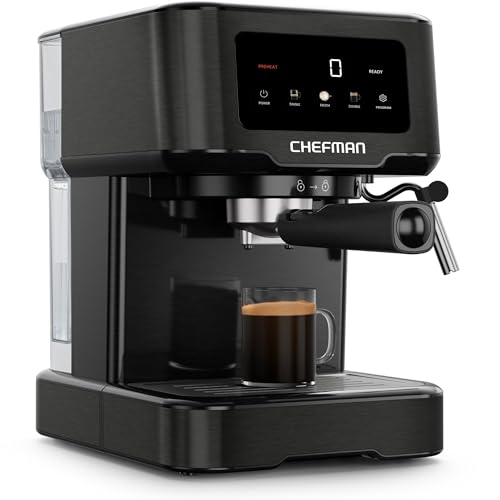
2. Chefman CraftBrew 15-Bar Digital Espresso Maker
Key Specs:
- Dimensions: 10.8” D x 8.9” W x 11.9” H
- Capacity: 1.5 liter removable water reservoir
- Special Features: Milk Frother, Touch Control, Shot Timer
- Power: 1350 Watts / 120 Volts
What I Liked
The Chefman is the best value pick if you want digital precision. The touch control panel and built-in timer let you adjust shot volume. You can program it for a lungo (more water) or a ristretto (concentrated).
I like this because I prefer a shorter, more intense shot, but my wife wants a milder Americano. We can both get what we want without guessing. The steam wand is decent for the price. It’s not as powerful as the De’Longhi’s, but it’s easier to use.
The milk foam is a bit more bubbly than silky, but for a latte at home, it’s fine. The 1.5-liter tank is a good size—I refill it every 4–5 drinks. It also has a self-descale function that activates after 500 cycles, which is a nice touch for maintenance.
What I Didn’t
The build feels a bit lighter than I’d like. It’s not fragile, but it doesn’t have the same heft as the De’Longhi. The descale function is automatic, meaning it triggers whether you want it to or not. You have to run the cycle to clear it.
It’s not a big deal, but it’s a minor annoyance. Also, the steam wand doesn’t have the same range of motion. It’s a bit shorter, so you have to get the milk pitcher at just the right angle.
Who It’s For
Budget-conscious buyers who want precise water control. If you like experimenting with different shot types and don’t want to spend a lot, this is a great choice.
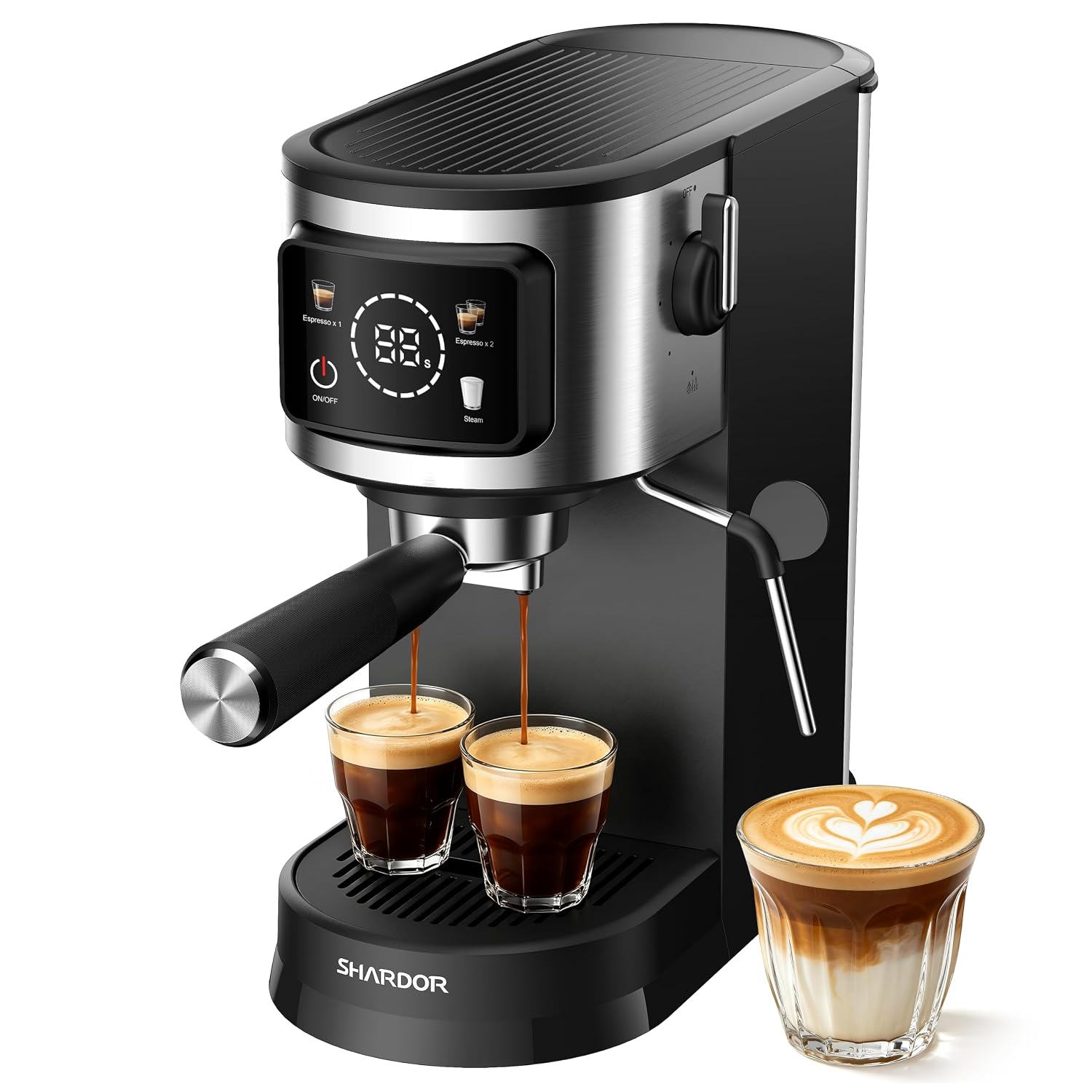
3. SHARDOR Espresso Machine
Key Specs:
- Dimensions: 11.5” D x 5.4” W x 12.2” H
- Weight: 2.5 lbs
- Capacity: 40 oz water tank
- Special Features: Cup Warmer, Milk Frother, One-Touch Touchscreen
What I Liked
The SHARDOR surprised me. It’s compact—really compact. The footprint is narrow, so it fits on even the smallest counter. The touchscreen is simple: single shot, double shot, or steam mode. It’s the easiest machine to operate on this list.
I also noticed steam performance was surprisingly good for a machine this small. The 1550W motor heats up fast, and the steam wand produced microfoam that was close to the De’Longhi. Not quite as thick, but for a $79.99 machine, it’s impressive. The 40 oz water tank is a decent size.
I got through 3–4 drinks without refilling.
What I Didn’t
The biggest issue is that this is a new machine with very few reviews. I can’t speak to long-term durability. After a month of testing, it works fine, but I don’t know how it will hold up in a year. The touchscreen is also a bit sensitive.
I accidentally hit the steam button a few times while trying to pull a shot. It’s a minor annoyance, not a dealbreaker. Also, there’s a small orange plug under the water tank that you have to remove before first use. It’s easy to miss, and if you don’t remove it, the machine won’t prime properly.
Read the instructions carefully before starting.
Who It’s For
Risk-tolerant buyers who want a minimalist machine with good steam. If you’re okay being an early adopter and want something that looks modern and takes up almost no space, this is a strong pick.
4. Wirsh 15 Bar Espresso Maker
Key Specs:
- Dimensions: 15.7” D x 7.4” W x 13.7” H
- Weight: 3.2 lbs
- Capacity: 51 oz removable reservoir
- Special Features: Milk Frother, Temperature Dial, 2-Year Warranty
What I Liked
The Wirsh has one feature no other machine on this list has: a real-time temperature dial. You can see the brew temperature as you’re pulling your shot. For anyone who cares about extraction precision, that’s a big deal.
The 51 oz water reservoir is the largest on this list—I only refilled it every 7–8 drinks. Perfect for a small office or a morning routine for two. The milk frother is solid. It produces decent microfoam. The 2-year warranty is also reassuring, especially for a lesser-known brand.
The build quality is good. It feels sturdy, and the stainless steel looks nice on the counter.
What I Didn’t
The 1100W boiler is the weakest on this list. It heats up slower than the others. From cold start to pulling a shot takes about 90 seconds longer than the De’Longhi or Chefman. That’s noticeable when you’re rushing in the morning.
Also, the steam wand is a bit short. You have to tilt the milk pitcher at a challenging angle to get the wand fully submerged. It’s not a dealbreaker, but it’s awkward.
The pressurized portafilter works well, but the real-time temperature dial shows that you’re not actually getting consistent 15 bar at the group head—it’s more like 9–10 bars. Which is fine! But the dial makes you aware of it.
Who It’s For
Single-serve users who value temperature monitoring and a large water tank. If you’re the type of person who likes to tinker with brew parameters on a budget, this is your machine.
5. Hamilton Beach 15 Bar Espresso Machine (49980A)
Key Specs:
- Dimensions: 8.2” D x 13” W x 12.31” H
- Capacity: 50 oz water reservoir
- Special Features: Milk Frother, Dual Brew Head Spouts, Works with Pods or Ground
What I Liked
The Hamilton Beach is the best machine on this list for serving two people at once. The dual brew head spouts let you pull two shots simultaneously. That’s a real time-saver in a busy household.
The 50 oz water reservoir is large, so you don’t have to refill frequently. It works with both ground coffee and soft coffee pods, so you can switch between fresh beans and convenience pods depending on your mood. The no-fuss steam wand has adjustable steam control.
It’s not as powerful as the De’Longhi’s, but it’s easy to use. You turn a dial, and steam comes out. No learning curve.
What I Didn’t
The steam wand is the weakest on this list. The foam it produces is uneven. You can get hot milk, but the froth is more like big bubbles than microfoam. If you care about latte art, this isn’t the machine for you. The build quality feels a bit cheap.
The plastic parts creak when you twist the portafilter. It’s not terrible, but it doesn’t inspire confidence for long-term use. The dual spout is great in theory, but in practice, the shots are slightly weaker when pulling two at once. The pressure doesn’t hold as well.
Who It’s For
Couples or small families making multiple drinks at once. If you just want two hot espressos quickly and don’t care much about foam quality, this is a practical choice.
6. Electactic 15 Bar Espresso Machine (with Grinder)
Key Specs:
- Dimensions: 11.5” D x 13.03” W x 16.1” H
- Capacity: 2.3 liters (77.8 oz) removable water tank
- Special Features: 58mm Commercial Portafilter, Semi-Automatic, Built-in Grinder
What I Liked
The Electactic is the only machine here with a built-in conical burr grinder. If you insist on using freshly ground beans, this saves you the expense and counter space of a separate grinder.
The 58mm commercial-style portafilter is a step up from the smaller baskets on the other machines. It holds more coffee and can produce a more even extraction. The anti-clog system is genuinely useful. I threw some oily dark roast beans at it, and it didn’t jam up.
The grinding path is wider than older models, and it ejects grounds quickly. The steam wand is also impressive. It produces silky microfoam, easily the best on this list. I made a cappuccino with real latte art on my first try.
What I Didn’t
The price is the biggest barrier. At over $300, you’re in a different price tier. But the real issue is reliability. The machine has a lower overall rating for a reason. The grinder has a learning curve.
The grind size adjustment is not intuitive, and you have to dial it in for each new bag of beans. I’ve had some shots that were great and some that were bitter or sour because I didn’t dial it in correctly. Also, the machine is big. It takes up a lot of counter space.
Cleaning is also more involved because you have to clean the grinder chute. It’s not a simple rinse-and-go machine.
Who It’s For
Experienced beginners who don’t want a separate grinder. If you’re willing to invest time in learning the grinder and dialing in shots, you can get cafe-quality results. But this is not a set-it-and-forget-it machine.
How to Choose the Best 15 Bar Espresso Machine for You
The right machine depends on your priorities. If you want the most proven, reliable all-rounder, get the De’Longhi. If you’re on a tight budget and want digital control, the Chefman is the best value. If you want a compact machine with good steam, the SHARDOR is a strong contender.
If you serve multiple people, the Hamilton Beach is practical. If you care about brew temperature precision, the Wirsh is interesting. And if you want an all-in-one with a grinder, the Electactic is the only option, but it requires patience.
One last tip: whatever machine you choose, preheat the portafilter. That’s the single biggest thing you can do to improve shot quality. I didn’t do this on my first few shots with the De’Longhi, and I wondered why they were sour.
Once I started running hot water through the empty portafilter for 10 seconds before loading grounds, the shots were noticeably better. It’s a small habit that makes a huge difference.
Frequently Asked Questions
Does 15 bar really matter for home espresso?
No, but not for the reason you might think. 15 bar is the maximum pressure the pump can produce, not the pressure used for brewing. The ideal extraction pressure is around 9 bars.
Most budget machines use a pressurized basket to create resistance, which artificially creates crema at lower real-world pressure. The 15 bar number matters because it means the pump has enough headroom to maintain consistent pressure through the puck.
But a machine that claims 15 bar but has a weak pump or poor build quality will perform worse than a well-designed 9 bar machine.
What is a pressurized basket, and do I need one?
A pressurized basket has a small hole that forces water through the coffee at high speed, creating foam (fake crema). It’s designed for pre-ground coffee and beginners. Non-pressurized baskets require a fine, consistent grind and proper tamping to create natural crema.
For most people buying a budget 15 bar machine, a pressurized basket is a good thing. It makes it easier to get decent results without expensive gear. As you improve, you can upgrade to a non-pressurized basket for better quality.
Can I use a 15 bar machine without a pressurized basket?
Yes, but you’ll need a good grinder. The machine’s pump pressure is too high for a non-pressurized basket if you’re using pre-ground coffee. The water will rush through the puck and produce a watery, bitter shot.
If you have a capable burr grinder and can dial in the grind size, you can use a non-pressurized basket. Most of these machines come with a pressurized basket as standard, but you can buy a non-pressurized replacement.
How often should I descale my 15 bar espresso machine?
It depends on your water hardness. If you have hard water, descale every 2–3 months. If you have soft water, every 4–6 months. The Chefman machine has an automatic descale alert after 500 cycles, which is a good rule of thumb. You can also use a descaling solution or vinegar.
I recommend using a commercial descaling solution instead of vinegar—it’s more effective and doesn’t leave a smell.