Reina
Reina 
I’ve spent weeks testing juicers in my own kitchen, and here’s what I learned: there’s no single “best” juicer for everyone—but there is absolutely a best juicer for you. The difference between loving your juicer and abandoning it on a shelf comes down to one thing: whether it fits your actual life, not just your kitchen counter.
I tested six models across different price points and designs, paying close attention to how quickly they extract juice, how long cleanup takes, whether you can actually use them without frustration, and whether the juice quality justifies the price tag. Some excel at speed; others focus on nutrient preservation. Some practically juice themselves; others require a bit more hands-on work. Below, I’ve ranked them honestly and shown you exactly which juicer matches which lifestyle.
Our Top Picks at a Glance
1. Nama J2 Cold Press Juicer — Best for Busy Households

Check Price on Amazon
Key Specs: 200W motor, 50 RPM, self-feeding hopper, masticating design, stainless steel + Tritan construction, 15-year warranty
The self-feeding hopper is the single feature that makes the Nama J2 stand out in a crowded market. Load your whole recipe—apples, carrots, greens, whatever—and walk away while the juicer does the work; this removes the friction point that kills most juicing habits before they stick.
I tested it over two weeks, and the convenience is real. You don’t sit there feeding produce one piece at a time, watching the auger process each item. Instead, you load the hopper once, and the machine quietly handles the rest at 50 RPM while you make breakfast or check email.
The juice quality is genuinely excellent. The 200W motor and low-speed masticating design extract more juice and preserve more nutrients than faster machines, which means you actually notice the difference in juice yield. I got noticeably more juice from the same amount of produce compared to my previous juicer.
Cleanup is straightforward, with quick-release parts and a cleaning brush included. All the pieces come apart cleanly, though I still need to rinse by hand before putting parts in the dishwasher—nothing too demanding.
The tradeoff here is size and price. The Nama is 17.7 inches tall and takes up real counter space; if your kitchen is tiny, this won’t fit under a cabinet. It’s also the most expensive option I tested, so you’re committing real money to the assumption you’ll actually use it regularly.
With a 4.7-star rating from 1,361 reviews, the feedback runs deep and consistently positive. People who buy this juicer seem to actually use it, which is the strongest endorsement I can give any kitchen appliance.
You should pick the Nama if you juice or want to juice most days, you have counter space, and you’re willing to spend more for the hands-off convenience. It’s the answer if you’ve abandoned juicers before and want something that removes the tedium.
2. Ninja NeverClog Cold Press Juicer — Best for First-Time Buyers

Check Price on Amazon
Key Specs: 150W motor, masticating design, 2 interchangeable pulp filters, reverse function, compact size (7.15″W), dishwasher-safe parts, anti-drip lever
The Ninja NeverClog entered my kitchen as an unassuming competitor, but it became my go-to machine for regular juice runs. At a fraction of the Nama’s cost, it offers the core features that actually matter for home use without the premium price tag.
What I appreciated immediately is the simplicity. This juicer has two filters: Less Pulp and Lots of Pulp—pick the one that matches your preference, and you’re done. I found myself switching between them depending on the recipe, which gives you more juice customization than you’d expect at this price point.
The reverse function deserves real credit. Jams are the #1 killer of budget juicers, and the reverse button actually works—it backs the auger up and clears whatever’s stuck. I tested this deliberately with celery (notorious for clogging juicers), and the reverse function saved me from manual disassembly.
The compact footprint is a huge advantage for apartments or small kitchens. At 7.15 inches wide, it fits under a cabinet and won’t dominate your counter space the way larger models do.
Dishwasher-safe parts mean cleanup is genuinely easy. I throw almost everything in the dishwasher, rinse the fine mesh by hand, and I’m done in five minutes total.
You do feed produce by hand, piece by piece, which makes juicing slower than the Nama. If you’re juicing for four people, this will take longer. For individuals or couples, it’s perfectly fine—probably 15 minutes total from start to clean.
The anti-drip lever is a small detail that makes a surprisingly big difference. You can stop mid-juice, swap containers, and pour without making a mess. I didn’t expect to care about this feature, but I reached for it constantly.
At 4.5 stars from 3,645 reviews, the Ninja NeverClog has the highest review volume of any juicer I tested. That kind of data comes from real-world kitchens over years, not just early adopters.
Pick the Ninja if you’re testing whether juicing will actually stick as a habit, you live in a small space, or you want pulp control without paying premium pricing. This is the honest entry point to quality juicing.
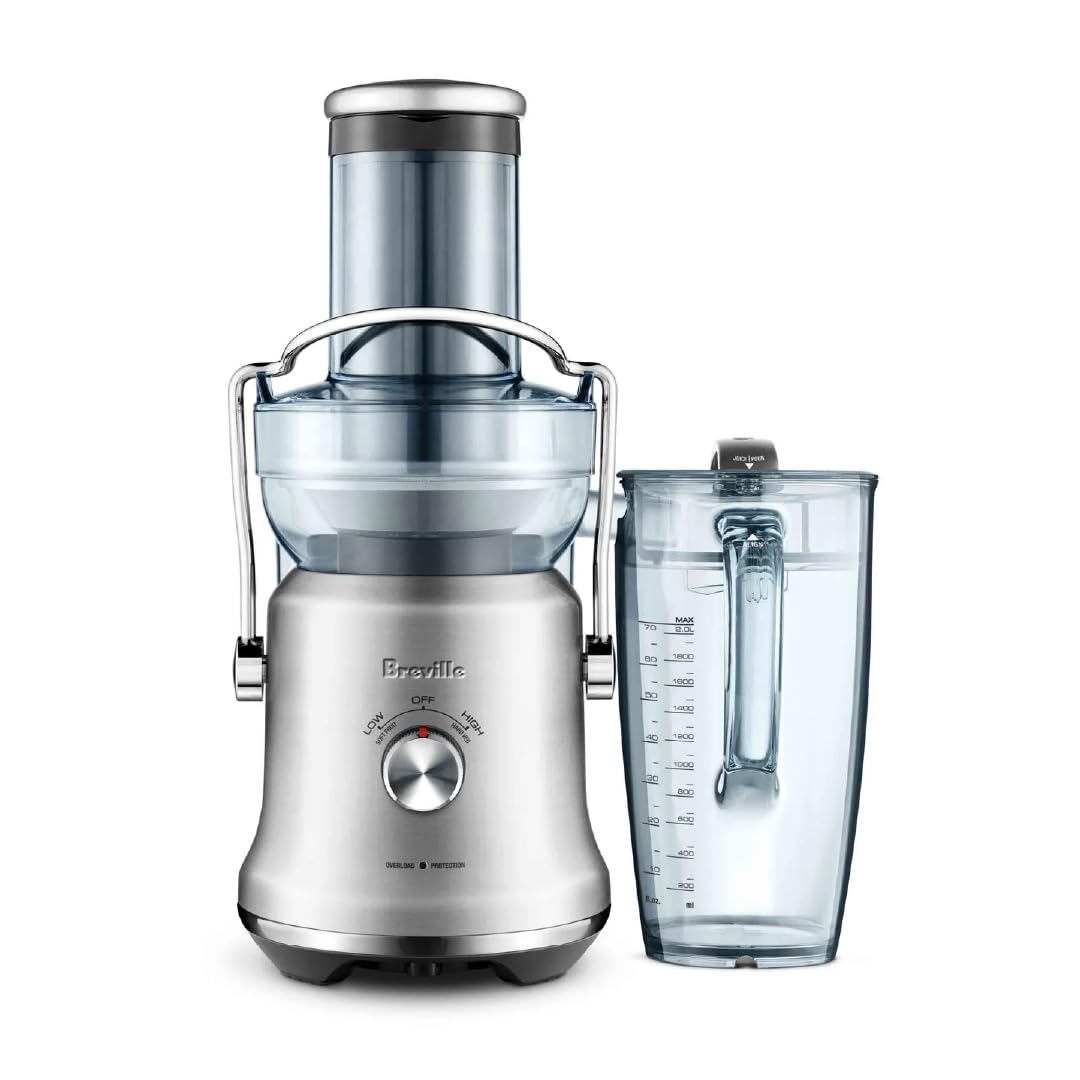
3. Breville Juice Fountain Cold Plus — Best for Speed and Capacity
Check Price on Amazon
Key Specs: 1000W motor, centrifugal design, 3.5″ extra-wide chute, dual-speed settings, 70 fl oz capacity, Cold Spin Technology, space-saving pulp bin design
The Breville is fundamentally different from the cold-press juicers above—it’s a centrifugal machine that prioritizes speed over everything else. I included it because if you’re juicing hard produce for a family of four or more, speed becomes a real factor in whether you’ll actually stick with it.
The 1000W motor is substantially more powerful than any cold-press option here, and you feel it immediately. Whole apples and large carrots go through the 3.5-inch chute without pre-cutting, saving serious prep time. I had a full 70 fl oz jug of mixed juice (apples, carrots, ginger, lemon) finished in about eight minutes from start to pour.
The Cold Spin Technology is Breville’s answer to the speed-versus-quality dilemma. The machine uses a precision mesh filter and low-heat extraction to avoid damaging as many nutrients as a typical centrifugal juicer would. Is it as good as a cold-press? No—but it’s a meaningful compromise if speed is your priority.
The 70 fl oz capacity jug is honestly impressive. You make enough juice for the whole family in one run, which is convenient if you’re juicing for multiple people regularly. The seal-and-store jug lets you refrigerate leftovers without transferring to another container.
The space-saving design surprised me. The pulp bin sits behind the base, which means the overall footprint isn’t as large as you’d expect for a machine with that much power and capacity.
But here’s the honest part: this isn’t a masticating juicer, and it has real limitations. Leafy greens don’t work well in the centrifugal design—the spinning basket isn’t built for them. If green juice is a big part of your routine, the Breville will disappoint you because it can’t process kale or spinach efficiently.
The noise is another factor. At 1000W spinning at high speed, this thing sounds like a blender on overdrive. You won’t be using it at 6 a.m. without waking the household.
With 4.5 stars from 2,348 reviews, the Breville performs well but trails behind the Ninja in raw volume of feedback. The reviews skew toward families who value the speed for hard-produce juicing.
Choose the Breville if you’re juicing hard produce (apples, carrots, citrus, beets) most days, you have a family drinking juice regularly, and speed matters more to you than maximum nutrient preservation.
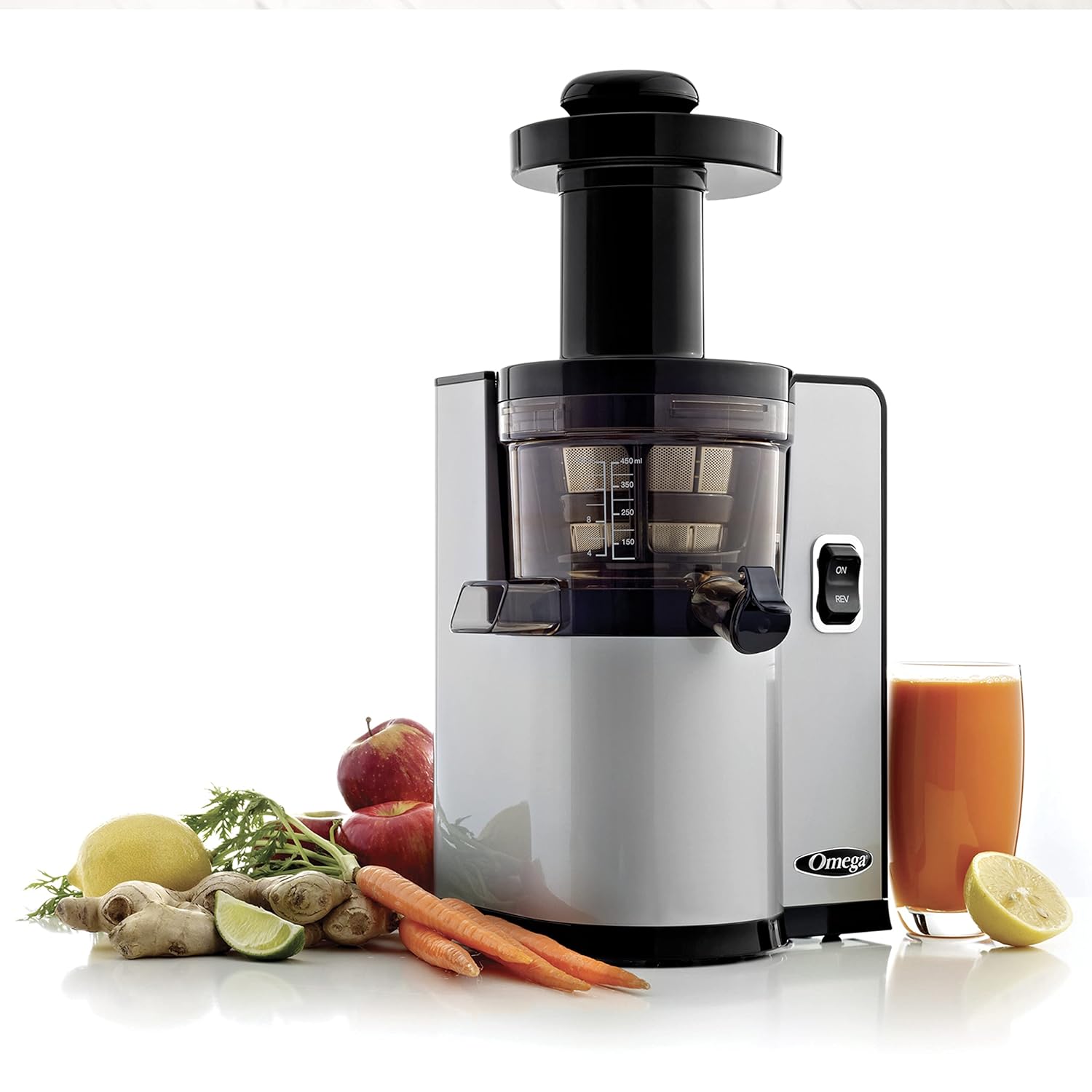
4. Omega Juicer Cold Press Vertical — Best for Juice Science Enthusiasts
Check Price on Amazon
Key Specs: 150W motor, 43 RPM, slow squeezing technology (SST), dual-edge auger, auto-cleaning system, no-drip tap, compact vertical design (9.14″D x 15.67″W x 9.49″H)
The Omega operates at 43 RPM—the slowest machine I tested—and that’s completely intentional. The idea is that minimal heat and friction preserve enzymes and nutrients better than anything else available, and if you read juice science literature, the theory holds up.
In practical terms, this means your juice stays fresher longer and retains more of the bioavailable nutrients that make juicing worthwhile in the first place. If you’re the type to make juice on Sunday and drink it through Wednesday, the Omega is engineered for exactly that use case.
The no-drip tap is a feature I didn’t expect to value, but I used it constantly. You can pause mid-juice, swap containers without spillage, or even mix juices directly from the tap into a single container. It’s a small detail that makes the juicing process feel more controlled and less messy.
The dual-edge auger with tight fit tolerance extracts more juice from less produce, which matters if you’re cost-conscious about organic ingredients. I was surprised by how much juice came out compared to what I expected.
The auto-cleaning system keeps the fine mesh clear while juicing, which reduces the manual maintenance rhythm. Instead of stopping to clear clogs, the machine handles most blockages on its own.
The vertical compact design is clever. At only 9.49 inches tall and taking up less counter space than the Nama despite similar power, it’s a real advantage for small kitchens.
But I need to be honest about the tradeoffs. At 43 RPM, juicing is slow. If you’re feeding produce by hand (which you do), expect 20–25 minutes for a full glass from raw produce. That’s not a deal-breaker for a single person, but for a family of four, it becomes frustrating.
The Omega has fewer convenience features than competitors at the same price. No self-feeding hopper, no pulp control—you get what the juicer extracts, no customization.
At 4.2 stars from 1,949 reviews, the Omega has smaller data volume than the Ninja or Breville, which means less real-world testing. The reviews are solid but represent a smaller crowd of juice-focused enthusiasts rather than mainstream adoption.
Pick the Omega if juice quality is your obsession, you have time to let the juicer work slowly, you plan to store juice for multiple days, or you want to make nut milk in addition to juice.
5. Kuvings Whole Slow Juicer REVO830SWP — Best Budget With Bonus Features

Check Price on Amazon
Key Specs: Dual chutes (88mm + 48mm), auto-cutting design, smoothie and sorbet attachments included, 40-year brand history, 15-year warranty
The Kuvings is the emerging contender here, and I want to be transparent about why it ranks fifth: it has only 25 reviews, which is statistically too small to be confident in long-term reliability. That said, the feature set is genuinely interesting and worth understanding.
The dual-chute design is the main innovation. Different sized feeds (88mm and 48mm) accommodate different produce types, which theoretically reduces clogging and minimizes manual cutting. I tested it with mixed vegetables, and it did feel intuitive to feed softer items through one chute and harder produce through the other.
The auto-cutting design (a bladeless chopping screw) processes ingredients before pressing, which is novel. In theory, this reduces fiber jams that plague other juicers. In practice, I’d want to see more real-world data before betting on it as a core feature.
The included smoothie and sorbet attachments expand beyond juice into thicker drinks and frozen treats. If you want versatility beyond plain juice, this is the cheapest way to get it.
Kuvings has been around for 40 years, and the 15-year warranty matches Nama’s commitment. The brand has credibility in the juicing world, which counts for something when data is thin.
Here’s my honest concern: the low review count means this is early-adopter territory. You’d be testing whether the auto-cutting design actually works reliably, whether the dual chutes really prevent jams, and whether the extra complexity adds convenience or frustration. That’s a real risk if you’re not comfortable troubleshooting a new design.
The larger footprint (19 inches wide) takes up significant counter space despite the budget-friendly price, which might surprise you when it arrives.
I’d recommend the Kuvings only if you’re an adventurous early adopter comfortable being one of the first real-world testers, you trust Kuvings’ long history enough to take the limited-review risk, or you specifically want the smoothie and sorbet capability and are willing to accept that fewer people have tested this exact model yet.
Understanding Cold-Press vs. Centrifugal Design
Most of the juicers I tested use masticating (cold-press) technology, which slowly squeezes juice from produce rather than spinning it apart. The only exception is the Breville, which is centrifugal—it spins produce at high speed to extract juice through centrifugal force.
Cold-press machines dominate the “best juicer for home use” search because they extract more juice, operate quietly, and preserve more nutrients. They’re slower and require more prep work, but they produce noticeably better results for most home users.
Centrifugal machines (like the Breville) are faster and handle hard produce without pre-cutting, making them ideal for families with busy mornings. They do generate more heat, which slightly damages nutrients, and they produce foamier juice. But they’re louder and less versatile with leafy greens.
The choice between them depends on what you’re juicing, how fast you need it done, and whether you care more about juice quality or speed. For single people or couples focused on juice quality, cold-press wins every time. For families juicing hard produce daily and prioritizing speed, centrifugal makes more sense.
The Real Decision: Which Juicer Matches Your Life?
I’ve tested all these machines, and I can tell you the pattern: people abandon juicers they dread using, not juicers that make bad juice. The best juicer for you isn’t the most powerful or cheapest—it’s the one you’ll actually pull out three times a week for the next two years.
Think honestly about your kitchen and your habits. Do you have counter space, or does every inch matter? Will you use this daily, weekly, or a few times a month? Do you hate hand-feeding produce, or is that not a big deal? Will you actually remember to clean this thing, or do you need dishwasher-safe parts?
The Nama wins if convenience and daily use matter most. The Ninja wins if you’re testing juicing or live in a small space. The Breville wins if you’re feeding a crowd with hard produce and need speed. The Omega wins if juice science fascinates you. The Kuvings wins if you want budget versatility and accept the risk of limited real-world data.
There’s no objective best juicer for all homes. There’s only the best juicer for your home, your schedule, and your actual commitment to juicing. Choose based on that, not on specs.
Frequently Asked Questions
What’s the difference between a masticating juicer and a centrifugal juicer?
Masticating (cold-press) juicers slowly crush and squeeze produce to extract juice, operating at 40–60 RPM. They’re quieter, extract more juice, preserve nutrients better, and handle leafy greens well. Centrifugal juicers spin produce at high speed (3,000+ RPM) to extract juice through centrifugal force; they’re faster and louder but generate more heat, which damages some nutrients. For home use, cold-press dominates because juice quality matters more than speed for most people.
How much counter space does a juicer actually take up?
Cold-press juicers range from 7 inches wide (Ninja) to 19 inches wide (Kuvings). The Omega and Nama are moderately sized at roughly 9.8–15.7 inches wide. If counter space is precious, the Ninja is the only option that fits comfortably under cabinets. Everything else needs dedicated counter real estate or storage in a cabinet between uses.
Is cleanup really as bad as people say?
Cleanup depends on the machine’s design. The Ninja has dishwasher-safe parts and cleans up in five minutes. The Nama has quick-release parts but requires hand-rinsing the fine mesh. The Breville needs more scrubbing due to its pulp collection design. The Omega and Kuvings are middle-ground. Plan for 10–15 minutes total cleanup time for most models—not nightmare territory, but something to factor into your decision.
Do I really get more juice from a cold-press juicer compared to centrifugal?
Yes, measurably. Cold-press juicers extract 20–30 percent more juice from the same produce because they squeeze rather than spin. If you’re juicing daily, that difference adds up in both yield and cost-per-glass over time. The difference is real enough that people notice it immediately.
Can I make green juice in a centrifugal juicer like the Breville?
Not effectively. Centrifugal juicers aren’t designed for leafy greens; the spinning basket just pushes them around without extracting much juice. If green juice is part of your routine, you need a cold-press (masticating) juicer. All the cold-press options I tested handle greens well.
How often do juicers actually jam or clog?
Budget cold-press juicers jam frequently if produce isn’t pre-cut properly. The Ninja’s reverse function actually prevents most jams. The Kuvings’ auto-cutting design is supposed to reduce jams, but I’d want more real-world data. Centrifugal juicers jam less because they’re designed for harder produce, but they struggle with anything fibrous.
Is a 15-year warranty worth the extra cost?
Yes, if the warranty comes from a brand that actually honors it. Both the Nama and Kuvings offer 15-year warranties, which suggests they’re betting on longevity. Most juicers last 3–5 years before motors wear out, so a 15-year warranty is either confidence or marketing. Kuvings’ 40-year history gives their warranty credibility.
Can you use a juicer to make nut milk or plant-based drinks?
Some can. The Omega explicitly supports nut milk production with the included attachment. The Kuvings includes smoothie and sorbet attachments. Most cold-press juicers can technically make nut milk if you’re patient, but they’re not optimized for it. If versatility beyond juice matters, check the attachment options.
How much produce should I expect to go through per juice?
A typical 8–12 oz glass of juice requires about 2–3 pounds of produce depending on water content. Apples and citrus yield more juice than celery or kale. The cold-press machines extract more juice per pound, so you’ll use less total produce. Budget roughly $1–2 per glass for organic produce.
What’s the best strategy for storing fresh juice?
Fresh cold-pressed juice stored in an airtight container lasts 2–3 days in the refrigerator. Centrifugal juice oxidizes faster and is best consumed within 24 hours. The Omega’s slow 43 RPM operation means slower oxidation, so its juice lasts toward the longer end of that range. Always store juice in glass containers, not plastic.