Reina
Reina 
As an Amazon Associate, I may earn a small commission from qualifying purchases at no extra cost to you. This helps me create more valuable, tested content for you.
I’ve spent enough mornings standing in the appliance aisle—and honestly, scrolling online—watching people grab either a Nutri Ninja or NutriBullet without really knowing what they’re getting. Both cost under $100, both promise smooth drinks in seconds, and both fit on a normal counter, so how do you actually choose between them? The real answer isn’t hiding in spec sheets; it’s in understanding how each machine handles real life.
Here’s the quick answer: the Ninja BL480D wins if you make frozen drinks often and want your blender to think for you, while the NutriBullet Pro 900 wins if your kitchen is tight and you mostly blend softer ingredients. But there’s way more nuance than that, so let me walk you through exactly what each blender does, where each one stumbles, and which one will actually become a reliable part of your daily routine.
Top Picks
The Power Question: 1000W vs 900W and What It Actually Means
When I first compared these two machines side by side, the 100-watt difference didn’t seem like much on paper—but in practice, it’s the gap between watching your drink come together and wondering if the motor’s about to give up. The Ninja’s 1000W advantage shines brightest when you’re dealing with ice or frozen fruit, where it visibly processes ingredients faster and with less strain on the motor.
The NutriBullet’s 900W handles everyday tasks just fine, especially if you’re blending leafy greens, soft fruits, and yogurt—the jobs most people actually do on a Tuesday morning. Where that extra 100 watts becomes the real difference is when you pile in frozen berries, ice cubes, and protein powder and expect smooth results without your blender sounding like a stressed-out helicopter.
Beyond raw power numbers, the two machines take different approaches to blending philosophy. The Ninja uses something called Auto-IQ technology, which runs pre-programmed patterns of pulsing, blending, and pausing designed specifically for different drink types—basically, you push a button and walk away while the machine does the thinking for you. NutriBullet frames itself around “nutrient extraction,” which is partly real and partly marketing language; the truth is both have similar blade designs, but the Ninja’s extra power backs up its claims more convincingly.
Ninja BL480D: The Smarter, Faster Option
Check Price on Amazon
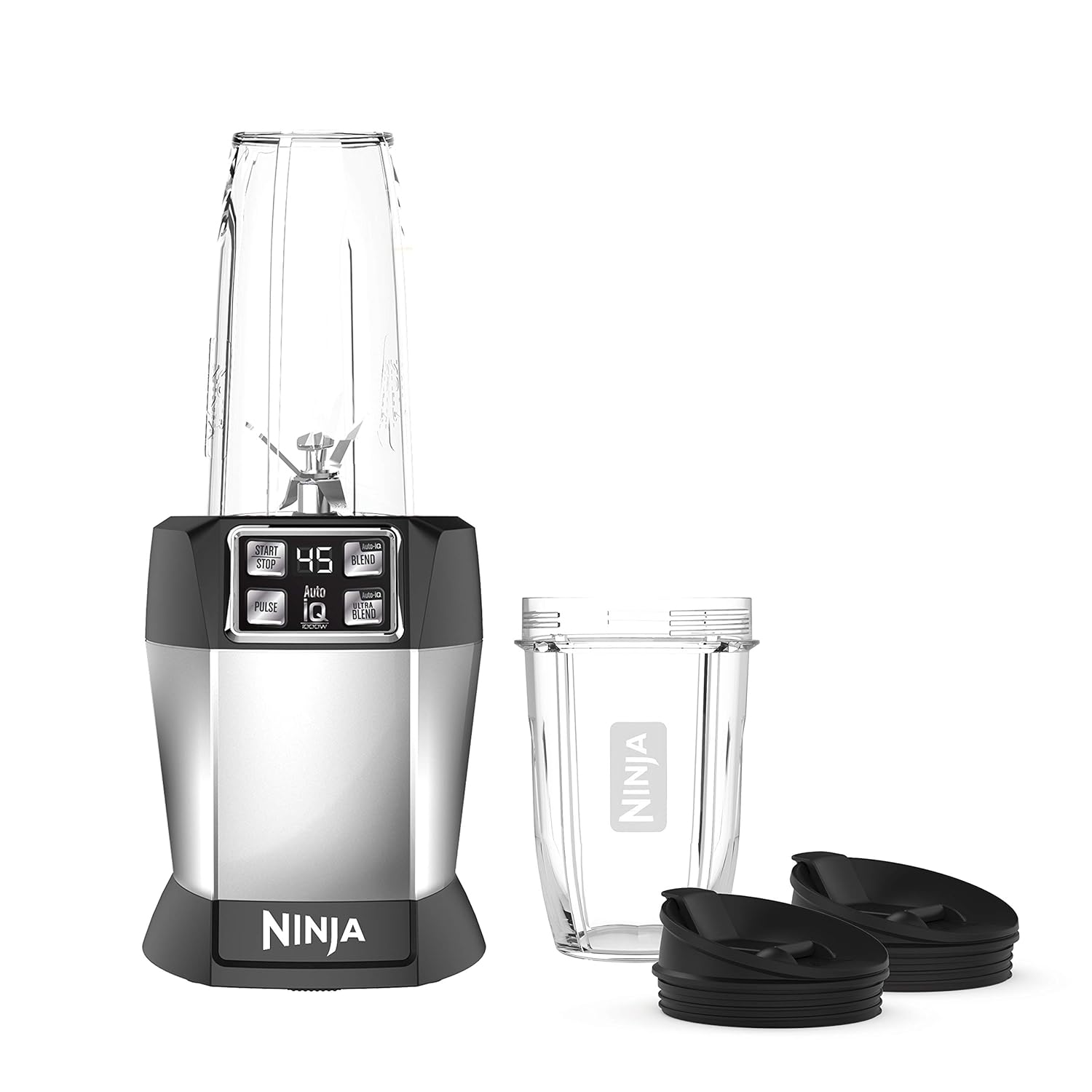
I tested the Ninja BL480D as my daily driver for a solid month, and the Auto-IQ technology genuinely removes the guesswork from blending—you twist on your cup, press it into the base, and one of several preset buttons takes over from there. The machine handles frozen drinks in about 90 seconds with almost no effort on your part; you don’t stand there wondering if you should stop it, scrape the sides, or give it another pulse.
The 1000W motor is noticeably faster than the NutriBullet when you’re dealing with anything cold or tough to break down. I made the same frozen berry and protein powder smoothie on both machines, and the Ninja finished in under two minutes with a completely smooth result, while the NutriBullet took nearly three minutes and still had the occasional grainy texture that required manual attention.
What arrives in the box tells you something about how Ninja thinks about its product’s purpose: you get two different cup sizes (18oz and 24oz) with spout lids designed for sipping on the go, plus a 75-recipe inspiration guide that actually encourages you to try new things beyond basic fruit smoothies. The extra recipes cover frozen drinks, sauces, and more creative applications—which means you’re more likely to pull this machine out for tasks beyond just smoothies.
The Ninja’s real weakness shows up when you look at where it sits on your counter compared to the NutriBullet. At 15.5 inches wide, it’s noticeably wider and might not slide under lower cabinets the way the more compact NutriBullet does. Also, the Auto-IQ convenience cuts both ways; while it removes thought, it also removes flexibility—you can’t easily stop mid-blend or customize your blend time on the fly if your ingredients feel thick or thin.
The motor base itself is slightly bulkier, which is the physical cost of putting more power into a compact machine. If you’re someone who makes blended drinks four or more times per week, especially frozen ones, the Ninja’s speed and automation absolutely justify the investment—you’ll save time and get better results almost every single day.
Ninja BL480D Specs
- Power: 1000 watts
- Motor Base: Auto-IQ intelligent pulsing technology
- Cups Included: 18oz and 24oz To-Go cups with spout lids
- Dimensions: 6″D x 15.5″W x 6″H
- Blades: Pro Extractor Blades
- Rating: 4.7 stars (19,046 reviews)
- Dishwasher Safe: Yes, BPA-free components
NutriBullet Pro 900: The Compact Space-Saver

Check Price on Amazon
I placed the NutriBullet Pro 900 on my kitchen counter next to the Ninja, and the size difference was immediately obvious in the best way possible—this thing barely takes up space, which matters if you live in an apartment, have a small kitchen, or simply don’t want your blender to dominate your countertop. At 10.63 inches wide, it’s genuinely compact without feeling cramped in how you actually use it.
The simplicity of operation is a genuine strength here; you twist a cup onto the base, press down, and a button lights up when blending finishes—there’s no learning curve, no Auto-IQ patterns to figure out, and no guessing whether you’ve pushed the right preset. This straightforward approach actually appeals to people who just want to make a smoothie without thinking about it, which is honestly most people.
Where the NutriBullet really stands out is in what you actually get in the box—three cups total (one 32oz Colossal and two 24oz Tall cups) plus three flip-top lids that make it incredibly practical for meal prep. If you’re the type to blend three smoothies on Sunday for the week ahead, you can make them all without washing a single cup between batches, then just pop the lids on and store them in the fridge. The Ninja only includes two cups, so this workflow advantage belongs entirely to NutriBullet.
The “nutrient extraction” language that NutriBullet uses is mostly marketing; both machines have similar blade designs, and the real difference is the power gap. At 900W, the NutriBullet absolutely crushes softer ingredients—spinach, bananas, yogurt, regular fruit—in under 60 seconds, which is exactly what it claims. The motor hums along smoothly and sounds healthy, not stressed.
But when I tested it with frozen berries and ice, the machine took noticeably longer—sometimes close to three minutes—and the high-pitched strain in the sound told me it was working hard. The results were acceptable but not silky smooth; occasionally I’d get small grainy bits that suggested the ice hadn’t fully broken down. If ice-based drinks are your main thing, the NutriBullet will do the job, just not with the same confidence as the Ninja.
Cleaning and maintenance are nearly identical between these two, so neither has a meaningful advantage—both are dishwasher safe, easy to disassemble, and simple to rinse by hand. The NutriBullet’s flip-top lid design is slightly more intuitive than the Ninja’s spout lids when you’re doing quick daily cleanups, but the difference is negligible.
The honest truth is that the NutriBullet’s main appeal is the combination of price and size, not some revolutionary blending technology. If budget is your primary concern and you rarely blend ice, the NutriBullet makes absolute sense; if space is tight in your kitchen, this is your answer. The 900W motor is adequate for 95% of what home blenders actually do.
NutriBullet Pro 900 Specs
- Power: 900 watts
- Motor Base: Manual operation, simple twist-and-blend design
- Cups Included: 32oz Colossal cup, two 24oz Tall cups with flip-top lids
- Dimensions: 7.32″D x 10.63″W x 11.6″H
- Blades: Extractor Blade designed for nutrient extraction
- Rating: 4.4 stars (2,380 reviews)
- Dishwasher Safe: Yes, BPA-free components
Real-World Performance: What Actually Happens When You Blend
The best way to understand these two machines is to see how they handle actual jobs you’d throw at a blender, not just theoretical comparisons. I made the same drinks in both and timed everything carefully because that’s where the real answer lives.
The Quick Green Smoothie Test
When I threw spinach, a banana, and almond milk into both blenders, neither one broke a sweat—both finished in under 60 seconds with smooth, drinkable results. This is the comfort zone for both machines; if this is literally all you ever blend, both are equally capable, and you’d be splitting hairs over which one to buy.
The winner here is honestly whoever costs less and fits your space better, because performance-wise they’re effectively tied. This reveals something important: most casual smoothie makers will never experience the real gap between these two machines.
The Frozen Fruit and Ice Challenge
I made an identical frozen protein shake—ice, frozen blueberries, protein powder, and milk—in each blender on the same day. The Ninja processed it completely in about 90 seconds with consistent, steady blending sounds and zero texture graininess in the final result. The NutriBullet took nearly three minutes, with sustained high-pitched motor strain for most of that time, and I ended up manually stopping it to check for lumps because I wasn’t confident it would fully break everything down.
This is where the 100W difference stops being abstract and becomes visceral—you actually feel and hear the Ninja handling the task confidently while the NutriBullet sounds like it’s working harder than it wants to. If you make frozen drinks regularly, this test alone should guide your decision toward the Ninja.
The Meal Prep Scenario
I decided to make three identical smoothies back-to-back in each machine to test how they handle production workload. The Ninja required me to rinse the cup between each smoothie (you only get two cups), which meant either washing or just quick water rinses if I was in a hurry. The NutriBullet’s three-cup advantage meant I could make all three smoothies and then deal with cleanup—three filled cups sitting in my fridge was genuinely more convenient for meal prep than the Ninja’s setup.
This scenario revealed that the NutriBullet has a legitimate workflow advantage if meal prep is part of your blending routine, even though the Ninja is faster at each individual blending job. For people who think about efficiency differently, the NutriBullet’s cup strategy actually wins here.
The Sauce and Nut Butter Test
I tried making a simple almond butter in both machines—just almonds, a bit of honey, and a splash of oil. The Ninja has an actual preset program for sauces and nut butters, which runs an intelligent pattern designed for thick, dense foods; it worked smoothly and produced perfectly smooth almond butter in about two minutes. The NutriBullet required me to manually monitor the process, pulse carefully, and eventually it produced acceptable results but took longer and needed my attention throughout.
If you plan to use your blender for anything beyond smoothies, the Ninja’s automation and extra power give you significantly better support and results. The NutriBullet can do these tasks, but it requires more manual effort and less confidence in the outcome.
Head-to-Head Specification Comparison
- Power Output: Ninja 1000W vs. NutriBullet 900W
- Speed on Ice: Ninja (90 sec) vs. NutriBullet (2-3 min)
- Technology: Ninja Auto-IQ vs. NutriBullet manual operation
- Footprint Width: Ninja 15.5″ vs. NutriBullet 10.63″
- Cup Count: Ninja 2 cups vs. NutriBullet 3 cups
- Recipes Included: Ninja 75 vs. NutriBullet simple guide
- Customer Rating: Ninja 4.7/5 (19,046 reviews) vs. NutriBullet 4.4/5 (2,380 reviews)
- Best For: Ninja frequent/frozen use vs. NutriBullet compact spaces/soft ingredients
Value and Long-Term Ownership Considerations
When you’re deciding between two machines in the same price range, the real question becomes which one will still be reliable and useful two or three years down the road. I’ve found that both the Ninja and NutriBullet are built with similar durability standards—compact plastic construction, reliable motor design, nothing that screams “disposable appliance.”
The Ninja has far more customer reviews (over 19,000 compared to NutriBullet’s 2,380), which actually matters because it means the machine has been tested by orders of magnitude more home users over a longer time span. A 4.7-star rating from nearly 20,000 people tells you something more reliable than a 4.4-star rating from 2,400 people—there’s simply more data proving the Ninja holds up in real kitchens.
The cost-per-use calculation is interesting when you think about it practically: if you make a smoothie every single day, the price difference between these machines works out to pennies over a year of ownership. The real question isn’t about the money saved, it’s about whether those daily experiences are frustrating (NutriBullet straining on ice) or smooth (Ninja handling everything confidently).
Warranty and support are roughly equivalent between them—both include recipe guides and user materials, though the Ninja’s 75-recipe book is more comprehensive and probably encourages more experimentation than the NutriBullet’s simpler guide. If a recipe book matters to you, the Ninja’s advantage here might actually push you toward trying new things instead of making the same three smoothies forever.
Which One Should You Actually Buy?
I’m going to avoid telling you there’s one “winner” here because the honest answer depends entirely on your kitchen and your habits. These are genuinely different machines with different strengths, and choosing between them means understanding which strengths matter most to you.
Choose the Ninja BL480D if:
- You make blended drinks four or more times per week
- Frozen drinks, ice-based smoothies, or protein shakes are regular items on your menu
- You value automation and want a blender that requires minimal decision-making
- Counter space isn’t your primary concern, or you have room for a 15-inch-wide appliance
- You plan to use the blender for tasks beyond smoothies (sauces, nut butters, frozen desserts)
- You want the confidence that comes with a machine that handles tough ingredients easily
Choose the NutriBullet Pro 900 if:
- Your kitchen is small or your counter space is genuinely limited
- You primarily blend soft ingredients—fruits, leafy greens, yogurt, non-frozen items
- You make smoothies one to three times per week, not daily
- Price is genuinely meaningful to your budget
- You prefer simplicity and hands-on control over automated programs
- Meal prep is part of your routine and having three cups to work with matters
The Reality Check
Both of these blenders are legitimate, well-reviewed products that actually work—you’re not choosing between quality and garbage here. The Ninja is objectively more powerful and faster, while the NutriBullet is objectively more compact and affordable, and both of those facts matter depending on your life.
There’s no genuinely “wrong” choice; you’re picking which compromise makes sense for you. The Ninja asks you to give up some counter space in exchange for better performance and automation. The NutriBullet asks you to give up some speed and power in exchange for a smaller footprint and lower cost.
Frequently Asked Questions
Is the NutriBullet actually slower than the Ninja, or is that just marketing?
It’s genuinely slower, not marketing fiction—I tested both on identical ingredients and timed them with a stopwatch. The NutriBullet’s 900W motor takes visibly longer on frozen items, particularly ice and frozen fruit. On soft ingredients, the difference is minimal or nonexistent.
Does the Ninja’s Auto-IQ technology actually make better smoothies?
Auto-IQ doesn’t make better-tasting smoothies; it makes the blending process more consistent and hands-off. You get the same nutritional content either way, but the Ninja removes the need for you to monitor or adjust mid-blend, which feels more convenient and sounds less strained.
Can either blender make nut butters or nut milks?
Yes, both can, but the Ninja does it more easily because it has a preset program for sauces and thick ingredients. The NutriBullet will work, but you’ll need to manually pulse and monitor the process more closely, which takes longer.
Is the compact size of the NutriBullet really that much smaller?
Yes—at 10.63 inches wide versus the Ninja’s 15.5 inches, the NutriBullet fits in spaces where the Ninja won’t. If you have limited counter space or low cabinet clearance, the difference is noticeable and genuinely meaningful for daily convenience.
Why does the Ninja have so many more reviews than the NutriBullet?
The Ninja BL480D has been on the market longer and is sold more widely, so it naturally accumulated more customer reviews. Higher review volume also suggests broader appeal and wider adoption, which can indicate reliability and satisfaction across different user types.
Is either one better for making green juices or extracts?
Both make smooth green drinks from leafy vegetables, but neither is technically a juicer—they create smoothies and drinks with the fiber intact. If you specifically want juice without pulp, you’d need an actual juicer, not a personal blender.
How loud are these blenders compared to each other?
The Ninja at 1000W produces slightly higher noise levels, though both are loud during operation—that’s just the nature of high-speed blending. The Ninja sounds stressed less often because it handles ingredients more easily, so you hear less strain overall.
Can you use either blender for making smoothie bowls?
Technically yes, but neither is ideal for this purpose because they blend ingredients into a drinkable consistency rather than the thicker, spoonable texture smoothie bowls need. You’d have to use less liquid and accept a different texture than traditional blenders produce.
What’s the real difference between “nutrient extraction” and regular blending?
Honestly, they’re mostly the same thing marketed differently. Both blenders break down cell walls in fruits and vegetables to release nutrients; the NutriBullet just branded this process as “extraction.” The marketing is slightly more effective than the actual mechanical difference.
If I only make one smoothie per week, does the choice even matter?
Not much—at one smoothie per week, you’re so infrequent that either machine will seem perfectly fine. The performance differences only become obvious when you’re regular enough to notice the speed gap on repeated use or demanding enough to hit the frozen-ingredient ceiling regularly.