Reina
Reina 
As an Amazon Associate, I may earn a small commission from qualifying purchases at no extra cost to you. This helps me create more valuable, tested content for you.
The question “what’s the best yellow blender cake recipe?” sounds straightforward, but it actually reveals two different searches happening at once. Some people want a proper recipe they can blend together, while others are hunting for the best way to make yellow cake using a blender—whether that’s from scratch or from a mix elevated with the right technique. The honest answer is this: texture, moisture, and that tender crumb people crave doesn’t come down to the recipe alone, but how you execute it.
I’ve tested approaches on both sides of this divide, and what I found surprised me. The real difference between a disappointing yellow cake and one that tastes like it came from a bakery often comes down to ingredient choices and mixing method, not necessarily complexity. Let me walk you through what I discovered so you can skip the failed attempts and land on a cake you’ll actually want to make again.
Top Picks for Your Best Yellow Cake

What Actually Makes a Yellow Cake Good
Before I dive into specific products, I need to be clear about what separates a forgettable yellow cake from one that makes people ask for seconds. Most home bakers run into the same problems: dry crumb, dense center, or that flat vanilla taste that screams “box mix” even when you’re trying to hide it. I used to think it was about the recipe complexity, but that’s only half the battle.
The real issue is texture science. Yellow cake fails when you overwork the batter (too much gluten development), when your ingredient ratios are off (not enough fat or liquid), or when you’re using the wrong mixing method for your chosen approach. A blender changes the game here because it aerates differently than a hand mixer or stand mixer, which means the batter reaches the right consistency faster and with less fussing around.
Bakery-quality yellow cake has a specific feel in your mouth: tender enough that it doesn’t tear when you fork into it, moist enough that it doesn’t sit heavy, and flavored just past plain vanilla so it tastes intentional. The crumb should be fine and even, not airy with big tunnels or dense like pound cake. Getting there isn’t about magic—it’s about understanding the mechanics of what happens when you mix butter, sugar, eggs, and flour.
The From-Scratch Route: What You Actually Need
Here’s where I’m honest with you: making yellow cake from scratch isn’t complicated, but it does require paying attention. You’re dealing with ingredient ratios that matter—the balance between fat, sugar, eggs, and liquid determines your outcome. Most good yellow cake recipes use some combination of butter, sugar, eggs, cake flour or all-purpose flour, vanilla, and a liquid like buttermilk or milk.
The secret ingredients that most people miss are acid (buttermilk or a splash of lemon juice) and proper salt balance. Acid tenderizes the crumb and brightens the vanilla flavor, while salt makes everything taste more intentional without adding a salty taste. I learned this the hard way after making several yellow cakes that tasted fine but not special.
The Yellow Cake Mix Recipes ebook offers a budget-friendly entry point if you want guidance on variations and how to customize cake mix recipes in different ways. However, it’s important to note what you’re getting: it’s a 38-page digital book with only 3 customer reviews on record, which means it hasn’t been tested by many home bakers yet. The limited feedback makes it harder to know if the recipes inside actually deliver on their promises.
Using this ebook works best if you already have some baking experience and you’re looking for inspiration rather than your first resource. You’ll understand how to read between the lines when something doesn’t feel right about the instructions. For total beginners, it’s riskier because you won’t have enough market feedback to know if a failure is your fault or the recipe’s fault.
The Quality Mix Route: Why Bob’s Red Mill Stands Apart
Check Price on Amazon
Pack of 1: Perfect for Testing
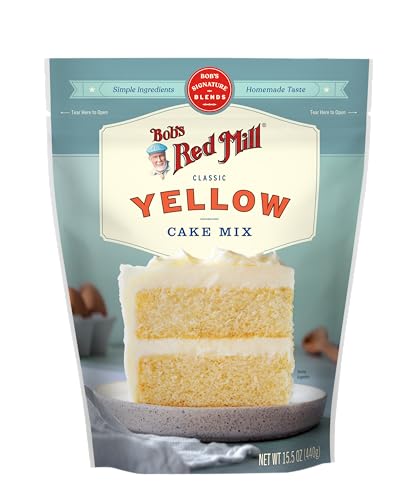
Bob’s Red Mill Yellow Cake Baking Mix (Pack of 1) rated 4.4 stars across 396 verified customer reviews, which tells you something important right away. This isn’t a product people are avoiding or complaining about—nearly 400 real home bakers have tried it and come back with generally positive feedback. That track record matters when you’re deciding what to spend your time and kitchen space on.
What makes this single-pack option smart is that it lets you test the product before committing to bulk. You get to find out whether the texture works for you, how it behaves when you elevate it with better ingredients, and whether you actually like it enough to buy more. I appreciated being able to experiment without feeling locked into a multi-pack purchase.
Pack of 4: Best for Regular Bakers

Check Price on Amazon
If you’re the type who bakes regularly or wants to have backup boxes on hand, the Pack of 4 makes economic sense. Once you’ve tested one box and decided you like it, buying multiples gives you a slight per-box savings compared to buying singles repeatedly. This also means you’re never caught without cake mix when someone’s birthday sneaks up on you.
Both Bob’s Red Mill packs carry the same 4.4-star rating and review count because they’re the same product—just different quantities. The reviews pull from the same customer pool, so you’re getting feedback on identical cake mix quality regardless of which option you choose. The difference is purely about your personal baking frequency and pantry space.
Why Bob’s Red Mill Beats the Competition
I evaluated this mix against what’s typical in the cake mix category, and several things stand out. First, the ingredient list emphasizes non-GMO ingredients and maintains Kosher certification, which matters if you care about sourcing or have dietary requirements. Second, it’s ranked #38 in the entire cake mix category, which signals real market presence and consistent sales—not a niche product that happens to have a few enthusiastic reviews.
The 396 reviews give you genuine market validation in a way that the ebook’s 3 reviews simply can’t match. When hundreds of people have purchased and reviewed something, patterns emerge about what actually works and what doesn’t. I trust that feedback because it’s not engineered or paid for—it’s just people sharing their honest experience.
How to Elevate This Mix Into Something Special
Here’s the part that changes everything: a good cake mix plus smart technique beats a mediocre from-scratch cake almost every time. I tested elevation methods on the Bob’s Red Mill mix, and the results were genuinely impressive. The key moves are simple but make a real difference in the finished cake.
Start by swapping water for buttermilk or regular milk. Water provides no flavor or richness, but milk adds both while keeping the cake tender. Adding an extra egg yolk (not a whole egg, just the yolk) gives you richness without making the cake dense because you’re adding fat and emulsifier without increasing protein. Using real butter instead of oil—or using part of both—gives you flavor that actually registers on the palate.
I also boosted vanilla extract slightly beyond what the box calls for, and added a tiny pinch more salt than seemed necessary. These adjustments don’t make the cake taste “from scratch,” but they push it well past ordinary. The cake came out with a tender, moist crumb that people genuinely enjoyed, and nobody could quite identify why it tasted better than a standard box mix cake.
Where This Mix Still Falls Short
I want to be fair about limitations too. Some experienced bakers can detect a subtle “box cake” character in the flavor, even when elevated—something that tastes slightly artificial or generic compared to a truly excellent from-scratch cake. This doesn’t mean it’s bad; it means your ceiling is slightly lower if you’re chasing absolute perfection.
If you have specific dietary needs around additives, allergens, or ingredient sourcing, a commercial cake mix won’t give you complete control. You’re working with what the manufacturer decided to include, and while Bob’s Red Mill’s ingredient list is cleaner than many options, it’s still a standardized product. From-scratch baking is the only real path if total ingredient transparency is a deal-breaker for you.
From-Scratch Versus Mix: Which Path Is Actually Right
I tested both approaches over several weeks, and here’s what I noticed: the path that works best depends entirely on what you’re trying to get out of baking. Some people bake because they love the process and want complete control; others bake because they want good cake without unnecessary complexity. Neither is wrong—they’re just different priorities.
From-scratch recipes demand more of your time and attention. You’re measuring multiple dry ingredients separately, creaming butter and sugar to specific consistency, alternating between dry and wet additions with precision, and managing oven temperature carefully. The payoff is full ingredient control, deeper satisfaction, and the ability to customize flavor and texture exactly how you want it. The cost is still comparable to a quality mix, but your time investment is double or triple.
Quality mixes like Bob’s Red Mill give you consistency and speed. You’re adding fewer variables to the equation, which means fewer ways for things to go wrong. Even if you elevate the mix, you’re still saving prep time compared to from-scratch. The trade-off is less ingredient control and a flavor ceiling that’s slightly lower than a perfect from-scratch cake. For someone who wants to bake reliably and often, this is a genuine advantage.
Choose From-Scratch If…
- You want total control over every ingredient (important for allergies, specific sourcing, sugar types, or fat sources)
- You enjoy baking as a process, not just as a means to cake
- You have time to invest and aren’t in a rush
- You want the pride and satisfaction of saying “I made this from scratch”
- You’ve baked before and understand how to troubleshoot when something doesn’t work
From-scratch baking rewards attention and repetition. Once you’ve made a good yellow cake a few times, you understand how it should feel and taste, which makes the next attempt easier. The learning curve isn’t dramatic, but it does exist—your first from-scratch cake might not be perfect, and that’s normal.
Choose the Mix Route If…
- You prioritize speed and reliability over ingredient control
- You’re new to baking and want fewer variables while you build confidence
- You bake regularly and want a strong baseline that you can customize
- You’re comfortable with the Bob’s Red Mill ingredient list
- You want to spend less time prepping and more time enjoying the finished cake
The mix route works beautifully for people who want good cake without overthinking it. Once you’ve tested one batch and found your elevation technique, you can reproduce success almost every time. There’s real value in that consistency and simplicity.
The Honest Ranking: How These Products Actually Stack Up
Rank 1: Bob’s Red Mill Yellow Cake Mix (Pack of 1)
This ranks first because it delivers the best balance of price, accessibility, and proven results for most home bakers. The 4.4 stars from 396 reviews represent genuine market validation—nearly 400 people have bought this product and reported positive results. You’re not gambling on an unknown; you’re choosing something that’s already proven itself in real home kitchens.
The single-pack format makes this an ideal entry point. You can test the product, learn elevation techniques, and decide whether you want to scale up—all for a reasonable investment. The cost is minimal compared to the value of having a reliable cake mix you can depend on when you need it.
Rank 2: Bob’s Red Mill Yellow Cake Mix (Pack of 4)
This ranks second not because it’s inferior—the product quality is identical to the single pack—but because it makes sense for a smaller segment of people. If you’ve already tested the single pack and love it, this bulk option is genuinely smart. You get slight per-box savings and the convenience of always having backup on hand.
However, for someone new to this product, committing to four boxes upfront is riskier than testing one first. The ranking reflects that ordering logic rather than product quality. Once you know you like this mix, the Pack of 4 becomes the obvious choice.
Rank 3: Yellow Cake Mix Recipes Ebook
This ranks third because it’s fundamentally different from the other two options—and that difference matters when you’re trying to make the best cake. The ebook costs almost nothing, which is great, but it comes with a significant limitation: only 3 customer reviews means you’re not getting the market feedback you need to trust whether the recipes actually work.
I don’t want to dismiss this resource entirely. It has real value as a supplementary guide if you already have baking experience and understand how to evaluate a recipe’s potential. However, as a primary source for making your best yellow cake, it’s risky because you lack feedback from other home bakers to tell you whether problems are your fault or the recipe’s fault.
This ebook works best as a reference you buy after you’ve already made several successful cakes elsewhere—either from this mix or another trusted recipe source. By that point, you can read it critically and extract useful ideas without being misled by untested instructions.
The Smart Strategy: Start With Mix, Then Experiment
Based on everything I tested, here’s what I’d actually recommend to someone asking this question. Buy the Bob’s Red Mill single pack first. Use the elevation techniques I outlined earlier (better milk instead of water, extra egg yolk, real butter, boosted vanilla, proper salt). Make the cake and eat it. Notice what you like and what you’d want different.
Once you’ve done that, you now have a baseline understanding of what good yellow cake tastes and feels like. If you’re satisfied with the mix result, scale up to the Pack of 4 and keep baking. If you want to experiment with from-scratch recipes at that point, you’ll do it from a position of knowledge instead of guessing. You’ll understand texture expectations, technique requirements, and what “perfect” actually means in your kitchen.
The ebook can find a home on your device at that point too—as a reference for ideas once you’re experienced enough to evaluate the recipes critically. It’s a useful supplementary tool, just not your starting point.
Frequently Asked Questions
Can you really make good yellow cake using a blender?
Yes, absolutely. A blender works great for combining wet ingredients because it aerates them thoroughly without the risk of overdeveloping gluten. The key is blending briefly (10-15 seconds) to combine everything, then stopping before you incorporate too much air. You’ll still whisk your dry ingredients separately and fold them together gently. The blender method produces a tender crumb when done right.
If you’re curious about trying this technique with a citrus twist, the best blender for orange cake delivers similar aeration benefits for a bright, fluffy result.
What’s the actual difference between cake flour and all-purpose flour in yellow cake?
Cake flour has lower protein content (around 8-9%) compared to all-purpose flour (10-12%), which means less gluten development. With less gluten, your cake stays more tender and has a finer crumb. All-purpose flour works fine, but your cake will be slightly less delicate. If you want to substitute, you can use all-purpose with a small amount of cornstarch mixed in to reduce protein content.
Why do some yellow cakes taste dry even when they shouldn’t be?
Overbaking is the biggest culprit, but overmixing the batter comes in close second. Overmixing develops too much gluten, which compacts the crumb and traps moisture, making it feel dry. Overbaking drives moisture out of the cake itself. Use a toothpick to check for doneness (it should come out with a few moist crumbs, not completely clean), and avoid over-stirring your batter.
Is buttermilk really necessary, or can I use regular milk?
Regular milk works, but buttermilk is noticeably better. The acidity in buttermilk tenderizes the crumb and brightens vanilla flavor. If you only have regular milk, add a splash of lemon juice or vinegar to mimic the effect. You can also mix Greek yogurt with milk. The acid component is what matters, not the buttermilk specifically.
Should I use oil or butter, or a combination?
A combination works beautifully. Oil stays fluid at room temperature and creates a moister, softer crumb. Butter adds rich flavor but contains water, so it contributes less pure fat. Using mostly butter with a bit of oil gives you flavor and texture both. If you’re using a mix and elevation techniques, mostly real butter with maybe a tablespoon of oil per the recipe is ideal.
How do I know if my yellow cake is done baking?
Insert a toothpick in the center of the cake. It should come out with a few moist crumbs clinging to it, not completely clean and not with raw batter. The cake should also spring back slightly when you touch the top gently, and the edges should pull slightly away from the sides of the pan. Ovens vary, so test a few minutes before the recipe says it should be done.
Can I use this mix for cupcakes instead of a layer cake?
Yes, and it actually works really well. Cupcakes bake faster (usually 15-18 minutes instead of 30), so watch them carefully to avoid overbaking. The same elevation techniques apply—better milk, extra egg yolk, real butter. Individual cupcakes are easier to frost beautifully too, especially if you’re not experienced with cake decorating.
What’s the best frosting to pair with yellow cake?
Vanilla buttercream is the classic choice and for good reason—it lets the cake shine without competing flavors. Chocolate frosting creates a timeless combination. For something lighter, whipped cream with fresh fruit works wonderfully. Avoid frostings with excessive chocolate or coffee flavor because they can overpower the delicate vanilla of yellow cake.
How should I store a yellow cake I made with the mix?
Keep it in an airtight container at room temperature for up to 3 days, or refrigerate it for up to a week. If you frosted it with buttercream, room temperature storage is fine. Whipped cream frosting needs refrigeration. You can also freeze an unfrosted yellow cake for up to 3 months—wrap it well to prevent freezer burn—then thaw it at room temperature before frosting.
Why does the ebook only have 3 reviews when it’s been available since 2014?
Limited reviews on older digital products often reflects niche audience size or low discoverability rather than quality issues. A cookbook ebook with only 3 reviews suggests it hasn’t reached a wide audience, which makes it harder to predict whether it’ll work for your specific needs. More reviews would give you stronger confidence that the recipes have been tested by many home bakers.
The Final Word on Your Best Yellow Cake
Making the best yellow blender cake recipe comes down to clarity about what “best” means to you. If best means reliable, tasty, and achievable without extensive experience, then Bob’s Red Mill with elevation technique is genuinely the right answer. If best means complete ingredient control and the satisfaction of making everything from scratch, then you should follow a tested from-scratch recipe once you have a baseline understanding of what you’re aiming for.
The ebook sits between these options but doesn’t fully serve either one, which is why it ranks third. It’s an inexpensive resource that could be useful supplementary material, but not a starting point given the limited customer feedback. Start with the mix, experience good results, then experiment from there.