
You stand at a bar, watching a bartender assemble a tall glass with a cascade of colorful spirits. The final result is a stunning, stratified beverage that looks as potent as it is vibrant. This is the Garbage Can, a cocktail known by many names but unified by its complex construction and powerful effect.
My first encounter with this drink was during my university years, a world away from my current role in nutrition. It was a celebration, and the spectacle of its creation was as memorable as its taste. Today, we will deconstruct this modern classic, from its flashy appearance to its substantial nutritional impact.
This guide provides the complete formula for making this multi-layered cocktail at home. We will examine each component, discuss its caloric footprint, and explore adaptations for various dietary needs. The goal is to equip you with all the knowledge required to prepare and understand this distinctive mixed drink.
How to Make Garbage Can Drink Recipe
This section details the standard method for constructing the classic Garbage Can. Precision in measurement and order is crucial for achieving the signature layered effect that defines this cocktail.
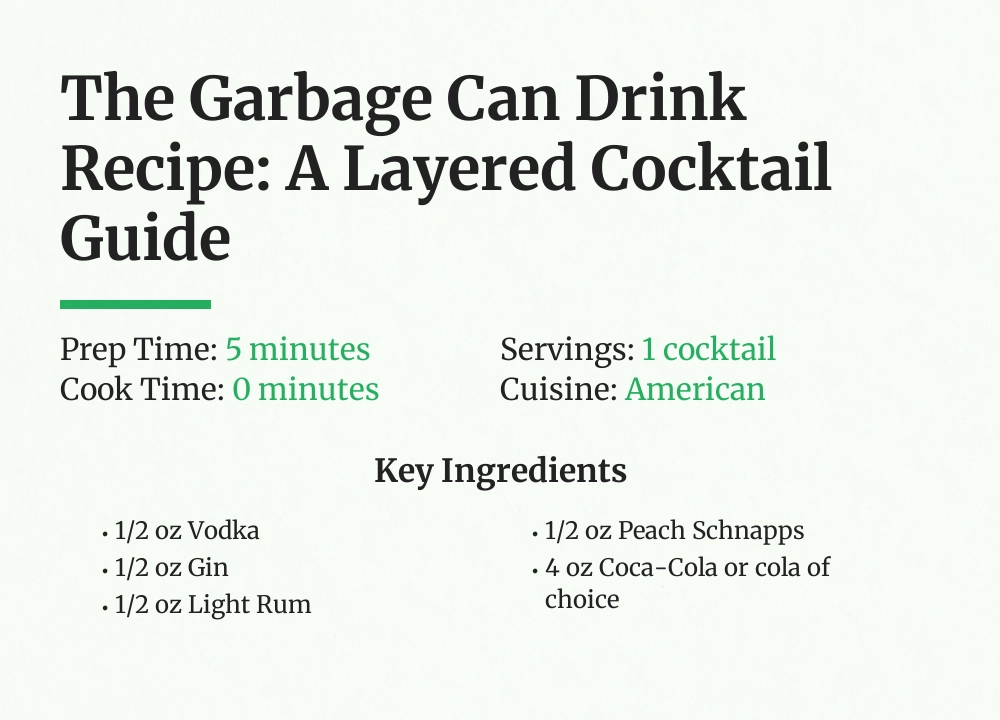
Recipe Details
- Prep Time: 5 minutes
- Cook Time: 0 minutes
- Servings: 1 cocktail
- Course: Beverage
- Cuisine: American
- Diet: Standard
Ingredients
- 1/2 oz Vodka
- 1/2 oz Gin
- 1/2 oz Light Rum
- 1/2 oz Triple Sec
- 1/2 oz Blue Curaçao
- 1/2 oz Peach Schnapps
- 4 oz Coca-Cola or cola of choice
- 1 can (8.4 oz) Red Bull or similar energy drink
- Ice cubes to fill a tall glass
Instructions
- Select a tall, clear collins glass to best display the layers.
- Fill the glass completely with ice cubes. A full glass of ice is essential for proper layering.
- Begin pouring the spirits directly over the ice in the exact order listed: vodka, gin, light rum, triple sec.
- Next, slowly pour the blue curaçao. Its density will cause it to settle, creating a distinct blue layer.
- Carefully add the peach schnapps on top of the blue curaçao layer.
- Slowly top the cocktail with the Coca-Cola, pouring it down the side of the glass to minimize disruption.
- Finish by gently pouring the energy drink as the final layer.
- Serve immediately with a long straw, instructing the drinker to stir before consuming for a uniform flavor.
Nutrition
- Calories: 373 kcal
- Protein: 0 g
- Fat: 0 g
- Carbohydrates: 45 g
- Sugar: 42 g
- Fiber: 0 g
- Sodium: 85 mg
- Cholesterol: 0 mg
Cooking Method
This beverage requires no heat application. The primary technique is the “float” or “layering” method. This relies on the varying densities and specific gravities of the different liqueurs and mixers to create separate strata of color in the glass.
Tools Needed
- Tall Collins Glass (14-16 oz)
- Jigger for measuring
- Long Cocktail Straw
Understanding the Garbage Can Cocktail
The Garbage Can, often called an Irish Trash Can, is a potent mixed drink belonging to the family of “long” cocktails. Its identity is built on two key elements: the inclusion of multiple spirits and the visually striking layered presentation.
Unlike simpler highballs, this recipe combines up to six different distilled beverages. The name likely originates from the “everything but the kitchen sink” approach to its ingredient list. It is a direct relative of other potent, multi-liquor drinks like the Long Island Iced Tea and the Adios Motherf*.
The signature blue-green hue comes primarily from the blue curaçao. This color, combined with the energy drink’s infusion, has made it a popular choice in social settings where a visually impressive and energizing beverage is desired.
Primary Spirits and Their Roles
Each spirit in this cocktail contributes a specific attribute to the overall flavor and alcohol content.
Vodka
Vodka provides a neutral ethanol base. Its purpose is to increase the drink’s alcohol by volume (ABV) without imposing a strong flavor that would clash with the other components. A high-quality, neutral grain vodka is ideal for this application.
Gin
Gin introduces a botanical complexity. The juniper and other herbaceous notes can cut through the sweetness of the liqueurs and sodas. London dry gin is typically used for its crisp, clear botanical profile.
Light Rum
Light rum adds a subtle sugarcane sweetness and a smooth finish. It acts as a bridge between the neutral spirits and the sweeter liqueurs. Its lighter body compared to dark rum ensures it does not overpower the color layers.
Triple Sec
Triple sec is an orange-flavored liqueur that provides a core citrus note. It sweetens the mix and complements the other fruit flavors from the peach schnapps and blue curaçao.
Key Liqueurs and Mixers
The character of this drink is defined by its distinctive liqueurs and non-alcoholic components.
Blue Curaçao
Blue Curaçao is the star of the show visually. It is a blue-colored liqueur flavored with the dried peel of the Laraha citrus fruit, native to Curaçao. Despite its vibrant color, its flavor is similar to a standard orange liqueur but often slightly sweeter.
Peach Schnapps
Peach Schnapps contributes a strong, sweet stone fruit flavor. This liqueur has a lower alcohol content and higher sugar content than the base spirits, which affects its placement in the layering process.
Energy Drink and Cola
The energy drink provides caffeine, taurine, and a sharp, acidic sweetness. The cola adds a caramel and vanilla note, along with carbonation that lifts the entire drink. Using a full-calorie version of both is standard for achieving the correct flavor balance and mouthfeel.
Nutritional Information and Health Considerations
From a dietary perspective, this cocktail is a significant source of empty calories and refined sugars. The estimated 373 calories per serving come almost exclusively from alcohol and simple carbohydrates.
The sugar content, at approximately 42 grams, exceeds the American Heart Association’s recommended daily limit for added sugar in a single serving. This can lead to a rapid spike in blood sugar followed by a crash, an effect that may be masked by the caffeine content.
Caffeine and Alcohol Combination
The combination of a full can of energy drink with multiple spirits creates a unique physiological impact. Caffeine is a stimulant, while alcohol is a depressant.
Mixing them can lead to a state often called “wide-awake drunkenness.” The stimulant effects can reduce the subjective feeling of intoxication, potentially leading to increased alcohol consumption and impaired judgment.
For individuals sensitive to caffeine or those monitoring their blood pressure, this combination requires careful consideration. The total caffeine dose from one serving is comparable to a strong cup of coffee.
Caloric Density Analysis
Each ingredient contributes to the overall caloric load. Alcohol itself contains 7 calories per gram, making it the second most energy-dense macronutrient after fat.
The liqueurs like triple sec, blue curaçao, and peach schnapps are high in sugar, adding significantly to the carbohydrate count. The energy drink and cola are also primary sources of simple sugars and calories.
Dietary Adaptations and Variations
You can modify this recipe to accommodate different dietary preferences and restrictions without losing its essential character.
Low-Sugar and Zero-Sugar Version
To reduce the sugar and calorie content, substitute the standard mixers with their zero-sugar counterparts. Use a diet cola and a sugar-free energy drink.
Be aware that the liqueurs—triple sec, blue curaçao, and peach schnapps—are inherently high in sugar. While lower-sugar versions exist, they are less common and will still contribute some carbohydrates.
Vegan Adaptation
The standard recipe is typically vegan, as none of the common spirits or mixers contain animal-derived products. The distillation process for clear spirits like vodka, gin, and rum usually involves no animal fining agents.
Always check specific brands if strict adherence is required, as some specialty liqueurs might use honey or other non-vegan ingredients.
Alternative Flavor Profiles
You can create a different flavored energy drink base for a new twist. A citrus-flavored energy drink can enhance the orange notes, while a tropical flavor can complement the peach and rum.
Substituting the blue curaçao with another fruit liqueur, such as raspberry or blackberry, will change the color and primary fruit note of the drink. A blood orange liqueur could create a deep red variation.
Expert Tips for Perfect Layering
Achieving clean layers is the mark of a well-made Garbage Can. The technique relies entirely on the specific gravity of each liquid.
Always pour the heaviest, most sugar-dense ingredients first. These will sink to the bottom. Lighter spirits and carbonated mixers will float on top. The order provided in the recipe is designed to exploit these density differences.
Use a bar spoon turned upside down. Pour each new ingredient slowly over the back of the spoon, letting it trickle down the side of the glass. This minimizes turbulence and helps each layer settle neatly on the one below it.
Ensure your glass is filled to the brim with ice. The ice acts as a physical buffer, slowing the pour and further preventing the layers from mixing prematurely. A chilled glass also helps maintain carbonation.
Serving, Presentation, and Pairing
Presentation is crucial for this cocktail. The clear collins glass is non-negotiable, as it showcases the colorful strata. Serve it with a long straw that reaches the bottom of the glass.
While it is a visually striking drink, the flavors are not integrated until stirred. The first sip from the top will taste predominantly of energy drink, while a sip from the bottom will be intensely sweet and alcoholic. Stirring combines the elements into a harmonious, if potent, mixture.
Due to its sweet and aggressive flavor profile, this cocktail does not pair well with complex foods. It is best served on its own or with simple, salty bar snacks like peanuts or pretzels that can counterbalance the sweetness.
Historical and Cultural Context
The Garbage Can is a modern cocktail, a product of the late 20th-century trend toward high-potency, visually extravagant mixed drinks. It shares a lineage with the Long Island Iced Tea, which also employs multiple spirits for a powerful effect.
Its popularity grew in college towns and nightlife scenes, where its high alcohol content and energizing properties were a draw. The name “Irish Trash Can” appears to be a marketing moniker rather than a drink with authentic roots in Ireland, often used to invoke a sense of festive, rowdy fun.
It represents a category of cocktails designed for spectacle and effect, prioritizing impact over subtlety. Understanding this context helps explain its composition and enduring presence in certain social settings.
Frequently Asked Questions
What is the difference between a Garbage Can and an AMF?
The Adios Motherf* (AMF) is a very similar cocktail. The primary difference is that an AMF typically uses lemon-lime soda like Sprite instead of cola and often includes a splash of sweet and sour mix. The Garbage Can’s use of cola gives it a darker top layer and a different, more caramel-like sweetness.
How strong is one Garbage Can drink?
This cocktail is exceptionally strong. With up to six different spirits and a total liquid volume of around 3 ounces of hard liquor, its alcohol content is comparable to having three standard shots. The caffeine from the energy drink can mask this potency, so consumption should be paced carefully.
Can I make a non-alcoholic version of this drink?
Yes, you can create a “mocktail” version. Use blue fruit punch or a blue sports drink to mimic the blue curaçao layer. Combine this with peach nectar, lemon-lime soda, and a caffeine-free energy drink alternative. You will achieve a similar layered visual effect without the alcohol.
Why did my layers mix together?
This usually happens if the ingredients are poured too quickly, in the wrong order, or without using ice as a buffer. The density differences between the liquids are subtle. Pouring slowly and methodically over the back of a spoon is the key to maintaining distinct layers.
Is there a specific brand of energy drink I should use?
While Red Bull is the traditional choice, any standard energy drink with a similar flavor profile will work. The recipe’s balance is designed for the tart, slightly medicinal taste of these drinks. Using a different flavored energy drink, like a tropical or berry variety, will alter the final taste.
How can I reduce the calorie count of this cocktail?
The most effective way is to use zero-sugar cola and a sugar-free energy drink. This can reduce the total calories by over 150 kcal. Be mindful that the liqueurs still contribute significant sugar, so the drink will never be a truly low-calorie option.
What type of glass is best for serving?
A tall, clear collins glass is ideal. Its height allows the layers to be visible, and its straight sides help maintain the separation between them. A hurricane glass can also work, but the classic presentation relies on the simplicity of the collins glass.