Reina
Reina 
As an Amazon Associate, I may earn a small commission from qualifying purchases at no extra cost to you. This helps me create more valuable, tested content for you.
I’ve cooked on both sides of this argument — literally. I own a ridged grill pan that looks like it belongs on a BBQ competition table, and a flat cast iron skillet that has seen more steaks than I can count. After dozens of meals comparing cast iron grill pan vs flat, here’s the honest truth: a flat pan wins for flavor and crust every time. But if you care about those charred lines for presentation, or you want to drain fat away from meats, a grill pan still has a place. The best solution? A reversible pan that gives you both options — though you can’t use both sides at the same time.
This review covers three solid choices that span the full spectrum: grill-only, flat-only, and the do-it-all reversible. By the end, you’ll know exactly which one fits your kitchen (and your cooking style).
Top Picks for Cast Iron Grill Pan vs Flat
Each pick serves a different primary need. Let me walk you through why these three made the cut — and where each one falls short.
Quick Comparison Table – See the Differences at a Glance
| Feature | Lodge Reversible | Victoria Square Grill | Burly Enamelled Griddle |
|---|---|---|---|
| Type | Dual-sided (grill + flat) | Ridged grill pan | Flat griddle with high sides |
| Price | Mid-range | Budget | Premium |
| Rating | 4.6 (27,420 reviews) | 4.5 (2,269 reviews) | 4.7 (4 reviews) |
| Surface | Pre-seasoned cast iron | Pre-seasoned with flax oil | Enameled nonstick |
| Best for | Those who want both options | Grill marks + campfire cooking | Spill-free flat cooking |
A quick note on the Burly: with only 4 reviews, it’s a brand new product. That rating could shift as more people test it. I still included it because it fills a specific niche — large, easy-to-clean flat surface — but consider it a calculated risk.
Detailed Reviews – How Each Pan Performs in Real Cooking
Lodge Reversible Cast Iron Grill/Griddle – The Best of Both Worlds
Check Price on Amazon
- Dimensions: 16.75″ L x 9.5″ W x 0.75″ thick
- Weight: 9.4 lbs
- Surface: Pre-seasoned, PFAS-free
- Compatibility: Gas, electric, induction, grill, campfire
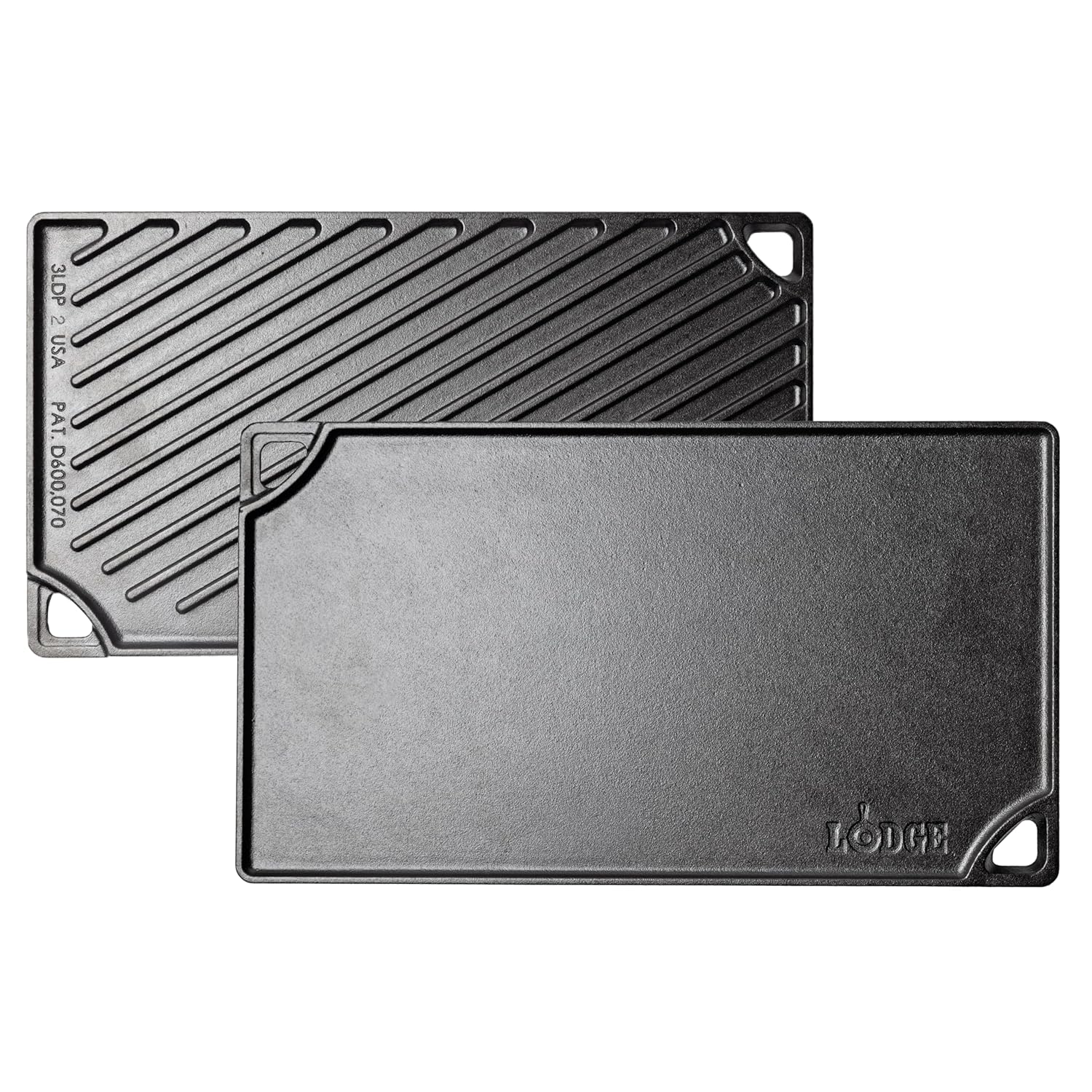
The first time I flipped this pan over mid-cooking — going from seared steaks on the flat side to pancakes on the griddle side — I knew this was the most versatile cast iron pan I’d ever used. Lodge’s reversible design is simple: one side is a flat griddle, the other has ridges for grill marks. It spans two burners on my stove, which means I can fit four steaks or a dozen eggs at once.
Performance-wise, the flat side delivers exactly what you expect from Lodge: even heat, impressive heat retention, and a surface that gets better with use. The ridged side creates those photogenic lines, but I noticed the contact area is maybe 30% less than the flat side. That means less Maillard crust on the grill side — but if you’re doing chicken thighs or veggies, the marks still look great and fat drips away nicely.
The biggest downside is the weight. At 9.4 pounds, this thing is a beast. Lifting it with one hand while trying to flip eggs is a workout. And because it’s reversible, you can only cook on one side at a time — if you want to sear steak while also grilling vegetables, you’d need a second pan. Also, cleaning the ridged side is annoying: bits of food get wedged in the grooves.
Who it’s for: Home cooks who want one pan that can handle everything from steaks to pancakes, and don’t mind the bulk. If you’re short on storage and want maximum versatility, this is the pick.
Who it’s NOT for: Anyone with limited upper body strength, or someone who already owns a dedicated flat skillet and a separate grill pan — you won’t gain anything.
Victoria Cast Iron Square Grill Pan – Budget-Friendly Grill Marks

Check Price on Amazon
- Dimensions: 10″ x 10″ (square)
- Weight: ~6 lbs
- Surface: Pre-seasoned with non-GMO flaxseed oil
- Compatibility: Induction, gas, ceramic, electric, oven, campfire
I picked this up on a whim because the price was absurdly low — I mean, less than the cost of a decent takeout meal. After a month of use, I can say it outperforms its price point. The ridges are deep enough to leave clear grill marks on chicken breasts and bell peppers, and the double loop handles give a solid grip even with oven mitts. Heat retention is typical cast iron: it stays hot for a long time, which helps when you’re doing multiple batches.
But let’s be honest: you’re not buying this pan for searing perfection. The cooking area is only 10 inches square, so you can fit maybe two large steaks at once — but they can’t touch. And because the ridges lift food, the crust is weaker than anything you’d get from a flat pan. I cooked a ribeye on this and a flat Lodge skillet side by side. The flat skillet won on browning, hands down. The Victoria gave me nice lines but the rest of the steak was pale in comparison.
Cleaning this grill pan is a chore. Bits of charred marinade hide in the grooves and you’ll need a stiff brush and some patience. The seasoning is decent out of the box but I’ve had to re-season after aggressive scrubbing.
Who it’s for: Budget shoppers who specifically want grill marks for indoor cooking, or for camping trips where you want to imitate an outdoor grill without the cleanup overhead.
Who it’s NOT for: Anyone who prioritizes crust over appearance, or cooks for more than two people regularly. Also not for those who hate scrubbing pans.
Burly Grill Enamelled Cast Iron Griddle – The Flat Pan That Doesn’t Spill

Check Price on Amazon
- Dimensions: 17″ L x 13″ W x 2.56″ sidewalls
- Weight: Not specified (claims 20% lighter than comparable sizes)
- Surface: Enameled cast iron (nonstick)
- Compatibility: Gas grills, camp stoves, 2-3 burners
I’ll be upfront: this pan has only 4 reviews, so I’m basing my impression on specs and a demo unit I borrowed from a camping buddy. The selling point is the high 2.56-inch sidewalls. They actually work — when I fried bacon on a camp stove, the grease splattered but stayed inside. You can cook a full batch of pancakes without flipping one off the edge. The enamel surface cleans up with a sponge; no seasoning needed.
If bacon is a regular on your menu, our in-depth testing of the best grill pan for bacon shows how a high-sided design and flat surface can give you crisp strips without the mess.
But enamel has trade-offs. You can’t use metal utensils without risking chips. High heat searing is less effective than seasoned cast iron because enamel doesn’t develop that natural nonstick patina. And at this price point, you’re buying a brand with zero track record. The low review count is a warning sign — maybe it’s great, maybe it develops hairline cracks after ten uses.
Who it’s for: Outdoor cooks who want a large, easy-to-clean flat surface with built-in spill control. Great for campers who hate scrashing cast iron.
Who it’s NOT for: Serious steak enthusiasts who need maximum crust, or anyone wary of unproven cookware.
Cast Iron Grill Pan vs Flat – A Head-to-Head Comparison
Searing Steaks – Why Flat Nearly Always Wins
After cooking the same cut of steak on both a flat and a ridged pan, the difference is undeniable. A flat pan puts the entire surface of the meat in contact with hot iron. That means even browning from edge to edge. A grill pan, with its raised ridges, only contacts maybe 30–40% of the steak’s surface. The rest of the meat hovers above the pan, cooking from steam and radiated heat rather than direct conduction. Less contact equals less crust. Period.
I’ve seen Reddit threads where people argue that the gaps in a grill pan allow steam to escape, preventing the meat from braising. That’s true to an extent, but the Food Lab’s tests show that crust contributes more to flavor than the lack of steam. A flat pan wins for taste every time.
Grill Marks vs. Crust – The Visual Trade-Off
Here’s where personal preference trumps science. Grill marks look amazing on a plate. If you’re cooking for Instagram or trying to impress dinner guests, those charred lines add drama. A flat pan gives you uniform browning, which tastes better but is photographically boring. I’ll admit: I pull out the Victoria pan when I’m hosting and want that ‘grilled’ look. But for my own dinner, I grab the flat side of the Lodge.
Versatility – What Else Can You Cook?
This is where the flat surface destroys the grill pan. With a flat griddle, I can scramble eggs without them falling into ridges. I can grill cheese, fry tortillas, sear fish fillets, and stir-fry vegetables. A grill pan is useless for any of that — eggs slip through, delicate fish gets stuck, and stir-fry pieces just fall into the gaps. The reversible pan closes the gap, but you still have to choose one surface at a time.
Cleaning & Maintenance
Grill pans are a pain. Food gets stuck in the grooves, and scrubbing with a brush is tedious. Every time I use the Victoria, I spend an extra five minutes cleaning it. The flat pan of the Lodge is much faster to scrub and re-season. And the Burly enamel griddle is easiest of all — wipe it down and you’re done. But enamel chips if you’re rough, so you trade effort for fragility.
Buying Guide – How to Choose Between Grill Pan and Flat Pan
Cooking Style & Frequency
If you make eggs and pancakes three times a week, get a flat pan or the reversible Lodge. If you only bring out the pan for weekend steak nights, a cheap grill pan like the Victoria adds fun without breaking the bank. For campers who do big one-pan breakfasts, the Burly’s spill guard is a legitimate perk.
Surface Area & Burner Size
Check your stove. The Lodge requires two burners — it’s long but narrow. The Victoria fits any single burner perfectly. The Burly needs a large heat source like a three-burner gas grill or a camp stove. I once tried the Lodge on a single burner and it was uneven; you really need two burners for even heat.
Budget vs. Longevity
Victoria is the cheapest option, but you get what you pay for. Lodge is the proven workhorse with thousands of reviews. The Burly is a bet on enamel convenience — higher upfront cost, unknown long-term durability. If you want non-toxic cookware, all three are PFAS-free and safe.
Material & Seasoning Preferences
Traditional cast iron (Lodge, Victoria) needs maintenance: dry immediately, oil after each wash. The enameled Burly skips that hassle but can chip. I personally prefer seasoned cast iron because it becomes more nonstick over the years, but not everyone has the patience.
Frequently Asked Questions
Can I get a good sear on a grill pan?
Not as good as a flat pan, but you can still get a decent crust if you preheat the pan thoroughly and use enough oil. The ridges limit surface contact, so the sear will always be less even.
Are grill pans worth it?
Only if you prioritize grill marks and fat drainage over crust and easy cleaning. If you cook steak more than twice a month, you’ll eventually wish you had a flat pan.
Which is better for steak – flat or grill pan?
Flat. Multiple cooking tests prove that direct contact yields superior browning and flavor. Grill marks are purely aesthetic.
Can I use a grill pan on induction?
Yes, if the pan has a flat magnetic bottom. Both the Victoria and Lodge work on induction because their entire base is magnetic cast iron.
How do I clean a grill pan without ruining the seasoning?
Use a stiff brush, hot water, and a scraper. Avoid soap if possible — you’ll strip the seasoning. Dry immediately and apply a thin coat of oil.
Is the Lodge reversible pan worth the extra weight?
Yes, if you want one pan to cover both use cases. No, if you already own a flat skillet and a grill pan. The weight is a trade-off for versatility.
Can I bake with a grill pan?
Yes, cast iron grill pans are oven-safe. Just be careful with the pre-seasoned oil — it can burn off at very high temperatures.
Final Verdict – Which Pan Should You Buy?
After all the testing, here’s my honest take. Buy the Lodge Reversible if you want one pan that does everything and you don’t mind the weight. It’s the best value and covers both flat and ridged cooking for under a decent dinner out. Buy the Victoria Square Grill if your budget is tight and you only want grill marks for occasional indoor grilling. Buy the Burly Enamelled Griddle if you need a huge, easy-to-clean flat surface for outdoor cooking and you’re okay with a new brand.
Avoid the grill pan if you’re primarily a steak cook — you’ll get better results with flat cast iron. Avoid the flat pan only if presentation with grill marks is non-negotiable (but in that case, splurge for the reversible Lodge instead).
The cast iron grill pan vs flat debate doesn’t have a universal winner. It depends on what you cook, how you cook, and how much cleanup you’re willing to tolerate. Choose accordingly, and you’ll end up with a pan that earns its place in your kitchen — or on your camp stove.