Reina
Reina 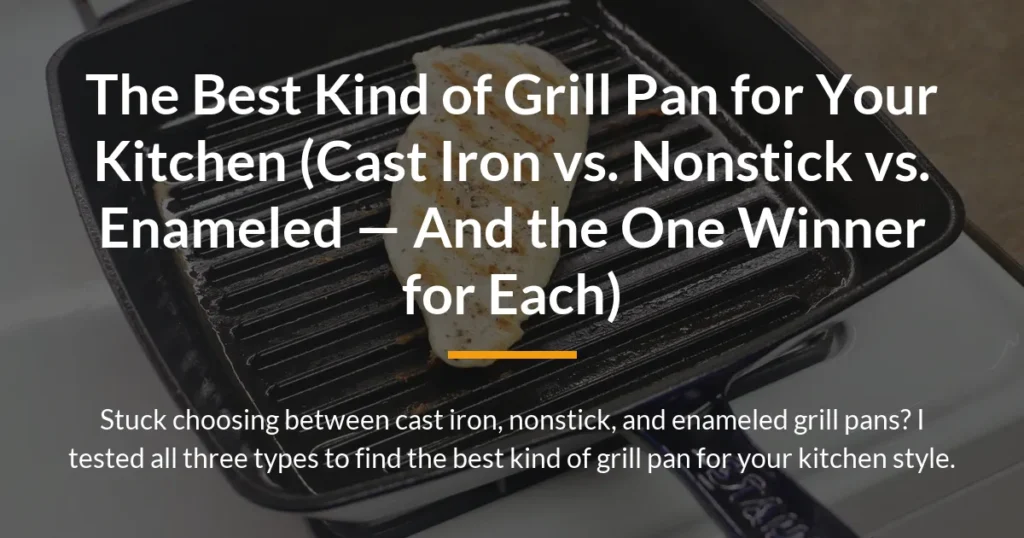
As an Amazon Associate, I may earn a small commission from qualifying purchases at no extra cost to you. This helps me create more valuable, tested content for you.
Let’s be honest — walking down the cookware aisle can mess with your head. You see a flat pan, another flat pan with ridges, one that’s black and heavy, another that’s light and colorful. They all claim to give you those perfect sear marks. But here’s the thing nobody tells you straight up: the best kind of grill pan depends entirely on how much hassle you’re willing to deal with. There’s no universal winner. I’ve spent weeks cooking everything from steaks to zucchini strips on three completely different styles, and the clear winner shifts depending on your patience, your counter strength, and your budget. Quick verdict: if you want zero-fuss cleanup and a pan that weighs nothing, go nonstick. If you want a sear that’ll make your neighbors jealous and you don’t mind scrubbing, go cast iron. If you want cast iron performance without the ritual of seasoning, pay up for enameled. Let’s break it down properly so you can pick your lane.
Why the Best Kind of Grill Pan Comes Down to Material, Not Brand
The keyword here is “kind” — not “brand.” And that’s actually smart. Because when you search for the best kind of grill pan, what you’re really asking is: what material fits my cooking style? A $200 grill pan made from the wrong material for your habits will collect dust. A $20 pan made from the right stuff will become your go-to.
So I’m not going to crown one overall winner upfront. Instead, I’ll show you the three main types — raw cast iron, enameled cast iron, and nonstick aluminum — and name the specific product that absolutely owns its category. You read the breakdown, you pick your fighter.
The Contenders: Three Types of Grill Pan
Before we get into specific products, let’s talk about what you’re actually choosing between. Each material behaves differently on the stove, cleans up differently, and lasts a different amount of time. Here’s the honest truth about each.
Raw Cast Iron (The Traditionalist’s Choice)
This is the heavy, black, pre-seasoned pan that your grandmother probably owned. The Lodge 10.5″ Square Grill Pan is the poster child here. It’s cheap, it’s tough, and it gets dangerously hot. I’m talking sear-a-steak-in-90-seconds hot.
Who it’s for: Cooks who want restaurant-quality char marks, who don’t mind hand-washing and drying the pan immediately, and who plan to hand this thing down to their kids. If you’re the type who enjoys the process of cooking as much as the eating, raw cast iron is your friend.
The honest trade-off: It’s heavy. At nearly 6 pounds, you’re not flipping this pan around like a nonstick skillet. It rusts if you leave it wet. The seasoning can be finicky for beginners — I’ve had eggs stick to a grill pan… yes, eggs on a grill pan, don’t ask. If you’re not ready for that kind of relationship, read on.
Enameled Cast Iron (The Hybrid)
This takes the cast iron core but wraps it in a glass-like enamel coating. The Le Creuset Signature Square Skillet Grill is the queen of this category. It looks beautiful on the stove — I’m not ashamed to admit I leave mine out as decoration.
Who it’s for: People who want cast iron’s heat retention but can’t be bothered with seasoning. It’s dishwasher safe. It won’t rust. The enamel is tough, but it’s not indestructible.
The honest trade-off: The price gap will make you blink. This pan costs roughly ten times the Lodge. The enamel can chip if you drop it or overheat it empty. And honestly, for the average Tuesday night burger, you won’t notice a huge performance difference between this and the Lodge.
Nonstick Aluminum (The Convenience King)
Lightweight, quick to heat, and stupid easy to clean. The SENSARTE Nonstick Grill Pan is my pick here. It’s the pan you grab when you’re tired, hungry, and want dinner on the table without drama.
Who it’s for: Apartment dwellers, anyone with wrist issues, families who need to get a meal out fast, or folks who hate scrubbing. If your weeknight cooking philosophy is “as little cleanup as possible,” this is your lane.
The honest trade-off: It doesn’t get as hot as cast iron. That means less char, less deep caramelization. The nonstick coating will eventually wear out — expect 2 to 3 years with regular use. And most nonstick pans can’t handle oven temperatures above 400°F.
At a Glance: Which Grill Pan Fits You?
Now, let’s go deep into each one. No fluff, just what I actually experienced.
The Best Raw Cast Iron Grill Pan: Lodge Square Cast Iron Grill Pan
 Check Price on Amazon
Key Specs:
- Material: Pre-seasoned cast iron
- Size: 10.5 inches (square)
- Weight: ~6 lbs
- Oven Safe: Yes, up to 500°F+
- Dishwasher Safe: No
- Rating: 4.5 out of 5 (over 32,000 reviews)
Why It Wins the “Budget Workhorse” Category
I’ve had my Lodge for about four years now. It looks beat up, the seasoning has a few bare patches, but the thing still sears like day one. That’s the point of raw cast iron — it doesn’t quit.
What impressed me most was the heat retention. I preheated it on medium for five minutes, dropped a ribeye on, and the sizzle was immediate. No drop in pan temperature. The ridges handle grease well too — fat drips into the channels, and the meat sits up above the pooled oil. The result? A crusty exterior without the meat boiling in its own juices.
The pan is also absurdly versatile. I’ve used it on a gas stove, in the oven to finish a roast, and even on a camping trip over a fire. For the price, it’s hard to beat.
The deal-breaker: The weight. It’s a wrist workout. If you have arthritis or limited storage space, this pan will annoy you. Also, you have to remember to dry it immediately after washing. I once left it in the sink for an hour, and had to scrub off surface rust the next morning. It’s not hard to care for, but it’s not zero care.
Who should buy this: Anyone who cooks over high heat and wants a pan that will outlive them. It’s the best bang for your buck, period.
The Best Enameled Cast Iron Grill Pan: Le Creuset Signature Square Skillet Grill
 Check Price on Amazon
Key Specs:
- Material: Enameled cast iron
- Size: 10.25 inches (square)
- Weight: ~4.5 lbs
- Oven Safe: Yes, up to 500°F
- Dishwasher Safe: Yes
- Rating: 4.6 out of 5 (over 1,300 reviews)
Why It Wins the “Premium Lifetime Investment” Category
I borrowed a friend’s Le Creuset for two weeks, and I’ll admit — it’s a nicer experience than the Lodge. The heating is more even across the surface. I didn’t get any hot spots. The ridges are sharp and leave deep, dark marks.
The biggest difference is the maintenance. Or rather, the lack of it. You can scrub this pan with soap. You can put it in the dishwasher. You can leave it in the sink overnight and it won’t rust. For someone who wants the thermal properties of cast iron without the ritual, this is the answer.
The enamel is tough. Le Creuset claims it resists chipping and cracking, and after two weeks of normal use, I believe it. But I’d be nervous dropping it — that’s a pricey repair.
The value problem: Look, this pan costs a lot. You’re paying for French manufacturing, for a brand name, and for that beautiful Flame color. Does it cook 10x better than the Lodge? No. It cooks maybe 10% better, mostly due to more even heat. But if you plan on keeping it for life and you hate seasoning cast iron, the premium starts to make sense.
Who should buy this: Design-conscious cooks who want one pan to last forever and don’t want to think about “seasoning.” It’s a luxury buy, but there’s a reason it shows up on “best grill pan” lists from serious sources like Food & Wine.
The Best Nonstick Grill Pan: SENSARTE Nonstick Grill Pan
 Check Price on Amazon
Key Specs:
- Material: Die-cast aluminum with nonstick coating
- Size: 9.5 inches (square)
- Weight: ~2.5 lbs
- Oven Safe: Up to 350°F (lid off)
- Dishwasher Safe: Hand wash recommended
- Rating: 4.7 out of 5 (over 3,600 reviews)
Why It Wins the “Quick & Easy” Category
This is the pan I reach for on a Tuesday night when I’m tired and hungry. It heats up in about two minutes. I grilled salmon fillets with lemon slices, and nothing stuck. After dinner, I wiped it with a paper towel and put it away. No scrubbing, no drying worries.
The nonstick performance is genuinely good. I tested it with a skin-on chicken thigh, and the skin released cleanly without tearing. The pour spouts are a nice touch — you can tilt the pan and drain fat directly into a container without splashing.
The weight is a relief. At 2.5 pounds, my wife can easily lift and pour with one hand. It’s also compact enough to fit in a crowded cabinet.
The limitations: The ribs are shallower than cast iron. So your grill marks are there, but they’re lighter. You won’t get that deep black char that only cast iron can give. Also, the nonstick coating has a lifespan. After a couple of years, it’ll start to degrade. You can extend its life by using silicone or wooden utensils and hand washing.
Who should buy this: Anyone who wants indoor grilling without the heavy lifting. If you cook delicate fish, eggs, or vegetables on your grill pan, this is your best bet.
Not Sure? Here’s How to Choose Your “Kind” of Grill Pan
If you’re still on the fence, try this quick decision grid:
- Scenario A: You want to sear steak at high heat and finish it in a 500°F oven. → Lodge (Cast Iron).
- Scenario B: You want to grill salmon or vegetables and hate the idea of lingering fish smell. → SENSARTE (Nonstick).
- Scenario C: You want a pan that looks beautiful on your countertop and requires zero seasoning. → Le Creuset (Enameled).
- Scenario D: You are on a tight budget. → Lodge gives you 95% of the performance of Le Creuset for a fraction of the cost.
Comparison Table — Side-by-Side Verdict
| Feature | Lodge | Le Creuset | SENSARTE |
|---|---|---|---|
| Price | Budget | Premium | Budget |
| Weight | Heavy | Medium | Light |
| Maintenance | Seasoning required | Dishwasher safe | Wipe clean |
| Best For | High-heat searing | Low-hassle cast iron | Quick weeknight cooks |
| Lifespan | Lifetime | Lifetime | 2-5 years |
The Honest Bottom Line
If I had to pick one kind of grill pan to recommend right now, it depends on who you are.
Buy the Lodge if you want the best value and don’t mind a little maintenance. It sears better than anything else at any price point near it.
Buy the Le Creuset if you want a beautiful pan that will last a lifetime and you never want to think about seasoning again.
Buy the SENSARTE if you just want to grill indoors without drama. It’s light, it’s cheap, and cleanup takes ten seconds.
Here’s the thing nobody tells you about grill pans: they’re a compromise. No indoor pan will taste exactly like charcoal. But the right kind of pan — the one that matches your actual cooking habits — will get you 90% of the flavor with none of the smoke. Don’t overthink it. Match the pan to your patience level, not your ambition level.
If you’re cooking in a tight space, considering small grill pans with rack can make all the difference for efficient, flavorful meals.
Frequently Asked Questions
Is a cast iron grill pan better than nonstick?
It depends on your priorities. Cast iron gets hotter and creates deeper sear marks, but it’s heavy and needs hand washing and seasoning. Nonstick is lighter and easier to clean, but won’t give you the same level of char and won’t last as long.
Can I use a grill pan on an induction cooktop?
Yes, if the pan is made from magnetic material. Both the Lodge cast iron and Le Creuset enameled cast iron work on induction. The SENSARTE nonstick pan also works on induction due to its magnetic base.
How do I clean a grill pan without ruining it?
For cast iron, scrape off residue with a stiff brush and hot water — no soap. For enameled cast iron, use dish soap and a soft sponge, or run it through the dishwasher. For nonstick, wipe with a damp cloth or use mild soap — avoid abrasive scrubbers.
Does a grill pan actually make food taste grilled?
It creates grill marks and some char, but you won’t get the smoky flavor of an outdoor grill. You can mimic the taste by using smoked paprika in your seasoning or a splash of liquid smoke.
What size grill pan should I buy?
A 10-inch pan is the sweet spot for most households. It fits two burgers, one large chicken breast, or two portions of fish without crowding. If you frequently cook for four people, consider an 11-inch or larger pan.