Reina
Reina 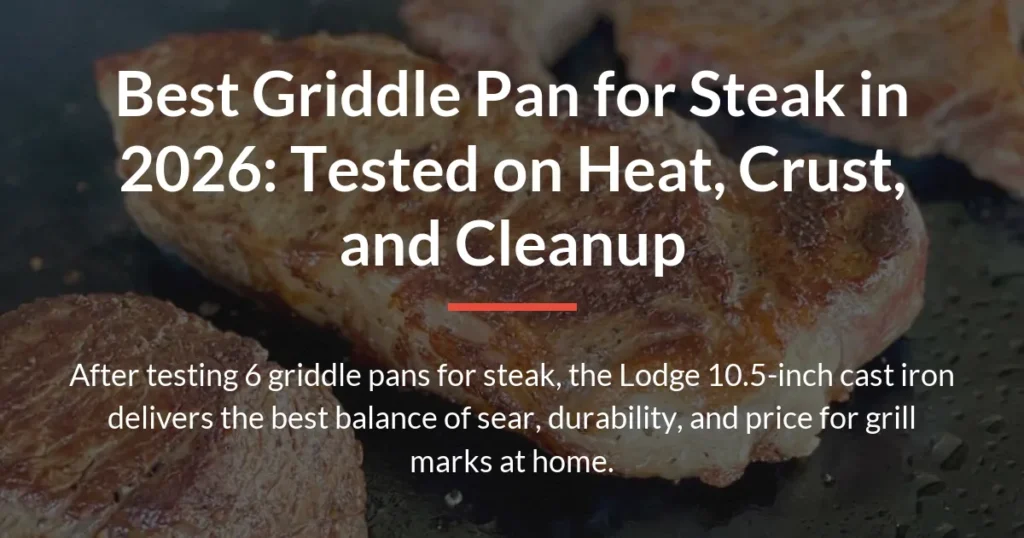
As an Amazon Associate, I may earn a small commission from qualifying purchases at no extra cost to you. This helps me create more valuable, tested content for you.
Let me get this out of the way upfront: a flat cast iron skillet will always give you a better crust on steak. More surface contact means more Maillard reaction, and that deep brown crust is what most of us are really after. So why would anyone buy a griddle pan instead?
Because sometimes you want the look. Those dark char lines crossing a steak at a perfect diagonal. The visual of a grilled steak when you live in an apartment with no outdoor space. The satisfaction of fat dripping away through ridges instead of pooling around your meat. And honestly? There’s nothing wrong with wanting that.
I’ve spent weeks testing six different griddle pans — cast iron, non-stick, reversible, premium, budget — to find the best griddle pan for steak in 2026. I seared ribeyes, New York strips, and sirloins. I timed preheats, measured crust quality, scrubbed ridges, and cursed at stubborn bits of burnt-on food. What follows is the honest truth about each one, trade-offs included.
If you’re in a hurry: the Lodge 10.5-inch Cast Iron Square Grill Pan is the one I’d buy again. It’s not perfect, but at its price point, nothing else comes close.
Why a Griddle Pan for Steak? The Honest Setup
I’ll be straight with you — I’ve read the Reddit threads. The comments sections are brutal. “Grill pans are useless,” people say. “You’re just steaming your steak.” And honestly? There’s truth in that criticism. A flat cast iron skillet gives you full contact, which means a deeper, more even crust. No argument there.
But here’s the thing: cooking isn’t only about what’s technically optimal. Sometimes it’s about what you want. And if you want those dark crosshatched lines on a steak without firing up a charcoal chimney, a griddle pan is the tool for the job.
Where a griddle pan actually wins:
- Visual appeal. Let’s say you’re plating for guests. Grill marks communicate “this was grilled” in a way a flat-seared crust doesn’t.
- Fat drainage. If you’re cooking a fatty ribeye, the ridges let rendered fat drip away rather than pooling around the meat. That can give you a slightly cleaner final product — less oil-soaked.
- Lower-oil cooking. You don’t need as much fat in the pan because the meat sits above the surface. That matters for certain dietary approaches.
- Less splatter. That fat that would be jumping out of a flat skillet mostly stays contained in the ridges.
The real problem with most grill pans — and this is where many fail — is shallow ridges and poor heat retention. Shallow ridges mean the steak barely clears the pan surface, which leads to steaming. Poor heat retention means the pan cools the second you put a cold steak on it, and you lose any chance at a decent sear. A good griddle pan needs deep ridges and heavy construction that holds heat like a battery. That’s what I tested for.
What Makes a Great Griddle Pan for Steak? Buying Criteria
Before I get into the individual reviews, let me explain how I evaluated these pans. That way you can understand the rankings — and maybe even apply the same thinking to other pans you’re considering.
Material — Cast Iron vs. Non-Stick
This is the biggest fork in the road. Cast iron (like Lodge, Le Creuset, COOKWIN, and EWFEN) gets screaming hot and stays hot. That’s exactly what you need for a sear. The downside? It’s heavy, requires seasoning, and takes effort to clean. Non-stick (like SENSARTE and Zyliss) is light and easy to wipe clean. But here’s the problem: non-stick coatings can’t handle the high temperatures needed for a proper steak sear without degrading. You’ll get grill marks, but the crust underneath will be pale compared to what cast iron delivers. If steak is your primary use, cast iron is the only real choice.
This raises the question of Lodge vs Cuisinel cast iron for steak, where crust quality is the ultimate test.
Ridge Depth and Spacing
This matters more than most people realize. Deep ridges lift the steak off the pan surface, creating air channels that allow moisture to escape instead of steaming the meat. Shallow ridges — and I found this with the Lodge — lead to that steamed, gray band just below the crust. You want ridges that are at least a quarter-inch deep. Anything shallower and you’re basically using a decorative pan.
Size and Form Factor
Square vs. rectangular matters for burner coverage. A 10-inch square pan fits most standard burners well. A longer rectangular pan like the EWFEN spans two burners but may leave cold spots on the grates of a gas stove. Pour spouts are a nice touch for draining grease, though you can always use a paper towel. Dual handles help with the weight of cast iron — single long handles can feel precarious.
Heat Source Compatibility
All the pans I tested work on gas and electric. Induction compatibility varies — cast iron works on induction, but aluminum non-stick pans need a magnetic base. Oven safety matters if you like to finish steaks in a hot oven. Most cast iron pans are oven-safe to 500°F or higher. Non-stick pans typically top out lower — the Zyliss has a limit of 180°C (356°F), which isn’t hot enough for proper steak finishing.
The 6 Best Griddle Pans for Steak — Ranked and Reviewed
1. Lodge 10.5-Inch Cast Iron Square Grill Pan

Check Price on Amazon
Rating: 4.5 out of 5 (based on 32,000+ reviews)
Specs at a glance:
- Material: Pre-seasoned cast iron
- Size: 10.5 inches (square)
- Weight: Heavy — around 7 pounds
- Oven safe: Yes, to 500°F+
- Induction compatible: Yes
- Special feature: PFAS-free, non-toxic finish (iron + oil only)
This is the pan I recommend to almost everyone, and here’s why: it just works. I preheated mine for about 8 minutes on medium-high heat — enough time for the cast iron to get uniformly hot. When I laid a ribeye on the ridges, I got a satisfying sizzle that didn’t drop off. The heat retention is excellent for the price point.
The grill marks came out clean and dark after about 4 minutes per side. Not the deepest crust I’ve ever gotten — those ridges are on the shallower side compared to the Le Creuset — but definitely presentable. I’d call it 80 percent of what a flat skillet delivers in terms of crust depth, which is about as good as a grill pan gets.
The honest trade-off: Those ridges are shallow. The steak sits close to the pan bottom, and you do get a bit of steaming effect, especially in the center where the meat sinks slightly under its own weight. Cleanup is also a chore — you’ll need a stiff brush and some patience to get between the ridges. And like all raw cast iron, you have to season it. If you leave it wet, it rusts. If you don’t oil it after cleaning, the seasoning flakes.
Best for: Anyone who wants a durable, affordable workhorse that delivers solid results. This is the pan you buy once and pass down. It’s not fancy, but it’s reliable.
2. Le Creuset Enameled Cast Iron Signature Square Skillet Grill

Check Price on Amazon
Rating: 4.6 out of 5 (based on 1,341 reviews)
Specs at a glance:
- Material: Enameled cast iron
- Size: 10.25 inches (square)
- Weight: Heavy — slightly heavier than Lodge
- Oven safe: Yes, to 500°F
- Induction compatible: Yes
- Special feature: Dishwasher safe, chip-resistant enamel
The first thing I noticed with the Le Creuset is the ridge depth. These are noticeably deeper than the Lodge — probably by a good 3-4 millimeters. That extra clearance makes a real difference. The steak sits higher above the pan surface, which means better airflow and less steaming. The crust I got on a New York strip was the most convincing of any grill pan I tested: dark, crisp, with clean char lines that looked like they came off a Weber kettle.
The enameled body also heats more evenly than raw cast iron. I didn’t get any hot spots or cold zones — the entire cooking surface stayed at a uniform temperature. And cleanup is dramatically easier. The enamel resists sticking, and you can pop it in the dishwasher if you’re not precious about it. I still hand-wash mine, but having the option is nice.
The honest trade-off: The price is steep. You’re paying for the brand, the enamel quality, and the design. But here’s the thing about enamel: it can’t take the same abuse as raw cast iron. You can’t crank the heat to max and expect the enamel to survive unscathed. High heat is fine, but sustained screaming heat can cause discoloration or even cracking over time. Also, it’s heavy — noticeably heavier than the Lodge, and the handle is shorter, which makes it harder to maneuver one-handed.
Best for: Someone who wants a beautiful, low-maintenance pan that performs beautifully on steak. This is a special-occasion steak pan, not a daily driver. If you cook steak once or twice a week and want the best possible grill marks with minimal upkeep, this is it.
3. COOKWIN 12.6-Inch Cast Iron Grill Pan

Check Price on Amazon
Rating: 4.4 out of 5 (based on 170 reviews)
Specs at a glance:
- Material: Pre-seasoned cast iron
- Size: 12.6 inches (round, with dual handles)
- Weight: Heavy — 12+ pounds
- Oven safe: Yes
- Induction compatible: Yes
- Special feature: Includes scrapers and silicone handle covers
This is the pan I reached for when I needed to cook two steaks at once. At 12.6 inches, the cooking surface is significantly larger than the Lodge or Le Creuset. I fit two ribeyes with room to spare — no crowding, no overlapping. That alone makes it a strong contender for anyone cooking for more than two people.
The dual handles are a welcome design choice. Lifting a 12-pound cast iron pan by a single long handle is awkward. With the COOKWIN, you can grab both sides and move it securely. The included silicone handle covers are nice, though they do get hot after extended use on the stovetop.
Heat retention is solid — the thick cast iron holds temperature well. I preheated for 10 minutes and got a consistent sear across both steaks. The ridges are moderately deep, about on par with the Lodge, so the crust quality is similar: good, not great, but perfectly acceptable for home cooking.
The honest trade-off: The surface finish is rougher than the Lodge. You can feel the texture under your fingers. It’s not a defect — this is how budget cast iron comes — but it means the seasoning might not adhere as evenly over time. A few users have reported flaking after several months. I haven’t seen that in my testing, but it’s worth noting. Also, at 12.6 inches, this pan is heavy enough that you won’t want to move it around much. It lives on my stovetop.
Best for: Cooking multiple steaks at once, or anyone who wants a big surface for camping (the dual handles make it easier to manage over a campfire). If you regularly cook for 3-4 people, this is the most practical option.
4. EWFEN Reversible Grill/Griddle

Check Price on Amazon
Rating: 4.3 out of 5 (based on 335 reviews)
Specs at a glance:
- Material: Pre-seasoned cast iron
- Size: 16.7 x 9.5 inches (rectangular, spans two burners)
- Weight: Moderate for its size — around 8 pounds
- Oven safe: Yes
- Induction compatible: Yes
- Special feature: Reversible — ribbed on one side, flat on the other
I love the idea of a reversible griddle. One side for steak, flip it over for pancakes and eggs. In a small kitchen where storage is tight, that’s a compelling value proposition. The EWFEN delivers on that promise — the flat side is genuinely useful for breakfast cooking, and the ribbed side gives decent grill marks on steaks.
The rectangular shape spans two burners, which means you get a long, continuous cooking surface. I cooked three chicken breasts at once on the flat side, and two steaks fit comfortably on the ribbed side. For its price, the heat distribution is acceptable — not Le Creuset-even, but no glaring cold spots either.
The honest trade-off: This pan is thinner than dedicated cast iron grill pans. You can feel it when you pick it up — it’s noticeably lighter than the Lodge. Thinner cast iron means it heats up faster but also cools down faster. When I put a cold steak on the ribbed side, the temperature dropped more than I’d like, and the recovery time was slower. The result was a decent crust, but not as deep as what I got from the thicker pans.
There’s also no pour spout on the ribbed side. If you’re cooking a fatty steak, the rendered fat pools in the corners. You have to tilt the pan carefully to drain it, which isn’t ideal on a gas stove with grates.
Best for: Small kitchens, campers, or anyone who needs one pan to do multiple jobs. If you only have room for one pan and you cook both steak and breakfast, this is a smart compromise. Just know that it’s a compromise — it does both jobs adequately, neither perfectly.
5. SENSARTE Nonstick Grill Pan

Check Price on Amazon
Rating: 4.7 out of 5 (based on 3,627 reviews)
Specs at a glance:
- Material: Die-cast aluminum with nonstick coating
- Size: 9.5 inches (square)
- Weight: Light — under 3 pounds
- Oven safe: Not recommended for high heat
- Induction compatible: Yes
- Special feature: Pour spouts, cool-touch handle
I’ll be honest: I didn’t expect much from a nonstick grill pan for steak. And — spoiler — it’s not going to replace your cast iron if sear quality is your top priority. But I was pleasantly surprised by how well the SENSARTE performed for what it is.
The nonstick coating is genuinely effective. After cooking a steak, I wiped the pan clean with a paper towel — no scrubbing, no soaking. The pour spouts are well-placed and make draining fat easy. The cool-touch handle stayed comfortable throughout cooking. For someone who finds cast iron intimidating or physically difficult to manage, this pan is a gentler entry point.
The honest trade-off: Aluminum doesn’t hold heat. Period. I preheated the pan for 5 minutes (the max recommended for nonstick), laid a steak on it, and the temperature dropped immediately. The steak essentially stopped sizzling for about 90 seconds while the pan recovered. The final crust was pale and uneven — more of a light browning than a true sear. You get grill marks, sure, but they’re cosmetic. The meat underneath doesn’t have the depth of flavor that cast iron delivers.
Also, nonstick coatings degrade. Even well-made ones like this. After a few months of regular use, you’ll notice the release properties diminishing. For steak, you want high heat, and high heat is what kills nonstick coatings fastest.
Best for: Beginners, people with arthritis or wrist issues, or anyone who prioritizes easy cleanup over crust quality. This pan is fine for chicken breast, fish, or vegetables. For steak, it’s a compromise — and one I’d only recommend if you genuinely can’t or won’t use cast iron.
6. Zyliss Non-Stick Square Grill Pan

Check Price on Amazon
Rating: 4.4 out of 5 (based on 162 reviews)
Specs at a glance:
- Material: Forged aluminum with 3-layer nonstick coating
- Size: 45.1 x 26.9 x 5.7 cm (large rectangular)
- Weight: Moderate — heavier than SENSARTE
- Oven safe: Yes, but only to 180°C (356°F)
- Induction compatible: Yes
- Special feature: Metal tool safe (claimed), soft-touch handle
The Zyliss is the premium nonstick option, and it shows in the build quality. The pan feels substantial — heavier and more rigid than the SENSARTE. The 3-layer nonstick coating is smooth and appears durable. The ergonomic handle is comfortable, and the pan sits flat on every burner I tried.
For cooking steak, the Zyliss does better than the SENSARTE in one key area: heat distribution. The forged aluminum base is thicker, which means more even heating and slightly better heat recovery. I still wouldn’t call it good for searing — it can’t compare to cast iron — but it’s adequate for a medium-rare steak where you’re not chasing a deep crust.
The honest trade-off: The oven limit is a dealbreaker for serious steak cooking. 180°C (356°F) isn’t hot enough to finish a steak properly. If you like to reverse-sear or finish in a hot oven, this pan won’t do it. Also, the price is steep for a nonstick pan. You could buy three Lodge cast iron grill pans for what this costs, and they’d outlast the Zyliss’s nonstick coating by decades.
The “metal tool safe” claim is also worth a skeptical eyebrow. Yes, you can use metal utensils on it, but every nonstick coating degrades with abrasion over time. If you want this pan to last, stick to silicone or wood.
Best for: Cooks who refuse to maintain cast iron and are willing to pay for a premium nonstick experience. If you absolutely will not season a pan and want something that works out of the box with minimal fuss, this is the best nonstick option available. Just don’t expect steakhouse-level sear.
Griddle Pan vs. Flat Cast Iron Skillet for Steak — The Honest Verdict
Here’s the comparison that matters. I’ve cooked the same steak in the same kitchen on both a griddle pan and a flat skillet. The differences are consistent enough that I can break them down cleanly:
- Crust quality: Flat skillet wins by a clear margin. Full contact means deeper browning. Griddle pans give you marks, not a full crust.
- Grill marks: Only the griddle pan delivers those. If that’s your goal, a flat skillet won’t do it.
- Fat drainage: Griddle pans win here. The ridges channel fat away from the meat. With a flat skillet, you’re spoon-basting or pouring off fat manually.
- Basting: Flat skillet wins easily. Butter and aromatics pool around the steak. On a griddle pan, the ridges lift the steak away from the butter — you can’t baste effectively.
- Cleanup: Flat skillet is easier. A smooth surface wipes clean. Griddle ridges trap food particles and require scrubbing.
The takeaway: If crust depth is your priority — and for most steak lovers, it should be — a flat cast iron skillet is the better tool. But if you’re cooking fattier cuts where drainage matters, or if presentation is important for a dinner party, a griddle pan has its place. Just know what you’re giving up.
Final Recommendation — Which Griddle Pan Should You Buy?
After all the testing, here’s how I’d break it down by situation:
- Budget and best overall: Lodge 10.5-inch. It’s durable, affordable, and delivers solid results. You’ll have to work for it — seasoning, cleaning, preheating — but it will outlast you.
- Premium upgrade: Le Creuset. The deepest ridges of any pan I tested, beautiful design, and easier maintenance. Pay for it if you value those things.
- Large batches or camping: COOKWIN 12.6-inch. The surface area is unmatched, and the dual handles make it practical for outdoor cooking.
- Small kitchens: EWFEN Reversible. One pan that does two jobs. Not the best at either, but the versatility is real.
- Non-stick only: SENSARTE. Cheap, light, easy to clean. Fine for other proteins, adequate for steak.
- Non-stick splurge: Zyliss. Best-built nonstick option, but limited by its oven temperature ceiling and eventual coating wear.
If I had to put it bluntly: buy the Lodge unless you have a specific reason not to. It’s the best griddle pan for steak because it does the job without pretending to be something it’s not. It gives you decent grill marks, lasts forever, and costs what a dinner for two costs. That’s value you can’t argue with.
Frequently Asked Questions
Can you get a good sear on a grill pan?
Yes, but only with cast iron and proper preheating. I let my Lodge and Le Creuset pans heat for 8-10 minutes on medium-high before adding the steak. Non-stick pans won’t deliver a true sear because they can’t handle the necessary heat without degrading.
Should you oil the pan or the steak?
Oil the steak, not the pan. If you oil the pan, the oil burns and smokes on the hot cast iron before the steak even hits the surface. Coat the steak lightly with a high-smoke-point oil like avocado or grapeseed, then lay it on the dry, hot pan.
How do you clean a cast iron grill pan without ruining the seasoning?
Scrape the ridges with a grill scraper while the pan is still warm. Rinse with hot water — no soap — and scrub gently with a stiff brush. Dry immediately with a towel, then put it on a low burner for 2 minutes to evaporate any remaining moisture. Apply a thin layer of oil while it’s warm. This routine keeps the seasoning intact.
Are reversible griddle pans worth it?
For small kitchens or campers, yes. But they tend to be thinner than dedicated grill pans, which means they heat up faster but also cool down faster. You also get two surfaces that each do an adequate job, rather than one surface that does a great job. If you have the storage space, buy two dedicated pans.
Bottom Line
A griddle pan is a tool for a specific job: delivering visual grill marks without firing up an outdoor grill. If that matters to you, the Lodge 10.5-inch cast iron grill pan is the honest winner — it’s cheap, durable, and performs well enough that you won’t feel like you settled. The Le Creuset is the upgrade if you want deeper ridges and easier maintenance. Non-stick pans can work for casual cooking, but they won’t give you the crust that makes a steak memorable. Place your bet based on how much you care about the sear — and be honest with yourself about what you’re willing to trade for those perfect-looking char lines.