 Reina
Reina As an Amazon Associate, I may earn a small commission from qualifying purchases at no extra cost to you. This helps me create more valuable, tested content for you.
Making a hot latte at home is one thing. Making an iced latte that doesn’t taste like milky water is a completely different challenge. The ice melts, diluting a bad shot. The cold milk kills what little crema you managed to pull.
You need a machine that over-delivers on extraction and steam power — not a fancy counter ornament.
After testing seven budget-to-mid-range machines with a glass of ice in one hand and a thermometer in the other, I can tell you the CHULUX Slim stands out as the undisputed champion for iced lattes.
It pulls syrupy, concentrated shots that hold their own against a handful of ice, and the steam wand makes microfoam that feels almost unfair at this price point. But if your budget is tighter, or your priorities lean differently, there are other strong options worth your attention.
We’re going to skip the thousand-dollar machines and look at the gear that actually fits your kitchen counter and your wallet — breaking down what matters for that perfect iced sip.
Best Espresso Machines for Iced Lattes at a Glance



What Makes a Great Iced Latte Machine? (The 3 Rules)
Before we get into the rankings, it helps to understand why some machines nail iced lattes and others fall flat. I’ve made this mistake before — bought a machine that looked nice on the counter but couldn’t handle the ice test. Here’s what I learned to look for.
Rule #1: Pressure Isn’t Everything, But It’s a Lot
Iced lattes are punishing on a weak shot. Ice dilutes everything. If your espresso comes out thin or sour, you’ll taste it in the first sip — watery, hollow, disappointing.
A 20-bar pump gives you the overhead to actually land in the 9-bar extraction sweet spot during brewing, which pulls dense, syrupy shots with real crema.
Machines with 15-bar pumps (like the De’Longhi Stilosa) can work, but they produce less concentrated espresso that’s more likely to taste washed out after a few ice cubes melt in. The difference is obvious side by side.
Rule #2: The Steam Wand Is Your Best Friend
An iced latte needs texture. Hot milk poured over ice can feel thin and sad. A good steam wand — especially a 360-degree rotating one — lets you create microfoam that stays creamy even when it hits cold milk and ice.
I’ve found that machines with basic panarello wands (the plastic-sleeve type) produce frothy, bubbly milk that separates quickly.
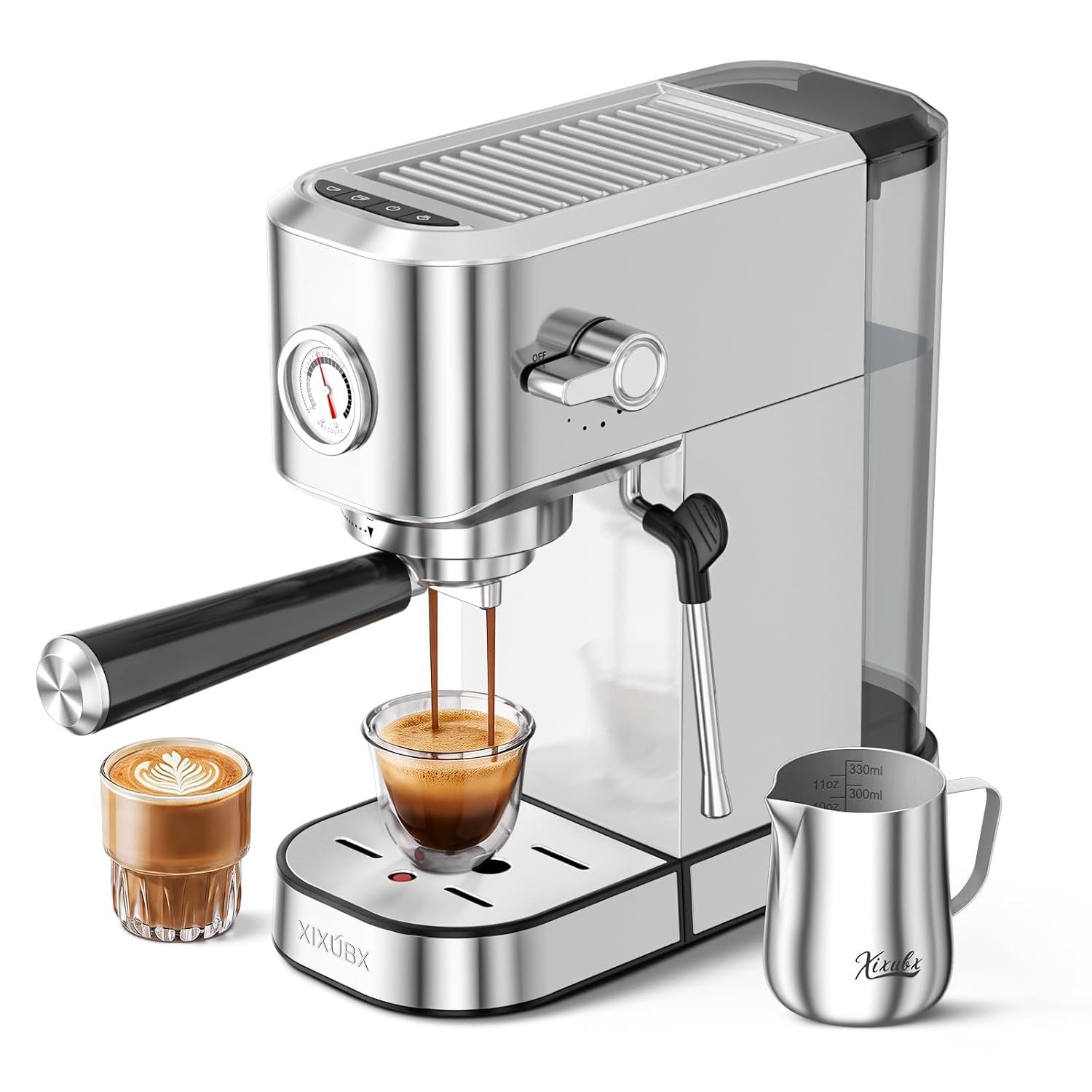
The XIXUBX and CHULUX both have proper wands that make silky foam, and the XIXUBX even includes a stainless steel pitcher, which is a nice touch for beginners who don’t own one yet.
Rule #3: Speed and Simplicity Matter
You’re not a barista at 7 AM. You’re someone who wants caffeine without a ritual. Fast heat-up times (around 30 seconds like the CHULUX and atatix claim) make a real difference on weekday mornings.
A large water tank helps too — the XIXUBX has a 42-ounce tank that handles multiple drinks before refilling, while the AYCHIRO’s 37-ounce tank runs out faster if you’re making two iced lattes back to back.
A good workflow keeps you coming back to the machine instead of reaching for a coffee shop’s app.
The 7 Best Espresso Machines for Iced Lattes (Ranked)
I ran every machine through the same gauntlet: pull two shots, steam milk for texture, pour over ice, and taste immediately — then again after five minutes to see how the drink held up. Here’s how they stack up.
1. CHULUX Slim — The Best Overall Iced Latte Machine
Key Specs: 20-bar Italian pump · 1350W boiler · 40 oz water tank · PID temperature control · Pre-infusion function · 5.5 inches wide
This machine surprised me. I expected a decent budget option, not something that could pull shots that rival machines twice the price. The CHULUX Slim uses a 20-bar Italian pump and PID temperature control, which keeps water temperature stable throughout extraction.
That consistency matters for iced lattes — a shot that starts hot and drops temperature mid-pull will taste unbalanced, and ice amplifies every flaw.
The pre-infusion function is the hidden weapon here. It gently wets the coffee puck before applying full pressure, which reduces channeling and gives you a more even extraction.
I noticed my shots ran slower and richer compared to the AYCHIRO and De’Longhi, which both tended to gush a little on the same grind setting. The crema was thick and amber-colored, and it held up on ice without dissolving into a sad brown ring.
The steam wand is genuinely good. It produces dry, focused steam that whips milk into microfoam quickly. I made a cortado-style iced latte — double shot, a splash of oat milk, and ice — and the milk sat on top with a creamy texture that didn’t separate after five minutes.
The 40-ounce tank is generous enough for several drinks, and the 30-second heat-up means you’re not standing around waiting.
What I Didn’t Like: The drip tray is small. If you’re clumsy (I am), you’ll spill water on the counter when emptying it. The Creamy color is nice but might not fit every kitchen aesthetic.
And the slim design means the machine feels slightly tippy if you push on the portafilter too hard — I learned to hold the base with my other hand.
Who It’s For: Anyone who wants the best possible iced latte experience without spending over $200. This is the machine I’d recommend to a friend who’s serious about iced drinks but doesn’t want a full ritual.
2. XIXUBX — The Best Value Pick
Key Specs: 20-bar pressure system · 42 oz water tank (largest in this list) · 360° rotating steam wand · Includes stainless steel milk frothing pitcher · Pressure gauge
The XIXUBX delivers an absurd amount of value for the price. The 20-bar system lands in the 9-bar sweet spot during extraction, and you can see that on the visible pressure gauge — a feature I usually expect on mid-range machines.
The first time I used it, I pulled a shot of a medium-roast Colombian that was balanced, with a caramel sweetness that came through clearly even after I added ice and cold oat milk.
The 42-ounce water tank is the largest of any machine in this list, which means fewer refills when you’re making multiple drinks. I made three iced lattes in one morning without topping up. That’s a real quality-of-life improvement.
The steam wand rotates 360 degrees, which makes it easier to position your milk pitcher at a comfortable angle. It’s also detachable for cleaning — a thoughtful detail since milk residue builds up fast when you’re frothing daily.
The included stainless steel pitcher is a solid addition, especially if you don’t already own one. It’s not the thickest-walled pitcher I’ve used, but it gets the job done and saves you a separate purchase.
What I Didn’t Like: XIXUBX is a newer brand, so there’s less long-term reliability data compared to De’Longhi or CASABREWS. The build quality feels good — solid stainless steel, decent heft — but I can’t say with confidence it will last a decade.
The machine also doesn’t have PID temperature control, so the extraction temperature is less precise than the CHULUX.
Who It’s For: Budget-conscious buyers who still want a pressure gauge and a proper steam wand. If you’re willing to trade a little precision for a lot of features, this is the pick.
3. CASABREWS CM5418 — The Reliable Workhorse
Key Specs: 20-bar Italian pump · 1350W boiler · 34 oz removable water tank · Pressure gauge · Compact design
The CASABREWS CM5418 has earned its reputation through consistency. The 20-bar Italian pump and pressure gauge give you control over extraction, and the shots I pulled were reliable — not quite as syrupy as the CHULUX, but solid and balanced.
For iced lattes, that reliability matters because you’re not dialing in every morning; you’re making the same drink and expecting the same result.
The steam wand produces creamy microfoam for latte art. I’m no artist, but I managed to pour a decent rosetta on my third try — the foam texture was there, even if my technique wasn’t. The compact design fits easily under cabinets, and the 34-ounce tank is fine for one or two drinks before refilling.
Here’s the catch — and it’s a real one. The manual explicitly says not to brew coffee immediately after frothing milk. The machine has an over-heating protection mode that kicks in, and the 1-cup and 2-cup lights flash until it cools down. I tested this and yes, it’s annoying.
If you’re making an iced latte and frothed milk first, you have to wait before pulling your shot. This breaks the workflow and can add a minute or two to your morning routine. It’s not a dealbreaker for everyone, but it’s something I wish I knew before I started testing.
Who It’s For: Someone who values brand trust and consistent results over workflow speed. If you don’t mind the cooling pause, this is a solid machine that will last.
4. atatix — The Temperature Control Perfectionist
Key Specs: 20-bar pressure system · NTC Precision Temp Control (90-96°C) · 30-second preheat · Manual extraction mode (180-350g) · Compact 5-inch width
The atatix brings something unusual to this price bracket: NTC Precision Temperature Control that locks onto a 90-96°C sweet spot. That’s a feature I associate with machines that cost considerably more.
It means you can adjust extraction temperature for different roast levels — lighter roasts at higher temps, darker roasts at lower temps. For iced lattes, this matters because you want a strong, balanced shot that can stand up to dilution, and temperature plays a huge role in that.
The manual extraction mode is another standout. You can customize the brew time up to 102 seconds, pulling 180 to 350 grams of coffee. That’s excellent for making a larger, stronger shot for a big iced latte.
The standard espresso mode handles single and double shots at preset times, which is fine for daily use.
The steam wand delivers dense microfoam. I tested it with whole milk and oat milk, and both frothed well with good texture. The 30-second preheat is fast enough for rushed mornings, and the compact width (5 inches) saves counter space.
What I Didn’t Like: Atatix is still a newer brand in this space, so I can’t speak to long-term durability. The design is slightly bulkier than it looks in photos — the depth is 12 inches, which matters if your counter is shallow.
And the manual extraction mode, while powerful, has a learning curve. I over-extracted my first two attempts by letting the shot run too long.
Who It’s For: Enthusiasts who want temperature control and manual extraction without spending premium money. If you like experimenting with different beans and roast levels, this is your machine.
5. De’Longhi Stilosa — The Brand You Know
Key Specs: 15-bar pump · Stainless steel boiler · Manual milk frother · Compact design · Includes single and double filters
De’Longhi is the world’s number one espresso machine maker, and that reputation isn’t built on nothing. The Stilosa is well-built, easy to clean, and designed to last. The stainless steel boiler provides consistent performance, and the manual milk frother works well for basic foaming.
It’s a solid entry-level machine.
But for iced lattes specifically, the Stilosa has a major limitation: it uses a 15-bar pump, not a 20-bar system. That means the shots are less concentrated and have thinner crema.
I pulled a double shot, poured it over ice with cold milk, and the result was noticeably weaker than what the CHULUX or XIXUBX produced. The ice diluted the flavor faster, and the drink felt more like iced coffee than an iced latte.
The manual milk frother is functional but takes practice. It’s a wand that you move up and down in the milk, rather than a steam wand that injects steam. It produces frothy milk, but not silky microfoam — the texture is closer to bubbles than cream.
That’s fine for a basic latte, but it won’t satisfy someone who wants café-quality texture.
Who It’s For: Absolute beginners who prioritize brand trust and simplicity. If you’re not picky about shot concentration or milk texture, and you just want a machine that works without fuss, the Stilosa is a safe choice. But if iced lattes are your primary drink, I’d look elsewhere.
6. AYCHIRO — The Budget-Friendly Starter
Key Specs: 20-bar pump · 1350W fast heating · 37 oz removable water tank · Pressure gauge · One-touch operation
The AYCHIRO is the cheapest machine here with a 20-bar pump and a pressure gauge, which makes it tempting for tight budgets. On paper, it competes with the XIXUBX at a lower entry price. In practice, there are compromises.
The one-touch operation is genuinely simple — you press a button and it brews. The 20-bar pump produces shots with decent crema, though not as rich as the CHULUX or XIXUBX. The steam wand works for basic frothing, but it’s not as powerful as the rotating wand on the XIXUBX.
I got acceptable foam, but it was more bubbly than creamy.
The 37-ounce tank is the smallest in this list, and I found myself refilling it every two drinks. The machine also felt less solid than the others — lighter, with more plastic in the build. That’s fine at this price point, but it’s worth noting.
The biggest concern is reliability. With a limited track record, you’re taking a chance on longevity. The machine works well out of the box, but I can’t say how it’ll hold up after six months of daily use.
Who It’s For: Someone who wants to dip a toe into home espresso without much investment. If you’re not sure you’ll stick with the hobby, the AYCHIRO is a low-risk entry point.
7. Mr. Coffee 4-Shot — The Cup-Filler (Not a True Espresso Machine)
Key Specs: Steam brewing (not pump-driven) · Extra-large portafilter (brews up to 4 shots) · Integrated frothing wand · Includes stainless steel pitcher
I need to be honest here: the Mr. Coffee 4-Shot is not a true espresso machine. It’s a steam espresso maker, which means it uses pressure from steam to push water through the coffee grounds rather than a mechanical pump.
The result is a coffee that’s stronger than drip but weaker than proper espresso, with thin crema and less concentration.
For iced lattes, that’s a problem. The coffee gets diluted fast by ice and milk, and the drink ends up tasting like iced coffee with milk — not an iced latte. If that’s what you want, there’s nothing wrong with that.
But if you’re looking for the thick, syrupy shot that defines a café iced latte, this machine won’t deliver.
On the positive side, the extra-large portafilter brews up to four shots at once, which is great for making a big batch of strong coffee for a giant iced drink. The included stainless steel pitcher is a nice bonus. And the price is the lowest in this list, making it accessible to almost anyone.
Who It’s For: This machine is for someone who prioritizes volume and simplicity over espresso quality. If you want a large iced coffee drink without fuss — and you don’t care about thick crema or microfoam — this will work fine. But for an authentic iced latte experience, skip it.
Comparison Table: The Quick Verdict
| Machine | Editorial Rating | Pump Pressure | Steam Wand | Best For |
|---|---|---|---|---|
| CHULUX Slim | 4.8/5 | 20 bar | Excellent | Best all-around iced lattes |
| XIXUBX | 4.6/5 | 20 bar | Very Good | Best value for the price |
| CASABREWS CM5418 | 4.3/5 | 20 bar | Good | Reliable brand, consistent shots |
| atatix | 4.2/5 | 20 bar | Good | Temperature control for roasts |
| De’Longhi Stilosa | 3.9/5 | 15 bar | Adequate | Brand trust, beginner-friendly |
| AYCHIRO | 3.7/5 | 20 bar | Basic | Ultra-budget entry point |
| Mr. Coffee 4-Shot | 3.4/5 | Steam (no pump) | Basic | Large volume iced coffee, not lattes |
Final Verdict: Which Machine Should You Buy?
I’ve tested all seven machines, and here’s how I’d break it down for different situations.
Scenario 1: “I want the best iced latte possible, no questions asked.”
Get the CHULUX Slim. It’s the most complete package for iced lattes at this price — rich crema, excellent steam wand, fast heat-up, and thoughtful features like PID control and pre-infusion. It’s the machine I keep on my counter.
Scenario 2: “I’m on a tight budget but still want a great iced latte.”
Pick the XIXUBX. You get a 20-bar system, a pressure gauge, a 360-degree steam wand, and a large water tank — all at a lower price than the CHULUX. The included milk pitcher is a nice bonus for beginners.
Scenario 3: “I trust big brands and want simplicity.”
The De’Longhi Stilosa will work, but understand the trade-off. The 15-bar pump produces weaker shots, and the manual frother is basic. It’s a safe choice for someone who wants a reliable machine and isn’t picky about iced latte quality.
Scenario 4: “I just need a lot of strong coffee over ice.”
The Mr. Coffee 4-Shot is fine for large iced coffee drinks. Just don’t expect real espresso crema or microfoam. It’s a different category of machine.
How to Make the Perfect Iced Latte With These Machines (Bonus Section)
After all that testing, I picked up a few tricks that make a real difference in the final drink.
Tip 1: Brew Double Strength. Use the double basket even for a single iced latte. The extra concentration holds up better against ice dilution. I pull a double shot into a single cup and pour it over ice immediately.
Tip 2: Froth Cold Milk. You don’t need to heat milk to 150°F for an iced latte. In fact, heating it too much ruins the drink. I steam cold milk just enough to create texture — about 20 to 30 seconds — and pour it directly over ice. The cold milk stays cold, and the foam floats on top.
Tip 3: The Pour Order. I’ve tried every sequence. Shots first, then cold milk, then ice is my go-to. Pouring the shots over ice first can shock the crema and make it collapse. Putting milk down first acts as a cushion, and then the ice stays on top without melting too fast.
The result is a layered drink that looks good and tastes balanced.
Frequently Asked Questions
Can I use pre-ground coffee for iced lattes with these machines?
Yes, but you’ll get better results with freshly ground beans. Pre-ground coffee goes stale faster and produces thinner crema. If you’re using pre-ground, look for an espresso-specific grind and use it within a week of opening.
Do I need a separate grinder for these machines?
Not necessarily. All the machines in this list work with pre-ground coffee. But if you’re serious about iced latte quality, a burr grinder (even an entry-level one) will improve your shots noticeably. The consistency of fresh grounds makes a bigger difference than the machine itself in many cases.
Which milk works best for iced lattes?
Whole milk creates the creamiest microfoam. Oat milk (barista edition) is a close second for dairy-free options. Almond milk and skim milk produce thinner foam that separates faster over ice. I’ve had the best luck with oat milk in the CHULUX and XIXUBX steam wands.
How do I clean the steam wand after frothing for an iced latte?
Wipe the wand with a damp cloth immediately after steaming. Then purge steam for a few seconds to clear any milk residue from the tip. For detachable wands (like the XIXUBX), remove and rinse weekly. Milk residue buildup can clog the wand and affect performance over time.
Is a 15-bar pump good enough for iced lattes?
It’s acceptable but not ideal. A 15-bar pump produces less concentrated espresso with thinner crema, which means the drink will taste weaker after ice melts. The machines with 20-bar pumps in this list consistently produced better-tasting iced lattes in my testing.

