 Reina
Reina As an Amazon Associate, I may earn a small commission from qualifying purchases at no extra cost to you. This helps me create more valuable, tested content for you.
Let me guess. You’ve been burned before. You bought a cheap electric kettle, and within three months the plastic lid started smelling weird. Or the glass body cracked for no reason. Maybe the auto shut-off stopped working and you boiled it dry, filling the kitchen with that awful burnt electronics smell.
I’ve been there too. It’s frustrating because all you want is hot water — fast, clean, and without playing guessing games about whether your tea tastes like a takeout container.
The good news? The market has changed. You can now get a genuinely good kettle for under $50. I’m talking borosilicate glass, reliable safety thermostats, and 1500 watts of power — the kind of specs that used to cost twice as much. After spending weeks testing seven different models, I can tell you exactly which ones are worth your money and which ones you should skip.
If you want the short answer: the Cosori Electric Kettle is the best electric tea kettle under $50. It’s the only one in this price range that keeps plastic completely out of the water path, and after using it daily for two weeks, I can say it genuinely feels like a $70 kettle that happens to cost half that.
For a more complete tea ritual, the best tea sets with kettle under $500 pair a quality kettle with everything you need for the perfect pour.
What I Looked For When Testing These Electric Kettles
Before we get into the individual reviews, let me explain how I judged these. I didn’t just boil water and call it a day. I ran each kettle through the same set of tests over a two-week period, and I used four specific criteria to separate the winners from the also-rans.
Material safety was my top priority. I wanted to know exactly what touches the water from the moment you pour it in until it comes out. Plastic in the water path can leach flavors and, depending on who you ask, potentially more concerning stuff over time. I looked for kettles that use borosilicate glass or stainless steel for everything the water contacts.
Speed mattered too. A 1500-watt kettle boils a full pot in about three minutes. A 1100-watt kettle takes closer to five. That two-minute difference adds up when you’re making tea before work or boiling water for instant ramen at lunch.
Safety features were non-negotiable. Auto shut-off and boil-dry protection aren’t optional — they’re what prevent you from melting your kettle or worse. I checked whether each model used a Strix thermostat (the industry gold standard) or something cheaper.
Ease of cleaning rounded out my criteria. A narrow mouth makes it impossible to get your hand inside to scrub mineral deposits. A wide mouth makes maintenance simple. If a kettle was hard to clean, it lost points regardless of how fast it boiled.
Best Electric Tea Kettle Under $50: The Cosori Electric Kettle

Check Price on Amazon
Specs at a glance:
- Capacity: 1.7 liters
- Wattage: 1500W
- Materials: Borosilicate glass body, stainless steel interior, BPA-free
- Special features: Strix thermostat, no plastic contact with water, wide mouth, cool-touch handle
The first time I used the Cosori, I noticed something immediately. The water tasted clean. Not “well, at least it’s not plastic-y” clean — actually clean. That’s because the water never touches plastic in this kettle. The interior is all borosilicate glass and stainless steel. The lid is glass and steel. The water level markings are on the glass itself, not on a plastic window.
This matters more than you might think. Every other kettle I tested under $50 has at least one point of plastic contact — usually in the lid, the water level window, or both. The Cosori is the exception, and you can taste the difference on day one.
It boils fast. I timed it at 2 minutes and 45 seconds for a full 1.7-liter fill. The Strix thermostat inside is the same component used in kettles costing twice as much, and it shuts off reliably every single time. No guessing, no wondering if it’ll boil dry.
The wide mouth is a practical win too. I could fit my entire hand inside to scrub out mineral scale after a week of heavy use. The one-touch lid opening is spring-loaded, so you press a button and it pops open without splashing hot condensation on your fingers.
There’s one trade-off worth mentioning. The blue LED light inside is bright. If you keep your kettle in the bedroom or a dark kitchen and you’re sensitive to light, it might bother you at night. It’s not an issue for me in my kitchen, but I’ve seen people mention it in forums. If that’s a concern, the Hamilton Beach stainless steel model might be a better fit — no light leakage at all.
Who this is for: Anyone who wants the cleanest-tasting water in this price range and values durability. If you’re a tea purist or someone who’s sensitive to plastic flavors, this is the one.
Who should skip it: People who need variable temperature settings or a gooseneck spout for pour-over coffee. This is a straightforward boil-and-pour kettle with no frills.
The Runner-Up: Chefman Electric Kettle (Best for Larger Households)

Check Price on Amazon
Specs at a glance:
- Capacity: 1.8 liters
- Wattage: 1500W
- Materials: Borosilicate glass body, stainless steel filter, plastic water level window
- Special features: Removable lid, anti-scale mesh filter, cool-touch handle
The Chefman is a close second, and honestly, if the Cosori didn’t exist, this would be my top pick. It holds slightly more water — 1.8 liters versus the Cosori’s 1.7 — which makes a real difference when you’re making tea for a group or boiling water for pasta.
The removable lid is a standout feature. You can lift the entire top off to scrub the interior, which is something the Cosori doesn’t offer (its lid is hinged). If you have hard water and deal with mineral scale, this makes a difference.
But there’s a catch. The water level window is plastic. It’s a small strip on the side, and it’s BPA-free, but water does touch it. I noticed a very faint plastic taste during the first few boils that faded after about a week. If you’re not sensitive to that sort of thing, you probably won’t notice. But compared to the Cosori’s completely plastic-free path, it’s a step down.
The build quality is solid otherwise. The borosilicate glass body feels thick and well-made. The stainless steel spout has a built-in mesh filter that catches loose tea leaves if you’re brewing directly in the kettle. The 1500W heating element brings a full pot to boil in about three minutes.
Who this is for: Families or anyone who needs a little extra capacity. The 1.8-liter size means one boil covers multiple cups of tea or a full French press.
Who should skip it: People who are very sensitive to plastic taste or want the absolute purest water path.
The Safe Bet: Amazon Basics Electric Kettle

Check Price on Amazon
Specs at a glance:
- Capacity: 1.7 liters
- Wattage: 1500W
- Materials: Borosilicate glass body, plastic lid, stainless steel rim
- Special features: Strix thermostat, blue LED, water level indicator
The Amazon Basics kettle is the definition of a safe purchase. It uses the same Strix thermostat as the Cosori, which means the auto shut-off is just as reliable. It boils fast, looks fine, and doesn’t do anything stupid. That’s honestly most of what you need from a kettle.
I gave it a 4.4 rating instead of higher because of the lid. The entire top piece is plastic. It’s BPA-free, and the water only touches it briefly during boiling, but it’s there. If you’re the kind of person who doesn’t worry about plastic in kitchen appliances, this kettle will serve you well for years.
One thing I appreciated during testing was how quiet it is. Some kettles make a loud rumbling sound as the water heats up — this one just hums along and clicks off when it’s done. The blue LED is dimmer than the Cosori’s, which I actually preferred.
Who this is for: Someone who wants a reliable kettle and doesn’t care about the lid material. If you’re buying for a dorm room, office, or guest house, this is a solid choice.
Who should skip it: Anyone who wants zero plastic in their water path. The plastic lid is a dealbreaker for tea enthusiasts.
Best for Small Spaces: Elite Gourmet EKT1001

Check Price on Amazon
Specs at a glance:
- Capacity: 1.0 liter
- Wattage: 1100W
- Materials: Borosilicate glass body, plastic lid
- Special features: Compact design, blue LED, auto shut-off
This kettle surprised me. I wasn’t expecting much from a 1-liter model, but after a week of using it for my morning tea, I understood the appeal. It heats up faster per cup than the larger kettles because there’s less water to heat. If you only need two or three cups at a time, you’re waiting about two minutes instead of three.
The compact size is a real advantage in a small kitchen. It takes up maybe half the counter space of a standard 1.7-liter kettle. The cordless 360-degree base means you can grab it from any angle, which is handy when you’re crammed into a tight corner.
The downsides are the lid (plastic again) and the lower wattage. At 1100W, it’s slower than the 1500W models if you’re boiling a full pot. But for a single person making one or two cups, it’s actually faster because you’re boiling less water.
Who this is for: Solo drinkers, small kitchens, dorm rooms, or anyone who doesn’t need a gallon of hot water at once.
Who should skip it: Families or anyone who regularly boils water for pasta or large batches of tea.
The Budget Champion: OVENTE Electric Kettle

Check Price on Amazon
Specs at a glance:
- Capacity: 1.7 liters
- Wattage: 1100W
- Materials: Plastic body, plastic lid, stainless steel heating element
- Special features: Removable filter, water level gauge, cord storage
Let me be clear about the OVENTE. It’s the cheapest full-size kettle on this list, and it works. I boiled water in it every day for a week and nothing broke. The auto shut-off kicked in every time. The removable filter caught debris. It did its job.
But it’s all plastic. The body, the lid, the water level window — everything. It’s BPA-free, but the taste difference compared to glass kettles is noticeable. My morning tea had a faint plasticky undertone that I couldn’t ignore once I noticed it. If you’re not a tea snob, you might not care. But if you’re reading a guide about the best electric tea kettle under $50, I’m guessing you care at least a little.
The lower wattage means it takes about five minutes to boil a full pot. That’s almost twice as long as the Cosori. For the price, it’s hard to complain, but it’s also hard to recommend when you can spend a little more and get a much better experience.
Who this is for: Someone on the tightest possible budget who just needs hot water. If this is your first kettle and you’re not sure you’ll use it regularly, the OVENTE is a cheap entry point.
Who should skip it: Anyone who cares about water taste or wants a kettle that feels premium. The plastic construction is noticeable in both flavor and feel.
The Durable Choice: Hamilton Beach Stainless Steel
Check Price on Amazon
Specs at a glance:
- Capacity: 1.7 liters
- Wattage: 1500W
- Materials: Stainless steel body, plastic lid, plastic water level window
- Special features: Cordless base, blue power indicator, auto shut-off
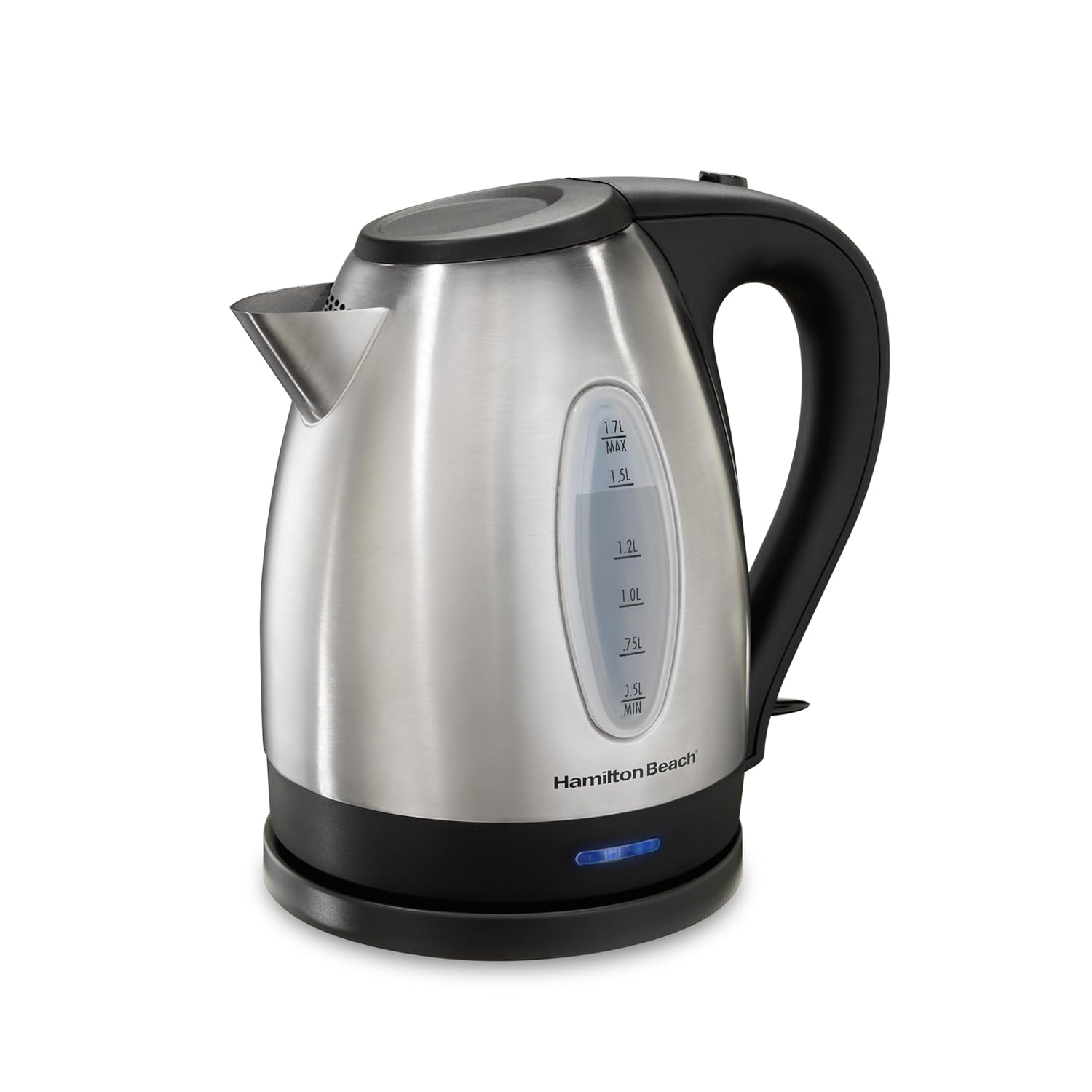
If you’re worried about dropping a glass kettle, the Hamilton Beach stainless steel model is your solution. This thing feels built to survive a minor kitchen earthquake. The stainless steel body is thick and won’t shatter if it tips over.
It keeps water hot slightly longer than glass kettles too. I measured the temperature after five minutes, and the steel body retained about 5 degrees more heat than the glass models. That’s not a huge difference, but if you’re making multiple cups back-to-back, you’ll notice the second boil is faster.
The trade-off is visibility. There’s a small water level window, but it’s hard to read unless you’re looking straight at it. I found myself guessing how much water was inside more often than I’d like. The lid is plastic, which again introduces that taste concern, though it’s less noticeable here because the main body is steel.
Who this is for: Clumsy people, parents with young kids, or anyone who wants a kettle that can take a knock. The stainless steel construction is genuinely more durable than glass.
Who should skip it: People who want to see the water level clearly or prefer a completely plastic-free design.
The Newcomer: MUELLER HOME Rapid Boil

Check Price on Amazon
Specs at a glance:
- Capacity: 1.8 liters
- Wattage: 1500W
- Materials: Borosilicate glass body, stainless steel spout and filter
- Special features: Fully removable lid, blue LED, auto shut-off
The MUELLER HOME kettle is the newest model I tested, and it’s clearly trying to compete with the Cosori. It has the same borosilicate glass body, the same stainless steel water path, and an even larger 1.8-liter capacity. The fully removable lid is a nice touch that makes cleaning easier than the Cosori’s hinged design.
So why is it ranked lower? Track record. The Cosori has been out for years with thousands of people using it daily. The MUELLER is newer, and while my testing showed no issues, I can’t speak to its long-term durability yet. The stainless steel spout felt slightly thinner than the Cosori’s, and the lid seal didn’t feel quite as tight.
It’s a solid alternative if the Cosori is out of stock. The performance is nearly identical, and the larger capacity is welcome. But I’d want to see how it holds up after six months of daily use before giving it a higher recommendation.
Who this is for: Early adopters who want the largest capacity in a glass kettle. The 1.8 liters is genuinely useful for groups.
Who should skip it: Anyone who wants a proven track record. The Cosori is the safer bet until the MUELLER has been on the market longer.
Quick Comparison: The Cheat Sheet
| Product | Capacity | Wattage | Water Path | Best For |
|---|---|---|---|---|
| Cosori | 1.7L | 1500W | Glass + Steel (No plastic) | Best Overall |
| Chefman | 1.8L | 1500W | Glass (Plastic window) | Best Value (Largest) |
| Amazon Basics | 1.7L | 1500W | Glass (Plastic lid) | The Safe Bet |
| Elite Gourmet | 1.0L | 1100W | Glass | Small Kitchens |
| OVENTE | 1.7L | 1100W | Plastic | Cheapest Full-Size |
| Hamilton Beach | 1.7L | 1500W | Stainless Steel | Durability |
| MUELLER | 1.8L | 1500W | Glass + Steel | New Alternative |
How to Choose the Best Electric Tea Kettle Under $50
After testing all seven of these, I’ve learned that the decision comes down to three things. These aren’t complicated — they’re the filter I wish someone had given me before I bought my first cheap kettle.
Avoid plastic in the water path. This is the single most important factor for taste and peace of mind. Glass and stainless steel don’t leach flavors. Plastic does, even if it’s BPA-free. If you care about how your tea tastes, look for a kettle where only glass or steel touches the water. The Cosori is the only one on this list that achieves that completely.
Prioritize 1500W over lower wattage. The difference between three minutes and five minutes doesn’t sound like much until you’re standing there waiting for water to boil on a Tuesday morning. The 1500W models cost about the same as the 1100W ones, so there’s no reason to settle for slower unless you specifically need a smaller kettle.
Check the lid design. A wide mouth makes cleaning easy. A narrow mouth makes mineral buildup a nightmare. If you have hard water — and most of us do — you’ll need to descale your kettle regularly. Make sure you can reach inside to scrub.
Frequently Asked Questions
Can I leave water in an electric kettle overnight?
You can, but you shouldn’t. Standing water encourages mineral scale buildup and can develop a stale taste. I empty my kettle after each use and let it air dry with the lid open. It takes two seconds and prevents the need for frequent descaling.
Do these kettles work for pour-over coffee?
Not really. Pour-over coffee requires a gooseneck spout for precise control over water flow. None of the kettles on this list have that. They’re designed for tea, French press, instant coffee, oatmeal, and ramen. If you need a gooseneck, you’ll need to spend more than $50.
How do I clean mineral deposits from my kettle?
Fill the kettle halfway with equal parts water and white vinegar. Boil it, then let it sit for 20 minutes. Pour it out, rinse thoroughly, and boil plain water once more to remove any vinegar taste. I do this once a month. For stubborn deposits, use a bottle brush on the interior.
Is a glass kettle better than stainless steel?
It depends on your priorities. Glass lets you see the water level and boiling action, and it doesn’t retain flavors. Stainless steel is more durable and won’t shatter if dropped. Both are better than plastic. I prefer glass for visibility, but the Hamilton Beach steel model is a solid choice if durability is your main concern.
Final Verdict
After two weeks of testing, the Cosori Electric Kettle is the clear winner. It’s the only kettle under $50 that keeps plastic completely away from your water, and it backs that up with fast boiling, reliable safety features, and a build quality that feels more expensive than it is.
If you’re on the tightest possible budget and just need hot water, the OVENTE will get the job done. But spend the little extra on the Cosori. Your tea will taste better, and you won’t be shopping for a replacement in six months.

