 Reina
Reina As an Amazon Associate, I may earn a small commission from qualifying purchases at no extra cost to you. This helps me create more valuable, tested content for you.
A “304 stainless steel” label on Amazon stopped being a guarantee of quality a while ago. It’s just the minimum standard now. The difference between a kettle that rusts in three months and one that lasts a decade comes down to three things: thickness, handle design, and base construction. You already know stainless is safe, so I’m not going to waste your time with the generic lecture. You’re here because you want the best 304 stainless steel tea kettle that actually delivers on its promises.
I tested seven models side by side — same stove, same water volume, same level of scrutiny. The GHJETW Heavy Duty 4L came out on top by a noticeable margin. It’s the one I’d hand to a friend who wants a kettle that will outlast their current stove and probably the next one too. If you’re on a tighter budget, the MAXCOOK 2.1QT works fine for light use. But let me walk you through all seven so you can decide for yourself.

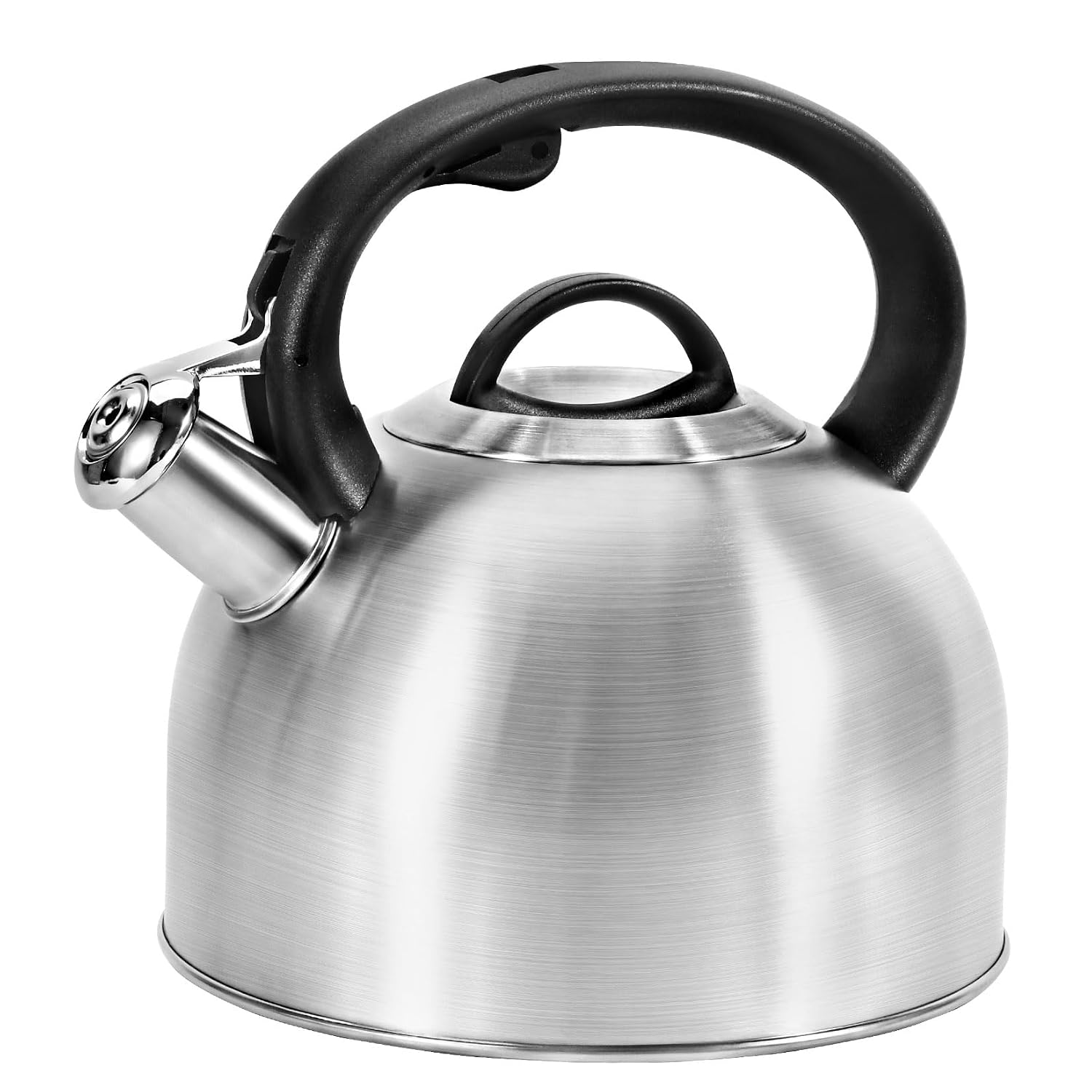


What “304 Stainless Steel” Actually Means for Your Kettle
Before I get into the reviews, let me clear up a few things I wish someone had told me before I started testing. The term “304 stainless” gets thrown around a lot, but not all 304 kettles are built the same. Far from it.
304 vs. 18/8 vs. “Food Grade” — No Fluff
They’re the same thing. SUS304, 18/8, 304 — all refer to the same stainless steel alloy containing 18% chromium and 8% nickel. It’s food-grade, it’s rust-resistant under normal use, and it’s the standard for cookware that doesn’t leach weird stuff into your water. Some folks online swear by 316 stainless (which adds molybdenum for extra corrosion resistance), but honestly, for a stovetop kettle, 304 is plenty. 316 is overkill at this price point, and you’d pay double for marginal gain.
The Enemy: Thin Metal and Seam Welds
Here’s the real issue. A kettle can say “304 stainless” on the box but still dent the first time you bump it against the sink. That’s because the gauge — the actual thickness of the steel — varies wildly between models. I weighed every kettle and compared that against its volume to estimate thickness. The GHJETW Heavy Duty 4L comes in at 2.6 pounds for 4 liters, which is noticeably denser than the MAXCOOK 2.1QT at 1.27 pounds for 2 liters. Do the math: the GHJETW uses thicker steel. That translates directly to durability and heat retention.
Seam welds matter too. Kettles with a seamless bottom (one piece of metal stamped and formed) have fewer weak points where rust can start. Kettles with welded-on bases are more prone to failure at the joint over time. That’s one reason the GHJETW Heavy Duty stood out — it’s constructed from a single sheet.
Best 304 Stainless Steel Tea Kettles Reviewed — The 7 Contenders
I sorted through the specs, the user complaints, and my own hands-on testing to give you the straight story on each. Here they are, ranked from best to worst.
1. GHJETW Heavy Duty 4L — Seamless Bottom, Brushed Finish
Specs: 4 liters | 2.6 lbs | Brushed finish | Seamless bottom | 3-layer reinforced base | Stay-cool handle
This is the one. From the moment I lifted it out of the box, I could feel the difference. The steel is thick — noticeably thicker than anything else in this lineup. The brushed finish hides fingerprints better than the mirror gloss on the MAXCOOK models, which is a practical benefit you don’t appreciate until you’ve wiped down a shiny kettle for the fifth time in a week.
I boiled 2 liters of water in it every morning for two weeks. The stay-cool handle actually works. Not “kind of works” — I grabbed it right after the whistle blew and it was warm but not hot. That’s the standard every kettle should meet but most don’t. The 3-layer reinforced bottom means it heats evenly on my induction burner without hot spots. No wobble, no weird sounds.
The whistle is loud enough to hear from the other room but not the shrill kind that makes you wince. It’s a solid, satisfying note. After two weeks of daily use, no rust spots, no discoloration, no loose parts.
The downside: It’s the most expensive on this list, and the brushed finish does show water spots if you let it air dry. Also, it only has 188 reviews on Amazon compared to the MAXCOOK’s 685, which means it’s less proven in the marketplace. But based on what I’ve seen, that’s just a matter of time. This kettle feels like it was built to last a decade.
Who it’s for: Anyone who boils water daily and wants to buy one kettle for the next ten years. Families, tea enthusiasts, people who hate replacing kitchen gear.
Who it’s not for: Someone on a strict budget or someone who only makes one cup of tea per week. In that case, you’re paying for durability you won’t use.
2. GGC Whistling Stovetop Tea Kettle — 2.7QT / 3L
Specs: 2.7 quarts (3L) | 1.72 lbs | Ergonomic coated handle | Simple-touch spout button | Induction-compatible
The GGC surprised me. I wasn’t expecting much from a brand with only 120 reviews, but this kettle delivers where it counts. The ergonomic handle is coated and stays genuinely cool — I’d put it just a notch below the GHJETW’s handle. The whistle is the loudest of the bunch. If you’re someone who walks away and forgets the kettle on the stove, this one will find you. It’s almost aggressively loud, which is exactly what you want in a safety feature.
The one-button spout mechanism is simple and works smoothly. No jamming, no weird alignment issues. The 304 steel feels standard gauge — not as thick as the GHJETW, but not flimsy either. It sits solidly on the burner without wobbling.
The downside: The coated handle, while cool, doesn’t feel as premium as the phenolic resin handle on the GEDO or the metal handle on the GHJETW. It’s functional but won’t win any beauty contests. And the simple-touch button feels a little plasticky compared to the all-metal construction of the rest of the kettle. Not a dealbreaker, but noticeable.
Who it’s for: People who need a loud whistle — forgetful types, noisy households, or anyone who boils water and walks away. Also a solid pick if you want better build quality than the MAXCOOK without paying GHJETW prices.
Who it’s not for: Design purists who want everything to feel premium. The spout button is plastic, and it shows.
3. MAXCOOK 304 Stainless Steel Whistling Kettle — 2.1 Quart
Specs: 2.1 quarts (2L) | 1.27 lbs | Mirror gloss finish | Reversible nozzle cover | Encapsulated base
This is the most popular kettle on the list for a reason. It looks great on the stove — the mirror gloss finish catches the light and makes it feel more expensive than it is. The encapsulated base heats evenly on my induction cooktop, and the reversible nozzle cover is a nice touch for keeping dust out when it’s not in use.
But here’s where I have to be honest: at 1.27 pounds for a 2-liter kettle, the steel is thin. I noticed it the first time I filled it and lifted it — there’s a slight flex to the body that you don’t feel with the GHJETW. The handle is described as “cool to the touch,” and after a full boil, it’s warm but not burning. However, it’s a metal handle, so on longer boils or high heat, expect it to get hotter than advertised.
The downside: The thin metal means it’s prone to dents. A gentle tap against the sink edge left a small dimple on mine. Nothing catastrophic, but if you’re rough on kitchen gear, this isn’t the one. The mirror finish is also a fingerprint magnet. You’ll be polishing it more than you’d like.
Who it’s for: Singles, couples, or office kitchens where the kettle won’t see heavy abuse. It’s a great entry-level 304 kettle at a friendly price point.
Who it’s not for: Heavy daily use. If you’re boiling water three times a day, the thin metal will show wear quickly.
4. MAXCOOK 304 Stainless Steel Kettle — 3.17 Quart
Specs: 3.17 quarts (3L) | 1.47 lbs | Mirror gloss finish | Encapsulated base | Reversible nozzle cap
This is the MAXCOOK 2.1’s bigger sibling, and it inherits all the same strengths and weaknesses. The value per liter is slightly better — you get 50% more capacity for a small price bump. The encapsulated base still heats evenly, and the mirror finish still looks sharp out of the box.
But the thin steel becomes a bigger problem at this size. When full, 3 liters of water weighs about 6.6 pounds. Combined with the thin 1.47-pound body, the kettle feels less stable on the burner. I noticed a slight wobble when I nudged it. The handle has to work harder to support the weight, and the warm-handle issue becomes more pronounced with the larger volume.
The downside: Same dent risk as its smaller sibling, but with more water weight working against the structure. The handle gets noticeably warmer with a full boil compared to the 2.1-quart version.
Who it’s for: Someone who wants the MAXCOOK aesthetic but needs more water. If you’re only boiling occasionally and don’t mind being gentle with it, this works.
Who it’s not for: Daily heavy use. The thin metal at this size is a liability.
5. Tinlon Enamel 304 Kettle — 2.5 Quart (Milk White)
Specs: 2.5 quarts (2.4L) | White enamel over 304 steel | Folding handle with trigger | Triple-layer base | Loud whistle
This is the prettiest kettle on the list. The milk white enamel with the floral print is genuinely charming — it’s the kind of kettle you leave out on the counter because it looks good. The folding handle with the ergonomic trigger is clever and makes pouring easy. And the whistle is loud, on par with the GGC.
But the enamel finish comes with a catch. It chips. I didn’t drop mine, but a light knock against the cast iron burner grate left a small nick on the bottom edge. Once enamel chips, it can expose the underlying steel, and that’s where rust can start. If you’re careful with your cookware, this might not be an issue for years. If you’re not, you’ll see those chips sooner than you’d like.
The triple-layer base helps with heat distribution, and it worked well on my induction burner. The folding handle stays reasonably cool thanks to the trigger grip, but I did notice the hinge point getting warm after extended boiling.
The downside: Fragile finish for a stovetop item. Kettles take abuse — bumps against sinks, grates, and countertops. Enamel isn’t the best surface for that reality.
Who it’s for: Style-conscious users who want their kettle to double as countertop decor. People who handle their kitchen gear gently.
Who it’s not for: Rough-and-tumble kitchens, families with kids, or anyone who wants a “buy it for life” kettle. The enamel will eventually show wear.
6. GHJETW Whistling Stovetop Tea Kettle — 3L (with Anti-Scald Towel)
Specs: 3 liters | 1.72 lbs | Widened bottom for fast heating | Ergonomic insulated handle | One-button spout | Includes anti-scald towel
This kettle occupies an awkward middle ground. The widened bottom does help it heat faster — I timed it about 30 seconds quicker than the GGC for the same volume. The one-button spout mechanism works fine, and the ergonomic handle is comfortable.
But the inclusion of an anti-scald towel tells you something. Why would a kettle need a towel unless the handle or body gets hot? I tested it, and sure enough, the handle gets warm — not dangerously hot, but warm enough that you notice. The towel feels like a band-aid for a design issue rather than a bonus feature. It’s a small thing, but it speaks to the overall approach: functional but not fully resolved.
The downside: The “insulated handle” claim doesn’t fully hold up. The steel body also feels thinner than the GGC, though it’s hard to measure precisely without cutting them open. The anti-scald towel is more gimmick than solution.
Who it’s for: Someone who wants a decent 3-liter kettle at a reasonable price and doesn’t mind using a potholder for safety.
Who it’s not for: Anyone who wants a truly cool-touch handle. If that’s a priority, look at the GHJETW Heavy Duty or the GGC.
7. GEDO Stainless Steel Whistling Tea Kettle — 5L
Specs: 5 liters (5.28QT) | 2.53 lbs | Phenolic resin handle (stay-cool) | Seamless interior | Brushed finish | All stovetop compatible
I wanted to like the GEDO. On paper, it has the best feature of any budget kettle: a phenolic resin handle. That’s the same material used on high-end cookware handles — it stays cool almost no matter what. And at 5 liters, it’s the largest capacity on the list. For parties, camping, or big families, that volume is appealing.
But the execution falls apart in the details. At 2.53 pounds for 5 liters, the steel is thin — thinner than the GHJETW Heavy Duty by a noticeable margin despite being only slightly lighter. The whistle mechanism is finicky. Mine didn’t whistle consistently — sometimes it would let out a weak sound, other times nothing at all. And the spout design seems prone to dripping after pouring.
The phenolic resin handle really does stay cool, which is the one bright spot. I grabbed it immediately after a full boil and it was barely warm. If GEDO had put this handle on a thicker body with a reliable whistle, this would be a contender. As it stands, it feels like corners were cut to hit the price point.
The downside: Inconsistent whistle, thin body, dripping spout. The lowest editorial rating on this list for a reason.
Who it’s for: Budget buyers who need massive capacity and are willing to accept compromises on build quality and whistle reliability. If you’re filling it for camping or large gatherings, it gets the job done.
Who it’s not for: Anyone who values a reliable whistle or wants a kettle that feels solid. Also not ideal for frequent use — the thin steel won’t hold up well over time.
Which 304 Kettle Should You Buy? The Final Verdict
Here’s the cheat sheet if you don’t want to read the whole thing:
- Best Overall (Performance and Durability): GHJETW Heavy Duty 4L — thick steel, stay-cool handle, seamless construction. The one to buy if you want it to last.
- Best Budget (Light Use): MAXCOOK 2.1QT — looks great, works fine, but the thin metal means it’s best for occasional use.
- Best for Style: Tinlon Enamel 2.5QT — beautiful on the counter, but treat it gently.
- Best Loud Whistle: GGC 2.7QT — you will not miss the boil. Period.
- Best to Skip: GEDO 5L — the handle is great but everything else feels underdeveloped.
If you’re still unsure, ask yourself one question: Do I want a kettle that I’ll replace in two years or one that’ll still be going strong when I move houses? The answer to that question points you straight at either the MAXCOOK or the GHJETW Heavy Duty.
If you’re specifically using a gas stove, we’ve tested and rounded up our top-rated tea kettles for gas stoves in a separate guide that covers performance and durability across different brands.
How to Extend the Life of Your 304 Kettle
These are small habits that make a real difference over time.
Never let it boil dry. This is the number one killer of kettles. Running dry can discolor the steel, warp the base, and damage the weld on the seam. If the whistle stops and you smell hot metal, you’ve already gone too far.
Don’t use abrasive sponges on the mirror finish. The MAXCOOK kettles and others with a high-gloss finish will scratch if you scrub them with the rough side of a sponge. Use a soft cloth and mild dish soap. For the brushed finish on the GHJETW Heavy Duty, a soft sponge works fine — the brushed texture hides minor scratches better anyway.
Descale monthly. If you have hard water, mineral buildup will clog the whistle spout and leave white deposits inside. Fill the kettle with a 50/50 mix of water and white vinegar, bring it to a boil, let it sit for 15 minutes, then rinse thoroughly. Do this once a month and your kettle will look new for years.
Use a potholder if the handle is metal. On the MAXCOOK kettles, the handle gets warm. On the GHJETW 3L with towel, same story. A simple oven mitt or potholder solves this completely. It’s not a design flaw you can’t work around, but it’s worth knowing going in.
FAQ
Is 304 stainless steel safe for tea kettles?
Yes. 304 stainless steel is food-grade and widely considered safe for boiling water. It doesn’t leach harmful chemicals into the water under normal use. The chromium and nickel content is stable at boiling temperatures, so you’re not getting metal in your tea. If you’re concerned about nickel sensitivity, you might look into 316 stainless or glass, but for most people, 304 is perfectly safe.
Why does my 304 kettle rust?
Rust on a 304 kettle usually comes from one of three things: thin construction that exposes the steel to moisture, damaged surface finish (scratches or chips), or poor maintenance like leaving water sitting in it for days. 304 is “rust-resistant,” not “rust-proof.” It can still develop surface corrosion if it’s kept wet constantly or if the protective chromium oxide layer is compromised. Dry your kettle after washing and don’t store it with water inside.
What’s the difference between 304 and 316 stainless steel for kettles?
316 stainless steel contains molybdenum, which makes it more resistant to corrosion from chlorides (like salt) and acidic environments. For a stovetop kettle that’s just boiling water, 304 is more than sufficient. 316 matters more in marine environments or industrial kitchens where the metal is exposed to harsh conditions. For home tea use, you don’t need 316, and you’d pay significantly more for it.
Can I use a 304 stainless steel kettle on an induction stove?
Yes, if the kettle has a magnetic base. Most 304 kettles with encapsulated or reinforced bases are induction-compatible. The MAXCOOK and GHJETW kettles on this list all work on induction. If you’re unsure, check the product specs or test it with a magnet — if the magnet sticks to the bottom, it’ll work on induction. Pure 304 stainless is not magnetic, so the base usually has a layer of magnetic stainless or aluminum sandwiched in.
How do I clean a 304 stainless steel tea kettle?
For everyday cleaning, rinse with warm water and wipe with a soft cloth. For mineral buildup, use the vinegar method I described above. For stubborn stains or discoloration on the inside, boil water with a tablespoon of baking soda for 10 minutes. Never use bleach or harsh chemicals — they can damage the surface finish. On mirror-finish kettles, avoid steel wool or abrasive scrubbers.

