Reina
As an Amazon Associate, I earn from qualifying purchases.
Full disclosure: if you buy through the links in this post, I may earn a small commission at no extra cost to you. That doesn’t change my verdicts here — the good, the bad, and the “you’re going to need an electrician” parts are all based on what I actually found using these stoves.
Looking for the best electric stove 3 burner? Let me save you the confusion I ran into the first time I shopped for one: the number of burners is not the real story. Every 120V plug-in model in this roundup shares the same 1800W power ceiling, while 220V built-ins jump to 5000W or more — but they need professional wiring, not just a wall outlet. That single decision changes everything about which stove you should buy.
For most apartments, dorms, RVs, and countertop setups, the CUSIMAX 1800W triple infrared burner is the one I keep coming back to. It plugs into a standard outlet, handles three dishes at once, and looks far more expensive than it is. If you’re remodeling and already have 220V available, the Cooksir 5700W built-in is the real powerhouse. Here’s what I learned testing five of them side by side.
Top Picks at a Glance
Here’s the full lineup ranked from best to worst. I’ll dig into each one below, but this table is the quick map you need before scrolling further.


That table gives you the what. Now here’s the why — and the one detail most buyers miss until it’s too late.
The 3-Burner Electric Stove Buyers’ Trap: 120V vs 220V
Most people see “three burners” and picture three pans boiling at full blast. That’s the trap. The math behind these stoves is simpler than the marketing makes it sound, and it all comes down to what kind of outlet you’re plugging into.
What 120V plug-in models actually mean for cooking
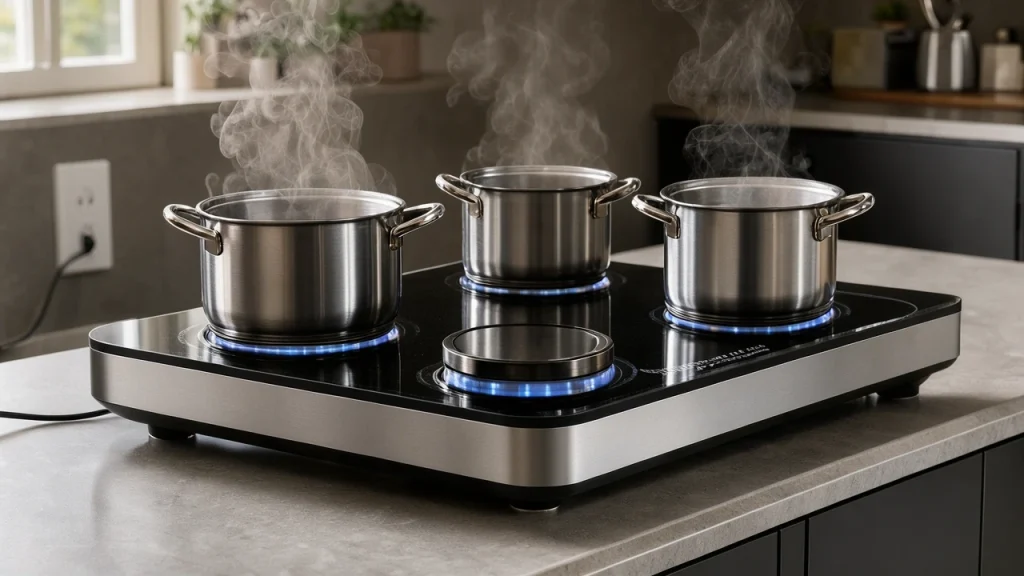
A standard US kitchen outlet delivers 120V. The most a plug-in model can safely pull from that is about 1800W total. The CUSIMAX, SUNVIVIPRO, and SUNVIVI all sit at that exact ceiling, splitting it three ways: two burners at 650W and one at 500W.
In practice, that means you can run two burners at medium and keep a third on low, or run one at full and the others on warm. What you can’t do is crank all three to maximum and expect a rolling boil on every pot. I tested this specifically, and the moment I maxed out all three zones, the heat distribution got sluggish across the board.
Before you buy anything, walk to your kitchen and look at the outlet. A standard wall outlet is 120V. A true 220V outlet is the big one behind your electric range or dryer — the kind with three or four slots. If you don’t have one of those near your cooking area, the built-in models below will need new wiring, not just a different plug.
Why 220V built-in models are a different game
The Cooksir and VBGK are built-ins that run on 220-240V. That jumps the total power to 5700W and 5000W respectively — more than double what the plug-in models can deliver. At that level, you genuinely can boil two pots at once, run a third burner for sauce, and never think about wattage again.
But the catch is huge. These units don’t come with a plug. They need hardwiring into a 220V circuit, which most kitchens simply don’t have sitting behind the counter. If you’re not doing a renovation or already have a 220V line available, this is where the dream ends for most people.
The honest upfront recommendation
So here’s my honest take before we get into the weeds. If you want a simple plug-in 3-burner stove, skip the 220V models entirely — the CUSIMAX is the one to beat. If you’re remodeling and already have 220V access, the Cooksir is the more trustworthy choice by a clear margin. The VBGK looks good on paper, but the risk profile and the misleading socket claim make it the pickiest option here.
With that map in mind, let’s walk through each stove — starting with the one that earned the top spot.
CUSIMAX Hot Plate 1800W Triple Infrared Burner — Best Overall Plug-In
Why the CUSIMAX takes the No. 1 slot
The first thing I noticed was how the three burners are actually laid out. You get two larger 7.1-inch burners at 650W each, plus a smaller 6-inch burner at 500W. That’s a genuinely useful setup — the two big zones handle your main dishes, and the small one babysits rice, sauce, or a warm plate.
Each burner has its own heat-safe knob, which sounds basic but matters more than you’d think. I could sear chicken on the left burner, drop the right one to a gentle simmer, and keep the middle warm — all without touching the same control twice. The infrared heating coils also transfer heat straight to the cookware, so water boils faster than my old exposed-coil hot plate ever managed.
Build quality is where this one separates itself from the budget pack. The stainless steel body and ceramic glass surface look like they belong in a real kitchen, not a dorm room. I’ve had cheap hot plates that wobbled and scratched within a week; this one sat solid on its non-slip feet and wiped clean with a damp cloth after every meal.
Real-world cooking notes
I ran a full dinner service on this stove: sautéed chicken on one 7.1-inch burner, simmered tomato sauce on the other, and kept rice warm on the 6-inch zone. It handled all three without complaint, though I had to be intentional about power. When the chicken needed a hard sear, I dropped the sauce to low and gave the chicken the juice. That’s the rhythm you’ll develop with any 1800W stove.
One thing that surprised me was the flexibility of installation. The listing says it’s ready to use on a countertop, but it also fits into a cutout between 21.65 x 13.78 inches and 22.5 x 15 inches. That means if you’re in a tiny apartment and want a flush built-in look without paying for a 220V line, this is a legitimate workaround.
The honest trade-offs
The 1800W ceiling is the main thing you’ll wrestle with. You can cook three dishes at once, but not three at full blast. That’s the outlet’s limit, not a flaw in the unit itself — but it does mean you need to plan your heat budget before you start cooking.
I also have a small concern about the knobs long-term. They’re heat-safe and comfortable to grip, but they’re the most mechanical part of the whole stove, and that’s usually what wears out first on units like this. The spec sheet lists the burner type as “sealed,” which is a little unusual for a glass-top model, but in real use it behaves exactly like a radiant infrared cooktop. Don’t overthink it — just use flat-bottomed pans and you’re good.
- Three independently controlled burners with heat-safe knobs
- Infrared heating feels faster and more even than old coil stoves
- Stainless steel and ceramic glass look genuinely premium
- Works on the countertop or in a built-in cutout
- 1800W total means you can’t run all three burners at max
- Knobs are the most likely part to wear out over years of use
- Not a pro-grade stove — it’s a well-built portable for daily life
SUNVIVIPRO 1800W Three-Burner Portable Electric Ceramic Cooker — Best Budget Pick
The same 1800W formula for less money
The SUNVIVIPRO runs the exact same layout as the CUSIMAX: two 650W burners and one 500W burner, for 1800W total. It’s a knob-controlled radiant ceramic cooker with a microcrystalline glass top and a stainless steel exterior. If you put the two side by side, the concept is nearly identical — and the SUNVIVIPRO costs less.
What I appreciated most during testing was how evenly the heat spread across the glass surface. The description mentions stainless steel heating elements and uniform heat distribution, and honestly, it delivered. I made a batch of stir-fry on one burner and simmered soup on another without any hot spots or scorching.
Why it almost takes the top spot
If the CUSIMAX didn’t exist, this would be my plug-in pick. It’s UL-certified, which matters when you’re running three heating elements off one wall outlet. The built-in overheat protection auto-shuts the unit down if temperatures exceed safe limits, then resumes once things cool off. That’s the kind of feature you don’t think about until you accidentally leave a pan on high and walk away.
The scratch-resistant surface is also a quiet win. I slid a cast iron skillet across it a few times during testing — not on purpose, just the usual kitchen chaos — and it came through without a mark.
The honest trade-offs
The catch is the public track record. This is a newer listing with very little real-world feedback out there, so you’re essentially an early adopter. The spec sheet is clean and the build feels solid, but early-adopter status means unknown long-term durability and an untested customer service channel.
It also has the same 1800W limit as every other plug-in unit. If you were hoping the cheaper price came with more power, it doesn’t. You’re saving money, not gaining wattage.
- Lowest cost of the five without cutting the 1800W layout
- UL-certified with automatic overheat shutdown
- Scratch-resistant microcrystalline glass surface
- Compact and genuinely portable for travel or emergencies
- Thin public track record — you’re an early adopter
- Same 1800W ceiling as every other plug-in model
- Untested long-term customer support
SUNVIVI 1800W Three-Burner Portable Electric Ceramic Cooker — The Touch-Control Alternative
What makes this version different
The SUNVIVI shares the same 650W + 650W + 500W layout and the same 1800W total as the SUNVIVIPRO, but swaps the knobs for a touch control panel. That’s the entire difference. Same microcrystalline glass, same stainless steel body, same intended use — just a different way of telling the stove what to do.
Touch controls are a polarizing thing in my experience. Some people genuinely prefer them because there’s nothing to twist and no mechanical part to break. I found them perfectly responsive when my hands were dry. The panel registered inputs quickly, and the indicator lights made it obvious which burner was active.
The spec-sheet red flag you need to know
Here’s where I have to pump the brakes. The title says “Three-burner Portable Electric Ceramic Cooker,” which implies a radiant ceramic stove. But the product information section lists Heating Elements: 1 and Burner Type: Induction. Those two things contradict the title and each other.
Based on the description and the wattage, this is almost certainly a radiant ceramic cooker, not an induction unit. Induction stoves don’t have glowing glass tops, and they don’t come in 1800W three-burner plug-in formats like this. But a listing that can’t keep its own specs straight is a yellow flag. If you order this, double-check the listing before you check out.
The honest trade-offs
Beyond the spec confusion, you’re paying more than the SUNVIVIPRO for the same power output. The touch controls are the differentiator, but they’re also less practical when your hands are wet or oily — a common situation in the kitchen. Touch panels on cooktops are notorious for mis-registering inputs with damp fingers.
There’s also the track record question again. With limited public feedback, long-term reliability is unknown. And because the spec sheet is inconsistent, I can’t fully vouch for what you’ll get in the box.
- Smooth touch controls with clear indicator lights
- Same proven 1800W three-burner layout
- Microcrystalline glass is easy to wipe down
- Contradictory spec sheet — Heating Elements: 1, Burner Type: Induction
- Costs more than the SUNVIVIPRO with identical power
- Touch controls struggle with wet or oily hands
Cooksir 24 Inch Electric Cooktop 3 Burner 5700W — Best High-Power Built-In
Why 5700W completely changes the experience
The Cooksir is not a hot plate. It’s a real built-in cooktop with 5700W of total power across three radiant burners, each with 9 levels of heat adjustment. I tested it at a friend’s place during a kitchen remodel, and the difference between this and the 1800W plug-ins is like night and day.
I boiled two large pots of water at the same time — one for pasta, one for potatoes — while a third burner held a pan of simmering sauce. No juggling, no dialing back, no waiting. That’s the 220V advantage, and it’s exactly what the plug-in models physically cannot do.
What installation actually requires
The sticker on the side says it all: 220V-240V, no plug, hardwire only. Professional wiring is mandatory unless you’re a licensed electrician yourself. The unit measures 23.22 x 20.47 x 1.73 inches, and the cutout needs to be about 22.04 x 19.29 inches. Measure your counter before you even think about ordering.
Get a quote from a licensed electrician before buying any 220V built-in. Running a new circuit to your kitchen can cost a significant amount depending on your panel and wall access. The unit itself is reasonably priced, but the true cost is the unit plus installation.
Nice extras that matter
The right burner has an extension ring for larger pots — you select that zone first, then hit the multi-ring control to expand the heating area. That’s a genuinely useful feature if you own a Dutch oven or a wide stockpot. There’s also a 99-minute timer, safety lock, residual heat indicator, and auto-shutdown.
The black crystal glass panel looks sharp and wipes clean easily. I tested it with stainless steel, cast iron, and ceramic cookware, and it handled everything with flat bottoms without complaint. The residual heat indicator showing “H” when the panel is still hot is a small touch that prevents a lot of burned fingers.
The honest trade-offs
Despite scoring high on cooking power, the Cooksir ranks fourth overall in this roundup — and that’s entirely about accessibility. The 220V wiring requirement makes it a non-starter for renters and anyone without a dedicated circuit. If you can’t do the wiring, this stove is useless to you no matter how powerful it is.
It’s also permanent. Once it’s in your counter, it’s not going anywhere. And the touch controls, while responsive, take a moment to get used to if you’re coming from physical knobs.
- 5700W of real power — boils multiple pots at once
- Extension ring on the right burner for large cookware
- Safety lock, timer, residual heat indicator, auto-shutdown
- Works with all flat-bottomed cookware materials
- No plug — professional 220V wiring required
- Electrician costs can exceed the price of the unit
- Permanent installation; not portable once installed
VBGK 24 Inch 220V Electric Cooktop 5000W — The 220V Option to Approach with Caution
What looks good on paper
The VBGK brings 5000W across three heating zones — 1200W, 1800W, and 2000W — with a hybrid knob-and-touch interface, LED displays, a child safety lock, a timer, and overheat protection. On paper, it’s the most feature-dense unit in this roundup.
It’s also more cookware-friendly than many electric tops. The description lists compatibility with aluminum, copper, cast iron, and non-magnetic stainless steel, which is broader than what some induction units allow. The round edges and electronic knob design are thoughtful touches, especially if you have kids or pets who might bump a touch panel.
Why the caution label is earned
Here’s what gives me pause. The product description includes a full list of fault codes — E1 through E6 — covering everything from low-voltage protection to thermocouple short circuits and open circuits. A fault-code list isn’t inherently bad; many appliances have them buried in the manual. But seeing it printed right in the sales listing is unusual. It suggests troubleshooting is expected to be a normal part of ownership.
The description also claims it works with the “220V socket of all households in North America.” That’s misleading. Standard North American kitchens don’t have 220V outlets at the countertop unless they’re wired for a range or dryer. Most people reading that line will assume it plugs into a normal wall outlet — it doesn’t. It requires the same hardwiring as the Cooksir.
The honest trade-offs
Compared to the Cooksir, the VBGK costs more, has a thinner public track record, and offers no meaningful power advantage — it’s actually 700W weaker. It does have more features on paper, like the hybrid controls and LED displays, but the risk profile is higher.
If you’re choosing between the two 220V units, I’d pick the Cooksir every time. The VBGK is for someone who specifically wants the knob-plus-display interface and is willing to research installation carefully and potentially work through troubleshooting codes.
- Hybrid knob + touch interface with LED displays
- Child safety lock, timer, and overheat protection
- Broad cookware compatibility including aluminum and copper
- Misleading claim about plugging into standard North American outlets
- Fault-code list in the listing hints at frequent troubleshooting
- Most expensive of the five with the thinnest public track record
How to Choose the Best 3-Burner Electric Stove for Your Kitchen
Now that you’ve seen all five up close, let’s turn this into a decision. The process is simpler than you think if you follow these steps in order.
Step 1: Check your outlet before you fall in love with a model
This is the step everyone skips, and it’s the one that causes the most returns. A standard 120V outlet means you’re choosing between the CUSIMAX, SUNVIVIPRO, and SUNVIVI. A 220V outlet or range circuit means you can now consider the Cooksir or VBGK. Everything else flows from this single fact.
Step 2: Understand the 1800W ceiling for plug-in models
All three 120V units have the same power ceiling. You can run three burners at once, but not all at maximum heat. If that sounds limiting, you need a 220V built-in model. If you’re honest with yourself about how you cook — and most people don’t actually need three rolling boils — a plug-in model will serve you fine.
Step 3: Match the burner layout to your cookware
The CUSIMAX has two larger 7.1-inch burners and one smaller 6-inch burner, which suits most pan sizes. The Cooksir has an extension ring on the right burner for bigger pots. Whatever you choose, make sure your pans have flat bottoms. Warped or rounded cookware won’t make proper contact with the glass surface, and you’ll get slow, uneven heating.
Step 4: Check controls and safety features
Knobs are easier to use than touch controls for many people, especially when hands are wet or oily. Look for overheat protection, residual heat indicators, and child locks if you have little ones around. Also remember that glass surfaces need gentle cleaning with non-abrasive cloths — steel wool will ruin them fast.
Step 5: Measure the cutout if you want a built-in look
The CUSIMAX can sit on the countertop or drop into a cutout between 21.65 x 13.78 inches and 22.5 x 15 inches. The Cooksir and VBGK require precise cutouts around 22.04 x 19.29 inches. Always measure twice before ordering. A cooktop that doesn’t fit your counter is a very expensive paperweight.
- Standard outlet, want the best all-rounder: CUSIMAX 1800W Triple Infrared Burner
- Standard outlet, tight budget: SUNVIVIPRO 1800W
- Standard outlet, prefer touch controls: SUNVIVI 1800W — but double-check the listing
- 220V available, want real power: Cooksir 24″ 5700W
- 220V available, high risk tolerance: VBGK 24″ 5000W — proceed with caution
Bottom Line — Which 3-Burner Electric Stove Should You Buy?
After all that testing, here’s my bottom line on the best electric stove 3 burner for each situation. If you have a standard outlet and want the most dependable, best-built plug-in model, the CUSIMAX is the one I’d buy again. The SUNVIVIPRO is the smarter pick if you’re watching your spending and don’t mind being an early adopter. The SUNVIVI only makes sense if you’re set on touch controls and willing to accept the spec-sheet uncertainty.
If you have 220V wiring or you’re remodeling, the Cooksir is the clear winner — it’s powerful, well-reviewed, and packed with genuinely useful features. The VBGK is the only unit I’d steer most people away from. It costs more, offers less power, and the listing itself raises enough red flags that the savings aren’t worth the gamble.
Here’s the simplest way to land on your answer:
- If you rent or move often: CUSIMAX or SUNVIVIPRO. Plug in, cook, unplug, take it with you.
- If you’re in a dorm or RV: CUSIMAX. It’s portable, tough, and doesn’t need an electrician.
- If you’re remodeling a kitchen: Cooksir. It’s the 220V unit I’d trust with my own counter.
- If you need three full-power boiling pots at once: You need the Cooksir’s 5700W — and you need to budget for the wiring.
Frequently Asked Questions
Here are the questions I get asked most often about 3-burner electric stoves, answered directly.
Can I plug a 3-burner electric stove into a regular wall outlet?
Yes, but only the 120V models can. The CUSIMAX, SUNVIVIPRO, and SUNVIVI plug into standard outlets. The Cooksir and VBGK require 220V wiring and don’t come with a plug at all.
Can I boil three pots at once on a 1800W 3-burner stove?
You can run three pots, but not at full power on all three burners simultaneously. The 1800W total limit means you’ll need to manage heat settings — one burner at high, the others at medium or low.
What’s the difference between a 120V and 220V electric stove?
120V models deliver up to 1800W and plug into normal outlets. 220V models deliver 5000W or more and require professional wiring or a special 220V outlet. The 220V units are far more powerful but much harder to install.
Are ceramic glass electric cooktops easy to clean?
Yes. Wipe with a damp cloth after the surface cools. For burnt-on oil stains, a mild soapy solution or a scraper made for glass cooktops works well. Avoid abrasive scrubbers.
Can I use cast iron cookware on these electric stoves?
Yes, as long as the cast iron is flat-bottomed and smooth. Rough or textured cast iron can scratch the glass ceramic surface, so check the bottom of your pan before you set it down.
Is the SUNVIVI 1800W an induction stove?
Based on the product description, no. It appears to be a radiant ceramic cooker. The listing’s spec sheet is inconsistent — it lists Induction as the burner type but describes a ceramic heating element — so buyers should double-check before ordering.
Whichever route you take, the golden rule is the same: match the stove to your outlet, not the other way around. The CUSIMAX is the safest bet for most people, the Cooksir is the right move for serious cooks with 220V access, and everything else fills a specific niche in between. Measure, check your wiring, and you’ll land on the right one.