Reina
As an Amazon Associate, I earn from qualifying purchases.
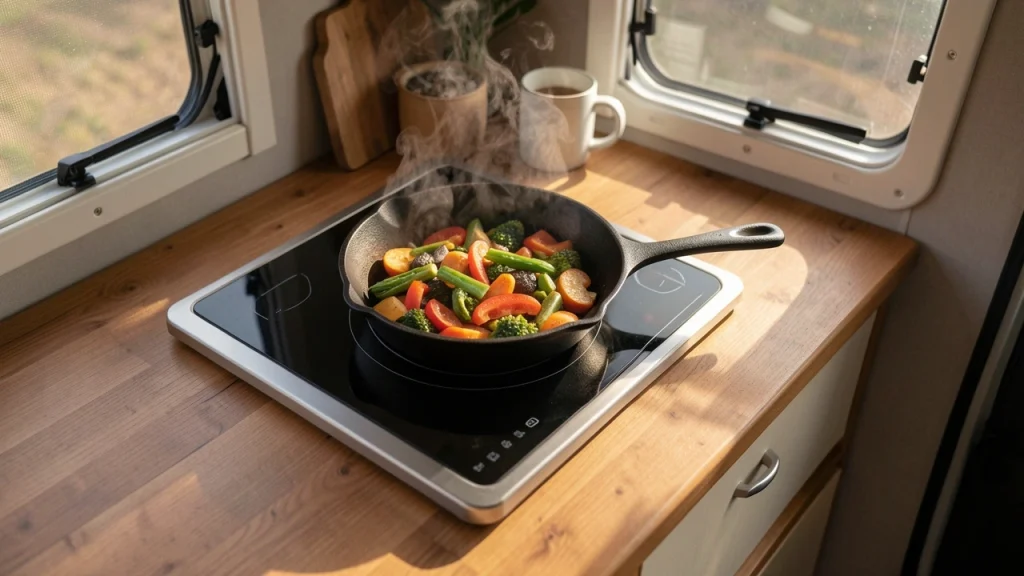
When I first searched for the best electric stove for van life, I figured the strongest burner would win and I’d move on. The reality was messier, and honestly, a lot more interesting. An electric cooktop is just another appliance at home — but inside a van, it’s the biggest draw your batteries will ever feed. That changes the entire decision.
So here’s the short answer up front: if you have a 200Ah+ lithium battery bank and a 2000W pure sine wave inverter, the Nuwave Pro Chef is the winner for most builds.
It offers 94 precise temperature settings and three wattage modes that let you manage your power draw, from gentle warming to serious searing. If you’re running a small electrical system, though, skip the high-power units and go with the Artilife 500W hot plate for coffee and light cooking instead.
Every one of these stoves has spent real time on my van countertop. I killed batteries, tripped inverters, burned a few meals, and took notes the whole way. The rankings below come from that experience — not from spec sheets.
Can Your Van’s Electrical System Handle an Electric Stove?
Before you think about burners, you need to think about electrons. In a van, electricity is a finite resource, and cooking is the most expensive thing you’ll do with it. Understand your battery limits first, and the right stove becomes obvious.
The First Question — Can Your Van Handle It?
Here’s the math that matters. Watts divided by volts equals amps. An 1800W cooktop running on a 120V circuit pulls about 15A from the outlet. But your batteries sit at 12V, so on the battery side of the inverter, that same stove is pulling close to 150A.
Let that sink in for a second. Thirty minutes of cooking at full power will drain roughly 75Ah from your battery bank. On a 100Ah lithium battery, that’s most of your usable capacity gone for a single meal. On a lead-acid battery, the voltage sag alone will probably shut your inverter down before the food is done.
Does that mean you need a warehouse of batteries? Not at all. Smaller stoves exist, and they solve real problems for smaller builds. But the point stands: your electrical system is the boss here, and every honest stove recommendation starts with that fact.
If you’re still mapping out your electrical system, it’s worth reading through a full van electrical build guide before you buy anything. The battery and inverter choice comes long before the cooktop.
Induction vs. Radiant vs. Low-Watt — The Real Difference
The phrase “electric stove” actually covers three very different technologies, and each one behaves differently inside a van.
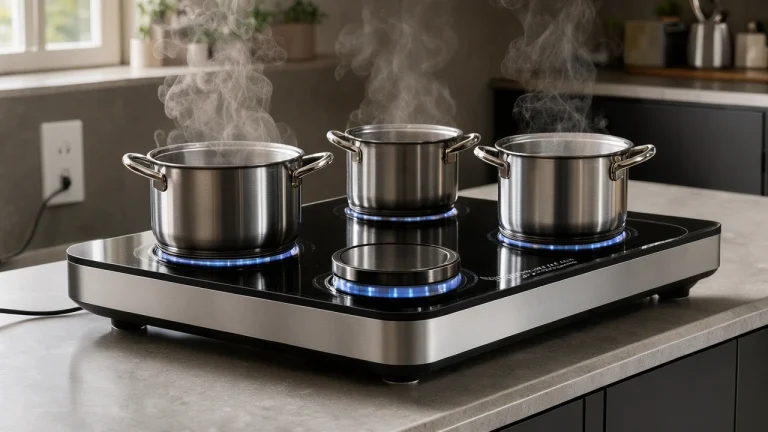
Induction uses a magnetic field to heat the pan directly. The glass surface stays cool while the pan gets hot. It’s fast — noticeably faster than radiant heat — and it converts about 85–90% of the energy into actual cooking heat.
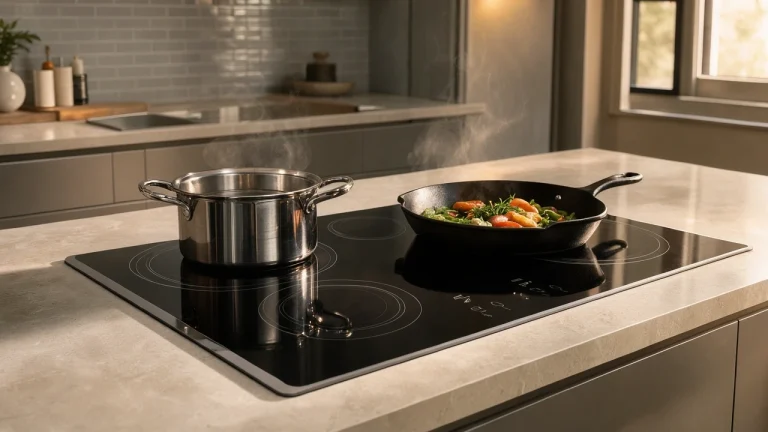
The catch is the magnet: induction only works with magnetic cookware. Cast iron, enameled steel, and magnetic stainless steel are in. Aluminum and glass are out. The magnet test takes two seconds: if a fridge magnet sticks to the bottom of the pan, induction will work.
Radiant (coil) cooktops work with absolutely any cookware — glass, ceramic, aluminum, you name it. The heating element glows beneath a glass surface, and the heat transfers up into the pan. That flexibility is wonderful. But radiant heat is less efficient, slower to boil, and the surface stays dangerously hot for a long time after you switch it off.
Low-wattage hot plates — the 500W class — are the coffee makers of the stove world. They draw almost nothing, run happily off a 600W+ power station, and handle small pots beautifully. They just can’t do high-heat cooking. Searing, stir-frying, and boiling a big pot of pasta are all outside their job description.
- Fast, 85–90% energy efficiency
- Cool glass while cooking
- Requires magnetic cookware
- Works with any cookware
- Slower, ~70% efficiency
- Glass stays hot after use
The Testing Criteria I Used
To keep things fair across three different stove technologies, I graded every model on the same five things:
- Power delivery and control — can it hold a gentle simmer without scorching, and can it hit real searing heat?
- Efficiency — how much of the energy actually ends up in the food, not the van’s air?
- Build quality — does it feel like it will survive daily life, vibration, and the occasional careless bump?
- Cookware compatibility — will it work with the pots and pans you already own?
- Van-life fit — size, portability, safety features, and flexibility across different power systems.
With that framework in place, here’s how the five contenders stacked up.
Top Picks at a Glance
Everything below is sorted from my #1 pick down to the specialist tools. The table gives you the highlight of each stove, and the detailed reviews after it dig into the messy, honest details.


The Best Electric Stoves for Van Life, Ranked
Each review below covers the same five criteria, with the good and the bad out in the open. I’ve ordered them from the stove I’d happily spend my own money on down to the one that only fits a very specific niche.
The Top Pick — Nuwave Pro Chef Induction Cooktop
The first time I fired up the Nuwave Pro Chef, what got me wasn’t subtle. I set a pot of water on it, picked 1800W, and within a couple of minutes the water was rolling hard. I’ve boiled water on plenty of conventional hobs over the years, and few of them kept up with this.
But speed is only half the story. The temperature range is the real headline. The Pro Chef offers 94 pre-programmed temperatures, spanning 100°F to 575°F in 5°F steps. I kept chocolate at 110°F one afternoon for dipping fruit — it sat glossy and liquid for an hour without ever scorching.
Then, later that same week, I pushed it to 575°F and seared a steak with the kind of crust I normally only get from cast iron over a proper flame.
That range matters more in a van than you’d think. You’re not just boiling pasta — you’re warming tortillas, keeping soup at eating temperature, simmering sauces slowly, and sometimes you just want a gloriously aggressive sear. This is the only portable unit in my test that handled all of it convincingly.
For van lifers specifically, the power selector is the feature that sealed the deal for me. Instead of one fixed draw, you can run the burner at 900W, 1500W, or 1800W. During my testing, I cooked off a 1500W inverter by simply switching the unit to its middle mode. And late at night when my battery bank was getting low, the 900W setting let me simmer a pot of tea without tripping anything. No other induction burner in this bunch gave me that kind of load management.
The build backs up the positioning, too. The shatter-proof ceramic glass top took a few rough gravel-road days with pans sliding around, and it never so much as scuffed. The lightweight frame means I can tuck it under the bench seat between meals. Nuwave markets it for RVs, campsites, and smaller apartments, and after testing, I can confirm that’s exactly the right call.
Now the honest catch — and it’s a real one. Induction cooking only works with magnetic cookware. I had to retire a favorite aluminum-core nonstick pan because it just sat there cold on the glass. Do the fridge magnet test on everything you own before you commit. If the magnet sticks, you’re fine. If it doesn’t, that pan won’t get hot on this stove, period.
The other small annoyances: the touch panel gets a little finicky with wet or dirty fingers, and if you plan to run it at full 1800W, you genuinely need a 2000W inverter behind it. On paper those sound minor. In practice, the inverter requirement is the one to respect.
To see how my testing scores played out across the five criteria, here’s the full breakdown.
- The entire range from warm to sear
- Adjustable wattage saves you when power is short
- Compact, light, and genuinely tough
- Magnetic cookware only
- Full power needs a 2000W inverter
- Touch panel prefers dry, clean fingers
Run a fridge magnet along the bottom of every pot and pan you own. If it clings, induction will work. If you feel nothing, that pan won’t get hot on this stove or any other induction unit.
The Budget Champion — Duxtop 1800W Portable Induction Cooktop
If the Nuwave is the sports car, the Duxtop is the work truck. It’s been the default budget induction burner for years, and after living with it on the road, I completely understand the reputation. It simply does its job.
You get 15 power levels from 200W to 1800W and 15 temperature settings from 140°F to 460°F. That’s a lot of control for the money. I simmered a pot of chili at power 3 for most of an afternoon, and it held a gentle bubble without sticking or scorching. The digital panel is old-school push-button, and I actually grew to like it — simple, legible, and easy to operate without staring at it.
The built-in timer became one of my favorite features on the road. It counts down in 1-minute steps, up to 170 minutes, and cuts the power when time runs out. I’d start a pot of rice, get pulled away by something else in the van, and come back to perfectly finished rice instead of a burnt mess. For scatterbrained cooks — which I absolutely am — that’s worth real money.
There’s also auto-pan detection at work here. If the unit doesn’t detect cookware for 60 seconds, it shuts itself off. I once switched it on with no pan on the surface while I grabbed ingredients from the back, and by the time I returned, it had powered itself down. In a tiny space full of distractions, that’s a meaningful safety net.
Now the trade-offs. The top temperature maxes out at 460°F, so you won’t get the dramatic 575°F sear the Nuwave delivers. Steak comes out good, not spectacular. It also pulls the full 1800W whenever you crank it to the top — there’s no reduced-wattage mode, so your inverter needs room to breathe.
One quirk worth mentioning before you buy: the product notes say that multi-clad cookware can produce a high-pitch sound, and I noticed a faint hum with a tri-ply stainless saucepan. It wasn’t a screech, and it didn’t bother me, but if you’re sensitive to electrical whines, you’ll want to use single-layer stainless or cast iron.
The gold finish also shows cosmetic scuffs over time. Mine earned a few marks from sliding in and out of cabinets. Purely cosmetic, but it’s part of the honest picture.
Here’s how it scored against my five testing criteria, side by side with the rest of the field.
- Excellent control for the cost
- Safety features that genuinely matter
- Lightweight and compact
- Lower max heat than the Nuwave
- Possible whine with multi-clad pans
- Gold finish shows scuffs
The Versatile Radiant Pick — Karinear 2-Burner Electric Cooktop
After testing induction cookers for a while, I was skeptical about returning to radiant heat. Then I set my glass tea kettle on the Karinear and remembered exactly why radiant still belongs in a van. No magnet test. No cookware purge. Anything with a flat bottom just works.
That flexibility is the core of this stove’s appeal. It’s compatible with glass, ceramic, iron, and stainless steel — and in my testing, all of them heated exactly the way you’d expect. Cast iron skillet? Great. Cheap non-stick pan? Great. Glass kettle? Also great. If I could only pick one stove for a household with mixed pans, this would be the one.
The dual burners are a legitimate advantage, too. A single induction burner is fine for one-pot meals, but the Karinear let me run pasta on one side and sautéed vegetables on the other, both at the same time. That’s the difference between cooking and actually making dinner in a van.
The controls took a second to learn. Each side has its own touch panel, and the two front rotary knobs fine-tune power or temperature across P0 to P9, or from 400°F to 1200°F. After a day of use, it became natural. The timer stretches to 240 minutes, which is generous for slow braises.
Safety is handled more thoroughly than I expected. There’s a child lock, an overheat protection system, and an “HOT” indicator that keeps flashing until the glass surface cools down. In a space the size of a van, that last one is not a gimmick.
But this stove has honest drawbacks. The glass surface gets extremely hot and stays hot for a long time after the burners are off. I nearly laid a towel over it minutes after lifting my pan — a mistake you only make once. Radiant heat is also slower than induction, and with each burner capped at 1600W, you don’t get the same raw boiling muscle. Add in the wide 22.2-inch footprint, and you need real counter tolerance to live with this one.
Curious how the slower-but-flexible radiant heat scored overall? Here’s the honest breakdown.
- Two burners at once
- Works with every pan you own
- Strong safety package
- Hot glass stays hot for ages
- Slower to boil than induction
- Wide footprint eats counter space
Unlike induction, this radiant surface stays burn-level hot for a long time after cooking. Give the glass a solid 20 minutes to cool before wiping it down or covering it with anything.
The Premium Option — Iwatani IWA-1800 Induction Burner
Iwatani has a legendary name in portable cooking, and the IWA-1800 carries it well. The stainless steel body is solid, with none of the hollow flex you feel on cheaper induction units. It’s the most sturdily built electric stove in this test, full stop.
Operating it feels deliberate. Instead of endless increments, you get 7 temperature settings and 9 power levels arranged through a digital touch panel. It’s a different control philosophy — fewer numbers, clearer decisions. I knew exactly which setting gave me a slow simmer and which one gave a strong boil. For someone who doesn’t want to babysit a display, that’s actually pleasant.
The safety engineering is the real standout, though. If the temperature of the pot gets too high and doesn’t drop within 60 seconds, the unit shuts off automatically with a short warning. There’s also an overtime detector: if a pot is left on or the unit goes unoperated for two hours, it powers itself down. When you’re in a tiny camper, those invisible layers of protection genuinely matter.
So why does it sit at #4? Because the delicious honesty of this test is that the Iwatani doesn’t cook meaningfully better than the Nuwave or the Duxtop. Searing, simmering, boiling — the results were comparable in my side-by-side tests. The Iwatani is tougher, yes, and the extras are nicer. But you pay a substantial premium for build quality that most van kitchens never fully use.
Think of it this way: for what the Iwatani costs, most van builders could upgrade their battery or add another solar panel. Both of those upgrades would improve daily life far more than a slightly stronger steel body. If money is no object and you want the last induction burner you’ll ever buy, this is a lovely object. For everyone else, the smarter spend sits further up this list.
For a unit this expensive, the scores need to justify the price tag. Here’s where it landed.
- Exceptional, tank-like build quality
- Serious automatic safety shutdowns
- Flat profile stores easily
- Big price tag for similar cooking results
- Same induction cookware limitation
- Touch panel can be finicky
If you’re comparing the Iwatani to the Nuwave or Duxtop, the difference will show up in longevity and feel — not in how your eggs taste.
The Low-Power Specialist — Artilife 500W Mini Hot Plate
Let’s set expectations before we start. This little unit is not a stove for cooking proper meals. It’s a specialist for low-power systems and small jobs — moka pot coffee, a mug of tea, a single serving of soup. Framed that way, it’s genuinely excellent at its job.
I used it almost daily for moka pot coffee. The 4-inch cast iron plate fits a stainless moka pot base neatly, as long as the base measures under 5 inches across. It also warmed a glass mug and a small non-stick pan without any issues. Just be patient at first — the plate needs one to two minutes to reach full temperature, so give it a proper preheat before you start.
The brain of this product is its draw. At just 500W, it runs fine off a 600W+ portable power station or a modest solar-powered system. No massive inverter, no giant lithium bank. For someone with a small electrical setup, this is the difference between drinking hot coffee at camp and drinking lukewarm instant coffee from a gas station.
But there’s real fine print, and you need it before you buy. The very first time I used mine, I got a strong plastic smell, and I wasn’t expecting it.
The instructions are clear: run it outside at the MAX heat level (level 5) with a pot of water for about 15 minutes to burn the odor off before normal use. Do that before you bring it inside, and don’t skip it — running it without water causes the stainless steel parts to brown.
There’s more. The dial works in on/off cycles to hold the plate temperature, so at level 1 it keeps cutting out before water even approaches a boil. For anything that needs actually boiling, set the dial to level 4 or 5. And this is a hot-plate stove in the truest sense — the burner itself glows hot, and the stove body gets dangerously warm. Touching it mid-use is a mistake you won’t make twice. Turn the switch to off and unplug it when you’re done.
That’s why this one ranks fifth. It’s not fighting for the same job as the induction cookers above. It’s a compact, useful tool for people whose power situation demands it — but it’s also a single-serving instrument, not a kitchen workhorse.
Scored against the same five criteria as the full-size cookers above, here’s the honest picture.
- Tiny power draw that any small station handles
- Perfect for moka pots and single servings
- Compact enough to forget it’s there
- Very slow for anything beyond small jobs
- Hot exposed surfaces
- Plastic smell on first use
Run this stove outside on MAX with a pot of water for 15 minutes before your first real use. Keep it away from loose fabric after that — the exposed cast iron gets seriously hot.
The Bottom Line — Which Stove Should You Buy?
Every cooker in this guide has a matching owner. The key is knowing your power budget first, then letting it point you toward the right stove. When the math is done, the choice becomes refreshingly clear.
The 60-Second Summary
Here’s my streamlined take after all the cooking, testing, and battery-grumbling:
The best all-around for serious builds with a 2000W inverter.
The budget-friendly workhorse with control that punches upward.
Radiant flexibility for mixed cookware and two-pot meals.
Premium build for anyone who wants a lifetime burner and doesn’t mind paying for it.
The low-power pick for coffee and small-batch cooking.
At the end of the day, finding the best electric stove for van life comes down to an honest conversation with your own electrical system. Buy the stove your batteries can feed and you’ll cook happily on the road for years. Ignore the numbers and you’ll likely be back to cold dinners within a week, wondering where things went sideways.
A Note on Complete Cooking Systems
One last thought from real road time: many van lifers, myself included, run a hybrid approach. An induction burner handles daily cooking efficiently and cleanly — no combustion fumes or moisture being dumped into a tiny living space. Then a small propane single burner sits in reserve for high-heat moments and battery-dead emergencies.
If you’re in the middle of a build, read through a solid van electrical system guide before you start wiring the kitchen. The extra hour of reading will save you a full weekend of rework later.
Frequently Asked Questions
Can I use an induction cooktop with my existing pots and pans?
Only if they’re magnetic. Put a magnet on the bottom of a pan — if it sticks, induction will heat it. Cast iron, enameled steel, and magnetic stainless steel work. Aluminum, copper, and glass don’t.
How many amps does an 1800W electric stove draw from my van’s battery?
At 120V it’s about 15A from the outlet. On the battery side, the same 1800W draw is roughly 150A at 12V. Thirty minutes of cooking uses around 75Ah, so a 200Ah lithium bank is the realistic minimum if you want to cook regularly.
Is electric or propane better for van life?
Electric wins on efficiency and safety — no open flame, no combustion fumes or moisture in your living space — and it’s cheap if you have solar. Propane wins on raw heat output and works with a much smaller battery setup. Many van lifers carry both: electric for daily cooking, a small propane burner as backup.
Can I plug my electric stove into a portable power station like a Jackery or EcoFlow?
Yes, as long as the station’s inverter wattage is high enough. An 1800W stove needs a 2000W+ station, which is large and expensive. A 500W hot plate works well on a 600W+ station. Always check the station’s continuous output rating before buying.
If you’re still torn, go back to your battery specs. That single number — usable amp-hours — is the tiebreaker for every stove on this list. Match the stove to your power, and you’ll be eating well on the road for years. I hope this guide saves you from learning that lesson the expensive way, like I almost did.