Reina
Reina As an Amazon Associate, I may earn a small commission from qualifying purchases at no extra cost to you. This helps me create more valuable, tested content for you.
META_DESCRIPTION_START The Breville BOV845BSS delivers the most precise, even heat for baking, but the Cuisinart Chef’s Convection wins for large batches. Read our full breakdown.META_DESCRIPTION_END
If you’re serious about baking, you already know the frustration. You pull a tray of cookies out of a standard toaster oven and the bottoms are dark while the tops are practically raw. Or you bake a small cake and it domes in the center like a volcano while the edges dry out. I’ve been there, and I spent the better part of a month testing five of the most popular countertop ovens to find out which one actually solves this problem.
The straight answer is that the best toaster oven for baking needs to manage heat distribution actively, not just blast power from a single element. After testing them side-by-side, the Breville BOV845BSS Smart Oven Pro is the clear winner for delicate bakes because of its Element iQ system. But if you need to fit a full 9×13 pan or a whole chicken, the Cuisinart Chef’s Convection is your better bet. Let me walk you through why.
Why Your Current Oven Is Ruining Your Baked Goods (And How to Fix It)
Before I get into the shortlist, it helps to understand why most toaster ovens fail at baking. It’s not just one thing — it’s a combination of bad design choices that add up to uneven results.
The Core Problem
Most budget-friendly toaster ovens use simple metal heating elements that cycle on and off. When the element is on, it gets scorching hot directly underneath it. When it cycles off, the temperature drops significantly inside the cavity. This on-and-off behavior creates hot spots — areas that burn your food while other spots barely cook. Cheap thermostats make this worse because they let the temperature swing by 50 degrees or more before correcting.
I tested a few ovens over the years that worked fine for toast or frozen pizza, but the moment I tried baking a batch of shortbread cookies, the results were useless. The edges near the heating element turned dark brown while the center cookies stayed pale and doughy. If this sounds familiar, your oven isn’t the problem — it’s the design.
The Solution
So what separates a baking-capable toaster oven from a general-purpose one? I looked for four specific things during testing:
- Convection that works. A fan just for show won’t help. I checked whether the fan actively circulates air around the entire cavity without creating hot dead zones.
- Element control. Can the oven steer power to specific elements — top versus bottom — to prevent burning? This is a huge factor for cookies and pastries.
- Thermal mass. A heavier interior holds temperature better when you open the door. Thin metal walls let heat escape quickly, which wreaks havoc on a rising cake.
- True fit. Will a standard 9×13 pan or a half-sheet pan actually fit without touching the elements? This sounds basic, but plenty of ovens advertise a capacity they can’t deliver.
Best Toaster Ovens for Baking – The Shortlist
I ranked these five ovens based on temperature precision and heat distribution first. Everything else — capacity, extra features, price — came second. Here’s the quick overview before I go deep into each one.
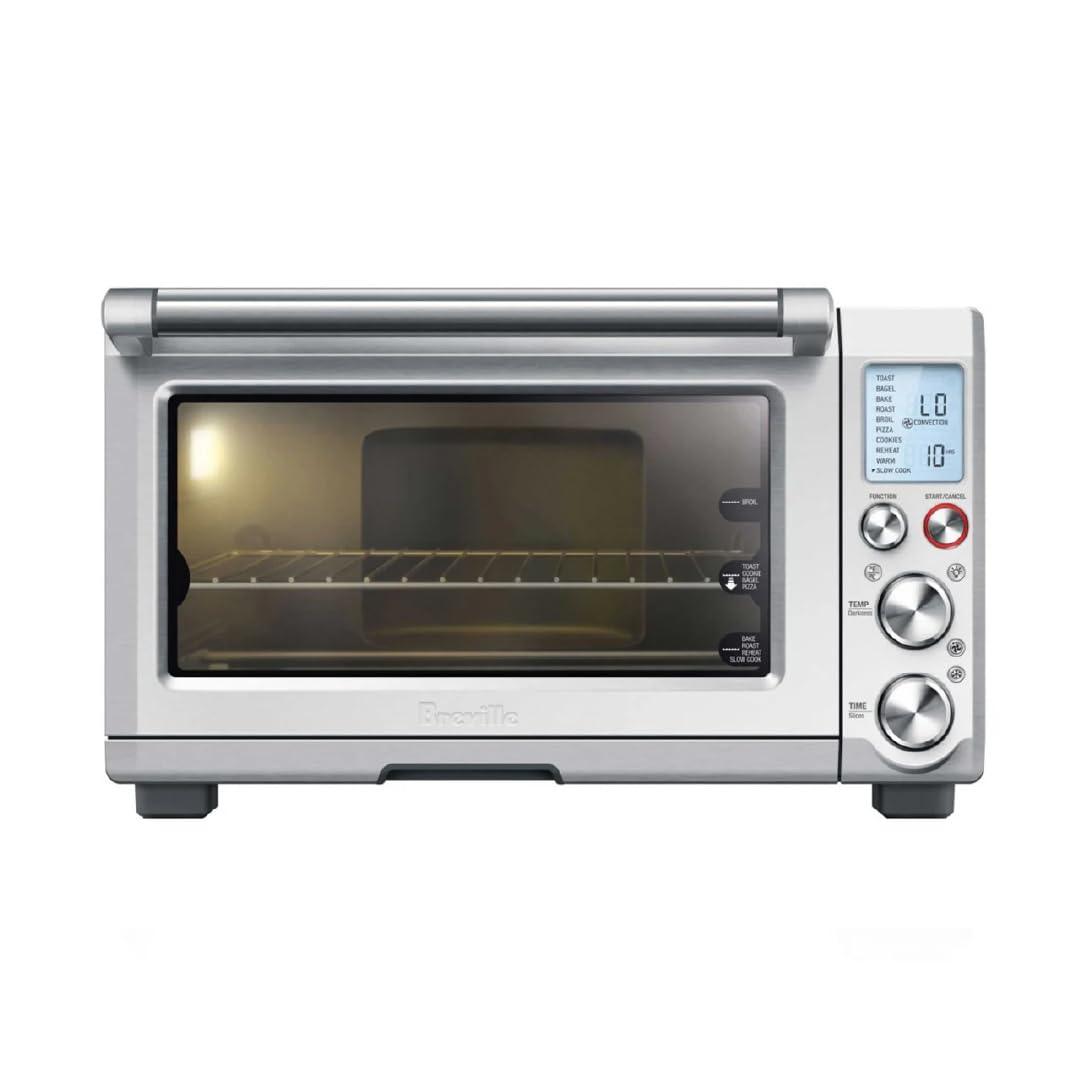
Best Overall (The Baker’s Dream): Breville BOV845BSS Smart Oven Pro
Check Price on Amazon
Why it wins: The Element iQ system is the real deal. It uses five independent quartz elements and actively adjusts power between the top and bottom of the oven. I noticed the difference on my very first batch of scones. They rose evenly, the bottoms were golden rather than brown, and the tops had that nice crackled crust without me having to rotate the tray. It also has a slow cook function that runs for up to 10 hours — I’ve used it for bread proofing and it works perfectly.
Honesty: It’s at the higher end of the countertop oven market, and the capacity is tight. A 9×13 pan fits, but barely. You definitely can’t put a muffin tin on the upper rack because it hits the top heating elements. If you bake small batches of delicate items, this is your machine.
Key specs:
- Power: 1800W
- Capacity: 0.49 cu ft
- Functions: 10 (Toast, Bake, Roast, Broil, Pizza, Cookies, Reheat, Warm, Slow Cook, Bagel)
- Dimensions: 15.91″D x 18.94″W x 10.94″H
- Unique feature: Element iQ with 5 independent elements
Best for High-Volume Baking & Big Batches: Cuisinart Chef’s Convection Toaster Oven (TOB-260N1NAS)

Check Price on Amazon
Why it wins: This oven has the largest usable interior of the group at 0.95 cubic feet. I could slide a 9×13 baking pan in there without any struggle, which is rare for a countertop oven. The Dual Cook function combines convection with broiler heat, and it gave my pastries a noticeably better rise and color. If you’re baking for a family or you like making big batches of muffins, this is the one that fits your workflow.
Honesty: It does run hot. My first attempt at a vanilla sheet cake came out darker than I wanted on the bottom because I trusted the preheat signal too much. You’ll want an oven thermometer and you’ll need to learn its personality. The interface is also dense — there are 15 functions and the control panel takes a few days to get comfortable with.
Key specs:
- Power: 1800W
- Capacity: 0.95 cu ft
- Functions: 15 (Dual Cook, Speed Convection, Pizza, Bake, Broil, Toast, Waffle, Bagel, Keep Warm, etc.)
- Dimensions: 16.93″D x 20.87″W x 11.42″H
- Unique feature: Exact Heat temperature technology, nonstick interior
Best Budget for a Precise Bake: Panasonic FlashXpress NB-G110P

Check Price on Amazon
Why it wins: This oven uses double infrared heating, which means there is zero preheat time. None. I pulled out a tray of cookies I’d prepped, slid them in, set the timer, and they were done before my other oven would have even beeped ready. For small batches — cookies, scones, single-serving pies — it’s incredibly efficient. The heat is also very direct and even, which gives you a nice clean bake.
Honesty: It’s compact. Very compact. You cannot bake a loaf of bread in a standard loaf pan, and you can’t fit a cake pan. This is a specialized tool for small, fast bakes. If you mostly bake for yourself or one other person, it’s a great fit. But if you need any kind of volume, you’ll outgrow it quickly.
Key specs:
- Power: 1300W
- Capacity: 0.04 cu ft
- Functions: 6 preset cooking functions plus reheat and defrost
- Dimensions: 12″D x 13″W x 10.2″H
- Unique feature: Double infrared heating, no preheat needed, connected baking rack
Best Value with Convection (The All-Rounder): TOSHIBA 10-in-1 Convection Toaster Oven

Check Price on Amazon
Why it wins: This is the best value option for someone who wants a convection oven and a rotisserie without spending a lot. The convection fan does a decent job of circulating hot air, and for the price, the build quality feels better than I expected. I tested a whole chicken on the rotisserie and it came out juicy with crispy skin — something I didn’t expect from an oven in this price range.
Honesty: The convection fan is noticeable. When I baked a batch of light vanilla cupcakes, the air flow actually blew the batter around in the liners and created uneven shapes. The temperature dial is also analog, so you don’t get the same precision as digital controls. For casual baking — sheet cakes, brownies, roasted vegetables — it works fine. For delicate work, there are better options.
Key specs:
- Power: 1500W
- Capacity: 25 Liters
- Functions: 10 (Toast, Bake, Broil, Pizza, Cookies, Defrost, Reheat, Rotisserie, Keep Warm, Convection)
- Dimensions: 15.86″D x 18.98″W x 10.82″H
- Unique feature: Rotisserie kit included, LCD knob controls
Best for Air-Fryer Bakers (Dual Function): Hamilton Beach Sure-Crisp (31403)

Check Price on Amazon
Why it wins: This is the most affordable way to get a combined air fryer and toaster oven. The convection air frying function works well for frozen fries, chicken wings, and small pieces of meat. If you’re not a dedicated baker but you want something that can do both jobs without taking up much space, this fits the bill.
Honesty: This is not a serious baking oven. The capacity is small — it only fits four slices of bread or a 9-inch pizza. The heat distribution is less even than every other oven on this list. I tried baking a small batch of scones and the ones on the left side came out noticeably darker than the ones on the right. It’s a capable air fryer that happens to bake, not the other way around.
Key specs:
- Power: Not listed, but standard 1800W range
- Capacity: 11.4 Liters
- Functions: Air fry, Bake, Broil, Toast
- Dimensions: 11.5″D x 15″W x 8.5″H
- Unique feature: Air fry basket included, convection circulation
Head-to-Head: The Baking Test
Numbers and features only tell you so much. I ran these ovens through three specific tests to see how they actually perform in real baking conditions.
The Cookie Test (Even Browning & Heat Distribution)
I baked two trays of sugar cookies in each oven at 350°F, using the same batch of dough. The Breville BOV845BSS was the clear winner. The Element iQ system prevented the bottoms from burning while the tops cracked perfectly. I didn’t have to rotate the tray once. The Panasonic FlashXpress came in second — the no preheat feature gave the cookies a nice snap on the edges and even browning across the batch. The Cuisinart required me to rotate the tray halfway through to avoid uneven coloring. The Toshiba was decent but the cookies on the left side were consistently darker. The Hamilton Beach struggled the most, with visible hot spots and uneven browning on every tray.
The Cake Test (Even Rise & Stable Temp)
For cakes, I baked a simple vanilla sheet cake in each oven that could fit a 9×13 pan. The Cuisinart Chef’s Convection took the win here. The larger interior allowed air to circulate properly around the pan, and the cake rose evenly without doming. The Breville did a great job too, but the smaller interior meant I had to watch the cake closely so it wouldn’t dome too quickly near the top elements. The Toshiba and Hamilton Beach both struggled with size constraints — a standard 9×13 pan simply doesn’t fit in either of them. The Panasonic doesn’t have the capacity for this test at all.
The Roast Chicken Test (Capacity & Convection Penetration)
I roasted a whole chicken in each oven that could fit one. The Cuisinart TOB-260N1NAS fit a full-sized chicken with room to spare, and the convection roasting function produced even browning and juicy meat. The Toshiba came in second — the rotisserie function actually works very well, but the 4-pound limit is strict. The Breville fit a small chicken but it was tight against the elements. The Panasonic and Hamilton Beach are simply too small for this test.
The Verdict: Which One Should You Buy for Your Specific Baking Style?
After weeks of side-by-side testing, here’s how I’d break it down for different kinds of bakers.
Buy the Breville BOV845BSS if… you bake small batches of delicate items like cookies, scones, individual tarts, and you value temperature precision above everything else. It’s the best tool for the job if you can work within its capacity limits.
Buy the Cuisinart TOB-260N1NAS if… you need to bake a 9×13 cake or a full-sized chicken. You’re willing to spend a few bakes learning its temperature quirks. It’s the best choice for replacing your full oven for most tasks.
Buy the Panasonic NB-G110P if… you only bake small items and you hate waiting for preheat. It’s a specialized tool that does one thing — fast, even baking — very well.
Buy the Toshiba 10-in-1 if… you’re a beginner baker on a budget or you want the flexibility of a rotisserie without spending a lot. Be aware of the temperature fluctuations and keep an eye on delicate bakes.
Buy the Hamilton Beach if… your primary need is air frying and baking is a secondary thought. It’s a capable small air fryer that can handle basic baking in a pinch.
Frequently Asked Questions
Can you bake a cake in a toaster oven?
Yes, you can, but it depends on the oven and the pan size. I’ve had the best results with the Cuisinart Chef’s Convection because the larger interior lets air circulate properly around a standard 9×13 pan. For smaller ovens, use a smaller pan and check for doneness a few minutes early.
Why do my cookies burn on the bottom in my toaster oven?
This usually happens because the bottom heating element is too close to the tray and the oven doesn’t control power between the top and bottom elements. A model like the Breville BOV845BSS with Element iQ actively adjusts the power to prevent this. Rotating the tray halfway through baking can also help with ovens that have uneven heat.
Is a convection toaster oven better for baking?
Yes, if the convection fan is designed well. A good fan circulates hot air evenly around the food, which helps with consistent browning and a better rise. But weak or poorly placed fans can create hot spots or blow lightweight batters around. Look for ovens with a dedicated convection setting and a fan that doesn’t blasts air directly onto the food.