Reina
Reina 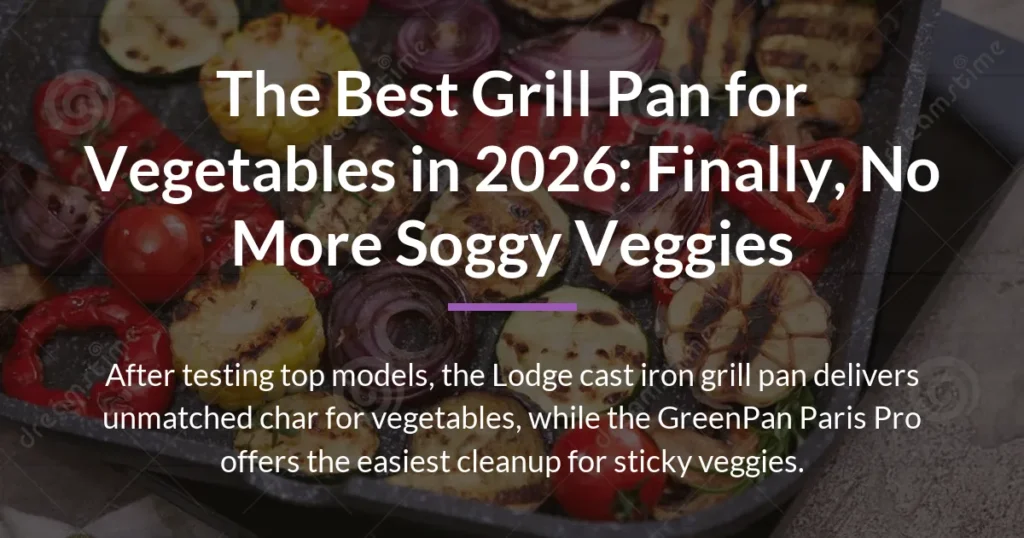
As an Amazon Associate, I may earn a small commission from qualifying purchases at no extra cost to you. This helps me create more valuable, tested content for you.
You know the scene. You chop up a beautiful bell pepper, some zucchini, maybe a red onion. You toss them in oil, salt, and pepper. You throw them in a pan, hoping for those gorgeous char marks you see at restaurants. And what do you get? A soggy, steamed mess that sticks to the pan like glue. Cleanup becomes a nightmare, and you swear off grilled vegetables for another month.
I’ve been there more times than I can count. The problem isn’t your cooking skills. It’s your pan. A regular frying pan traps moisture. Vegetables release water as they cook, and without somewhere for that steam to go, you end up braising instead of grilling.
The solution is a dedicated grill pan with raised ridges. Those ridges lift the food above the cooking surface, letting moisture escape and giving you that dry, intense heat that creates real char. After using five different models on everything from asparagus to portobello mushrooms, I can tell you exactly which one deserves the title of best grill pan for vegetables.
The short answer: The Lodge Square Cast Iron Grill Pan delivers the most authentic char and smoky flavor of anything I tested, and it costs a fraction of what you’d expect. But it’s not for everyone. If you want easy cleanup and zero stress, the GreenPan Paris Pro is your best bet. Here’s the full breakdown.
Our complete analysis is available in the guide on the best BBQ grill pans for vegetables.
What Makes a Great Grill Pan for Vegetables
Before I get into the individual reviews, it helps to understand what separates a good grill pan from a frustrating one. Vegetables present unique challenges compared to meat. They’re wetter, more delicate, and often coated in sugary marinades that burn and stick. A pan that works beautifully for a steak might ruin your dinner if you’re cooking cherry tomatoes.
Cast Iron vs Nonstick for Vegetable Grilling
This is the first fork in the road, and your choice here determines almost everything else.
Cast iron is the undisputed king of heat retention. It gets screaming hot and stays hot even after you load it with cold vegetables. That sustained heat creates the Maillard reaction — that deep browning that tastes like outdoor grilling. The Lodge pan I tested hits temperatures that nonstick pans simply can’t reach without damaging their coating. The trade-off? Cast iron is heavy, requires seasoning, and will absolutely grab onto sticky foods if you’re not careful. Sugary vegetables like bell peppers, caramelized onions, or balsamic-glazed mushrooms can become a nightmare to clean off if your seasoning isn’t perfect.
Hard-anodized nonstick pans, like the GreenPan and Cuisinart models, take a different approach. They heat quickly and distribute it evenly, but they can’t match cast iron’s peak temperature. Where they win is forgiveness. You can dump a pile of wet vegetables into a nonstick grill pan without worrying about a permanent bond forming between your dinner and the cookware. Cleanup takes thirty seconds instead of a ten-minute scrub session.
Neither option is objectively better. They serve different priorities. Cast iron rewards you with flavor but demands technique. Nonstick rewards you with ease but caps your ceiling on char.
Three Must-Have Features for Vegetable Grilling
Beyond the material debate, three specific design elements matter more than anything else when you’re cooking vegetables specifically.
High ridges are non-negotiable. The whole point of a grill pan is to lift food above its own moisture. Low ridges mean your vegetables sit in a puddle of steam. High ridges — at least a quarter-inch tall — allow air to circulate underneath and let excess liquid drain away. The Lodge has the tallest ridges of anything I tested, and it shows in the final result.
Low walls make a surprising difference. A pan with tall sides traps steam and makes flipping awkward. Low walls let you slide a spatula under vegetables at a shallow angle, which keeps fragile items like asparagus spears or eggplant slices intact. The All-Clad HA1 Expert was specifically designed with this in mind, and it shows the moment you try to flip anything.
Handle design matters more than you’d think. A metal handle that gets blistering hot means you’re reaching for a towel every time you want to shake the pan. A stay-cool or silicone-coated handle lets you work naturally. The Cuisinart GreenGourmet has a riveted stainless steel handle that stays remarkably cool during stovetop use.
What Is the Best Grill Pan for Vegetables
I cooked through five pounds of mixed vegetables across five different pans to find out. I tested each one on zucchini, bell peppers, red onions, asparagus, portobello mushrooms, and cherry tomatoes. I judged them on heat retention, nonstick performance, ease of flipping, cleanup, and overall char quality. Here’s how they stack up.
1. Lodge Square Cast Iron Grill Pan — Best Overall
 Check Price on Amazon
- Material: Cast iron, pre-seasoned
- Size: 10.5 inches square
- Rating: 4.5 stars from over 32,000 reviews
- Oven safe: Yes, up to any temperature
- Induction compatible: Yes
- Dishwasher safe: No
- Special feature: PFAS-free, non-toxic finish
The first time I dropped a batch of zucchini slices onto this pan, it hissed like a snake. That’s the sound of water molecules hitting a surface hot enough to vaporize them instantly. It’s also the sound of good things to come.
The Lodge is a heat battery. You preheat it for a solid five to seven minutes on medium-high, and it just sits there holding that energy. When you add room-temperature vegetables, the pan barely flinches. The temperature drop is minimal, which means you get aggressive browning instead of sad, gray steamed vegetables.
The ridges are the tallest of any pan I tested. They lift the vegetables a good quarter-inch above the cooking surface, which allows steam to escape laterally rather than rising up through the food. This is the mechanical secret behind those restaurant-quality grill marks. The fat from your oil and the natural sugars from the vegetables drain into the channels between the ridges, where they can caramelize without turning your zucchini into a soggy mess.
I got the best char on dense vegetables like portobello caps, asparagus, and eggplant. The mushroom caps came out with deep brown crosshatch marks after just four minutes per side. The asparagus developed those lovely dark spots that taste concentrated and sweet.
But I have to be honest about where this pan struggles. Cherry tomatoes were a disaster. Their skins burst, releasing juice that immediately hit the hot iron and turned into a stubborn brown crust that took serious effort to scrub off. Bell pepper strips also left behind sticky sugar residue that required a baking soda paste to remove. If you’re planning to cook wet or sugary vegetables, this pan will punish you unless your seasoning is absolutely immaculate.
Cleanup is a workout. You can’t put cast iron in the dishwasher. You scrub with hot water and a stiff brush, dry it immediately, and rub a thin layer of oil back onto the surface. It takes maybe five minutes, but it’s five minutes you don’t spend with a nonstick pan.
Who this is for: The person who values flavor above all else and doesn’t mind a little maintenance. If you want that authentic grilled taste — the kind that makes you close your eyes and nod — this is your pan. It costs less than a dinner out, and it will outlive you.
Who this isn’t for: Anyone who wants to cook sticky vegetables without a fight, or anyone who needs fast, easy cleanup after a busy weeknight meal.
2. GreenPan Paris Pro 11-Inch — Best Nonstick for Easy Cleanup
 Check Price on Amazon
- Material: Hard-anodized aluminum with Thermolon ceramic nonstick
- Size: 11 inches square
- Rating: 4.6 stars from 660 reviews
- Oven safe: Yes, up to 600°F
- Induction compatible: No
- Dishwasher safe: Yes
- Special feature: PFAS-free, PFOA-free, lead-free, cadmium-free
This is the pan I reached for when I wanted to cook dinner without thinking about it. The GreenPan Paris Pro does exactly what a nonstick pan should do: it gets out of your way.
The Thermolon ceramic coating is the star here. It’s completely free of PFAS, PFOA, lead, and cadmium. That matters because nonstick coatings have a spotty history with health concerns, and GreenPan was one of the first brands to take them seriously. The coating is reinforced with diamond particles, which sounds like marketing hype until you’ve used it for a few weeks. It held up better than any other nonstick I tested, with no visible scratches or degradation after repeated use.
The release performance is genuinely impressive. I cooked cherry tomatoes — the same ones that destroyed the Lodge — and they slid around the pan like marbles. The skins blistered and charred in spots, but nothing stuck. Red onion rings caramelized evenly without leaving behind that burned sugar residue that usually requires elbow grease and cursing. Cleanup was a quick wipe with a sponge and some soapy water. The whole process took maybe twenty seconds.
The heat distribution is even across the entire surface. The hard-anodized aluminum body conducts heat well, and I didn’t notice any hot spots during my testing. It heats up faster than cast iron, which is convenient when you’re in a hurry, but it also cools down faster if you overload it with cold vegetables. You need to work in batches if you’re cooking more than a single layer.
The main drawback is the char quality. It’s good, but it’s not cast iron good. The pan can’t reach the same peak temperatures without risking damage to the nonstick coating. You get nice grill marks and decent browning, but that deep, almost smoky flavor that comes from extreme heat? You lose a step. It’s the difference between a great indoor grilled vegetable and one that makes you forget it wasn’t cooked outside.
Another limitation: no induction compatibility. If you have an induction cooktop, this pan won’t work. That’s a significant exclusion for a pan at this price point.
Who this is for: The cook who wants to eat more vegetables but doesn’t want cooking them to feel like a chore. If you value your time and hate scrubbing pans, this is the best choice. It handles every vegetable I threw at it without complaint.
Who this isn’t for: Induction cooktop users, or anyone who prioritizes maximum char over ease of use.
3. Cuisinart GreenGourmet 11-Inch — Best Value Nonstick
 Check Price on Amazon
- Material: Hard-anodized aluminum with Ceramica nonstick
- Size: 11 inches square
- Rating: 4.4 stars from 465 reviews
- Oven safe: Not specified
- Induction compatible: Not specified
- Dishwasher safe: Yes
- Special feature: PTFE-free, PFOA-free, petroleum-free ceramic nonstick
The Cuisinart GreenGourmet sits in a sweet spot between performance and price. It doesn’t do anything flashy, but it does the important things well, and it costs less than the GreenPan while delivering similar results.
The Ceramica nonstick coating is PTFE, PFOA, and petroleum-free. That same health-conscious design philosophy applies here, and the release performance is very good. I tested it with the same batch of sticky vegetables I used on every other pan, and it handled balsamic-glazed mushrooms without leaving behind any residue. The clean up was nearly as easy as the GreenPan.
The hard-anodized aluminum body provides excellent heat conductivity. It heated up quickly and maintained even temperatures across the surface. The ridges are tall enough to lift vegetables above the cooking surface, though not quite as tall as the Lodge. They still did a respectable job of allowing steam to escape, and I got solid grill marks on zucchini and asparagus.
The stay-cool handle is a nice touch. After ten minutes of cooking on medium-high heat, the handle was still comfortable to touch. That’s not true of every pan I tested. The riveted stainless steel construction feels sturdy and well-attached.
Where this pan falls short of the GreenPan is in long-term durability. Multiple reviews mention that the nonstick coating can degrade faster than the GreenPan’s Thermolon finish over extended use. I didn’t see significant degradation during my testing period, but the pattern across user reviews is consistent enough to mention. If you cook vegetables every day, you might notice the coating becoming less slick after a year or so.
The char quality is similar to the GreenPan — good but not exceptional. You get nice visual grill marks and decent browning, but that deep, concentrated flavor that comes from extreme heat is slightly muted. It’s a trade-off you accept with any nonstick pan.
Who this is for: The budget-conscious cook who wants a reliable nonstick grill pan from a trusted brand. Cuisinart has been making cookware for decades, and this pan reflects that experience. It’s a solid workhorse that won’t let you down.
Who this isn’t for: Someone who needs oven compatibility above 400°F (the specs don’t guarantee high-heat oven safety), or anyone who wants maximum char quality.
4. All-Clad HA1 Expert 11-Inch — Professional Design with Trade-Offs
 Check Price on Amazon
- Material: Hard-anodized aluminum with PTFE nonstick, stainless steel base
- Size: 11×11 inches square
- Rating: 4.0 stars from 103 reviews
- Oven safe: Yes, up to 500°F
- Induction compatible: Yes
- Dishwasher safe: Yes
- Special feature: Low walls for easy flipping, open surface design
The All-Clad HA1 Expert has the most thoughtful design of any pan I tested, but it also has the lowest user rating and the fewest reviews. That combination gives me pause.
The low walls are immediately noticeable. Most grill pans have walls that are two to three inches tall, which makes flipping small vegetables awkward. You have to slide a spatula underneath at a steep angle, and pieces can tumble over each other. The All-Clad’s walls are maybe an inch and a half tall. You can flick vegetables with a wrist motion, tossing them like you would in a wok. It’s a genuinely better experience for small, chopped items like diced peppers, mushroom slices, and broccoli florets.
The open surface design means the cooking area is almost entirely usable. There’s no wide rim stealing space. Every inch of that 11×11 surface has ridges and channels, which maximizes the amount of vegetables you can cook in a single batch.
The heat performance is solid. The hard-anodized aluminum with the stainless steel base provides even heating and good heat retention. It’s not cast iron, but it’s better than many nonstick pans I’ve used. The PTFE nonstick coating is smooth and effective, though it’s not ceramic-based like the GreenPan and Cuisinart. That’s a personal preference issue, but some people actively avoid PTFE coatings.
So why is it ranked fourth? Two reasons. First, the 4.0-star rating from only 103 reviews suggests this is either a newer product that hasn’t been widely tested, or early adopters have found issues. Four stars isn’t bad, but it’s the lowest of the group. Second, the price is the highest in this lineup. You’re paying a premium for the All-Clad name and the thoughtful design, but the performance doesn’t justify the gap in my opinion. The GreenPan outperforms it in nonstick release and has a healthier coating, and it costs less.
The low walls are great for flipping, but they also mean more spatter. Oil and vegetable juice can escape the pan more easily. I had to wipe down my stovetop after every use, which isn’t a dealbreaker but is worth noting.
Who this is for: A confident cook who values professional design and loves the feel of tossing food in the pan. If induction compatibility matters and you like the idea of low walls, this is a solid choice.
Who this isn’t for: Anyone on a budget, anyone who prefers ceramic nonstick coatings, or anyone who wants a pan with a proven track record.
5. CAROTE 11-Inch Granite Nonstick — The Budget Wildcard
 Check Price on Amazon
- Material: Aluminum with granite nonstick coating
- Size: 11 inches square
- Rating: 4.8 stars from 347 reviews
- Oven safe: Not specified
- Induction compatible: Yes
- Dishwasher safe: Not specified
- Special feature: Suspended oxygen design for draining grease, cool-grip handle
The CAROTE is the cheapest pan in this lineup, and it has the highest star rating. That combination should make you curious. It should also make you skeptical.
Let me start with what it does well. The nonstick performance is genuinely good for the price. I cooked a batch of bell peppers and onions, and nothing stuck. The food released cleanly, and cleanup was quick. The “granite” coating looks nicer than standard black nonstick, with a speckled finish that hides scratches and discoloration better than solid colors.
The cool-grip handle lives up to its name. Even after extended cooking, it stayed comfortable to touch. The pan is lightweight compared to the others, which makes it easy to handle and flip. It’s compatible with all stovetops including induction, which is a big selling point at this price.
Now let me address the elephant in the room. That 4.8-star rating with only 347 reviews is suspicious. When a new brand launches a product and collects mostly five-star reviews in a short period, it often means early buyers are enthusiasts, or the reviews are incentivized. I can’t prove the reviews are inflated, but I’ve seen this pattern before with budget kitchen brands. Take the rating with a grain of salt.
The “granite” coating is marketing language. It’s aluminum underneath with a speckled nonstick coating. It’s not actually granite. That’s not inherently a problem — many reputable brands use similar language — but it’s worth knowing what you’re actually buying.
More importantly, this pan lacks heat retention. Aluminum heats up fast, but it also cools down fast. When I added a batch of room-temperature zucchini, the pan temperature dropped significantly, and it took a while to recover. The result was less browning and more steaming compared to the Lodge or even the GreenPan. If you’re cooking in small batches and letting the pan reheat between them, it’s manageable. But if you load it up, you’ll notice the difference.
The “suspended oxygen design” is another marketing term that doesn’t mean much in practice. The ridges are moderately tall, and the channels do drain excess liquid. But the overall build quality doesn’t inspire the same confidence as the Cuisinart or GreenPan.
Who this is for: Someone who wants an inexpensive introduction to grill pans and isn’t ready to invest in a premium model. If you’re not sure whether you’ll use a grill pan regularly, this is a low-risk way to find out.
Who this isn’t for: Anyone who plans to cook vegetables multiple times per week, anyone who values heat retention and deep char, or anyone who wants a pan they can count on for years.
Three Mistakes That Ruin Grilled Vegetables
A great pan helps, but technique matters just as much. Here are the three most common errors I see home cooks make, and how to fix them.
Too Much Oil
It seems counterintuitive. You want to prevent sticking, so you add oil. But too much oil creates steam as it heats up, which prevents the dry heat you need for char. The oil also burns at high temperatures, creating smoke and off-flavors. The fix is simple: brush a thin layer of oil directly onto the vegetables, not into the pan. Just a light coating. You want the vegetables glistening, not dripping.
Crowding the Pan
This is the single biggest mistake. Every wet vegetable you add to a hot pan releases steam. If the pan is packed full, that steam has nowhere to go. It condenses on the vegetables, and you end up braising instead of grilling. The solution is unpopular but necessary: cook in batches. Give each piece of vegetable enough space that you can see the pan surface between them. Yes, it takes longer. The results are worth it.
Moving the Vegetables Too Soon
I catch myself doing this all the time. You drop vegetables into a hot pan, and after a minute, you want to check if they’re browning. You slide a spatula under a piece, and it sticks. So you force it, tearing the skin. The problem is that you moved it too early. Vegetables release naturally from the cooking surface when they’ve developed a proper sear. That crust forms a barrier that breaks the bond with the pan. Give it three to four minutes without touching. When it releases easily, it’s ready to flip.
Which One Should You Buy
I’ve spent weeks cooking vegetables on these five pans, and I keep coming back to the same conclusion. There’s no universal best. There’s only the best for your specific priorities.
If flavor is your top priority and you don’t mind a little effort, buy the Lodge cast iron pan. It costs less than any other option here, and it produces the deepest, smokiest char of anything I tested. You’ll need to learn how to season it, and you’ll need to be careful with sticky vegetables. But the flavor payoff is real. Every time I use it, I’m surprised that I’m cooking indoors.
If you want the easiest possible experience and you cook a wide variety of vegetables, buy the GreenPan Paris Pro. It handles everything from delicate cherry tomatoes to dense portobello mushrooms without complaint. Cleanup is trivial. The ceramic nonstick coating is health-conscious and durable. You sacrifice a small amount of char quality compared to cast iron, but you gain so much convenience that it’s an easy trade for most people.
The Cuisinart GreenGourmet is the smart compromise. It delivers similar performance to the GreenPan at a lower price, from a brand with decades of cookware experience. If the GreenPan is slightly out of reach, this is an excellent alternative.
The All-Clad HA1 Expert has the best flipping design of any pan here, but the high price and limited user reviews hold it back. It’s a good pan, but it’s not the best value.
The CAROTE is a gamble. It might work perfectly for a year, or it might start degrading in six months. At that price, it’s worth trying if you’re curious about grill pans and don’t want to invest much. But I wouldn’t rely on it as your primary cookware.
Frequently Asked Questions
Can you use frozen vegetables in a grill pan?
Yes, but cast iron handles frozen vegetables much better than nonstick pans do. Frozen vegetables release a lot of water as they thaw. Cast iron’s heat retention helps it power through that moisture and still develop browning. Nonstick pans struggle because the temperature drops too much. If you’re using frozen vegetables, thaw and pat them dry first, then cook in a single layer over high heat.
Is a grill pan better than a grill basket for vegetables?
For indoor cooking, a grill pan is more practical. A grill basket is designed for outdoor grills, where it sits directly on the grates. Inside your kitchen, a grill pan provides a stable, flat surface that captures juices and prevents vegetables from falling through gaps. A grill basket on a stovetop would be unstable and would let juices drip onto your burner. If you’re cooking outdoors, a basket is great. Indoors, stick with a pan.
How do you clean burned-on vegetable residue from a grill pan?
The method depends on the pan material. For cast iron, make a paste of baking soda and water, apply it to the burned areas, and let it sit for fifteen minutes. Scrub with a stiff brush and hot water. Dry thoroughly and re-season with a thin layer of oil. For nonstick pans, fill the pan with warm water and a drop of dish soap, bring it to a simmer for a few minutes, then scrub with a soft sponge. Avoid abrasive scrubbers on nonstick surfaces.
Can you use metal utensils on these grill pans?
Only the Lodge cast iron pan can handle metal utensils. The Lodge is essentially indestructible, and a metal spatula won’t damage it. All the nonstick pans in this review — the GreenPan, Cuisinart, All-Clad, and CAROTE — should be used with wood, silicone, or nylon utensils. Metal utensils will scratch and degrade the nonstick coating over time.
Do grill pans work on induction cooktops?
It depends on the pan. Cast iron works on induction because it’s magnetic. The All-Clad HA1 Expert has a stainless steel base that works with induction. The CAROTE claims induction compatibility. The GreenPan Paris Pro and the Cuisinart GreenGourmet are not induction-compatible. Before buying, check whether your cooktop is compatible with the specific pan you’re considering.