Reina
Reina 
As an Amazon Associate, I may earn a small commission from qualifying purchases at no extra cost to you. This helps me create more valuable, tested content for you.
Why Your Salmon Sticks (And How the Right Pan Fixes It)
You’ve been there. You drop a beautiful fillet into the pan, wait a few minutes, and try to flip it. The skin tears, half the fish stays welded to the surface, and you’re left with a mangled mess instead of restaurant-quality dinner. The problem isn’t your cooking technique – it’s the pan you’re using.
Most people grab a flat skillet for salmon, which lets the fat pool around the fish and steam the skin rather than crisp it. A grill pan changes everything. Those raised ridges lift the fillet, drain excess fat, and leave those picture-perfect sear marks. But not all grill pans are created equal.
I’ve spent weeks cooking salmon on five different grill pans, testing for crust quality, ease of flipping, cleanup, and overall reliability. The best pan to grill salmon depends on what you value most. If you want that shatteringly crispy skin and don’t mind a little elbow grease, cast iron is your answer. If you want a stress-free weeknight dinner with no sticking at all, go nonstick.
These same considerations apply when choosing the best outdoor grill pan for fish, ensuring you get perfect results every time.
Here’s the short answer: The Lodge 10.5-Inch Cast Iron Square Grill Pan delivers the best crust of any pan I tested. But the SENSARTE Nonstick Grill Pan is the one I reach for when I just want dinner done without drama. Below, I’ll explain exactly why, and walk you through all five pans so you can pick the right one for your kitchen.
Best Pans to Grill Salmon: At a Glance
If you’re short on time, here is a ranked list of the five pans I tested, from best overall to “good but with caveats.”
The Best Pan to Grill Salmon: 5 Detailed Reviews
I evaluated each pan based on four criteria: crust quality on a standard 6-ounce skin-on salmon fillet, ease of flipping (how much the skin stuck or tore), cleanup time, and overall durability after multiple uses. The ratings reflect my personal experience – not what the manufacturer claims. Here’s how they stacked up.
1. Lodge 10.5-Inch Cast Iron Square Grill Pan (The King of Crust)
Specs: Material: Cast Iron | Special Feature: Made without PFOA or PTFE | Color: Black | Capacity: Not stated (approx. 1 oz?) | Pre-seasoned
 Check Price on Amazon
This pan sits at the top of my list for one reason alone: it creates the single best crust I’ve ever gotten on pan-grilled salmon. The first time I used it, I preheated it over medium-high heat for about six minutes, brushed the ridges with oil, and laid a seasoned fillet skin-side down. The sizzle was immediate and aggressive. After five minutes, I tested the skin with a thin spatula – it released cleanly, with a deep mahogany sear that shattered like glass when I bit into it.
The cast iron holds heat like a thermal battery. Even after I added a cold fillet, the pan temperature barely dipped, which means even cooking from edge to edge. The ridges are tall enough to keep the fish elevated, so the fat drains rather than pools. That’s the secret to dry, crispy skin.
But let’s be honest about the downsides. This pan is heavy – around 7 pounds. You won’t be flipping it with one hand. More importantly, the pre-seasoned surface is not very nonstick at first. My first attempt with a less-than-hot pan resulted in the skin tearing. You absolutely must preheat it properly and use enough oil. Cleanup requires scrubbing with a brush and reapplying a thin coat of oil to prevent rust. It’s not a “set and forget” pan.
Who is this for? Anyone who prioritizes texture over effort. If you love that crispy, crackly skin and don’t mind spending a few extra minutes on care, this is your pan. It’s also a steal for the price – under $30 for performance that rivals pans costing three times as much.
Verdict: Best overall for crust. 9/10 for sear, 4/10 for ease of use. Not for beginners who want zero sticking.
2. SENSARTE 11-Inch Nonstick Grill Pan (The Easiest Cleanup)
Specs: Material: Aluminum | Special Feature: Electric & Gas Stovetop Compatible | Color: Gray Granite | Capacity: 6.1 Quarts | PFOA Free
 Check Price on Amazon
If you told me I could only keep one grill pan for the rest of my life)Skip to the SENSARTE. It’s the pan I use most often, especially on busy weeknights. The nonstick coating is genuinely exceptional – I’ve cooked salmon without any oil (not recommended for flavor, but as a test) and the fish slid right off the ridges. No tearing, no sticking, no drama.
The die-cast aluminum body heats evenly, but it doesn’t hold heat the way cast iron does. That means if you load the pan with two cold fillets, the temperature drops noticeably. I learned to preheat it for a solid five minutes on medium heat (not high – you don’t want to damage the coating). Once hot, the crust comes out decent – not as shatteringly crisp as the Lodge, but easily a 7/10. Good enough for most home cooks.
The cleanup is where this pan shines. A quick wipe with a paper towel, and it’s clean. I’ve even run it through the dishwasher once (though I wouldn’t make a habit of it). The pour spouts on two corners make draining excess fat simple, and the pan is light enough to handle comfortably.
Who is this for? Anyone who hates scrubbing pans. If you cook salmon twice a week and want it to release perfectly every time without fuss, this is the one. It’s also ideal for delicate salmon varieties like Sockeye or King, where the skin can be thinner and more prone to tearing.
Verdict: Best nonstick option. 7/10 for crust, 10/10 for ease. A safe, reliable choice for almost everyone.
3. All-Clad HA1 Hard Anodized Nonstick Square Grill Pan (The Professional’s Choice)
Specs: Material: Aluminum | Special Feature: Induction Safe, Oven Safe to 500°F | Color: Black | Capacity: 5 Quarts | Dishwasher Safe
 Check Price on Amazon
The All-Clad HA1 sits in an interesting spot. It costs significantly more than the SENSARTE, but offers better heat distribution and the ability to finish thick fillets in the oven. I used this to make salmon one evening where I seared the skin on the stovetop, then transferred the pan to a 375°F oven for six minutes to cook through without drying out the flesh. That versatility is the main reason it makes the list.
The hard anodized construction feels premium. The pan is heavier than the SENSARTE but lighter than cast iron. The low walls make it easy to slide a thin spatula under the fish – I had no trouble flipping fillets of any size. The raised ridges are well-spaced and create nice grill marks. Crust quality is comparable to the SENSARTE (maybe a hair better due to the oven finish), but not as good as the Lodge.
The honest truth is that the nonstick coating isn’t as forgiving as the SENSARTE. I noticed a little sticking on the third use when I didn’t use enough oil. It’s dishwasher safe, which is great, but I still prefer to hand wash to preserve the coating. At its price point, it’s a serious investment – you have to really want that oven capability.
Who is this for? Serious home cooks who want one pan that can go from burner to oven without a second thought. If you regularly make thick cuts of salmon or like to experiment with finishing techniques, this is worth the upgrade.
Verdict: Good all-around performer, but overkill for the average weeknight. 7/10 for crust, 8/10 for versatility, 6/10 for value.
4. Victoria 10-Inch Cast Iron Square Grill Pan (The Colombian Contender)
Specs: Material: Cast Iron | Special Feature: Hand Wash | Color: Black | Capacity: 1 Cubic Inches | Pre-seasoned with flaxseed oil
 Check Price on Amazon
The Victoria grill pan is very similar to the Lodge, but a few details make it a solid #4 in my ranking. The seasoning from the factory is a bit smoother than the Lodge’s – they use flaxseed oil, which produces a nice, even surface. I noticed slightly less initial sticking on my first cook compared to the Lodge. It also has larger loop handles that feel more secure when you need to pour out grease or hold the pan steady while scraping.
The performance is nearly identical in terms of heat retention and crust quality. Give it a proper preheat, and you’ll get that same crackly skin. The ridges are well-defined and spaced far enough apart to allow fat to drain easily. I cooked two fillets on it without issues – though the 10-inch surface is a little tight; you can fit two 6-ounce fillets, but they have to sit diagonally.
The main reason it falls behind the Lodge is the smaller size and slightly lower overall value. The Lodge is a few dollars cheaper and has a longer track record. The Victoria is still an excellent pan – especially if you want a slightly lighter feel (it’s about half a pound lighter than the Lodge) and a smoother initial seasoning. But for pure salmon grilling, I give the edge to the Lodge.
Who is this for? Cooks who want cast iron performance but prefer a smoother start and larger handles. Also a great choice if you cook for one or two people only.
Verdict: Excellent cast iron pan, but the Lodge wins on price and availability. 8/10 for crust, 6/10 for size.
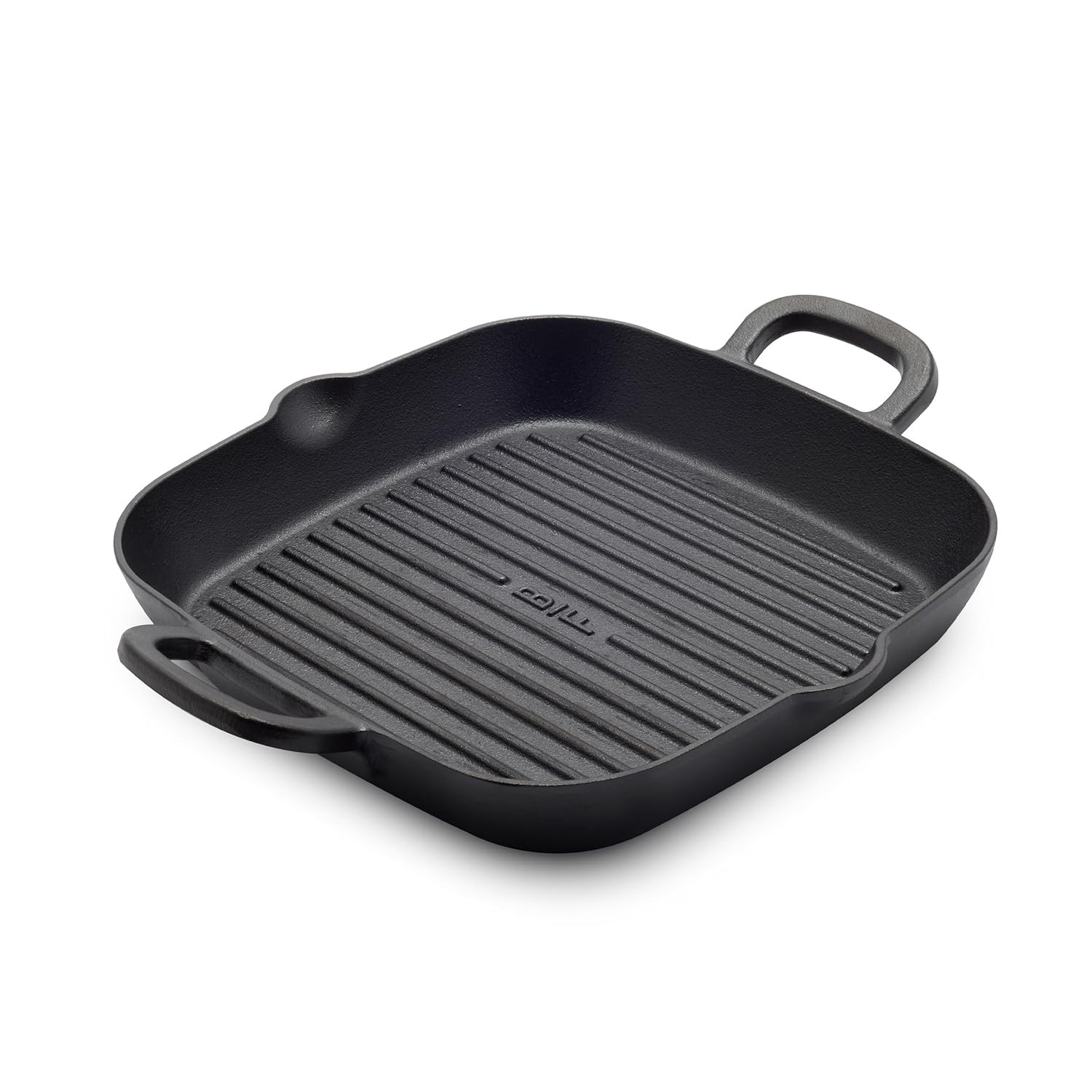
5. GreenPan x Bobby Flay 11″ Cast Iron Grill Pan (The Celebrity Design)
Specs: Material: Cast Iron | Special Feature: Electric & Gas Stovetop Compatible | Color: Black | Capacity: 3 Cups | Pre-seasoned
 Check Price on Amazon
I wanted to like this pan more. It’s a partnership with a celebrity chef, and the design features are thoughtful – high ridges, pour spouts, and wide helper handles. The pre-seasoning worked well out of the box, and the first salmon I cooked on it had decent grill marks and a crunchy skin. The pour spouts are genuinely useful for draining butter or oil without tilting the heavy pan.
But after a few uses, I noticed some inconsistencies. The pan isn’t as heavy as the Lodge, but it’s still cast iron, so it requires the same care. The seasoning started to show thin spots after the third cook – likely because I used it on high heat. The crust quality was good but not remarkable; about on par with the Victoria. Given that it costs more than the Lodge and doesn’t outperform it, I can’t justify putting it higher.
Also, the “designer” aspect adds a premium cost without a meaningful performance advantage. If you’re a Bobby Flay fan and want the aesthetic, go for it. But for pure function, you’re better off with the Lodge or Victoria.
Who is this for? Fans of Bobby Flay or anyone drawn to the unique design features. Also good if you want a pre-seasoned pan that looks different from the standard black cast iron.
Verdict: Good performer, but overpriced for what it delivers. 7/10 for crust, 5/10 for value.
Cast Iron vs. Nonstick: The Salmon Showdown
Still unsure which camp to choose? Here’s how the two main types stack up specifically for salmon.
Why Cast Iron Wins for Flavor
Cast iron gets screaming hot and stays hot. That means the skin hits the pan and immediately starts the Maillard reaction – browning and crisping in minutes. The seasoning builds over time, adding a subtle layer of flavor to everything you cook. You can also take it from the stovetop to the oven to the campfire without worry.
Why Nonstick Wins for Delicate Fillets
If you’re cooking thin fillets like trout or wild salmon, or if you hate the thought of scrubbing a cast iron pan, nonstick is your friend. The surface releases the fish without a fight. Nonstick pans are also much lighter and easier to store. The trade-off is that you won’t get the same crust, and the coating will eventually wear out.
Comparison Table
- Best for Skin Crisp: Lodge Cast Iron (9/10) vs. SENSARTE Nonstick (7/10)
- Best for Easy Flip: Lodge (4/10) vs. SENSARTE (10/10)
- Weight: Lodge (heavy) vs. SENSARTE (light)
- Ease of Cleanup: Lodge (manual scrub) vs. SENSARTE (wipe clean)
- Durability: Lodge (lifetime) vs. SENSARTE (3-5 years with care)
The 3 Rules for Perfect Pan-Grilled Salmon (Regardless of Pan)
Even the best pan won’t save you if you break these fundamental rules. Follow them every time.
Rule 1: The Dry Skin Rule
Pat the salmon completely dry with paper towels. Any moisture on the skin creates steam, which prevents crisping. I press the paper towel firmly on both sides and let the fillet air-dry for a couple minutes while the pan heats up.
Rule 2: The “Sizzle Test”
The pan must be hot enough that a drop of water flicked onto the surface skitters and evaporates instantly (the Leidenfrost effect). For cast iron, that’s about 5-6 minutes on medium-high. For nonstick, 3-4 minutes on medium is enough – don’t go to high heat or you’ll damage the coating.
Rule 3: The “Don’t Touch It” Rule
Place the salmon skin-side down on the ridges and leave it alone for at least 4-5 minutes. The fish will release naturally when the skin is fully cooked. If you try to flip earlier, the skin sticks and tears. I know it’s hard, but resist the urge to peek. You’ll hear the sizzle settle into a steady hiss – that’s when the release is near.
Bonus Tip: Use the ridges to your advantage. Lay the fillet diagonally across the ridges for maximum fat drainage. The drippings fall away, and the skin gets direct contact with the hot metal for those perfect sear marks.
Frequently Asked Questions
Can I use a grill pan on an induction cooktop?
It depends on the pan’s material. Cast iron pans like the Lodge and Victoria are induction-compatible because they’re magnetic. The SENSARTE is also induction-safe according to its specs. The All-Clad HA1 has a stainless steel base that works on induction. Always check the product description before buying.
How do I clean a cast iron grill pan after cooking salmon?
Let the pan cool slightly, then rinse with hot water and use a stiff brush to remove stuck bits. Avoid soap – it can strip the seasoning. For stubborn residue, boil a little water in the pan and scrape with a wooden spatula. Dry thoroughly over low heat, then rub with a thin layer of oil.
Is it safe to use metal utensils on a nonstick grill pan?
No. Metal utensils scratch and damage nonstick coatings. Use silicone, wood, or plastic utensils. Even the hard-anodized All-Clad recommends non-metal tools to preserve the coating’s lifespan.
Why does my salmon skin always stick to the pan?
Three most common reasons: the pan wasn’t hot enough, the skin wasn’t dry enough, or you tried to flip too early. Fix those three things, and the sticking should stop. If it still sticks with a nonstick pan, the coating may be worn out.
Can I grill salmon without oil on these pans?
You can on nonstick pans, but I don’t recommend it because oil adds flavor and helps transfer heat. On cast iron, you need oil to prevent sticking and to build up the seasoning. Even a thin film of oil makes a big difference.
So, What is the Best Pan to Grill Salmon?
After all the testing, here’s my final answer.
- Best overall crust: Lodge Cast Iron Grill Pan – if you value texture and don’t mind maintenance.
- Best hassle-free option: SENSARTE Nonstick Grill Pan – perfect for weeknights and easy cleanup.
- Best premium all-rounder: All-Clad HA1 – if you need oven versatility and have the budget.
Stop fighting with sticking fish. Pick the pan that matches your patience level and start grilling perfect salmon tonight. Your taste buds will thank you.