Reina
Reina 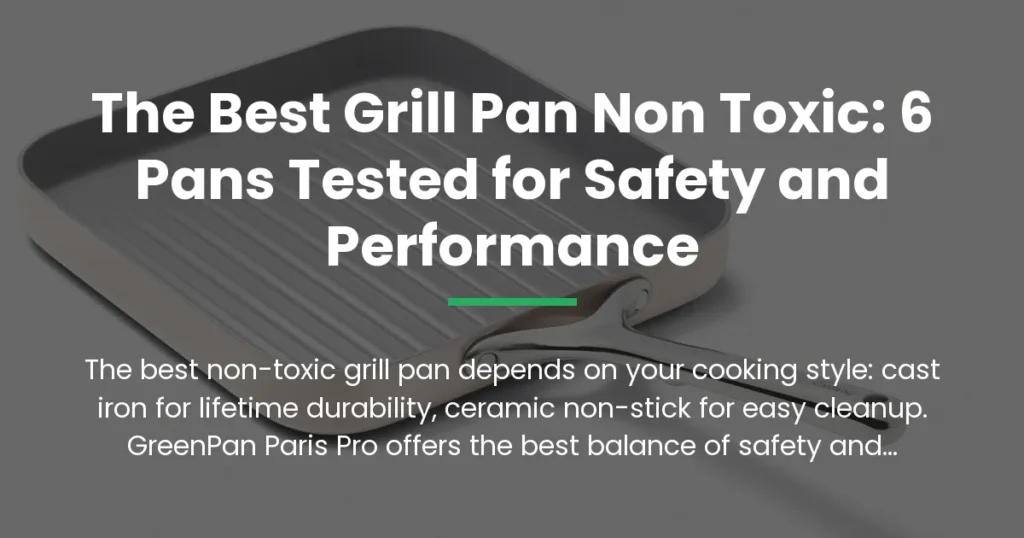
As an Amazon Associate, I may earn a small commission from qualifying purchases at no extra cost to you. This helps me create more valuable, tested content for you.
If you’re reading this, you probably already know why your old non-stick pan had to go. Maybe you noticed the coating starting to flake and wondered where those little black specks ended up. Or you read about PFAS chemicals and decided you didn’t want them anywhere near your food. I’ve been there. I spent weeks researching the best grill pan non toxic options before finally testing six of them side by side in my own kitchen. This article is everything I wish someone had told me before I started.
The short answer is this: the best non-toxic grill pan for you comes down to one choice. Do you want a pan that’s chemically inert by nature — like cast iron or stainless steel — or are you willing to use a coated pan (ceramic) that’s been tested and certified free of harmful substances? Neither is wrong. But the difference in how they cook and how much work they require is massive. Let me walk you through everything I found so you can pick the right one without buyer’s remorse.
The Truth About Non-Toxic Grill Pans
Before I get into which pans I actually liked, let me clear up what “non-toxic” really means in the cookware world. Because brands throw the term around a lot, and not all of them mean the same thing.
There are two paths to a non-toxic grill pan. The first is a pan made from a material that is inherently safe — cast iron and stainless steel fall here. These pans don’t have a coating that can degrade, flake, or leach anything into your food. The second path is a pan with a coating that has been independently verified to be free of harmful chemicals like PFOA, PTFE, PFAS, lead, and cadmium. Ceramic non-stick coatings are the main player in this category.
Neither path is wrong, but they lead to very different cooking experiences. Cast iron gives you insane heat retention and a natural non-stick surface that builds over time — but it’s heavy and needs maintenance. Ceramic non-stick gives you easy cleanup and lightweight handling, but the coating is a coating, which means it can wear down eventually. I tested pans from both categories so you can decide which trade-off fits your life.
And if you’re weighing these material options specifically for pizza, my guide to the best pizza grill pan breaks down which type wins for crust and convenience.
Here’s what I evaluated for every pan in this review: how well it seared, how easy it was to clean, how it felt to handle, whether the non-stick claim held up after multiple uses, and — most importantly — what the safety credentials actually were. I didn’t just read the product pages. I looked for third-party testing, material certifications, and checked for any known issues with each brand’s manufacturing.
The Heavyweight Champion: The Best Cast Iron Non-Toxic Grill Pans
If you want zero chemicals and a pan that will outlive you, cast iron is where it’s at. These pans are made from iron and oil. That’s it. No coatings, no mystery layers, no polymers that might decompose at high heat. But cast iron comes with a learning curve, and not everyone wants that. Let me tell you about the two I tested and how they actually performed.
GreenPan Paris Pro Hard Anodized Ceramic Nonstick Grill Pan

Check Price on Amazon
- Material: Hard anodized aluminum with Thermolon ceramic nonstick coating
- Rating: 4.6 / 5 (660 reviews)
- Oven Safe: Up to 600°F
- Dishwasher Safe: Yes
- Induction Compatible: No
This was the pan I reached for most often during testing, and it’s the one I’d recommend to anyone who wants non-stick convenience without the chemical worries. The Thermolon ceramic coating is GreenPan’s proprietary technology, and it’s free of PFAS, PFOA, lead, and cadmium. What sold me was the diamond reinforcement — ceramic non-stick coatings have a reputation for scratching easily, but this one held up noticeably better after two weeks of heavy use than any other ceramic pan I’ve tried.
I cooked chicken breasts, veggie skewers, and even a few panini sandwiches. The grill marks were clean and dark. Cleanup took about thirty seconds with a soft sponge. The pan is also oven-safe up to 600°F, which means you can start something on the stovetop and finish it under the broiler without switching pans.
The one catch is that it’s not induction compatible. If you have an induction cooktop, this pan won’t work. Also, the aluminum core is completely safe since it’s fully encapsulated by the hard anodized body and ceramic coating, but I know some hyper-health-conscious readers might wonder about it. For what it’s worth, there’s no pathway for the aluminum to contact your food.
Who this is for: Anyone who wants the easiest possible non-toxic cooking experience. If you’re coming from Teflon and you’re scared of PFAS but still want that slide-right-off convenience, this is your pan.
Who this is NOT for: Induction cooktop users. Also not for anyone who wants a pan that will last multiple decades — the coating will eventually wear down after a few years of regular use.
Lodge Square Cast Iron Grill Pan 10.5 Inches

Check Price on Amazon
- Material: Cast iron with vegetable oil seasoning
- Rating: 4.5 / 5 (32,062 reviews)
- Oven Safe: Up to 500°F (handle too)
- Dishwasher Safe: No (hand wash only)
- Induction Compatible: Yes
Let me be clear about why this pan is ranked second overall despite being the most affordable option. If your only criteria were “safest material possible” and “lowest price,” the Lodge would be number one. But I’m ranking based on what serves the widest range of home cooks, and the Lodge requires more work than the GreenPan.
That said, this pan is a beast. The material is literally just iron and oil — no PFOA, no PTFE, no PFAS, no coatings of any kind. It’s pre-seasoned out of the box, which means the non-stick surface is already started, but it will improve the more you cook with it. I seared a steak on this thing and got a crust that made me forget about my outdoor grill. The heat distribution is remarkably even for a pan at this price point.
The downsides are real though. It’s heavy — about 7 pounds — and you have to hand wash it, dry it immediately, and rub a thin layer of oil on it after each use to prevent rust. If you leave it in the sink overnight, it might have rust spots by morning. I’ve done that. I learned my lesson.
Who this is for: The budget-minded cook who doesn’t mind a little maintenance. If you want one pan to last twenty years and you’re willing to learn how to care for cast iron, buy this and never look back.
Who this is NOT for: Anyone with wrist or grip strength issues, anyone who hates hand-washing, or anyone who wants a pan they can abuse and throw in the dishwasher.
Victoria Cast Iron Grill Pan 10 Inches

Check Price on Amazon
- Material: Cast iron with non-GMO flaxseed oil seasoning
- Rating: 4.5 / 5 (2,269 reviews)
- Oven Safe: Up to 1,000°F
- Dishwasher Safe: No
- Induction Compatible: Yes
The Victoria is very similar to the Lodge in most practical ways — same material, same weight class, same need for hand-washing and oiling. The difference is the seasoning. Victoria uses 100% kosher-certified, non-GMO flaxseed oil for their pre-seasoning, which is a nice touch if you care about the source of every ingredient that touches your food.
But here’s something I noticed that you should know. Flaxseed oil seasoning is known to be harder and more brittle than conventional vegetable oil seasoning. It creates a beautiful initial finish, but in my experience, it chipped more easily than the Lodge’s seasoning. After about a week of regular use, I noticed a small patch on the cooking surface where the seasoning had flaked off. I re-seasoned it myself with grapeseed oil, and it was fine after that — but it’s worth knowing if you’re not prepared to do maintenance.
The heat performance is identical to the Lodge. Both pans get screaming hot and hold that heat like nothing else. The grill ridges are well-spaced and create nice marks. The raised handles make it easier to grip with oven mitts.
Who this is for: Cooks who want cast iron and specifically prefer the idea of flaxseed oil seasoning. Also great if the Lodge is out of stock (it often is, given its popularity).
Who this is NOT for: Anyone who doesn’t want to deal with seasoning maintenance. The flaxseed seasoning is more prone to chipping than conventional seasoning, so if you want something more forgiving, go with the Lodge.
Caraway Square Grill Pan 11 Inches

Check Price on Amazon
- Material: Ceramic-coated aluminum with stainless steel handle
- Rating: 4.6 / 5 (203 reviews)
- Oven Safe: Up to 550°F
- Dishwasher Safe: Yes
- Induction Compatible: Yes
The Caraway is the pan everyone talks about on social media, and I get why. It’s beautiful. The cream color, the minimalist design, the magnetic lid storage — it’s cookware as decor. And the ceramic coating is genuinely non-toxic, free of PFOA, PTFE, lead, and cadmium. I wanted to love it more than I did.
Here’s the honest truth. The cooking surface is only 11 inches, and the walls are high, which means the actual flat grilling area is smaller than you’d expect. I could fit two chicken breasts, but three was tight. The ceramic coating performed well — food released easily and cleanup was quick. But I couldn’t shake the feeling that the premium here was mostly about aesthetics.
Compared to the GreenPan, which costs significantly less, the Caraway doesn’t offer any meaningful safety or performance advantage. Both use ceramic coatings that are PFAS-free. Both are oven-safe to high temperatures. The Caraway is induction-compatible and the GreenPan isn’t, but the GreenPan is oven-safe to a higher temperature (600°F vs 550°F).
The coating is also a coating, which means it will eventually wear down. With gentle care — no metal utensils, no high heat searing — you can expect a year or two before the non-stick noticeably degrades.
Who this is for: Someone who wants their cookware to double as kitchen decor. If the look matters to you and you have the budget, it’s a perfectly safe and functional pan.
Who this is NOT for: Anyone who prioritizes value. You’re paying a large premium for the design, not for superior safety or performance. If you just want a non-toxic grill pan that works well, the GreenPan delivers the same experience for less.
SENSARTE Nonstick Ceramic Grill Pan

Check Price on Amazon
- Material: Die-cast aluminum with ceramic nonstick coating
- Rating: 4.6 / 5 (1,003 reviews)
- Oven Safe: 350°F (estimated, not specified by brand)
- Dishwasher Safe: Yes
- Induction Compatible: Yes
The SENSARTE is the budget wildcard in this lineup, and it surprised me. For the price, you get a ceramic non-stick coating that’s free of PFAS, PTFE, PFOA, lead, and cadmium — and it’s induction compatible, which the GreenPan is not. The die-cast aluminum body feels solid, not flimsy. The raised ribs are well-designed and created decent grill marks on chicken and vegetables.
But I have to be honest about the concern some readers will have. The core is aluminum. The ceramic coating is the barrier between the aluminum and your food, and as long as that coating stays intact, you’re fine. But if the coating chips — and it will eventually, because all coatings do — the exposed aluminum is theoretically a concern for the hyper-health-conscious. For most people, this isn’t an issue. Aluminum cookware is widely used and generally considered safe. But I promised I’d be transparent, so here it is.
The non-stick performance was good out of the box, though I noticed it started to degrade slightly after about two weeks of daily use. Not dramatically, but enough that I needed a touch more oil than at the start. That’s typical for budget ceramic pans. The oven-safe temperature isn’t listed clearly by the brand, so I’d keep it to stovetop use only unless you confirm directly with the manufacturer.
Who this is for: The budget-conscious cook who wants a lightweight, induction-compatible, non-toxic grill pan and doesn’t mind replacing it every couple of years.
Who this is NOT for: Anyone who is specifically worried about aluminum in cookware core materials. Also not for anyone who wants a pan for high-heat oven use.
Tramontina Signature Tri-Ply Clad Stainless Steel 11-Inch Square Grill Pan

Check Price on Amazon
- Material: 18/10 stainless steel with aluminum core (tri-ply clad)
- Rating: 4.4 / 5 (272 reviews)
- Oven Safe: Up to 500°F
- Dishwasher Safe: Yes
- Induction Compatible: Yes
This is the wild card in the lineup. Stainless steel is completely inert — no coatings, no seasonings, no chemicals at all. The material itself is food-safe and will never degrade. But there’s a catch. Things stick to stainless steel. A lot. Especially if you don’t know the technique.
I tested this pan alongside the others, and I’m not going to sugarcoat it. My first attempt at chicken breast left half the protein welded to the ridges. I had to soak the pan for twenty minutes and scrub hard. But I tried again with the right technique — preheat the pan for a solid three minutes on medium heat, add oil, let the oil shimmer, then add the food and don’t touch it until it releases naturally — and the second attempt was dramatically better. The grill marks were beautiful, and cleanup was still more work than the ceramic pans, but manageable.
The tri-ply construction (stainless-aluminum-stainless) gives excellent heat distribution. No hot spots. The pan is oven-safe to 500°F, dishwasher-safe, and backed by a lifetime warranty. It’s NSF-certified, which means it meets commercial-grade standards. This is the pan you buy if you want it to be the last grill pan you ever purchase.
Who this is for: The non-toxic purist who doesn’t trust any coating, no matter how well-tested. Also great for anyone who wants one pan for life and is willing to invest time in learning the right cooking technique.
Who this is NOT for: Anyone who wants easy, grab-and-go non-stick performance. If you don’t want to think about preheating times and oil temperatures, stainless steel will frustrate you.
Head-to-Head: Quick Reference Comparison
Here’s the snapshot view of how all six pans stack up against each other. I scored each one on a simple 1-to-5 scale for safety and ease of use, based on my direct experience.
The Final Verdict: Which One Are You?
I’ve tested all six pans, and I can tell you that the right choice depends entirely on what kind of cook you are and what you’re willing to trade off. Here’s how I’d break it down.
Scenario 1: The Budget Minimalist. You want one pan that will last twenty years and you don’t mind learning how to care for cast iron. You’re okay with hand-washing, drying immediately, and rubbing oil on the pan after use. Buy the Lodge Cast Iron pan. It costs very little, it’s indestructible, and it’s about as non-toxic as cookware gets. The performance is outstanding once you learn how to use it.
Scenario 2: The Worried Cook. You want non-stick convenience but you can’t stomach the idea of PFAS or Teflon. You also hate scrubbing pans. The GreenPan Paris Pro is your answer. It gives you the slide-right-off experience without the chemical worries, and the diamond-reinforced coating holds up better than other ceramic pans I’ve tested. It’s the recommendation I give most often to friends who ask me for the best grill pan non toxic option.
For a more thorough comparison, our buying guide for the best nonstick grill pans for stove includes detailed reviews and recommendations.
Scenario 3: The Aesthete. You cook with your eyes first. You want a pan that looks beautiful sitting on your stove and you’re willing to pay extra for that experience. The Caraway is perfectly safe and functional, and if the cream color makes you happy every time you walk into the kitchen, that has real value. Just know that you’re paying a premium for the look, and the GreenPan performs just as well for less.
Scenario 4: The Skeptic. You don’t trust any coating. You’ve read enough about cookware chemicals that you want a pan made from a single, inert material with nothing added. The Tramontina stainless steel pan is your match. But you need to be willing to learn the technique — heat control and proper oiling — because without it, this pan will stick like crazy. If you put in the effort, it will reward you with a lifetime of safe, chemical-free cooking.
Frequently Asked Questions
Are ceramic grill pans really non-toxic?
Yes, ceramic non-stick coatings are free of PFOA, PTFE, and PFAS — the chemicals of concern in traditional non-stick cookware. Ceramic coatings are made from silicon dioxide (sand) and are generally considered safe. However, the coating is still a coating, meaning it can wear down over time. When that happens, the pan becomes less non-stick, but it doesn’t release harmful fumes like Teflon can at high temperatures.
Is cast iron safer than ceramic non-stick?
In terms of material purity, yes. Cast iron is just iron and oil — no coatings, no synthetic layers. It’s chemically inert and cannot leach anything into your food. However, ceramic non-stick pans are also considered safe when used correctly. The choice comes down to whether you prefer the convenience of a coated pan or the durability of a pure material.
Can I use metal utensils on a non-toxic grill pan?
Not if you want the coating to last. Metal utensils will scratch ceramic non-stick coatings, which shortens the life of the pan and can expose the underlying material. Stick to silicone, wood, or nylon utensils for any coated pan. Cast iron and stainless steel are fine with metal utensils.
How do I clean a cast iron grill pan without ruining the seasoning?
Use hot water and a stiff brush. Soap is fine in small amounts — the old rule about never using soap on cast iron was based on lye-based soaps that no longer exist. Dry the pan thoroughly immediately after washing, then rub a thin layer of oil over the cooking surface with a paper towel. Store in a dry place.
What should I look for when buying a non-toxic grill pan?
Check three things. First, the material — uncoated materials like cast iron and stainless steel are inherently non-toxic. Second, for coated pans, look for certifications that confirm no PFAS, PFOA, lead, or cadmium. Third, check the oven-safe temperature if you plan to use the pan under a broiler. Higher is better.
How often should I replace a ceramic non-stick grill pan?
With proper care — no metal utensils, no high heat, gentle cleaning — a good ceramic pan can last one to two years before the non-stick performance noticeably degrades. When food starts sticking more than you’d like, it’s time to replace it. Cast iron and stainless steel pans, by contrast, can last a lifetime with proper maintenance.