Reina
Reina 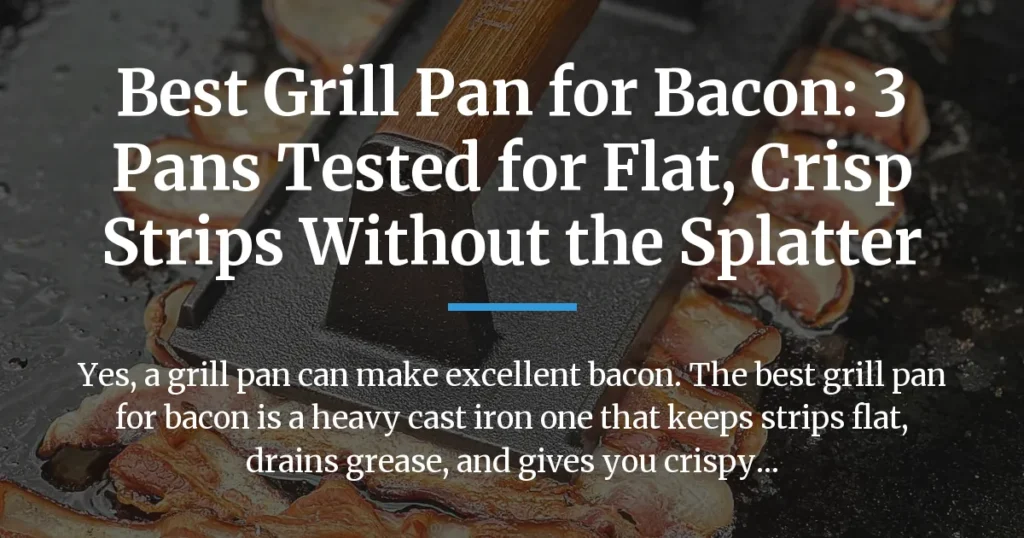
As an Amazon Associate, I may earn a small commission from qualifying purchases at no extra cost to you. This helps me create more valuable, tested content for you.
Cooking bacon in a grill pan sounds like one of those internet ideas that sounds clever but doesn’t actually work. You picture grease pooling in the channels, the bacon curling up like a potato chip, and a nightmare clean-up. Then you see a Reddit thread where someone swears by their IKEA grill pan, and you start wondering. So I spent a few weekends testing this exact premise. Does a grill pan actually make better bacon? Or is it just a gimmick for people who like grill marks on their toast?
Short answer: It works, but only with the right pan. A grill pan solves the two biggest stovetop bacon problems — grease splatter and uneven cooking — but it introduces a new one: the curl. Bacon loves to cup up on a ridged surface. The solution is weight. Heavy pans keep the meat flat while the channels catch the rendered fat. After testing three very different pans, I can tell you exactly which one solves that curl problem the best.
Here’s the honest breakdown of the best grill pan for bacon, ranked from best texture to easiest clean-up. Your priority determines your pick.
My Top Three Grill Pans for Bacon at a Glance
If you just want the short version, this list sums up who should buy which pan. I’ll dive into the details below, but this gives you a fast snapshot based on your kitchen style.
How a Grill Pan Changes Your Bacon Game
The first thing you notice when you cook bacon on a grill pan is the reduction in mess. A flat skillet leaves bacon sitting in a pool of hot grease, which splatters as it pops. The ridges on a grill pan lift the meat above the fat line. I’ve had fewer grease burns on my forearm since switching. That alone was worth the experiment.
But there are real physics at play here, not just convenience. The grill pan changes how heat transfers to the bacon and how the fat renders.
The Two Critical Criteria for Bacon
Not every grill pan works the same way. I learned this the hard way after my first attempt with a cheap nonstick pan that had shallow, decorative ridges. The bacon sank into the channels and fried in its own grease anyway. That defeated the whole point. Here’s what matters.
Channel Depth and Spacing: The ridges need to be tall enough to keep the meat suspended. If the channels are shallow, the bacon makes contact with the pan floor and starts frying from the bottom. You lose the dry-heat effect. Deep, wide channels give the fat room to pool below the meat. Both cast iron pans I tested have excellent channel depth. The All-Clad is shallower, which puts it a step behind.
Weight and Pressure: This is the big one. Bacon curls because the muscle fibers contract faster than the fat renders. A lightweight pan flexes with that contraction. A heavy pan resists it. The best grill pan for bacon is heavy enough to act as its own weight. You don’t necessarily need a separate press if the pan is heavy enough.
The Curl Problem
On a smooth skillet, the entire strip makes contact with hot metal, so it tends to cup upward at the edges. On a grill pan, only the ridges touch the meat. This uneven contact creates a different problem: the bacon wants to curl into the gaps. But if the pan is heavy and the heat is right, the weight flattens it. That’s why the Lodge and Victoria win — they’re six to eight pounds of dead weight pressing down.
1. Lodge Square Cast Iron Grill Pan 10.5 Inches
 Check Price on Amazon
- Brand: Lodge
- Material: Cast Iron (Pre-Seasoned)
- Size: 10.5 Inches
- Rating: 4.5 (32,000+ Reviews)
- Key Feature: Deep ridges that channel grease away from the meat
This is the one I reach for when I want the best texture. The first thing that surprised me was how flat the bacon stayed. I laid three strips of thick-cut bacon on the cold pan, turned the heat to medium, and watched. Usually I have to flip bacon halfway through because it warps. With the Lodge, it barely moved. The weight — roughly eight pounds — keeps everything pinned down.
The grease management is also impressive. The ridges are deep enough that the fat pools below the bacon strips without the meat soaking it up. You end up with crispy ridges on the contact points and slightly softer valleys. It’s not oven-crispy across the whole strip. But if you like the contrast between crunch and chew, this pan delivers that better than anything else I’ve tested.
Heating is not lightning-fast. Cast iron takes time to come up to temp, and you have to be patient. But once it’s hot, it stays hot. Even when I added cold bacon straight from the fridge, the pan didn’t drop temperature noticeably. That’s important for bacon because you want steady rendering, not a flash fry.
Now the downsides. You cannot put this in the dishwasher. Cleaning it means scrubbing with hot water and a stiff brush, then drying immediately and giving it a light oil rub. If that sounds like too much work, this pan is not for you. My seasoning has held up well after maybe two dozen uses, but I’m careful with it. A friend who owns the same pan left it soaking once and had to re-season the whole thing. So the upkeep is real.
Who is this pan for? It’s for someone who cooks bacon once or twice a week, wants restaurant-quality texture, and doesn’t mind a five-minute cleaning routine. It’s for people who cook on gas or induction and appreciate the way cast iron handles heat. And honestly, for the price point, it’s a no-brainer. You’d have to spend three or four times as much to get noticeably better bacon.
2. Victoria Cast Iron Square Grill Pan 10 Inches
 Check Price on Amazon
- Brand: Victoria
- Material: Cast Iron (Seasoned with Flaxseed Oil)
- Size: 10 Inches
- Rating: 4.5 (2,200+ Reviews)
- Key Feature: Anti-warp curvature and double loop handles
The Victoria came close to unseating the Lodge for the top spot. In some ways, it’s actually better. The invisible curvature on the bottom is designed to prevent warping on flat stovetops. If you’ve ever put a cast iron pan on a glass cooktop and watched it rock slightly, you know how annoying that is. The Victoria doesn’t do that. It sits perfectly flat every time.
The seasoning on this pan uses flaxseed oil, which is a non-GMO, kosher-certified coating. In practice, that means the surface feels slightly textured compared to the Lodge. I found that the bacon released more easily from this pan, especially during the first flip. The ridges are also well-spaced, so the fat drains effectively. The double loop handles are a nice touch too. They make it easier to grip with a towel or to lock a grill press onto if you want extra weight.
But there’s a trade-off. The flaxseed seasoning can be a bit fragile. I’ve read reports of it flaking off over time, and after several uses, I noticed a small patch near the edge where the seasoning seemed thinner. It hasn’t affected performance yet, but I suspect this pan may require more frequent re-seasoning than the Lodge. That’s the main reason it’s second instead of first.
In terms of bacon performance, it’s essentially the same as the Lodge. Flat strips, crispy ridges, good grease control. The difference comes down to durability over years of use. The Lodge has a proven track record across hundreds of thousands of users. The Victoria is newer to my kitchen. So far, it’s great, but the seasoning question gives the longevity edge to Lodge.
This pan shines most for people with induction or glass stovetops. The anti-warp design is a genuine advantage for that setup. It’s also a great choice for anyone who wants a slightly lighter pan — it’s about half a pound less than the Lodge, which makes a difference when you’re moving it from burner to countertop.
3. All-Clad HA1 Expert Hard Anodized Nonstick Grill Pan
 Check Price on Amazon
- Brand: All-Clad
- Material: Hard Anodized Aluminum (Nonstick Coating)
- Size: 11×11 Inches
- Rating: 4.0 (103 Reviews)
- Key Feature: Dishwasher safe and oven safe up to 500°F
This is the pan for people who hate the idea of hand-washing cookware. I get it. Not everyone wants to babysit a piece of iron. The All-Clad is different from the other two in every meaningful way. It’s lightweight, heats up fast, and goes straight into the dishwasher when you’re done. No seasoning. No oil rubs. Just soap and a cycle.
Bacon performance is decent but not great. The nonstick coating means the bacon releases immediately, which is nice. You don’t have to pry it off the ridges. The surface is also easier to wipe clean between batches. But the pan is much lighter than the cast iron options — probably a third of the weight. That means it doesn’t keep bacon flat as well. I noticed the strips curled more, especially towards the ends. You can mitigate that with a grill press, but that’s an extra tool to buy and store.
The ridges on the All-Clad are also shallower. Bacon makes more contact with the pan floor, which reduces the grease-draining effect. You still get some benefit, but it’s not as pronounced as with the Lodge or Victoria. The fat stays in the channels, but some of it touches the bottom of the meat.
Heat control is excellent. The hard anodized aluminum responds quickly to temperature changes. If you accidentally overshoot the heat, you can dial it back and the pan cools down fast. That’s harder to do with cast iron, which holds heat for minutes after you turn the burner off. For someone who wants precision, this is an advantage.
The cost is the other issue. It’s roughly three times the price of the Lodge. You’re paying for the All-Clad name and the convenience features. Whether that’s worth it depends on how much you value dishwasher safety. For perfecitonist bacon cooks, the cast iron pans are almost certainly better. But if your priority is getting through a Wednesday breakfast with minimal cleanup, the All-Clad makes sense.
The Technique: How to Cook Bacon in a Grill Pan
Even the best grill pan for bacon won’t save you if you use the wrong technique. I’ve made every mistake possible — high heat, oiling the pan, overcrowding. Here’s what actually works.
Cold Pan Method: Start with a cold pan. Lay the bacon strips on the ridges, then turn the heat to medium. This gives the fat time to render slowly before the meat gets hot. If you put bacon on a screaming hot pan, the outside cooks too fast and the fat doesn’t melt properly. You end up with tough, chewy strips.
Set the Heat to Medium or Medium-Low: This is counterintuitive if you’re used to searing steaks. Bacon sugar burns at high heat. You want a gentle sizzle, not a violent pop. I set my gas burner to just above medium and let it work for about six minutes per side. For thinner bacon, you might need less time. Thick-cut bacon needs more. Adjust based on what you see.
When to Use a Press: If your pan is light (like the All-Clad), use a press. Lay it on top of the bacon after the first two minutes of cooking. Don’t press too early or you’ll squeeze out the fat before it renders. A little patience goes a long way.
Do Not Oil the Pan: Bacon has plenty of fat. Adding oil makes the grease splatter worse and interferes with the searing. The only time you might need oil is if your seasoning is very new and you’re worried about sticking. But even then, a very light wipe is enough.
Comprehensive Comparison Table
| Feature | Lodge (Best Overall) | Victoria (Best Flatness) | All-Clad (Best Cleanup) |
|---|---|---|---|
| Material | Cast Iron | Cast Iron | Hard Anodized Aluminum |
| Bacon Flatness | Excellent (Very Heavy) | Excellent (Anti-Warp) | Good (Lighter Weight) |
| Grease Drainage | Excellent (Deep Ridges) | Excellent | Good (Shallower Ridges) |
| Clean Up | Hand Wash / Season | Hand Wash / Season | Dishwasher Safe |
| Best Stove Top | All (Gas is best) | Induction / Glass | All (Including Induction) |
| Durability | Heirloom Quality | Heirloom Quality | Durable (Coating wears) |
| Rating | 4.5 (32K+ Reviews) | 4.5 (2.2K Reviews) | 4.0 (103 Reviews) |
The Verdict: Which One Should You Buy?
Bacon is personal. Some people want crisp, others want chewy. Some people will happily spend five minutes cleaning a pan if it means perfect results. Others just want breakfast done and the pan in the dishwasher. Here’s how I think about these three options.
Scenario A: “I want the best bacon of my life, and I don’t mind caring for a pan.” Get the Lodge. It’s the cheapest, heaviest, and most proven option. The 32,000 reviews aren’t an accident. People have been using these pans for decades. It keeps bacon flat, the ridges drain grease beautifully, and the heat management is superb once you learn the timing.
Scenario B: “I have a modern glass stovetop and want it to stay flat forever.” Get the Victoria. The anti-warp design is a genuine innovation. On glass or induction, a rocking pan is infuriating. Victoria solved that. The seasoning is good, the texture works, and the bacon comes out nearly identical to the Lodge. It just requires a bit more care over the long run.
Scenario C: “I just want quick, easy bacon on a weeknight without scrubbing.” Get the All-Clad. It’s not the best bacon maker out there, but it’s the most convenient. The nonstick surface cleans up instantly. The fast heat response is nice for people who forget to preheat. You trade a little texture for a lot of ease.
Frequently Asked Questions
Can I use a bacon press with a grill pan?
Yes, especially if your grill pan is lightweight. The Victoria pan with its double loop handles makes it easy to seat a press securely. For the Lodge, the press sits fine but the pan is heavy enough that you may not need one.
These same considerations come into play when choosing the best pan to grill salmon, where even heat and non-stick properties are critical for perfect skin.
Is one grill pan strip enough for a pound of bacon?
No. These pans are 10 to 11 inches across. You can fit about three to four strips comfortably without overlapping. For a full pound, you’d need to cook in batches or use a larger flat griddle. A grill pan is a small-batch tool.
Does the grill pan make bacon crispy?
It does, but the crispiness is textured. The ridges give you crunchy lines while the gaps stay softer. If you want every micron of the strip to be shatteringly crisp, the oven method is better. If you like a mix of crispy and tender, the grill pan wins.
Should I preheat the grill pan before adding bacon?
For this application, no. Start cold. Heating the pan empty can cause the bacon to seize up when it hits the hot surface. A cold start lets the fat render gradually and keeps the strips flatter.