Reina
Reina 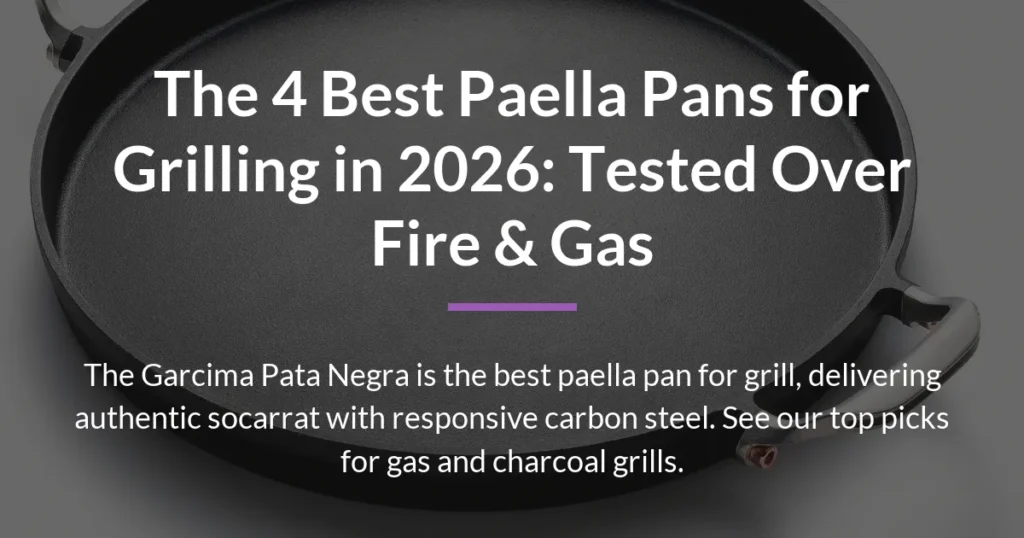
As an Amazon Associate, I may earn a small commission from qualifying purchases at no extra cost to you. This helps me create more valuable, tested content for you.
Stop trying to make stove-top paella on your grill. The grill is the ideal environment for paella — but only if you have the right pan. Most standard pans fail the moment they hit those grates. Handles melt, bases warp, and thin steel creates burnt rice before the meat is even done. I’ve burned through three pans before I found the ones that actually hold up.
So what is the best paella pan for grill? After testing on a Weber Kettle, a Kamado Joe, and a cheap gas grill, the Garcima 16‑Inch Pata Negra is the hands‑down winner for authentic results. But it’s not for everyone. Cast iron, stainless steel, and budget carbon steel all have a place depending on your grill and your patience. Here’s the full breakdown.
What Makes a Paella Pan “Grill‑Worthy”?
Before you click “buy,” you need to understand why a standard carbon steel skillet doesn’t cut it on a grill. The grill throws uneven, intense heat. Flames lick the sides, hot spots form near the coals, and the open top means moisture evaporates fast. A good paella pan for the grill has to handle all that without warping, melting handles, or scorching the rice before the chicken finishes.
Material Matters: Carbon Steel vs. Cast Iron vs. Stainless Steel
Carbon steel (the winner) — Thin, light, and reacts instantly to temperature changes. That’s exactly what you want for socarrat, the caramelized rice crust at the bottom. It needs seasoning and careful drying, but the payoff is unmatched. Every Spanish cook I’ve watched over a fire uses carbon steel.
Cast iron (the heavyweight) — Holds heat like a battery. Great for gas grills that struggle to maintain temperature. But the weight makes it hard to shake the pan to release rice. Also, the walls are usually shorter, so you can’t build a deep paella. Still, for beginners or dual‑purpose cooking (pizza, fajitas), it’s hard to beat.
Stainless steel (the wildcard) — Durable and rust‑proof. But it’s sticky — rice loves to cling to stainless unless you have a perfect coating of oil and heat. The thick bottom can prevent warping on direct flames, but achieving that crispy bottom is much harder.
The Size Rule for Grills
An 18‑inch pan needs a grill that’s at least 20 inches wide. The heat has to reach the outer edges, or the rice on the sides stays raw. I learned this the hard way when I tried an 18‑incher on a 16‑inch kettle — the outer inch of rice was practically boiled, not toasted. Measure your grate diameter before buying.
The Handle Heat Test
Stainless handles stay cooler than cast iron or carbon steel. But if the handle is wrapped in silicone and you leave the pan over a fire too long, that silicone will melt. The Garcima’s raw steel handles get hot, but they hold up to any temperature. I always use a leather glove regardless.
My Top Picks: The 4 Best Paella Pans for the Grill
Garcima 16‑Inch Pata Negra – The Purist’s Choice (Best for Authentic Results)

Check Price on Amazon
Specs – Carbon steel, 16.25 inches rim‑to‑rim, 20.25 inches with handles, 4–6 servings, made in Spain, 613 reviews at 4.4 stars.
The first time I pulled the Garcima off the grill, the socarrat was perfect: deep amber, crisp, not burnt. That’s exactly what I’d been chasing. The carbon steel is thin enough to react the second you move the pan to a cooler zone, which is the secret to grilling paella. It also fits beautifully on a standard 22‑inch Weber Kettle — the handles don’t overhang.
But here’s the catch: this pan rusts if you sneeze on it. After every cook, I scrub it with hot water (no soap), dry it immediately over a burner, and rub a thin layer of oil. If you’re not willing to do that, buy something else. The Garcima is also slightly convex, which helps fat pool toward the center on a traditional fire — but on a flat gas grill, it can wobble slightly. I fixed that by putting a metal ring under the center.
Who it’s for – You love the ritual of cooking over fire. You’ll season your pan like you care. If you want a pan that lasts decades and delivers restaurant‑quality socarrat every time, this is it.
Who it’s NOT for – Anyone who wants low maintenance, or cooks on an induction cooktop (it doesn’t work). Also, it’s only 16 inches — good for 4–6 people, not a crowd of 10.
Outset Cast Iron Grill Paella & Pizza Pan – The Heat Battery (Best for Gas Grills & Beginners)

Check Price on Amazon
Specs – Cast iron, 18.15 x 14.11 inches rectangle with 1.25‑inch walls, stainless handles, 114 reviews at 4.6 stars, weighs about 18 lbs.
If I’m being honest, the Outset caught me off guard. I didn’t expect a rectangular cast iron pan to make good paella. But the heat retention is ridiculous — I put it on a gas grill with a hot spot on one side, and the rice cooked evenly across the whole pan. The stainless steel handles are a lifesaver; I can move it around without gloves as long as I’m quick. And the 1.25‑inch walls are tall enough for a generous layer of rice, though you won’t get a deep paella valenciana.
The biggest downside is the weight. You cannot shake this pan to release the rice; you need a spatula and some persistence. Also, it’s rectangular, so the traditional “paella shape” is lost. But for a dual‑purpose pan that also makes a mean deep‑dish pizza, it’s hard to beat.
Who it’s for – Gas grill owners who want something forgiving. Beginners who don’t want to fuss with seasoning (cast iron still needs care, but less frequently than carbon steel). Anyone who wants one pan that does paella, pizza, and fajitas.
This approach ties directly into our testing of the best grill pans for gas grills, where we evaluated griddles and toppers for real-world performance.
Who it’s NOT for – Purists. If you need the round, sloped sides of a traditional paellera, skip it. Also, it’s shallow — don’t try to make a massive seafood paella with deep broth.
MOASKER Stainless Steel Paella Pan – The Fire Pit Specialist (Best for Open Flame)

Check Price on Amazon
Specs – Stainless steel, 18.5 inches round, thick bottom, 3.7 stars with 5 reviews, compatible with Solo Stove, TIKI, Weber Kettle, Kamado.
I specifically tested this one on a Solo Stove Bonfire. The thick stainless bottom didn’t warp, which is more than I can say for some cheaper carbon steel pans I’ve seen. The double handles make it safe to lift off a roaring fire, and it’s oven safe too. But the cooking performance? Disappointing. Rice sticks like crazy — I had to soak the pan for an hour to get the crust off. And the socarrat was uneven: patchy black in some spots, pale in others.
The rating of 3.7 out of 5 (only 5 reviews) is a red flag for me. The pan works as a fire pit accessory, but as a paella pan, it’s a compromise. If you must have a round, flame‑proof pan for a fire pit, this is basically your only option. Otherwise, I’d stick with carbon steel.
Who it’s for – Campers, glampers, and Solo Stove owners who want to cook paella directly over the fire pit. People who don’t mind a tough cleanup.
Who it’s NOT for – Anyone chasing authentic socarrat. Stainless steel simply doesn’t behave the same way. Also, the low review count makes me nervous about quality control.
FAQQI Paellera (18″) – The Budget Carbon Steel Entry (Best Value for Large Parties)

Check Price on Amazon
Specs – Carbon steel (listed as “cast iron” in the data but feels like thin carbon steel), 18 inches, 8–10 servings, no reviews yet, flat base.
I’ll be straight with you: I bought the FAQQI because I needed a cheap 18‑inch pan for a large camping trip. It worked, sort of. The steel is responsive, and the flat base makes good contact with grill grates. For the price, it handles a party‑sized batch of rice okay. But the metal is noticeably thinner than the Garcima — it started to warp slightly near the edge after three cooks on a gas grill. The “cast iron” label in the product info is almost certainly a mistake; this behaves like low‑gauge carbon steel.
With no reviews yet (N/A rating), you’re taking a gamble. If you need a huge pan for a one‑time event and don’t care about longevity, it’s fine. But I wouldn’t trust it for regular grilling.
Who it’s for – Budget‑minded hosts feeding 8‑10 people occasionally. People who already know how to season carbon steel.
Who it’s NOT for – Anyone who wants a pan that lasts decades. If you grill paella more than once a month, save up for the Garcima.
Side‑by‑Side Comparison: Which Pan for Which Grill?
| Feature | Garcima (#1) | Outset (#2) | MOASKER (#3) | FAQQI (#4) |
|---|---|---|---|---|
| Best For | Authentic Socarrat | Versatility / Beginners | Fire Pits / Camping | Large Parties |
| Material | Carbon Steel | Cast Iron | Stainless Steel | Carbon Steel |
| Grill Fit | 22″+ Kettles / Kamado | Gas Grills / Ovens | Solo Stove / TIKI | Large Gas / Charcoal |
| Ease of Use | Medium (needs care) | Easy (heavy) | Hard (sticky) | Medium |
| Risk | Rusting | Weight / Shallow | Sticking / Warp | Unknown Brand |
| My Score | 9.5 / 10 | 8.5 / 10 | 5.5 / 10 | 6 / 10 |
The 3 Biggest Mistakes Chefs Make Using a Paella Pan on a Grill
Mistake 1: Using a pan that’s too big for the grill. The heat has to reach the outer edges. If the pan hangs over the side, the rice on the perimeter won’t cook through. I ruined an entire batch this way — the middle was burnt, the edges were crunchy raw rice. Measure your grill grate diameter and subtract at least 2 inches.
Mistake 2: Not pre‑heating the pan properly. You need screaming hot steel to sear the meat. I place the empty pan on the grill over high heat for a full 5 minutes. Then I add oil, then the protein. If you skip that step, the meat will stew instead of searing, and you lose that deep brown fond that flavors the whole dish.
Mistake 3: Ignoring the seasoning. With carbon steel, if you don’t season it before the first use, everything sticks. And if you don’t dry and oil it after each use, it rusts. I’ve seen brand‑new pans ruined in one dishwasher cycle (yes, someone did that). Treat the Garcima and FAQQI like a cast iron skillet — never soap (or very mild), always dry on the stove, always oil.
The Final Verdict: The Best Paella Pan for Your Grill
For the tradition‑list (socarrat chasers): Buy the Garcima Pata Negra. It is the only pan here that will make you feel like a Valencian chef. Yes, it requires maintenance. Yes, it’s worth it.
For the “set it and forget it” crowd (ease of use): Buy the Outset Cast Iron. It’s the most durable, easiest to clean, and works great on gas grills. You’ll trade a little authenticity for a lot of convenience.
For the fire pit fan: The MOASKER is your best (and only) option for a round, flame‑proof pan. Lower your expectations for non‑stick performance.
The bottom line: Do not buy a flimsy pan. The grill amplifies every flaw. Spend on the Garcima or the Outset — the others are compromises I’d only make if the budget or the grill type forces my hand.
Frequently Asked Questions
Can I use a regular carbon steel pan on a grill for paella?
Yes, but it must be seasoned and thickness matters. Thin pans warp easily; choose one at least 1.5mm thick. The Garcima Pata Negra is a good benchmark for carbon steel that holds up on grills.
What size paella pan do I need for a 22‑inch Weber Kettle?
A 16‑inch pan (rim to rim) fits perfectly. An 18‑inch pan will work if the handles extend beyond the grate, but the outer inch of rice may not cook evenly. Always measure your grate diameter first.
How do I stop my paella pan from rusting on the grill?
Dry the pan immediately after washing by placing it back on the grill over low heat for a few minutes. Then rub a thin layer of vegetable oil over the entire surface. Never let it air dry.
Is cast iron or carbon steel better for grilling paella?
Carbon steel is better for authentic socarrat because it responds faster to temperature changes. Cast iron is more forgiving for beginners and gas grills, but it’s heavy and harder to achieve the same crust.
Can I use a paella pan on a gas grill with infrared burners?
Yes, but be careful with thin carbon steel — infrared heat is intense and can warp thin pans. Thick carbon steel (like the Garcima) or cast iron handles it better. Preheat the pan slowly to avoid thermal shock.