Reina
Reina 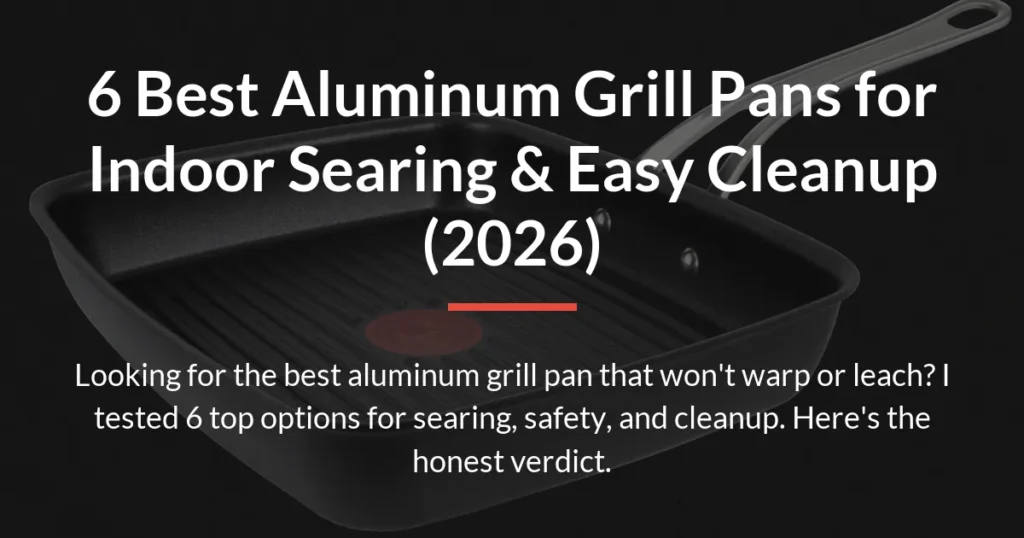
As an Amazon Associate, I may earn a small commission from qualifying purchases at no extra cost to you. This helps me create more valuable, tested content for you.
I love the taste of a good char. That smoky, slightly crisp exterior on a steak or a bell pepper — it’s what summer is built around. But I live in an apartment with a gas stove that doesn’t vent worth a damn, and I got tired of setting off the smoke detector every time I wanted a sear.
Cast iron felt like the obvious answer. Except I hated the weight. I hated the seasoning ritual. And honestly, I didn’t love the idea of hauling a 20-pound slab out of the cabinet every Tuesday night.
So I started looking at aluminum grill pans. Lightweight, conducts heat fast, and if you pick the right one, cleanup is a breeze. But here’s the thing — not all aluminum pans are created equal. Some warp the second you look at them wrong. Some have coatings that make you wonder what exactly you’re eating. And some just don’t sear worth a damn.
If you frequently cook fish, the best grill pan for fish can be a game-changer for achieving those perfect grill marks without the frustration of sticking.
After spending weeks cooking on six different models — from reusable nonstick pans to disposable trays — I landed on a clear winner. If you want the short version: the best aluminum grill pan for most people is the Moss & Stone Aluminum Nonstick Grill Pan. It balances weight, heat distribution, and durability better than anything else I tried. But depending on what you care about most — health safety, versatility, or zero cleanup — there’s a better pick for you. I’ll walk through all of them.
How to Choose a Non-Toxic, Non-Warping Aluminum Grill Pan
Before I get into the reviews, let me tell you what I learned the hard way. Aluminum grill pans look simple, but a few details separate the ones that last from the ones that end up in the trash after three uses.
The Coating Matters Most — PFAS vs. Ceramic
Here’s the tension. Standard nonstick coatings — the kind that work really well — have historically relied on PFAS chemicals. The industry has moved away from PFOA specifically, but many still use related compounds. If you’re someone who reads ingredient labels and worries about what’s leaching into your food, you want a ceramic coating. GreenPan’s Thermolon coating is the gold standard here — it’s PFAS-free, and I can personally vouch that it doesn’t degrade into weird fumes even when I accidentally left it on high heat for too long.
But here’s the trade-off: ceramic coatings are generally less slick than traditional nonstick. They release food well, don’t get me wrong, but they don’t have that glassy, egg-slides-off surface that Teflon-style coatings have. The Moss & Stone uses a double-layer PFOA-free nonstick that’s closer to traditional performance. So if you prioritize release over absolute toxin-free peace of mind, that’s your move.
The Warp Factor — Why Gauge and Material Type Matter
The first aluminum pan I ever bought — a cheap one from a grocery store — warped on my stovetop the second time I used it. It spun like a top. The problem was thin aluminum. When you’re shopping, look for either hard-anodized aluminum (like the GreenPan) or cast aluminum (like the Moss & Stone and SENSARTE). These materials resist warping because the metal is denser and more rigid.
The disposable pans — PLASTICPRO, Frcctre, and DCS Deals — are a completely different animal. They’re thin aluminum, and they’re not meant for stovetop use at all. Those are designed for oven roasting or lining grill grates. I’ll get into that later.
Stovetop Compatibility — What Works Where
One thing that tripped me up early: not all aluminum pans work on induction. Induction cooktops require a magnetic base, and aluminum is non-magnetic. The GreenPan, for instance, is gorgeous but won’t work on induction. The Moss & Stone, on the other hand, has a base that’s induction-compatible. Here’s a quick breakdown:
- Moss & Stone: Induction, gas, electric, ceramic — all of them
- GreenPan Chatham: Gas and electric, but not induction
- SENSARTE Pro-Grid: Gas and electric, but not induction
- Disposables (all three): Oven use only — never put these on a stovetop burner
The Best Aluminum Grill Pans — Reviewed and Compared
I cooked the same meals across all six pans: a ribeye steak, chicken thighs, zucchini slices, and a batch of bell peppers. I paid attention to heat distribution, how well the food released, cleanup effort, and any signs of warping or coating wear. Here’s what I found.
1. Moss & Stone Aluminum Nonstick Grill Pan — Best Overall

Check Price on Amazon
- Rating: 4.7 / 5.0 (1,678 reviews)
- Material: Cast aluminum with double-layer PFOA-free nonstick
- Size: 11 inches square
- Compatibility: All stovetops including induction
- Dishwasher safe: Yes
This pan surprised me. I went in expecting it to be fine, not great. But from the first cook, it performed like something twice its price. The cast aluminum body is thick enough that I didn’t see any warping, even when I preheated it on medium-high for a good five minutes. Heat spread evenly across the entire surface — no hot spots in the center while the edges stayed cold.
The ribs are well-proportioned too. They’re tall enough to leave distinct sear marks but not so tall that food balances awkwardly. My ribeye came out with a deep, even crust. The chicken thighs released without sticking, which is usually where nonstick pans fail — the skin gets tacky and you end up tearing it. Not here.
Cleanup was genuinely easy. A quick rinse and a soft sponge wiped off the grease. I didn’t need to soak it. The pour spouts on the sides are a small touch, but they made draining the fat after cooking bacon a lot less messy than tilting a square pan toward the sink.
The only catch: the coating is standard nonstick, not ceramic. It’s PFOA-free, which is good, but if you’re the type who worries about any nonstick chemistry at all, you might prefer the GreenPan. That said, for most people, this is the one.
Who it’s for: Anyone who wants one pan that works on any stovetop, cooks well, and cleans up fast.
Who it’s not for: People who insist on ceramic nonstick or need oven safety above 500°F.
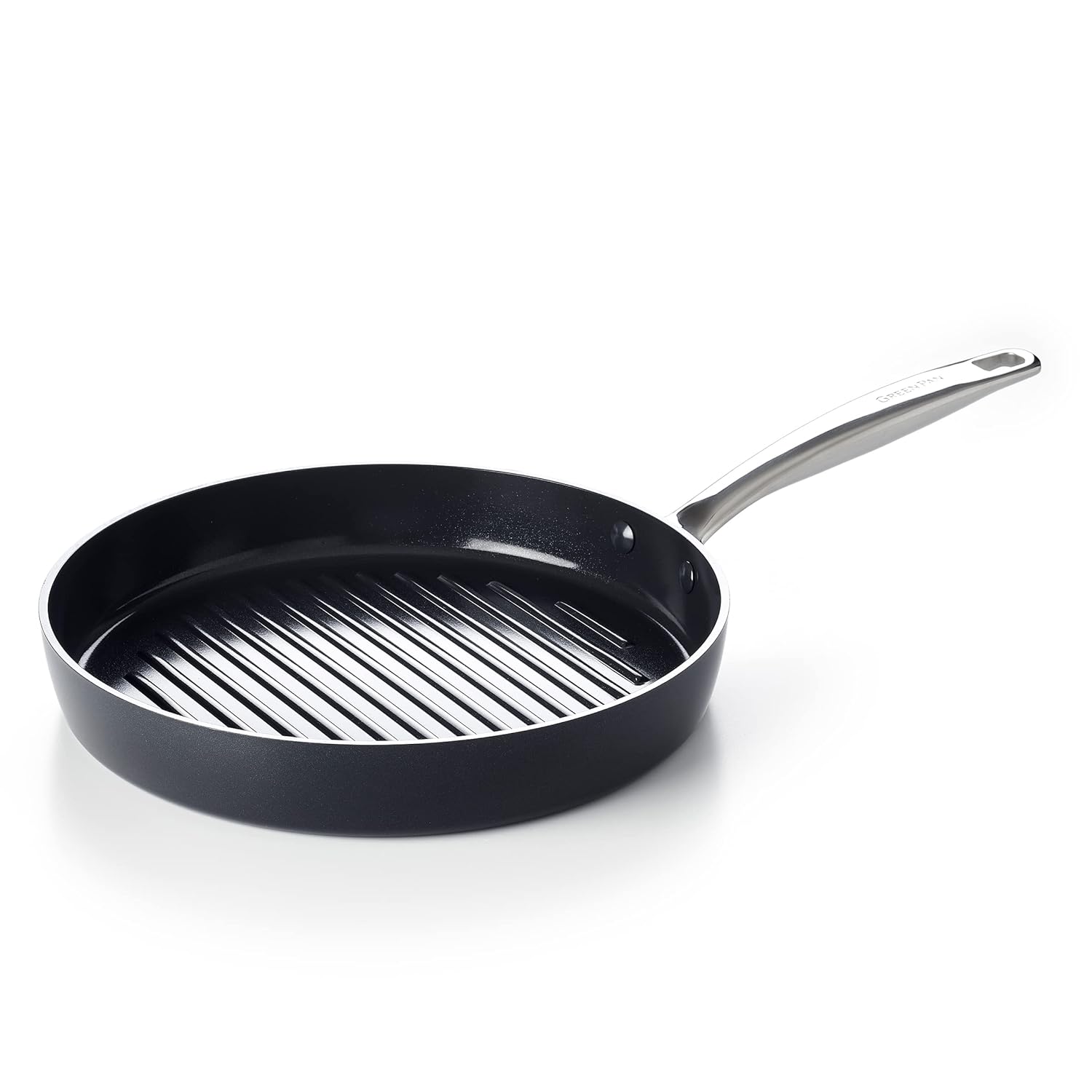
2. GreenPan Chatham Prime Midnight — Health-First Choice
Check Price on Amazon
- Rating: 4.6 / 5.0 (87 reviews)
- Material: Hard-anodized aluminum with Thermolon ceramic nonstick
- Size: 11 inches
- Compatibility: Gas and electric — not induction
- Oven safe: Up to 600°F
If you’re concerned about what’s in your cookware’s coating, this is the pan you want. The Thermolon ceramic is free of PFAS, PFOA, lead, and cadmium. I’m not a paranoid person about cookware, but I did notice that even when I cranked the heat too high — which I did intentionally to test — there was zero smell or smoke from the coating itself. That alone gave me peace of mind.
The hard-anodized body is a tank. It’s the most durable-feeling pan in this lineup. The diamond-reinforced coating is also metal-utensil safe, which I tested by using a metal spatula on it a few times. No scratches. I wouldn’t make a habit of it, but it handled the abuse better than any other nonstick I’ve used.
Performance-wise, it seared well. The heat distribution was even, and the 600°F oven safety meant I could start a steak on the stovetop and finish it in the oven without switching pans. That’s a luxury the others don’t offer.
But — and here’s the honest part — the ceramic coating isn’t as slick as the Moss & Stone’s traditional nonstick. Food released fine, but I had to use a tiny bit more oil to prevent sticking on the ribbed ridges. Also, at a higher price point, and without induction compatibility, it’s a more targeted purchase.
Who it’s for: Health-conscious cooks who want zero PFAS and don’t mind spending more for peace of mind.
Who it’s not for: Induction cooktop owners or anyone on a tight budget.
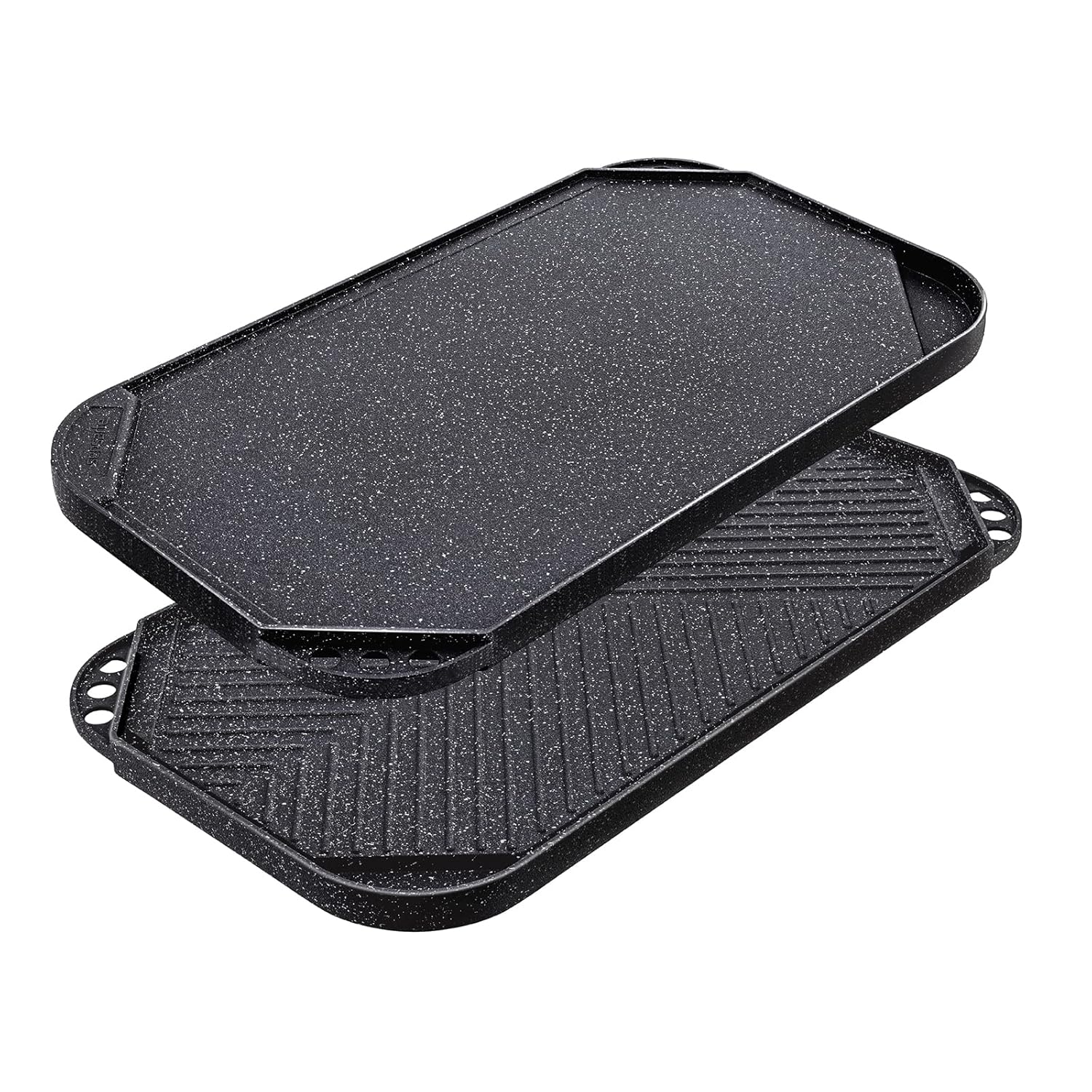
3. SENSARTE Pro-Grid Reversible Grill & Griddle — Most Versatile
Check Price on Amazon
- Rating: 4.6 / 5.0 (3,225 reviews)
- Material: Cast aluminum with Switzerland ILAG nonstick (PFOA/PFOS-free)
- Size: 19.5″ x 10.7″ (two-burner)
- Weight: 4.4 lbs
- Compatibility: Gas and electric — not induction
This one is a monster. Not in a bad way — it’s still lighter than a cast iron griddle of the same size — but it’s big. It spans two burners, which means you can cook a lot of food at once. I made four burgers and a heap of sliced onions on the griddle side, then flipped it over for chicken breasts on the ribbed side. The reversible design is genuinely useful, not a gimmick.
The Switzerland ILAG coating is toxin-free, which I appreciated. It’s not ceramic, but it’s free of PFOA, PFOS, and APEO. The release performance was excellent — eggs on the flat side slid around like they were on ice.
It has a grease trap, which catches drippings when you’re using the ribbed side. That kept my stovetop cleaner than any other pan in this test. And the hanging hole in the handle makes storage manageable, even though it’s large.
The downside: because it’s two-burner width, it won’t fit on a single small burner evenly. You need two burners running at similar temperatures, which isn’t always easy to coordinate. And it’s heavy for aluminum — 4.4 lbs — though still manageable compared to cast iron.
Who it’s for: Families, campers, or anyone who cooks large batches and wants both a griddle and grill in one pan.
Who it’s not for: Small kitchens with limited burner space or single-burner cooks.
4. PLASTICPRO Disposable Aluminum Grill Pans — Best for Zero Cleanup

Check Price on Amazon
- Rating: 4.5 / 5.0 (1,584 reviews)
- Material: Thin disposable aluminum
- Pack: 10 pans
- Use: Oven, broiler, or grill liner — not stovetop
- Features: Ribbed bottom for grill marks
These are a completely different category from the reusable pans. They’re thin aluminum trays with a ribbed bottom, designed for oven use or as liners on a gas grill. I used them under the broiler for salmon fillets and vegetable medleys, and they worked exactly as intended. The ribbed bottom lifted the food slightly, allowing air to circulate and creating those light char lines.
The biggest advantage is obvious: zero cleanup. When dinner was done, I tossed the pan. That’s unbeatable for busy weeknights or tailgating. I also used one as a drip tray on my gas grill to catch grease from burgers, which saved me a scrubbing session.
But you cannot — and I mean cannot — put these on a stovetop burner. The aluminum is too thin. It will warp instantly, possibly flip, and you’ll have a mess. These are strictly for oven, broiler, or grill use. Also, they’re single-use, which means ongoing cost and waste.
Who it’s for: People who want grill marks in the oven without buying a reusable pan, or anyone who prioritizes convenience over sustainability.
Who it’s not for: Stovetop cooking or daily use where you want a permanent pan.
5. Frcctre 25-Pack Disposable Aluminum Grill Pans — Best for Large Batches

Check Price on Amazon
- Rating: 5.0 / 5.0 (8 reviews — new product)
- Material: Disposable aluminum
- Size: 16.5″ x 11.75″ x 0.8″
- Pack: 25 pans
- Features: Small holes for smoke infusion and grease drainage
These are larger than the PLASTICPRO pans, and they come with small holes punched in the bottom. The idea is that when you use them on a grill, smoke and heat come up through the holes to infuse the food with BBQ flavor while grease drains out. I tested these on a gas grill with chicken thighs, and the concept works. The skin crisped nicely, and the holes didn’t cause any flare-ups.
They’re also thick enough — for disposable pans — to hold a full tray of vegetables without buckling. The size is generous; you can fit a whole chicken or a large batch of burgers.
The caveat: this is a new product with only 8 reviews. The 5.0 rating is promising, but there’s no long-term data on batch consistency. Also, same as all disposables, these are not for stovetop use.
Who it’s for: Big-batch grillers who want smoke penetration and easy cleanup for large parties.
Who it’s not for: Anyone who needs stovetop capability or prefers established products with more reviews.
6. DCS Deals Disposable Broiler Pans — Best Value Pack

Check Price on Amazon
- Rating: 4.6 / 5.0 (1,369 reviews)
- Material: Disposable aluminum
- Size: 13.4″ x 9″ x 0.85″
- Pack: 25 pans
- Features: Ribbed bottom for grill marks
These are the most established disposable option in this lineup, with over 1,300 reviews and a solid rating. They’re a bit smaller than the Frcctre pans, which means they fit better in a standard oven or under a broiler. The ribbed bottom works well — I roasted asparagus and broiled fish fillets, and both came out with nice light char marks.
The aluminum is sturdy enough for a single use without tearing or leaking. I also used one as a liner under a roasting rack, which saved me from scrubbing a baking sheet. For the price per pan, it’s hard to beat the value.
The size is the main limitation. At 13.4″ x 9″, you’re not cooking a full brisket or a large turkey in these. They’re best for smaller portions or as liners. And again, stovetop use is out of the question.
Who it’s for: Budget-conscious cooks who want a reliable disposable option for oven grilling or grill liners.
Who it’s not for: Large-batch cooking or anyone who needs a reusable pan.
Which Pan Should You Buy? A Straightforward Breakdown
I’ve used all six, and here’s how I’d decide if I were you.
For the health-conscious cook who wants zero toxins and high-heat oven safety: The GreenPan Chatham is your pan. The ceramic Thermolon coating is about as safe as nonstick gets, and the 600°F oven rating is a genuine advantage. Just know it won’t work on induction and the coating isn’t quite as slick as standard nonstick.
For the budget-conscious cook who wants one pan to rule them all: The Moss & Stone is the best aluminum grill pan for the money. It works on every stovetop, sears beautifully, and cleans up in seconds. Over 1,600 reviews back it up, and my own testing confirmed it.
For the family cook or camper who needs to feed a crowd: The SENSARTE Pro-Grid is a workhorse. The reversible design gives you two surfaces in one pan, and the size means you can cook for six people at once. It’s not induction-friendly specifically because of its size, but on gas and electric it’s fantastic.
For the lazy cleaner or tailgate chef: The PLASTICPRO 10-pack is the move. Use them in the oven or on the grill, then toss them. No scrubbing. Just make sure you never put them on a stovetop burner.
How to Use an Aluminum Grill Pan Without Ruining It
I ruined my first aluminum pan by doing exactly what felt intuitive: cranking the burner to high and waiting for smoke. Don’t do that. Aluminum conducts heat so efficiently that medium-high is usually enough for a solid sear. If you go full blast, you risk warping the pan and burning your food before the inside cooks.
Another trick I learned: even nonstick pans benefit from a light coat of oil wiped into the ribs before heating. It fills the micro-grooves and helps food release from the raised ridges. Just a thin layer with a paper towel does the trick.
And for cleaning, hand wash with a soft sponge. Dishwasher detergent is harsh on nonstick coatings, and over time it will degrade the surface. A quick hand wash takes thirty seconds — worth it to keep the pan performing well.
Frequently Asked Questions
Are aluminum grill pans safe? Won’t aluminum leach into my food?
This is the most common concern I hear. The short answer is that hard-anodized aluminum and nonstick coatings — like those on the GreenPan, Moss & Stone, and SENSARTE — create a barrier that prevents leaching. The aluminum is sealed. Disposable pans are fine for occasional use, but I wouldn’t cook acidic foods like tomatoes in them for long periods. If you’re still worried, the ceramic-coated GreenPan is the safest bet.
Can I use an aluminum grill pan on an induction cooktop?
Only if the pan is specifically designed for it. The Moss & Stone works on induction because it has a magnetic base. The GreenPan and SENSARTE do not. Always check the product specs before buying if you have induction.
Do these pans produce a lot of smoke indoors?
They can, but it depends on your oil and heat level. Use an oil with a high smoke point — avocado or grapeseed oil — and keep the heat at medium-high. If you see smoke, you’re too hot. These pans are for indoor grilling, not recreating a flattop grill at a diner.
Can I put these pans in the dishwasher?
The manufacturers say yes for most of them, but I recommend hand washing. Dishwasher detergents are abrasive and can dull the nonstick surface over time. It takes thirty seconds to wash by hand, and your pan will last years longer.
The Final Verdict
If I had to pick just one pan to recommend — one pan that works for the widest range of people, stovetops, and cooking styles — it’s the Moss & Stone Aluminum Nonstick Grill Pan. It’s lightweight, sears well, doesn’t warp, and works on induction. It’s the best aluminum grill pan for the simple reason that it does everything well without asking you to compromise.
But if your priority is absolute non-toxic safety, the GreenPan Chatham is your pan. And if you’re feeding a crowd or want the convenience of disposables, the SENSARTE and PLASTICPRO respectively are excellent choices.
The bottom line: you don’t need a 20-pound cast iron skillet to get a good sear. Grab an aluminum pan, preheat it on medium, and get those grill marks back. I promise your arm — and your smoke detector — will thank you.