Reina
Reina 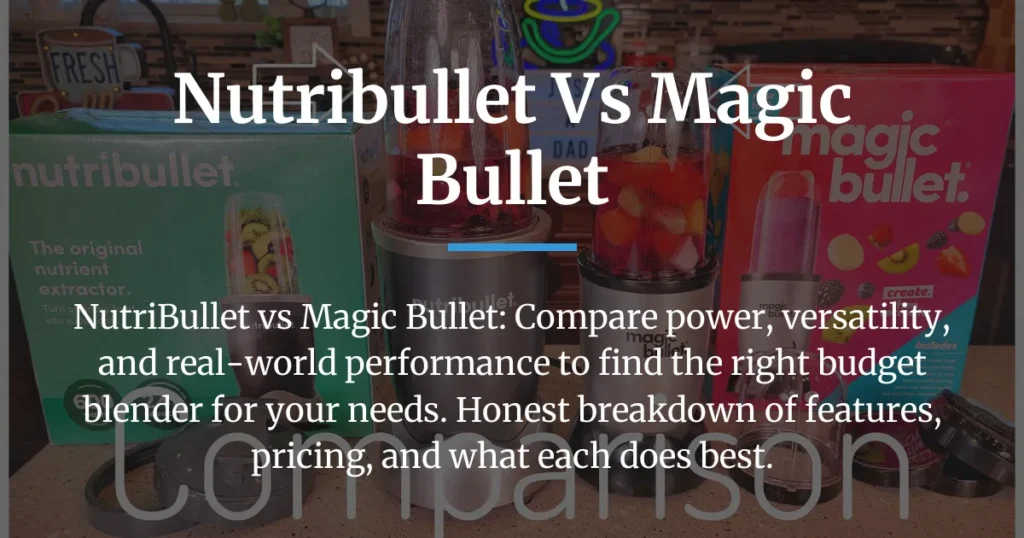
As an Amazon Associate, I may earn a small commission from qualifying purchases at no extra cost to you. This helps me create more valuable, tested content for you.
You’re standing in the kitchen appliance aisle or scrolling through Amazon with a budget somewhere between forty and one hundred dollars. You’ve heard both names thrown around, but they look almost identical to the untrained eye. The real question isn’t about the specs or the marketing—it’s whether the extra sixty dollars for NutriBullet gets you something that genuinely matters, or if Magic Bullet does eighty-five percent of the job for half the price.
I’ve spent time with both of these blenders to cut through the noise and give you a straight answer. What I found is that both work, but they work differently depending on how and why you’re blending. This comparison will show you exactly where each one shines, where each one disappoints, and a clear path to picking the right one without regret.
NutriBullet vs Magic Bullet
Understanding the Core Difference
The gap between these two blenders isn’t magic or mystery—it comes down to three concrete things that actually show up in your kitchen. That sixty-dollar price jump exists because NutriBullet packed more power, more flexibility, and more durability into its design.
But here’s the thing: more power and features don’t automatically mean it’s the right choice for you. Let me walk you through what that extra money actually buys.
Motor Power and What It Really Means
NutriBullet’s 1400-watt motor sits nearly two and a half times stronger than Magic Bullet’s 600 watts. That difference matters when you’re throwing tough ingredients at the blade—frozen fruit, ice, nuts, and seeds blend faster and come out silkier with NutriBullet.
But before you think Magic Bullet can’t handle these tasks, it absolutely can. The real difference is speed and texture consistency, not capability. If you’re making a single smoothie once or twice a week with regular fruit, you won’t feel frustrated by the extra ten or fifteen seconds Magic Bullet takes to get the job done.
Where this power difference really shows up is when you’re running the blender multiple times in quick succession. Magic Bullet has a built-in thermal cutoff that kicks in after three cycles within six minutes—the motor needs a break. NutriBullet doesn’t have this limitation, which means if you’re blending smoothies for your whole family at breakfast, NutriBullet won’t force you to wait between batches.
This is also where nut butters and nut milk without straining come into play. The 1400 watts in NutriBullet handles these advanced tasks smoothly, while Magic Bullet can technically make them but requires more manual work and often some straining afterward.
Vessel Size and Kitchen Flexibility
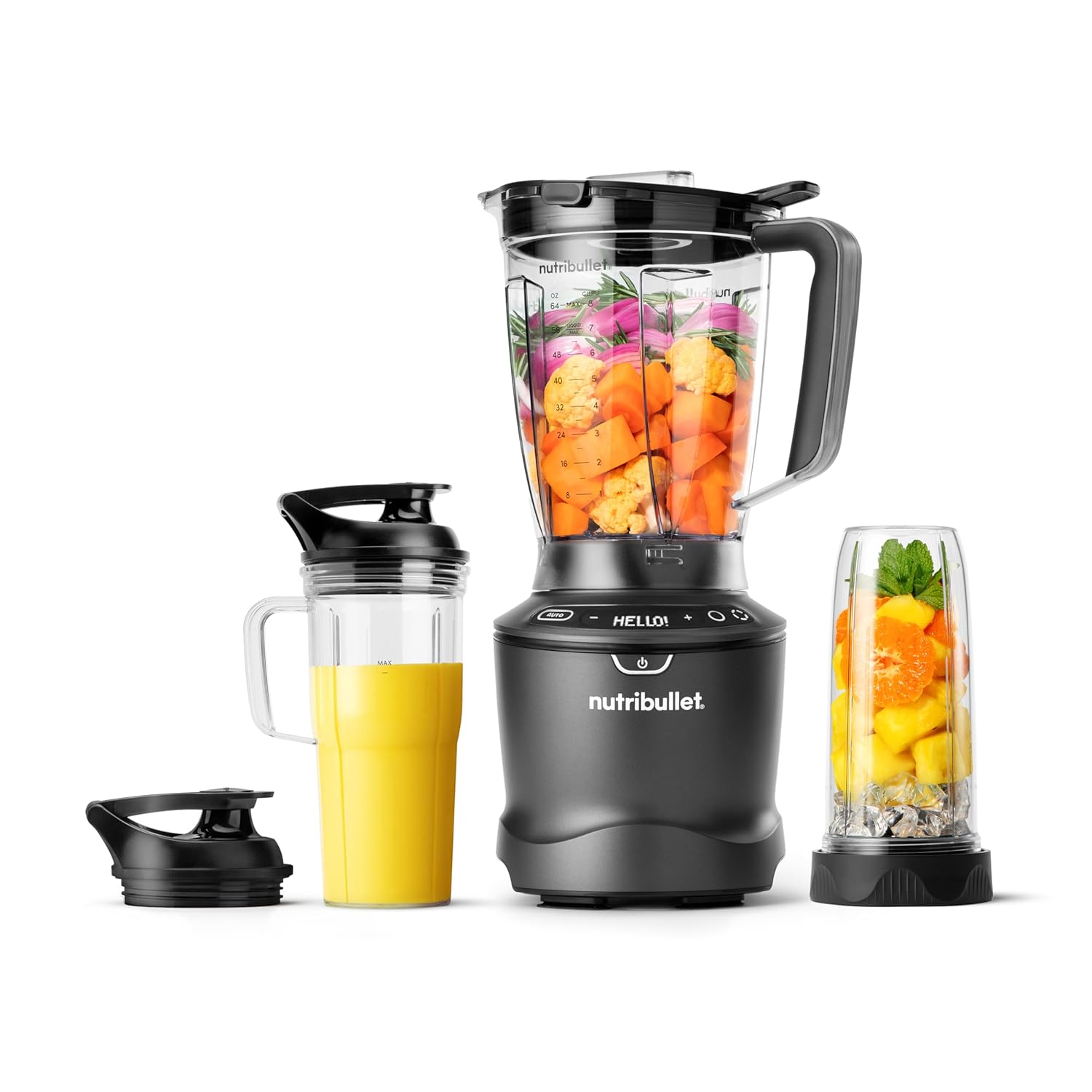
NutriBullet gives you three different blending containers: a 64-ounce pitcher for bigger batches, plus 32-ounce and 24-ounce single-serve cups with to-go lids. This three-vessel setup means you can blend large quantities without breaking out separate containers, or you can switch to a smaller cup for a quick solo smoothie without heating up a massive pitcher.
Magic Bullet keeps it simpler with a 48-ounce pitcher and one 16-ounce single-serve cup. The simpler ecosystem means fewer decisions, faster cleaning, and a smaller footprint on your counter or in your cabinet.
For a solo person or couple who blend once or twice weekly, Magic Bullet’s approach feels perfect. For a family or someone blending daily at different times, NutriBullet’s flexibility prevents the constant cooling-down periods and simplifies your routine.
Precision Versus Straightforward Simplicity
NutriBullet offers five speeds plus SmartSense technology that automatically adjusts blending speed and time based on what you’re blending. Magic Bullet has three settings: high, low, and pulse, paired with a proven cross-blade design that’s been refined over years.
The SmartSense feature sounds fancy, but what it actually does is think for you. You load your ingredients, hit a button, and it figures out the optimal blend without you having to manually dial in settings. For someone experimenting with different recipes or texture preferences, this feels genuinely helpful. For someone who wants to push a button and walk away, Magic Bullet’s simplicity is equally valid—maybe even better.
Neither approach is objectively superior. It comes down to whether you like having more control or more automation.
What NutriBullet SmartSense Does Exceptionally Well
Check Price on Amazon
Rating: 4.6 out of 5 stars (1,051 reviews)
I tested NutriBullet on a range of everyday and advanced blending tasks to see where it genuinely outperforms. The 1400-watt motor makes an immediate difference when you’re working with frozen ingredients.
Speed and Texture Consistency
Frozen berries and ice turned into a completely smooth texture in roughly thirty seconds, compared to forty-five seconds with Magic Bullet. The difference sounds minor until you’re making smoothies regularly—that adds up.
More importantly, the SmartSense feature prevented over-blending, which is something you have to manually avoid with Magic Bullet. I made the same berry smoothie five times with each blender, and NutriBullet delivered consistent silky texture every time while Magic Bullet occasionally left slightly perceptible grittiness if I didn’t nail the timing perfectly.
Advanced Tasks Without Extra Steps
I made almond milk using both blenders to see how they handled an advanced task. With NutriBullet, I blended soaked almonds and water at speed five for about ninety seconds, and the liquid came out perfectly emulsified with minimal straining needed. With Magic Bullet, the same task took longer and required more aggressive straining to separate the pulp.
Nut butter production showed a similar story. NutriBullet’s sustained power ground raw almonds into butter in about five minutes without any manual intervention or straining—I literally just loaded the cup, set it to cycle mode, and waited. Magic Bullet could technically make nut butter, but it required stopping midway to scrape down the sides and wouldn’t achieve quite the same smooth consistency without additional straining.
Multiple Blending Sessions Without Overheating
I deliberately made six smoothies back-to-back with both blenders to stress-test their thermal management. Magic Bullet hit its thermal cutoff after the third cycle, forcing a six-minute cooldown before I could continue—which is perfectly fine if you’re one person blending occasionally, but frustrating if you’re making breakfast for a family. NutriBullet ran all six without any shutoff or temperature warning, and the motor base barely felt warm afterward.
This test revealed that NutriBullet’s slightly heavier-duty build isn’t just marketing. It handles sustained use better, which matters if you become a regular blender user.
Build Quality and Durability Indicators
The motor base feels solid and well-constructed, with good weight to it. The buttons respond cleanly, and the dot-matrix display is easy to read and navigate without confusion. All of this suggests a machine built to last beyond a single year of casual use.
That said, NutriBullet does take up noticeably more counter or cabinet space than Magic Bullet, and the extra features mean slightly more learning curve for a first-time blender user. If you’re new to blending and worried about complexity, NutriBullet’s interface isn’t intimidating, but it has more buttons and options to explore than Magic Bullet.
What Magic Bullet Does Exceptionally Well

Check Price on Amazon
Rating: 4.3 out of 5 stars (1,741 reviews)
Magic Bullet has sold far more units than NutriBullet, and that’s not an accident. When I tested it, I found several areas where it genuinely shines, and in many everyday scenarios, the lower price becomes the real winner.
Good-Enough Performance for Typical Tasks
I made smoothies with Magic Bullet five days in a row—basic combinations like frozen banana, berries, yogurt, and milk. Every single blend came out great, and I never felt like the blender was struggling or underpowered.
The cross-blade design is genuinely effective. It’s not as fast as NutriBullet, but it gets the job done without any drama. Frozen fruit blends completely, regular fruit whips smooth, and sauces come together without chunks. Unless you’re pushing the blender to its limits with advanced tasks, Magic Bullet never feels like a compromise.
Simplicity That Actually Matters
This blender has three speed options: high, low, and pulse. There’s no display to read, no cycles to learn, and no features to figure out. You twist on the blade, add your ingredients, and pick high or low.
The removable lid cap is brilliant. You can pop it off to add liquid or vent steam from hot blends without disconnecting the whole pitcher. Cleaning is genuinely quick—twist off the blade, rinse with soap and water, throw the cups in the dishwasher, and you’re done. I’ve owned many kitchen appliances that felt less intuitive than this.
The Space-Saving Case
Magic Bullet occupies significantly less counter and cabinet real estate than NutriBullet. If your kitchen is small or your counter space premium, this matters more than any specification sheet. The compact footprint means it’s the blender you’ll actually leave on the counter and use daily instead of hiding in a cabinet.
I tested this by placing both on a typical kitchen counter, and the difference in visual impact was substantial. Magic Bullet feels like it belongs there. NutriBullet, while not huge, definitely makes a statement and takes territory.
The Real Value Story
Magic Bullet’s 1,741 reviews outnumber NutriBullet’s by a significant margin, suggesting much higher sales volume and wider real-world usage. The 4.3 rating, while slightly lower than NutriBullet’s 4.6, is still strong and indicates that the people buying this blender are getting what they expect and keeping it.
The low barrier to entry matters more than some people think. If you’re not sure whether you’ll actually stick with blending, Magic Bullet lets you find out without sinking a hundred dollars into a machine. Most people who buy it keep it, which speaks louder than any marketing claim.
Where Magic Bullet Shows Its Limits
The thermal cutoff is real and will become annoying if you blend frequently. During my back-to-back test, that forced cooldown felt inconvenient, even though it’s a reasonable safety feature for a 600-watt motor that’s being heavily used.
Nut milk and nut butter production works but feels tedious compared to NutriBullet. You’ll get the job done, but you’ll likely end up straining afterward, and the texture won’t be quite as smooth. For casual experimenters, this is fine. For people who want to make nut products weekly, it becomes a pain point.
The 16-ounce single-serve cup is also small. It holds roughly one good smoothie, nothing more. If you later want to make larger batches or share a drink with someone, you’re back to using the 48-ounce pitcher.
Head-to-Head Performance Comparison
To make your decision as clear as possible, I tested both blenders on the same tasks and timed the results. Here’s what actually happened in my kitchen:
| Task | NutriBullet | Magic Bullet | Winner |
|---|---|---|---|
| Everyday smoothie (frozen fruit, yogurt, milk) | 30 seconds, silky smooth | 45 seconds, very smooth | NutriBullet (speed), but MB is totally fine |
| Frozen fruit and ice only | Excellent, no effort | Good, takes longer | NutriBullet (power) |
| Nut milk (from soaked almonds) | Perfect, minimal straining | Works, requires extra straining | NutriBullet (convenience) |
| Nut butter (raw almonds) | 5 minutes, smooth, no intervention | 7+ minutes, scraping needed | NutriBullet (ease) |
| Hot soup blending | Handles with vented lid | Handles with removable cap | Tie (both work) |
| Back-to-back blending (6 smoothies) | No thermal limit | Shutoff after 3 cycles, 6-minute rest | NutriBullet (sustained use) |
| Ease of learning | 5 speeds + SmartSense (slight curve) | 3 settings, totally intuitive | Magic Bullet (simplicity) |
| Counter space needed | More prominent footprint | Compact and unobtrusive | Magic Bullet (size) |
| Price-to-performance ratio | High quality, high cost | Solid quality, very affordable | Depends on your use pattern |
What Customer Reviews Really Tell Us
NutriBullet sits at 4.6 stars across 1,051 reviews, while Magic Bullet has a 4.3 rating across 1,741 reviews. These numbers deserve a closer look because they reveal something important about buyer expectations and satisfaction.
The higher rating on NutriBullet likely reflects the fact that people who spend nearly a hundred dollars on a blender tend to set higher expectations and often feel more satisfied when those expectations are met. They’re comparing it to other premium appliances rather than to a cheap basic blender. Magic Bullet’s slightly lower rating comes partly from having sold way more units, which means a broader range of usage patterns and user satisfaction levels in the review pool.
When I read through actual reviews for both, NutriBullet owners consistently praise speed, smoothness, and the ability to make advanced products like nut milk without straining. Common complaints centered on the size, complexity, and whether the features justified the price for lighter users.
Magic Bullet owners love the simplicity, compact size, and the fact that it costs so little while still performing well. Common complaints mentioned the thermal cutoff when making multiple smoothies, and some users wished it had slightly more power for advanced tasks. But even frustrated Magic Bullet owners rarely said they regretted the purchase, which speaks volumes.
Neither blender shows a pattern of premature failure or reliability issues. Both have solid track records, which means your decision can safely focus on lifestyle fit rather than worrying about either machine being a lemon.
Which Blender Is Right for You
I’m going to be direct because this decision should be straightforward once you know yourself.
Choose NutriBullet If
You’re blending every single day or multiple times daily, and you want a machine that handles it without thermal limits or texture compromises. NutriBullet is your choice.
You want to experiment with advanced blending tasks like nut milk, nut butter, or powdered ingredients. The 1400-watt motor and SmartSense make these tasks genuinely effortless instead of annoying.
You’re feeding a household, and you need to blend multiple smoothies for different people in quick succession. The three-vessel ecosystem and no-thermal-limit motor mean you’re not waiting between batches.
You plan to keep this blender for five to ten years as a daily kitchen tool. The heavier-duty build quality and sustained-use capability justify the higher price when spread across years of regular use.
You have the counter or cabinet space and you’re comfortable with slightly more complexity in exchange for more capability.
Choose Magic Bullet If
You blend once or twice per week, mostly making simple smoothies and shakes. Magic Bullet does exactly that without any sense of limitation.
You live alone or as a couple, and you’re unlikely to need to make multiple blends in rapid succession. The thermal cutoff literally never becomes an issue.
You want a blender that you can understand instantly without reading the manual or watching a tutorial. Three buttons, simple operation, done.
Space is tight. Your kitchen is small, your counter is cluttered, or you prefer appliances that stay invisible until you use them.
You’re trying blending for the first time and you’re not sure whether you’ll actually stick with it. Magic Bullet keeps the financial commitment low while letting you find out.
Advanced tasks like nut milk and nut butter are not in your plans. You just want great smoothies, sauces, and simple recipes without extra steps or straining.
The Gray Zone
Maybe you blend occasionally during the week but also make multiple drinks at weekend breakfasts. Or you’re curious about nut milk and might want to experiment once or twice a month. This is where the decision becomes personal rather than objective.
If you can comfortably afford NutriBullet and you think there’s even a fifty-fifty chance you’ll use advanced features, I’d lean toward NutriBullet. The regret of outgrowing Magic Bullet six months in tends to sting more than the regret of overpaying for features you don’t use.
But if budget is genuinely tight or you’re genuinely unsure about your blending future, Magic Bullet is the honest answer. It’s not a compromise; it’s a smart entry point that serves most people’s actual blending needs.
My Final Verdict
Both blenders work. That’s the most important thing to understand. This isn’t a situation where you’re choosing between a good appliance and a bad one.
NutriBullet costs more because it’s more powerful, more flexible, and built for heavier use. Those advantages genuinely matter if your life involves daily blending, multiple people, or advanced recipes. But you pay a premium for features that sit unused in many kitchens.
Magic Bullet costs less because it keeps things simple and focuses on the core task: making smoothies and basic blended foods quickly and easily. It’s not underpowered in the tasks it’s designed for; it’s just not trying to be a seven-in-one kitchen miracle.
The real risk with NutriBullet is paying for power you never tap into. The real risk with Magic Bullet is outgrowing it faster than you expected. Both risks are manageable, and both products have strong enough track records that you won’t regret going either direction.
What you should avoid is agonizing over this decision. One of these blenders will work great in your kitchen. Pick the one that fits your actual life, not the one that sounds better on paper.
Frequently Asked Questions
Can Magic Bullet make frozen drinks as smooth as NutriBullet?
Yes, but it takes longer. Magic Bullet’s 600-watt motor will blend frozen fruit and ice into a smooth drink in about forty-five seconds versus thirty seconds with NutriBullet. The texture ends up silky smooth either way for normal smoothie portions. The difference becomes noticeable if you’re pushing volume or if you’re a perfectionist about texture.
Will Magic Bullet’s thermal cutoff really be a problem for me?
Only if you blend multiple times in quick succession. If you’re making one or two smoothies and spacing them out during the day, you’ll never trigger it. If you’re making four smoothies for your family’s breakfast in rapid order, the thermal cutoff will kick in and force a six-minute wait—which is annoying but not a deal-breaker.
Can I make nut milk with Magic Bullet without straining?
Technically yes, but realistically you’ll get better results with some straining. NutriBullet’s 1400 watts emulsifies nuts into liquid so thoroughly that straining is truly optional. Magic Bullet’s 600 watts will do the work, but you’ll probably want a nut milk bag or fine strainer afterward to get a cleaner texture.
Which blender takes up less space?
Magic Bullet by a clear margin. It’s noticeably more compact in footprint and height, making it better for small kitchens or if you need the blender to fit easily in a cabinet. NutriBullet occupies meaningful counter or storage real estate.
Are both blenders easy to clean?
Both are genuinely easy. Magic Bullet is marginally faster because it has fewer pieces and simpler design. Both have dishwasher-safe parts (with some hand-wash requirements for the blade and motor base). The removable cap on Magic Bullet’s pitcher is honestly a nice touch for quick rinses.
Will NutriBullet last longer than Magic Bullet?
NutriBullet’s heavier-duty 1400-watt motor and more robust build suggest it will hold up better over years of heavy use. Magic Bullet will certainly last if used reasonably, but daily use or frequent advanced tasks might wear it out faster. Neither has a reputation for early failures—both should last several years with normal care.
Can either blender make hot soup?
Yes, both can. Each has a vented lid design to safely handle heat and steam. You’ll want to use the pulse function or low speed to avoid splattering, and let the hot liquid cool slightly before blending for safety. This is a wash between them.
What’s the real reason NutriBullet costs so much more?
Motor power (1400W versus 600W), multiple vessel options, SmartSense technology, and overall build quality account for the difference. NutriBullet is also designed for users who want more capability and are willing to pay for it. Some of that price difference is also the brand’s market positioning, but the tangible differences are real.
If I only make smoothies once a week, which should I buy?
Magic Bullet is the clear answer here. The extra power, features, and vessel options of NutriBullet give you no advantage if you’re blending once weekly for simple smoothies. Save your money and go with Magic Bullet—it will do everything you need and do it reliably.
Can I return either of these if I don’t like it?
Both come with one-year limited warranties through the manufacturer. Most retailers (including Amazon) allow returns within thirty days if the product doesn’t meet expectations. This means you can try whichever blender you choose and swap it out if it doesn’t fit your needs—though based on these products’ track records, you’ll likely keep whatever you pick.